Last Minute Flight Deal Types: Your 2026 Guide

Last Minute Flight Deal Types: Your 2026 Guide
Last minute flight deal types are the specific pricing mechanisms airlines and travel platforms use to fill unsold seats within 21 days of departure, and knowing each one gives you a real edge over travelers who just refresh Google Flights and hope for the best. Prices escalate sharply at the 14-day and 7-day marks before departure, which means the window for genuine savings is narrow and specific. The main categories include flash sales, mistake fares, last-seat fills, mystery getaway packages, and award seat redemptions. Tools like KAYAK, Skyscanner, and Going.com each surface different deal types, so understanding what you’re looking for determines which platform you use.
1. What are flash sales and how do they work for last minute flights?
Flash sales are the most recognizable of all last minute flight deal types. Airlines release a batch of heavily discounted seats for a limited 24 to 72 hours, typically to clear inventory on routes that are underperforming in advance bookings. The discounts are real, but the window to act is short and the seat count is fixed.
Airlines promote flash sales primarily through email newsletters and push notifications. Southwest Airlines ran a June 2026 promotion offering up to 40% off base fares, and it sold out within 48 hours on several routes. If you are not already subscribed to airline newsletters and deal alert services like Going.com, you will almost always hear about these sales after the best seats are gone.
Flash sales work best for travelers who are flexible on destination and can book within hours of seeing the deal. The trade-off is that you rarely get to choose your exact route. You pick from what is available, not what you planned.
Sign up for airline newsletters from carriers you fly most often
Enable push notifications on deal alert apps like Going.com and Hopper
Keep a short list of airports you can realistically depart from
Have your payment details saved so you can complete a booking in under five minutes
Pro Tip: Set a calendar reminder for Tuesday and Wednesday mornings. Most U.S. airlines release flash sales early in the week to drive weekend bookings, and those are the hours when seat availability is highest.
2. Understanding mistake fares and spotting them safely
A mistake fare is a pricing error, usually caused by a currency conversion glitch, a missing fuel surcharge, or a data entry mistake in an airline’s reservation system. The result is a fare that is dramatically below market rate, sometimes by 70% or more. These are among the most exciting types of last minute airfare, but they require the fastest response of any deal category.

Mistake fares disappear within hours. Dedicated services like Secret Flying and Airfarewatchdog track and publish them as soon as they appear. The risk is that airlines occasionally cancel tickets booked on mistake fares, though U.S. Department of Transportation rules generally require airlines to honor fares purchased before a correction is made.
The practical approach is to book first and plan second. Do not pay for non-refundable hotels or activities until the airline has confirmed your ticket and the fare has held for at least 24 hours. Most cancellations happen within that window.
Book immediately when you spot a mistake fare. Waiting even 30 minutes can mean the fare is corrected
Use a credit card that offers trip cancellation protection in case the airline does pull the ticket
Avoid booking connecting flights or hotels on the same day until the fare is confirmed
Check Secret Flying, Airfarewatchdog, and Going.com’s mistake fare alerts daily if this deal type appeals to you
Pro Tip: Book directly through the airline’s website when you find a mistake fare, not through a third-party OTA. Airlines are more likely to honor tickets issued through their own systems, and customer service is faster if something goes wrong.
3. How last-seat fills and unsold inventory drive last minute discounts
Last-seat fill pricing is the mechanism airlines use when a flight is approaching departure with too many empty seats. The airline would rather collect partial revenue than fly an empty row, so fares drop. This is the most common form of cheap last minute flights, but it does not apply equally to every route.
Business-heavy routes rarely see last minute price drops, because corporate travelers book close to departure at full price and airlines know it. Leisure-heavy routes with multiple competing carriers are where last-seat discounts actually appear. Think Orlando, Cancun, Las Vegas, and Caribbean beach destinations rather than New York to London or Chicago to San Francisco.
Here is how to maximize your odds of finding genuine last-seat discounts:
Target leisure routes with multiple carriers. Competition forces airlines to price aggressively when seats go unsold.
Compare alternate airports. Flying into Fort Lauderdale instead of Miami, or Oakland instead of San Francisco, often surfaces cheaper inventory on the same travel day.
Use flexible date search tools. KAYAK’s flexible dates view and Google Flights’ price calendar show you which days in a given week still have discounted seats.
Consider one-way tickets. Booking two separate one-way fares sometimes costs less than a round trip when one direction has heavy last-seat discounting.
Try virtual interlining on Kiwi.com. This combines flights from different airlines not normally sold together, which can unlock cheaper route combinations that standard search engines miss entirely.
Last minute success depends on flexibility in dates, airports, and willingness to accept connections. Travelers who insist on a specific departure city, nonstop routing, and exact travel date will rarely find last-seat discounts worth booking.
4. Exploring mystery getaway packages and bundled last minute offers
Mystery getaway packages are a distinct category of last minute travel deals where the destination is revealed only after you complete the booking. They appeal to travelers who prioritize the experience of travel over the specific location. The trade-off for giving up destination control is a significant price reduction.
Package deals can offer up to 45% off all-inclusive vacations when flights and hotels are bundled together. Sunwing’s June 2026 last minute sale is a current example, combining flights with resort stays at prices that undercut booking each component separately. This happens because tour operators hold blocks of hotel rooms and airline seats, and they discount the bundle aggressively when departure is close.
Bundling flights with hotels via specialized platforms can sometimes be cheaper than booking flights alone, because the platform accesses discounted unsold inventory across both categories simultaneously.
Deal type | Destination control | Typical discount | Best for |
|---|---|---|---|
Mystery package | None until booked | Up to 45% off | Adventurous, flexible travelers |
Bundled flight + hotel | Full control | 15 to 30% off | Budget-focused planners |
Flight-only last minute | Full control | 10 to 25% off | Solo or business travelers |
Mystery packages require booking in pairs on most platforms, which makes them ideal for couples or friends traveling together. Solo travelers generally get better value from standard last-seat fill deals or flash sales.
Confirm the destination reveal timing before you book. Some platforms tell you the region; others tell you nothing until 48 hours before departure
Check passport and visa requirements for all possible destinations in the mystery pool before committing
Read the cancellation policy carefully. Mystery packages are almost always non-refundable
5. Using points, miles, and award seats for last minute flight deals
Award seat redemptions are one of the most underused last minute flight deal types, particularly for premium cabin travel. Airlines release unsold business and first class seats as distressed inventory close to departure, and the cash price for those seats at that point is often three to five times the economy fare. Redeeming points for the same seat locks in a fixed cost that does not spike with demand.
Points and miles offer exceptional value for last minute booking, especially as award seats release closer to departure while cash fares climb. Airlines like Lufthansa, Emirates, and ANA regularly release premium cabin availability close to departure, making them particularly strong targets for last-minute award redemptions.
Dynamic award pricing linked to cash fares varies between airlines. Booking through partner programs with fixed award charts, rather than the operating carrier’s own program, can lock in affordable rates even when the cash fare has spiked. American Airlines AAdvantage miles used to book on British Airways, for example, price at a fixed chart rate regardless of what the cash fare is doing.
Set award availability alerts through tools like Award Hacker and ExpertFlyer
Prioritize transferable credit card points from programs like Chase Ultimate Rewards or American Express Membership Rewards, which give you access to multiple airline partners
Check partner programs first. The operating carrier’s own award program often prices last-minute redemptions at a premium
Focus on routes where the cash fare has spiked. That is where the points-to-cash value ratio is highest
Pro Tip: If you hold transferable points and spot a last-minute premium cabin opening, transfer points to the airline partner with the best fixed chart rate rather than the one with the most points availability. The difference can be 30,000 points or more on a single transatlantic flight.
6. Comparing last minute flight deal types side by side
Choosing the right deal type depends on your flexibility, risk tolerance, and how much time you have to act. Each category has a distinct profile.
Deal type | Discount size | Risk level | Flexibility needed | Booking speed required |
|---|---|---|---|---|
Flash sale | High (up to 40%) | Low | Moderate | Fast (hours) |
Mistake fare | Very high (up to 70%) | Medium | High | Immediate (minutes) |
Last-seat fill | Moderate (10 to 25%) | Low | High | Moderate |
Mystery package | High (up to 45%) | Low | Very high | Moderate |
Award seat | Very high (points value) | Low | Moderate | Moderate |
The Goldilocks window for booking is generally 1 to 3 months for domestic flights and 2 to 8 months for international. Waiting beyond that window usually raises prices, which means last minute deals are the exception rather than the rule. They reward travelers who are genuinely flexible, not those who simply delayed booking.
Combining strategies produces the best results. Set flash sale alerts while monitoring award availability. Search for last-seat fills on leisure routes while keeping mistake fare services running in the background. The travelers who consistently find best last minute flight offers are the ones running multiple detection methods simultaneously.
Key takeaways
The most reliable way to find cheap last minute flights is to match the right deal type to your flexibility level and act immediately when the right opportunity appears.
Point | Details |
|---|---|
Flash sales require speed | Sign up for airline newsletters and deal apps to catch 24 to 72-hour windows before seats sell out. |
Mistake fares reward fast action | Book immediately and avoid non-refundable commitments until the airline confirms the ticket. |
Last-seat fills favor leisure routes | Business-heavy routes rarely discount last minute; target competitive leisure destinations instead. |
Points beat cash for premium cabins | Award seats release close to departure while cash fares spike, making points redemptions highly valuable. |
Flexibility is the real deal finder | Shifting dates, using alternate airports, and accepting connections unlocks deals that rigid searches miss. |
What I’ve learned booking last minute flights for years
The biggest mistake I see travelers make is treating last minute booking as a passive activity. They check a few sites, see high prices, and conclude that deals do not exist. The reality is that searching for “Anywhere” as a destination and comparing multiple departure airports is what separates travelers who consistently find deals from those who pay full price.
My personal preference is award seat redemptions for anything involving a premium cabin. The math is almost always better than paying cash when you are booking within two weeks of departure. For economy travel, I rely on flash sale alerts and last-seat fill monitoring on leisure routes. Mistake fares are exciting, but I treat them as a bonus rather than a strategy because the timing is genuinely unpredictable.
The uncomfortable truth about last minute travel is that the “deal” is often the flexibility itself. If you can leave from any airport within 150 miles, travel on a Tuesday or Wednesday, and accept one connection, you are not really booking last minute in the traditional sense. You are booking smart. The travelers who struggle are the ones who want a last-minute price with a peak-time, nonstop, preferred-airport itinerary. That combination almost never exists.
Set realistic expectations and the experience stays enjoyable. Treat every last-minute booking as a negotiation where your flexibility is your currency.
— Nick
Fly last minute without the stress with Bluebirdjets
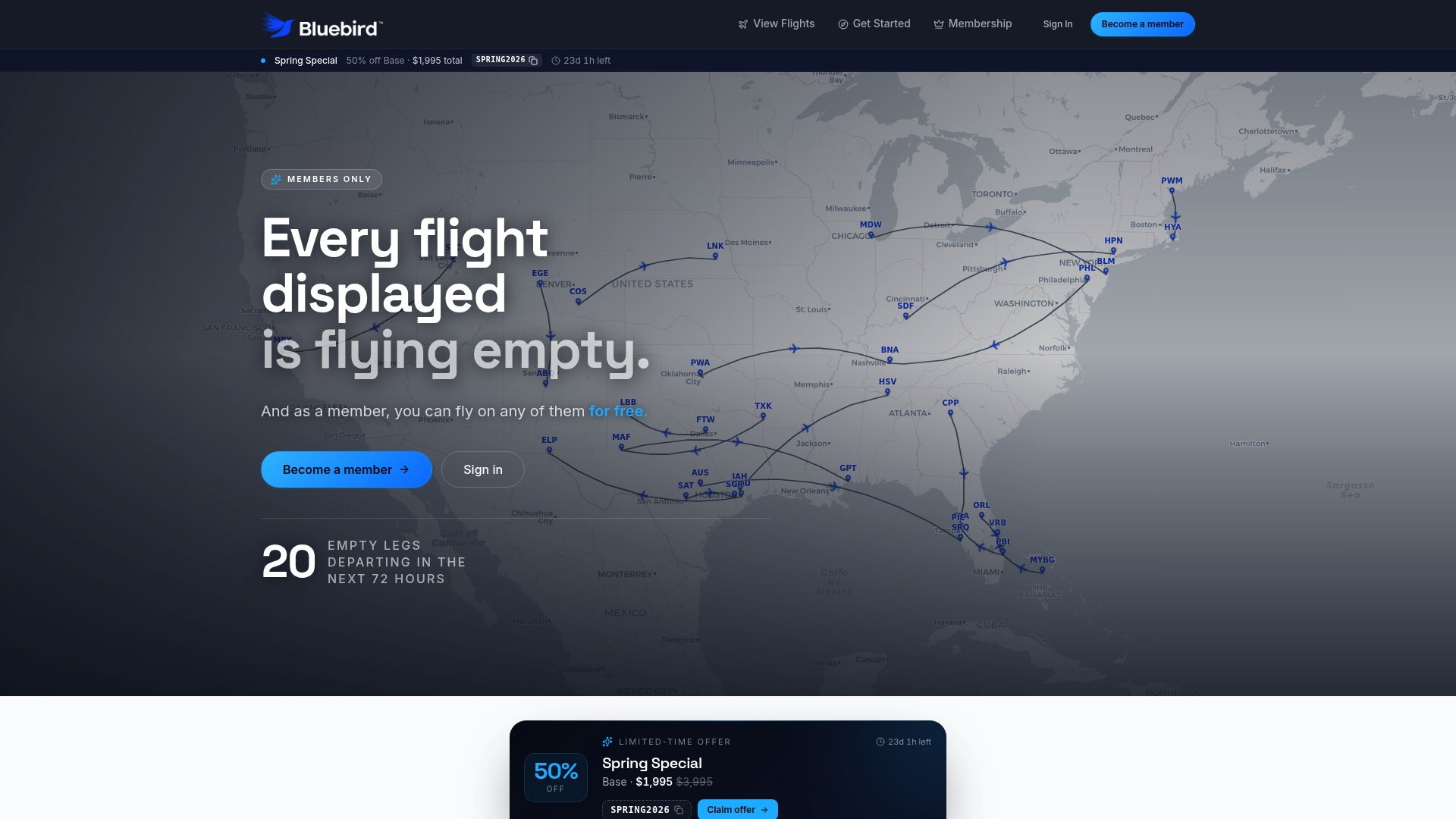
Spontaneous travel does not have to mean hours of searching and uncertain outcomes. Bluebirdjets offers a membership that gives you unlimited access to empty leg flights on the platform. Empty legs are one of the best last minute flight deal types available in private aviation. They occur when a chartered jet needs to reposition after dropping off passengers, and the seats are offered at a fraction of the standard charter rate. Bluebirdjets members get first access to these openings, which means premium travel at last-minute prices without the unpredictability of commercial airline deals. Browse available last minute flights and see what is departing near you.
FAQ
What counts as a last minute flight booking?
Industry standard defines last-minute bookings as those made within 21 days of departure, with prices typically rising sharply at the 14-day and 7-day marks.
Are last minute flights always cheaper?
No. Booking at least 21 days in advance is generally cheaper, but genuine last minute deals do appear on leisure routes and through flash sales, mistake fares, and award seat releases when travelers act quickly.
Which last minute deal type has the highest discount?
Mistake fares offer the deepest discounts, sometimes 70% or more below market rate, but they are the most time-sensitive and carry a small risk of airline cancellation.
Do points and miles work well for last minute bookings?
Points and miles are particularly strong for last minute premium cabin travel, since award seats release close to departure on airlines like Lufthansa, Emirates, and ANA while cash fares spike significantly.
What is virtual interlining and does it help last minute travelers?
Virtual interlining combines flights from different airlines not normally sold together, creating cheaper route combinations that standard search engines do not surface. Kiwi.com is the primary platform for this approach, though it requires managing transfers and baggage independently.