What Determines Empty Leg Availability: Insider Guide

What Determines Empty Leg Availability: Insider Guide
Empty leg availability is the direct result of private jet operators needing to reposition aircraft between paying charter bookings, creating discounted flight segments that travelers can purchase on those otherwise empty routes. These repositioning flights, known in the industry as “deadhead legs,” account for roughly 35 to 40% of all business aviation flights annually in the US and Europe. That scale means genuine opportunity exists for travelers willing to understand the system. Knowing what determines empty leg availability puts you ahead of the majority of private aviation enthusiasts who treat these deals as random luck rather than predictable patterns.
What determines empty leg availability: the operational basics
Empty legs exist solely because an operator must move an aircraft from point A to point B to serve a paying client. That repositioning flight is a cost the operator absorbs regardless. Selling the seat or cabin on that leg recovers fuel, crew, and landing fees, which is the entire economic logic behind the offer.
Several operational factors shape when and where these flights appear:
Aircraft repositioning requirements. When a client books a one-way charter from Miami to New York, the aircraft must return to its base or travel onward to the next booking. That return or onward segment becomes an empty leg.
Crew scheduling and rest rules. FAA Part 135 regulations govern crew duty hours, meaning operators cannot always fly a repositioning leg immediately. Crew availability directly affects when an empty leg gets listed and whether it can depart on schedule.
Maintenance windows. Aircraft scheduled for routine maintenance at a specific facility create repositioning flights to reach that facility. These are often predictable and can generate recurring empty leg patterns on fixed routes.
Primary client itinerary changes. If the paying client modifies their trip, the repositioning leg shifts or disappears entirely. This is why empty leg scheduling is inherently volatile.
Pro Tip: Search for empty legs on routes that connect major business aviation hubs to leisure destinations. These corridors generate the highest repositioning volume because one-way demand is structurally imbalanced.
The typical window when empty legs become available is 24 to 72 hours before departure. Operators list them once the primary charter is confirmed and logistics are locked. Earlier listings do exist, particularly on predictable seasonal routes, but the majority of inventory surfaces close to the flight date.

How do route popularity and seasonality shape empty leg supply?
Geography is the single biggest structural factor in factors influencing empty leg flights. High-traffic corridors generate disproportionate repositioning volume because one-way demand is consistently stronger than round-trip demand. New York to Florida and London to Paris are the two most cited corridors for consistent empty leg inventory, and both share the same characteristic: a large population of travelers who fly one direction and return commercially or via a different aircraft.
The table below illustrates how route type and season interact to shape availability:
Route | Peak season | Primary driver | Typical availability window |
|---|---|---|---|
New York to Florida | November to March | Winter southbound leisure | 24 to 48 hours pre-departure |
Florida to New York | March to May | Northbound repositioning | 12 to 36 hours pre-departure |
Los Angeles to Las Vegas | Year-round | Event and weekend demand | 6 to 24 hours pre-departure |
Aspen to major hubs | December to March | Ski season one-way flows | 24 to 72 hours pre-departure |
London to Paris | Year-round | Business travel imbalance | 12 to 48 hours pre-departure |
Seasonal directional patterns are predictable enough that experienced travelers plan around them. Winter generates heavy southbound traffic from northeastern US cities toward Florida and the Caribbean, which means northbound repositioning legs are abundant and often deeply discounted. Summer reverses the flow, with northbound leisure travel creating southbound repositioning inventory.
Event-driven surges add another layer. After major events like the Super Bowl, Art Basel Miami, or the Monaco Grand Prix, aircraft that flew clients in need to fly back out. The 48-hour window following a major event in a single city is one of the richest moments for availability of empty leg charters, because dozens of operators are simultaneously repositioning away from the same location.
Pro Tip: Track the calendars of major sporting events, art fairs, and music festivals in cities you want to fly from. The post-event repositioning window consistently produces the highest concentration of empty leg listings on outbound routes.
What role does timing play in empty leg pricing and availability?
Timing is where understanding empty leg offers shifts from theory to real money. Availability and pricing are most favorable in the 12 to 48 hours before departure, when operators face a binary choice: sell the leg at a reduced price or fly it empty and absorb the full cost.
Here is how the pricing curve typically moves as departure approaches:
72 to 96 hours out. The empty leg is listed, often at a modest discount of 25 to 40% below standard charter rates. The operator is not yet motivated to cut deeply because time remains.
24 to 48 hours out. Discounts deepen to 50 to 75% as the operator prioritizes cost recovery over margin. This is the sweet spot for travelers who can commit quickly.
12 hours or less. The “fire sale” window. Operators may accept almost any reasonable offer to avoid flying empty. Travelers who can move on very short notice find the steepest discounts here.
Day of departure. Listings that survive to this point are either priced at near-zero or pulled entirely if the operator decides the administrative burden outweighs the recovery.
Travelers can save 25 to 75% off standard charter rates, but that range is not random. The actual discount reflects route demand, aircraft type, and how close to departure the booking occurs. A light jet repositioning on a high-demand corridor at 36 hours out will price differently than a heavy jet on an obscure route at 12 hours out.
The risk in this timing model is real. Empty leg flights can be canceled or altered on short notice if the primary client changes plans, sometimes with minimal notice to the empty leg traveler. Operators typically refund the fare, but they offer no alternative travel arrangements. Travelers who book empty legs must treat them as opportunistic, not guaranteed.
How do operational constraints limit your flexibility?
Understanding empty leg offers fully means accepting that flexibility runs in one direction: the operator’s. The flight exists to serve the operator’s logistics, and the traveler is a revenue opportunity attached to that logistics decision.
The core constraints every traveler faces:
Fixed departure time. Routes and times are set tightly by the primary client’s itinerary. Operators will not delay a repositioning flight to accommodate an empty leg passenger’s schedule.
Fixed destination. The aircraft is going where it needs to go. Minor adjustments within approximately 50 nautical miles are sometimes permitted by operator consent, but rerouting to a different city is not an option.
Non-refundable terms. Most empty leg agreements are non-refundable from the traveler’s side, even though the operator retains the right to cancel. This asymmetry is standard and non-negotiable.
Passenger count limits. The aircraft type determines maximum occupancy. You cannot add passengers beyond the certified capacity, and some operators restrict empty leg bookings to fewer passengers than the aircraft’s maximum.
Short booking windows. The combination of late listing and rapid price movement means travelers must have payment methods verified and passenger details ready before they search. Hesitation costs the booking.
Travelers with rigid schedules or low risk tolerance are not well suited to empty leg travel. The model rewards those who treat it as a standby upgrade rather than a primary travel plan. Building a secondary itinerary around an empty leg, rather than depending on it as the only option, is the approach that works consistently.
Key takeaways
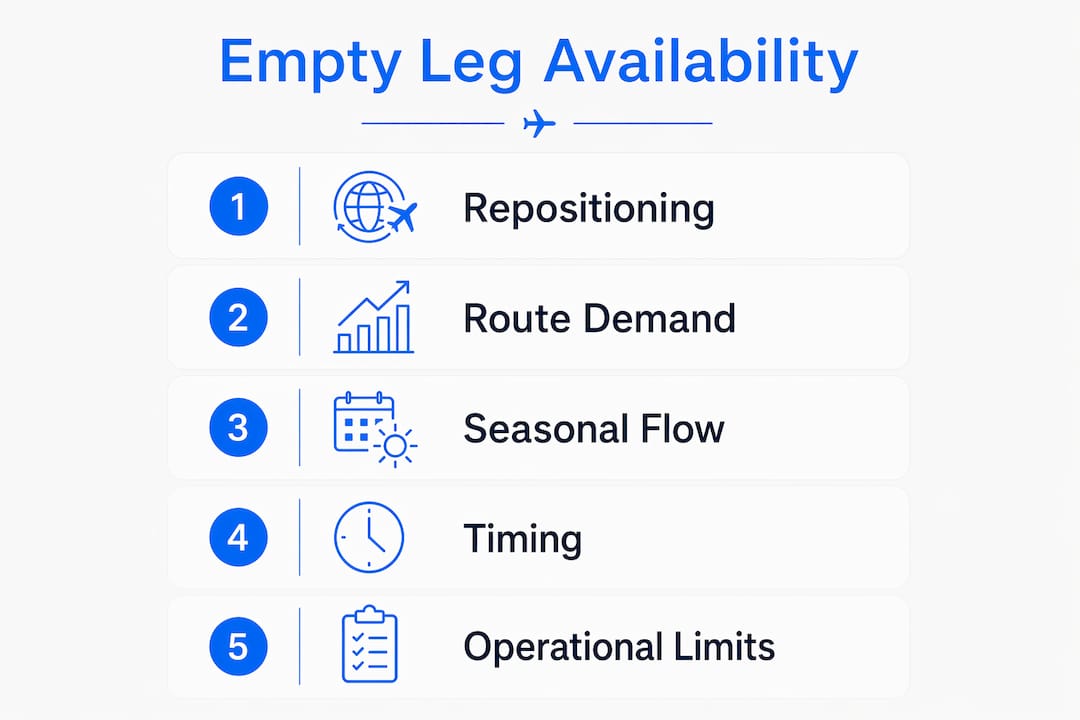
Empty leg availability is determined by operator repositioning needs, route demand, seasonal flow patterns, and timing proximity to departure. These four factors interact to create a predictable but volatile market that rewards informed, flexible travelers.
Point | Details |
|---|---|
Repositioning drives supply | Empty legs exist only when operators need to move aircraft between paying charters. |
Route and season predict volume | High-traffic corridors like New York to Florida generate the most consistent inventory. |
12 to 48 hours is the prime window | Operators cut prices deepest when departure is imminent and cost recovery is urgent. |
Flexibility is non-negotiable | Departure times and routes are fixed by the operator; travelers must adapt, not the aircraft. |
Cancellation risk is structural | Primary charter changes can eliminate your flight with minimal notice and no alternative offered. |
What I’ve learned from watching the empty leg market closely
Most travelers approach empty legs the wrong way. They search once, find nothing that fits their exact schedule, and conclude the market doesn’t work for them. That’s the wrong frame entirely.
The best empty leg deals never reach public aggregator listings. They go to repeat clients and brokers with standing relationships first. I’ve seen travelers who maintain a simple standing search profile with a broker, specifying their preferred departure radius and aircraft type, consistently access inventory that never appears on any public platform. That relationship layer is where the real market operates.
The second mistake is treating the booking process as leisurely. When a prime empty leg surfaces, the window to act is measured in hours, sometimes less. Travelers who haven’t pre-verified their payment method or don’t have passenger passport details ready lose bookings to someone who does. Preparation is the actual competitive advantage here, not luck.
The misconception I encounter most often is that empty legs are primarily a budget play. They are, but only incidentally. The travelers who use them most effectively are those who value the private aviation experience and use empty legs to access it more frequently, not those chasing the lowest possible price on a flight they’d otherwise take commercially. That distinction matters because it shapes how you approach flexibility, timing, and risk tolerance across every booking.
Access empty leg flights through Bluebirdjets
Bluebirdjets is built specifically for travelers who want consistent access to empty leg inventory without monitoring dozens of operator websites or waiting for a broker to call back.

The Bluebirdjets membership gives you unlimited access to empty legs listed on the platform, with real-time availability across popular corridors including routes like Las Vegas to Palm Springs and Austin to Sarasota. Members get early visibility on new listings before they move to broader distribution, which directly addresses the timing problem that costs most travelers their best opportunities. Browse current available flights to see what’s live right now across the network.
FAQ
What is an empty leg flight?
An empty leg flight, also called a deadhead leg, is a private jet repositioning flight that an operator sells to travelers at a discount because the aircraft must fly that route regardless of whether passengers are on board.
How far in advance do empty legs become available?
Most empty legs are listed 24 to 72 hours before departure, with the deepest discounts appearing in the 12 to 48 hour window when operators prioritize cost recovery over margin.
Can empty leg flights be canceled?
Yes. Empty leg bookings are subject to cancellation if the primary charter is modified. Operators typically refund the fare but provide no alternative travel arrangements.
What affects empty leg pricing?
Pricing reflects route demand, aircraft type, and time remaining before departure. Discounts range from 25 to 75% below standard charter rates, with the steepest cuts occurring closest to departure.
How do I improve my chances of booking an empty leg?
Build relationships with brokers and set standing search profiles specifying your preferred routes and aircraft type. Pre-verify payment methods and have passenger details ready so you can confirm a booking within minutes of a listing appearing.