Why Empty Legs Are Cheaper: The Real Pricing Logic

Empty leg flights are defined as repositioning flights that private jet operators must fly regardless of whether a paying passenger is on board. Because the aircraft has to return to base or reach its next charter departure point anyway, operators sell these seats at a fraction of the standard charter rate. Savings range from 30% to 75% off a comparable one-way charter price. Platforms like Villiers Jets, Blade, and Bluebirdjets have made these deals accessible to spontaneous travelers who know how to move fast.
Why empty legs are cheaper: the cost structure explained
The industry term for these flights is “repositioning legs,” and the pricing logic behind them is straightforward once you understand how private aviation economics work. When a charter client books a one-way flight from Miami to New York, the operator collects full charter revenue for that leg. The aircraft still needs to fly back to Miami or proceed to its next assignment. That return flight generates zero revenue unless the operator sells it.
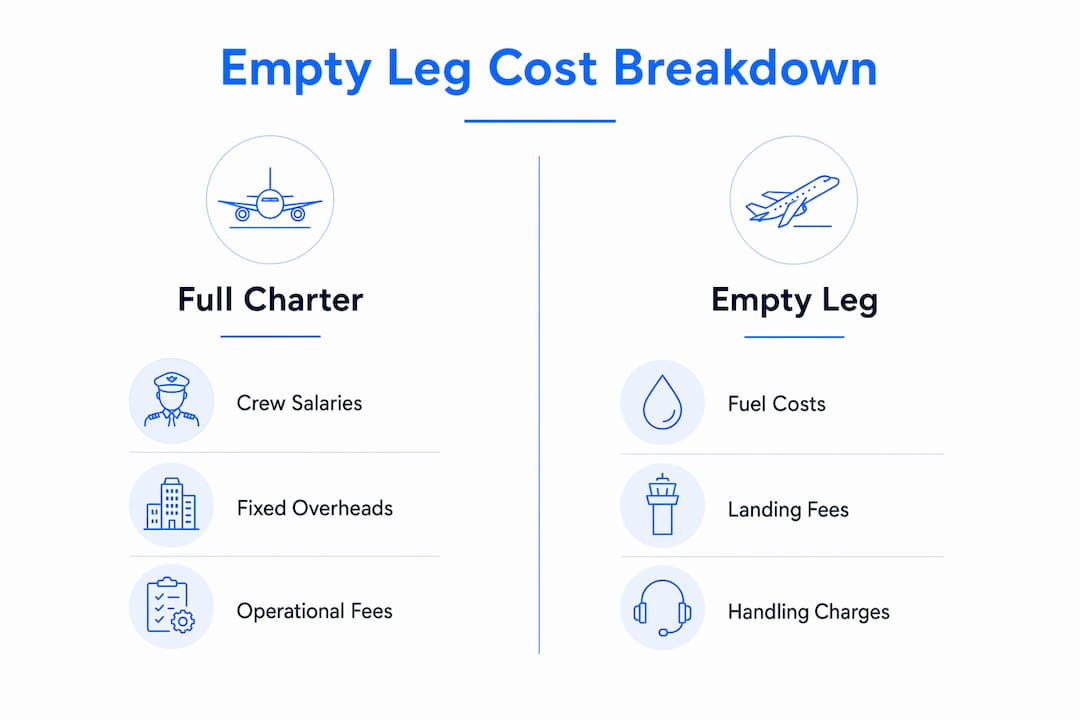
Operators price empty legs to recover only their direct operating costs, not the fixed overhead already covered by the original charter. Fixed costs like crew salaries, aircraft depreciation, insurance, and hangar fees are already baked into the primary booking. What remains are the variable costs: fuel, landing fees, and handling charges.

Here is how the cost split looks in practice:
Cost Category | Full Charter | Empty Leg |
|---|---|---|
Crew salaries | Charged to passenger | Already covered by primary client |
Aircraft depreciation | Charged to passenger | Already covered by primary client |
Fuel ($800–$3,000/hr) | Charged to passenger | Charged to empty leg passenger |
Landing fees ($150–$2,000) | Charged to passenger | Charged to empty leg passenger |
Handling charges | Charged to passenger | Charged to empty leg passenger |
Operator margin | 15–25% above all costs | 5–15% above direct costs only |
The result is a dramatically lower ticket price. A light jet empty leg typically costs $2,000–$6,500, a midsize jet runs $4,000–$9,000, and a heavy jet ranges from $9,000–$25,000. Those figures represent a fraction of what a full charter on the same aircraft would cost.
Pro Tip: When evaluating an empty leg deal, ask the operator for the comparable full charter quote on the same route. If the empty leg price is not at least 30% lower, the discount may not be genuine.
Nearly 40% of all private aviation flights operate as empty repositioning legs. That statistic reveals just how structural this phenomenon is. It is not a rare exception. It is a built-in feature of the one-way charter model, which means supply is consistent for travelers who know where to look.
Why do empty legs have strict schedules and limited availability?
The schedule of an empty leg flight is entirely dictated by the primary charter client’s itinerary. The operator has no flexibility to adjust the departure time, origin, or destination. If the primary client decides to leave a day earlier or cancel the trip, the empty leg disappears with it.
This creates a booking environment that rewards spontaneous travelers and punishes planners. The best window to book is 12–48 hours before departure, and operators typically respond to quote requests within 15–60 minutes during that window. Waiting longer means the deal is gone. Waiting for the perfect route to appear means you may wait indefinitely.
Before committing to an empty leg, consider these factors:
Route flexibility: The origin and destination are fixed. You cannot request a detour or alternate airport.
Departure time: The schedule is set by the operator, not negotiated with you.
Cancellation risk: Last-minute cancellations are a real and significant risk if the primary client changes plans.
Booking window: Deals often surface and sell within 24 hours, requiring immediate commitment.
Passenger count: The aircraft is fixed, so you may be paying for a cabin larger than you need.
Luggage and catering: Confirm these details upfront since the operator may have limited time to arrange them.
Pro Tip: Always keep a backup travel option open until the aircraft actually departs. Book a refundable commercial ticket or identify an alternate flight so a last-minute cancellation does not strand you.
Understanding empty leg availability factors helps you predict which routes are worth monitoring and which are too unpredictable to rely on.
How to find and book empty leg flights effectively
The best empty leg deals rarely appear on public aggregator websites. Highly desirable deals often sell within 24 hours and are distributed first through operator relationships and membership platforms. Public listings are the leftovers.
Here is a practical process for securing genuine deals:
Identify your target corridors. Routes like New York to South Florida and Los Angeles to Las Vegas generate consistent empty leg availability because of high round-trip charter volume. Start there.
Join membership platforms. Services like Bluebirdjets offer unlimited access to empty leg listings, putting members ahead of the general public on new postings.
Contact operators directly. Call or email charter operators who fly your preferred routes and ask to be added to their empty leg notification list. This costs nothing and often yields the best prices.
Set up alerts. Many platforms allow route-specific alerts. Configure these for your most-traveled corridors so you receive notifications the moment a matching flight posts.
Respond within the hour. When a deal appears, move fast. Operators field multiple inquiries simultaneously and award the booking to the first confirmed buyer.
Negotiate on ultra-short notice. Fire-sale pricing within 12–24 hours of departure can push discounts to 75% off because the operator’s only alternative is flying empty. Use that urgency to your advantage.
Confirm all details in writing. Get the aircraft type, departure time, passenger limit, and cancellation policy confirmed before paying.
Regional patterns matter here. The Northeast corridor, South Florida, and the Mountain West (think Aspen, Jackson Hole, and Telluride) generate heavy empty leg traffic during peak seasons. If you travel to these destinations regularly, you have a structural advantage. Travelers chasing obscure routes will find the supply thin and unpredictable.
How empty leg routes surprise travelers is often about timing. A route you never considered becomes available at a price that makes a spontaneous weekend trip genuinely affordable.
What are the pros and cons of empty leg flights?
Empty legs are not the right tool for every traveler. They suit a specific travel style, and being honest about the trade-offs saves frustration.
Factor | Advantage | Disadvantage |
|---|---|---|
Cost | 30%–75% off full charter rates | Still more expensive than commercial economy |
Schedule | Fixed and predictable once booked | Cannot be adjusted to your preferences |
Availability | Consistent on popular corridors | Rare on niche or low-demand routes |
Booking process | Fast and direct | Requires immediate commitment and flexibility |
Cancellation risk | Low once confirmed | High if primary client changes plans before departure |
Experience | Full private jet service and cabin | Cabin size may exceed your actual needs |
The travelers who get the most value from empty legs share one characteristic: they adapt their travel plans to match available flights rather than searching for a flight that matches their existing plans. Empty legs are operational byproducts, not products you can order on demand. The mindset shift from “I need to fly Thursday at 2pm” to “I can fly Thursday or Friday if the price is right” unlocks the real savings.
A practical example: a traveler with flexibility between Friday afternoon and Saturday morning on the New York to Palm Beach corridor can realistically find a light jet empty leg for under $4,000. The same one-way charter booked conventionally would run $12,000 or more. That gap is why spontaneous travelers treat empty legs as a genuine travel strategy rather than a lucky accident.
Key takeaways
Empty legs are cheaper because operators recover only variable costs on repositioning flights, with fixed costs already covered by the original charter booking.
Point | Details |
|---|---|
Pricing logic | Operators charge only fuel, landing fees, and handling on empty legs, not fixed overhead. |
Savings range | Discounts run 30%–75% off full charter rates, with the deepest cuts in the final 12–24 hours. |
Booking window | The best deals appear and sell within 24 hours, requiring fast commitment from travelers. |
Availability patterns | Popular corridors like New York to South Florida generate the most consistent supply. |
Biggest risk | Primary client cancellations can eliminate your flight; always keep a backup travel plan. |
The mindset that actually gets you on these flights
I have watched a lot of travelers approach empty legs the wrong way. They treat them like a discount airline: pick a date, pick a route, expect a deal to appear. That approach fails almost every time.
The travelers who consistently fly private for a fraction of charter rates think about it differently. They monitor two or three corridors they travel regularly, they have their payment ready, and they have trained themselves to say yes within 30 minutes of a deal appearing. That discipline is the actual product they have built.
The other thing most articles do not tell you: the relationship with the operator matters more than the platform. I have seen members get calls about empty legs that never posted publicly because the operator knew they would commit fast and not waste time negotiating. That kind of access does not come from browsing a website. It comes from being a known, reliable buyer.
Seasonal patterns are also underrated. The Mountain West corridor from december through march generates heavy empty leg traffic because of ski season charter volume. The Hamptons and Nantucket corridors spike in summer. If you know when and where the charter volume concentrates, you can position yourself to catch the repositioning flights that follow.
The uncomfortable truth about empty leg travel is that the savings are real, but they require you to be a different kind of traveler. Not better or worse. Just more flexible, more responsive, and more willing to let the available flight shape the trip rather than the other way around.
— Nick
Get unlimited access to empty leg deals with Bluebirdjets
Bluebirdjets sells a membership that gives you unlimited access to every empty leg listed on the platform, including flights that never reach public aggregators. Members receive alerts the moment a new repositioning flight posts, putting you ahead of the general market on the deals that sell fastest.

Current listings include routes like Las Vegas to Page and Chicago to Columbia, with new flights added daily as operators post their repositioning schedules. If you fly the same corridors regularly, a Bluebirdjets membership pays for itself the first time you book a heavy jet at 60% off the charter rate. Browse the full inventory of available empty legs and see what is flying your routes this week.
FAQ
What makes empty leg flights so much cheaper than charters?
Empty leg flights cost less because operators only charge passengers for variable costs like fuel, landing fees, and handling. Fixed costs such as crew salaries and aircraft depreciation are already covered by the original charter client.
How far in advance can you book an empty leg flight?
Most empty leg deals appear 12–48 hours before departure, and the best prices surface within 12–24 hours of the flight. Booking windows are short, so same-day or next-day flexibility is required.
Are empty leg flights worth it for spontaneous travelers?
Empty legs deliver genuine value for travelers who can adapt their schedule to match available flights. Savings of 30%–75% off full charter rates make private jet travel accessible at a fraction of the standard cost.
What is the biggest risk of booking an empty leg?
The primary risk is last-minute cancellation caused by changes in the original charter client’s itinerary. Keeping a backup commercial travel option open until departure is the standard way to manage this exposure.
Which routes have the most empty leg availability?
High-traffic private aviation corridors generate the most consistent supply. Routes like New York to South Florida and Los Angeles to Las Vegas see frequent empty leg postings because of strong round-trip charter volume on those paths.