Empty Leg City Hopping Strategy: Your 2026 Guide

Empty Leg City Hopping Strategy: Your 2026 Guide
An empty leg city hopping strategy is a method that uses discounted private jet repositioning flights to build spontaneous, multi-city itineraries at a fraction of standard charter costs. Empty legs are flights an aircraft must make to reposition after dropping off passengers, and operators price them to recover costs rather than profit. Discounts range from 30% to 75% off standard charter rates. That spread means a traveler with schedule flexibility can access private aviation at prices that genuinely compete with premium commercial fares, while skipping airports, security lines, and fixed schedules entirely.
What does an empty leg city hopping strategy actually require?
A successful empty leg city hopping strategy starts with one non-negotiable: flexibility. Trips with fixed dates and destinations are a poor fit for empty leg flights. The model only works when you can move your departure window by 24–48 hours and swap destination pairs without derailing your plans.
The tools you need before you start
Alert platforms are the foundation of this approach. Registering for empty leg alerts and having travel documents ready before deals appear dramatically improves your chances of securing a flight. Passport, travel insurance, and a flexible accommodation strategy should all be in place before you start monitoring. Bluebirdjets members get direct access to the live empty leg inventory, which removes the need to monitor multiple sources manually.

Budget expectations also matter. Empty legs cover the flight itself, but ground transport, hotels, and repositioning fees for secondary airports add up. Build a buffer of at least 20% above your estimated flight cost to absorb those variables.
| Prerequisite | Why it matters | Recommended approach |
|---|---|---|
| Schedule flexibility | Deals appear with little notice | Keep 2–3 travel windows open per month |
| Alert registration | Inventory moves fast | Use a platform like Bluebirdjets for real-time access |
| Documents ready | No time to scramble at booking | Passport, insurance, and payment method on hand |
| Accommodation buffer | Plans shift with flight changes | Book refundable hotels or use flexible booking platforms |
| Budget buffer | Secondary costs vary | Add 20% above estimated flight cost |
Pro Tip: Set your alert radius wider than you think you need. An empty leg from a secondary airport 60 miles away often costs far less than one from the primary hub, and the drive is worth it.
How do you plan routes for multi-stop empty leg travel?
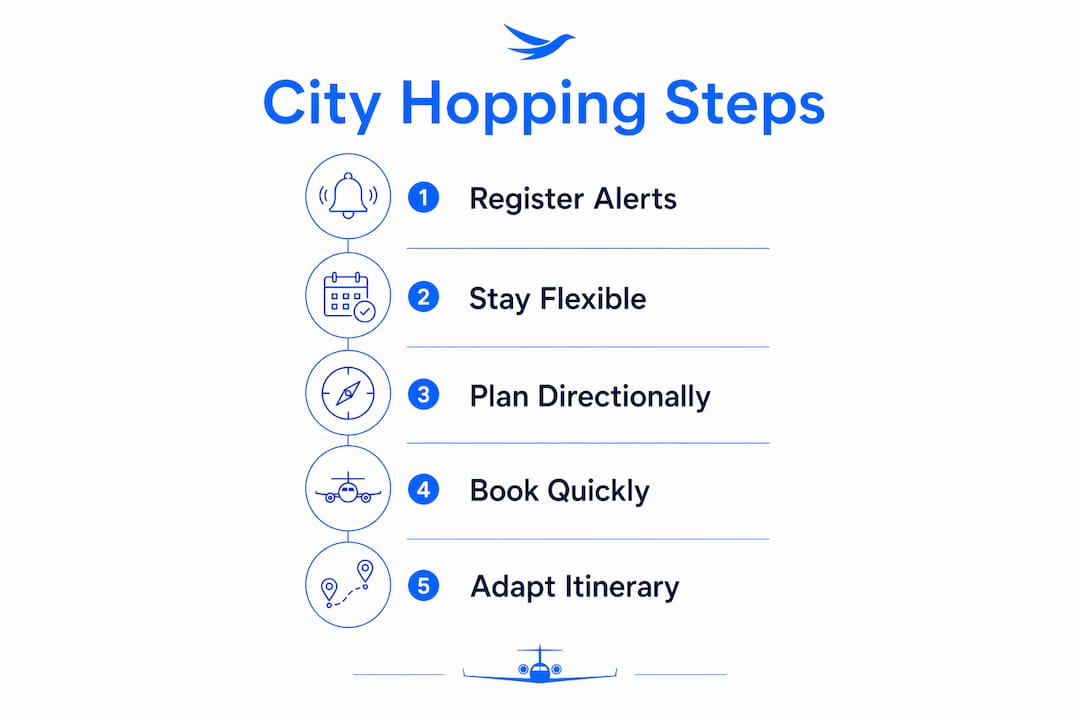
Route planning for charter flight city hopping works differently from commercial travel. You are not choosing from a fixed schedule. You are watching a live market and building your itinerary around what appears.
Follow directional logic, not a wish list
The most effective empty leg itinerary ideas follow a forward directional path. Flying New York to Miami, then Miami to New Orleans, then New Orleans to Dallas creates a logical arc. Backtracking, say flying Miami back to New York mid-trip, wastes time and eliminates the cost advantage because repositioning legs rarely run in reverse on the same route twice.
High-volume empty leg corridors include New York to South Florida, Los Angeles to Las Vegas, and major European hub pairs. These routes generate the most frequent inventory because they carry the most charter traffic. Building your base itinerary around one of these corridors gives you the highest probability of finding connecting legs.
Pacing is the variable most travelers underestimate
Alternating high-energy exploration days with recovery days reduces burnout and improves overall trip satisfaction. A two-city sprint in three days sounds exciting until you are exhausted in city three with four more stops ahead. Plan one full rest day for every two to three active days.
Grouping activities by neighborhood or district within each city also matters. Transit fatigue compounds across a multi-stop trip. Spending two hours commuting across a city every day adds up to a full lost day by the end of a week-long itinerary.
- Identify your anchor corridor (e.g., East Coast, West Coast, or a European hub pair).
- List three to five cities within that corridor you want to visit.
- Arrange them in a logical geographic sequence to avoid backtracking.
- Assign flexible two-day windows to each city rather than fixed dates.
- Monitor empty leg alerts for legs that connect your sequence.
- Book the first confirmed leg and adjust the remaining sequence around it.
Pro Tip: Do not plan more than two confirmed stops in advance. The value of this approach comes from adapting in real time. Over-planning kills the flexibility that makes empty legs accessible.
How do you book empty leg flights for city hopping?
Most empty legs appear within 7–14 days of the scheduled flight, which means the booking window is short and the decision cycle needs to be fast. This is where preparation from the prerequisites stage pays off directly.
Understanding fire sales and last-minute pricing
Fire sale pricing kicks in 24–48 hours before departure, when operators will accept almost any offer that covers their costs. These are the deepest discounts available in private aviation. They also carry the highest schedule volatility. A fire sale empty leg can be rerouted or canceled with minimal notice, so they suit travelers who can absorb a last-minute change without losing money on non-refundable bookings downstream.
The pricing logic behind empty legs is straightforward: the operator is flying the aircraft regardless. Any revenue above fuel and handling fees is a gain. That dynamic gives you real negotiating room, especially within the final 48 hours.
What to ask before you confirm
Transparency on pricing components, including block hours, landing fees, and repositioning charges, is the clearest signal of a trustworthy broker. Ask for a full fee breakdown before confirming. Opaque pricing, where a single number is given with no line items, is a red flag for commission padding.
- Confirm the aircraft type and passenger capacity.
- Request a full cost breakdown including landing fees and handling charges.
- Ask about cancellation and rerouting policies specific to this leg.
- Verify departure airport and confirm ground transport logistics.
- Book immediately once terms are confirmed. Inventory does not wait.
| Booking approach | Best for | Key risk |
|---|---|---|
| 7–14 days out | Moderate savings, more planning time | Less inventory, higher prices |
| 48–72 hours out | Strong discounts, better selection | Requires flexible accommodation |
| Fire sale (under 48 hours) | Deepest discounts available | High cancellation and rerouting risk |
Pro Tip: Have your payment method pre-authorized and your travel documents open on your phone before you start negotiating. Operators move to the next buyer if confirmation takes more than a few hours.
What mistakes should you avoid with this travel approach?
The biggest mistake in empty leg travel is treating it like a commercial booking. Rigid scheduling is the fastest way to lose money and miss flights.
- Booking non-refundable hotels before confirming your flight. Schedule changes are common. Always book refundable accommodation until the flight is locked in.
- Choosing routes that don’t align with actual repositioning patterns. Not all empty leg deals are equal. The deepest discounts often signal the highest schedule volatility. A route that looks perfect on paper may have a history of last-minute changes.
- Ignoring secondary airports. Flying from a smaller airport near a major hub often requires a short drive but can yield meaningful savings. Factor that into your planning rather than defaulting to the primary airport.
- Working with brokers who won’t itemize costs. A single lump-sum quote with no breakdown is a sign of hidden fees. Walk away and find a platform that shows full pricing transparency.
- Packing too much into each city stop. Two days in a city is enough for highlights, not deep exploration. Over-scheduling each stop creates pressure that eliminates the enjoyment of the trip.
“The traveler who wins with empty legs is the one who treats the itinerary as a starting point, not a contract.”
Baggage logistics also deserve attention. Private jets have smaller cargo holds than commercial aircraft. Check weight and size limits before you pack, and plan for ground transport between secondary airports and city centers.
Key Takeaways
An empty leg city hopping strategy works best when flexibility, preparation, and directional route logic are built in from the start.
| Point | Details |
|---|---|
| Flexibility is non-negotiable | Fixed dates and destinations eliminate most empty leg opportunities before they appear. |
| Alerts and documents first | Register for real-time alerts and have your passport and payment ready before deals surface. |
| Follow directional route logic | Plan city sequences that move forward geographically to maximize available legs and minimize backtracking. |
| Book fast, ask for full pricing | Request a complete fee breakdown and confirm immediately once terms are agreed. |
| Pace your itinerary | Alternate active and recovery days to sustain energy across a multi-stop trip. |
The part most guides skip over
I have watched a lot of travelers approach empty legs with the wrong mental model. They treat it like a discount airline, where you pick a destination and find the cheapest fare. That framing leads to frustration every time.
The travelers who get the most out of this approach think like opportunists, not planners. They have a loose geographic zone in mind, say the Southeast or the Western Mediterranean, and they let the available inventory shape the specific cities. That shift in mindset changes everything. Suddenly a leg from Miami to Nashville is not a compromise. It is an unexpected city you would not have chosen but end up loving.
The cost-versus-convenience trade-off is also real. Fire sale pricing is genuinely exciting, but it demands that nothing else in your trip is locked in. I have seen people save $3,000 on a flight and lose $1,500 on non-refundable hotels because the leg rerouted. The net saving was barely worth the stress. Build your flexibility into every layer of the trip, not just the flight.
The luxury element is worth naming directly. Private aviation, even at a discount, delivers a fundamentally different travel experience. No queues, no middle seats, no 90-minute early arrival requirements. For a traveler doing three or four cities in a week, that time and energy saving compounds significantly. The right empty leg approach makes the luxury accessible without requiring a full charter budget.
— Nick
How Bluebirdjets fits into your city hopping plans
Bluebirdjets offers a membership that gives you unlimited access to empty leg inventory on the platform. For travelers who want to run a consistent empty leg city hopping strategy, that access removes the biggest friction point: finding deals before they disappear.

Members get real-time visibility into available legs, transparent pricing with full cost breakdowns, and direct booking without broker intermediaries. If a specific route is not available as an empty leg, the private charter options fill the gap without requiring you to rebuild your itinerary from scratch. For travelers serious about multi-city private travel, the Bluebirdjets membership is the most direct path to consistent access and savings.
FAQ
What is an empty leg flight?
An empty leg is a private jet flight that must reposition after dropping off passengers, offered at a discount because the aircraft flies regardless. Discounts typically range from 30% to 75% off standard charter rates.
How far in advance do empty legs get listed?
Most empty legs appear within 7–14 days of the scheduled departure, with the deepest discounts surfacing in the final 24–48 hours before the flight.
Can you build a full multi-city trip using only empty legs?
Yes, but it requires flexible dates, a directional route plan, and real-time alert monitoring. Booking each leg sequentially rather than all at once gives you the best chance of connecting a full itinerary.
What is the biggest risk with fire sale empty leg deals?
Fire sale legs carry the highest cancellation and rerouting risk. Travelers should avoid non-refundable downstream bookings until the flight is confirmed and departure is imminent.
How do I know if an empty leg price is fair?
Ask for a full cost breakdown including block hours, landing fees, and handling charges. A trustworthy operator or platform will itemize every component. A single lump-sum quote with no line items is a sign of hidden fees.