Maximize Empty Leg Flight Deals: 2026 Guide

Empty leg flights are discounted private jet repositioning trips that operators sell at a fraction of standard charter rates. These flights exist because a jet must return to its base or reposition for the next client after dropping off passengers, leaving one direction empty. To maximize empty leg flight deals, you need to know where to look, when to book, and how to move fast. The savings are real: 30–75% off standard charter rates, with last-minute bookings reaching up to 80% off. Platforms like VistaJet, XO, and broker networks list these flights daily, but the best ones disappear within hours.
What are empty leg flights and why are they so cheap?
Empty legs are a byproduct of how private aviation works. When a client charters a jet from New York to Miami, the aircraft still needs to fly back to its home base or reposition for the next booking. That return flight has no paying passengers. Rather than absorb the full operating cost, operators sell the seat at a steep discount.
The discount exists because the operator is already committed to flying the route. Fixed costs like fuel, crew, and landing fees are largely unavoidable. Selling the leg at 50% of retail is far better than flying empty. This is why empty leg pricing logic differs from standard charter pricing.

The trade-off is rigidity. The route, date, and departure time are set by the original booking. You are fitting your plans around the aircraft, not the other way around. Listings can appear up to seven days in advance, but the optimal booking window is 12–48 hours before departure, when discounts peak.
One more factor shapes the market: cancellation rates run roughly 10–15%. If the original client changes plans, the empty leg disappears. That risk is real, and any smart booking strategy accounts for it.
How do you find empty leg flights efficiently?
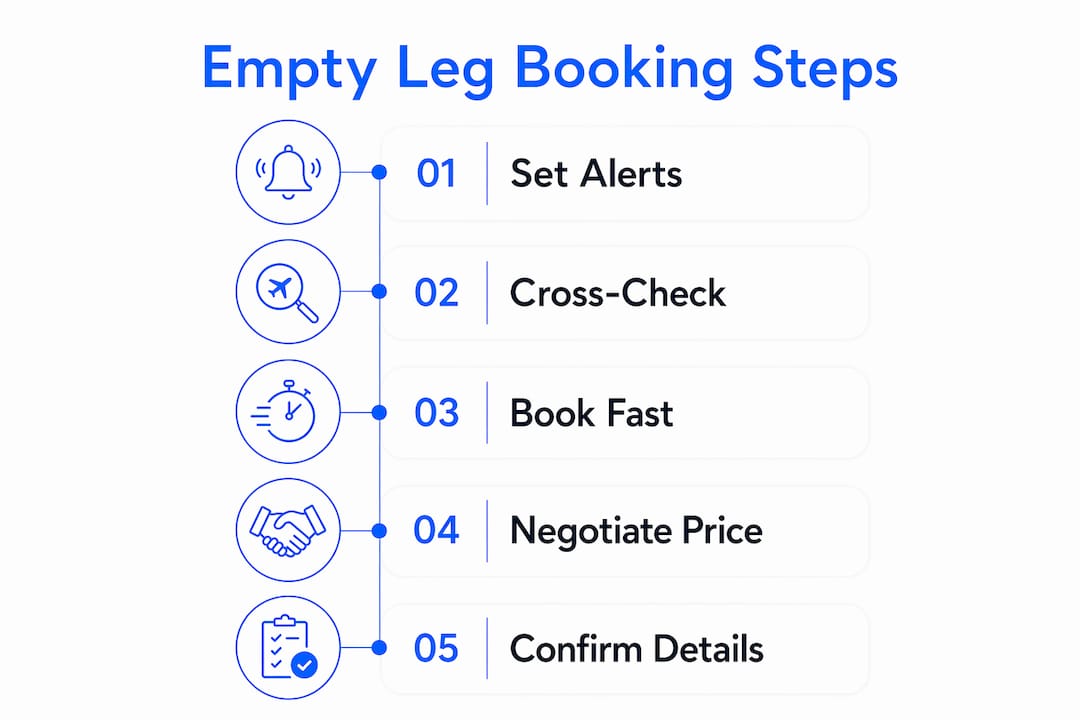
Finding discount private jet deals requires checking multiple sources simultaneously. Listings are fragmented across brokers and direct operator channels, meaning the same flight may appear on only one platform or not at all on aggregators. Here is a practical search sequence:
Start with broker platforms. Villiers Jets, Jettly, XO, and Victor all maintain searchable empty leg databases. Each pulls from different operator networks, so a flight on Jettly may not appear on XO.
Check direct operator sites. Many operators post exclusive listings on their own websites before pushing them to brokers. This is where you find deals that never hit the aggregators.
Follow operator Instagram accounts. Accounts like @amsterdamjets and @theskyaccess regularly post last-minute deals that sell within hours of going live. This channel is underused by most travelers.
Subscribe to email newsletters. Several brokers send daily or weekly digests of available legs. These are useful for route monitoring without active searching.
Enable push notifications. Apps from XO, Victor, and Jettly offer alert settings by route and airport. Turn them on and keep your phone accessible.
Pro Tip: Set alerts for regional airports within roughly 60 miles of your target city. Widening your search radius to include nearby hubs significantly increases the number of available legs and often surfaces cheaper options.
Cross-checking platforms takes only a few minutes once you build the habit. The travelers who consistently find affordable charter flights are the ones who check multiple sources within the same session, not those who rely on a single app.
What booking timing gets you the deepest discounts?
Timing is the single biggest lever in empty leg booking strategy. Operators use dynamic pricing tied to how close the flight is to departure. The closer you get, the more they need to sell the seat, and the more room there is for discount.
The 12–48 hour window before departure is where the steepest savings on private flights appear. Discounts in this range commonly hit 50–80% off standard charter rates. Beyond 48 hours, you may still find good deals, but the operator has less urgency to cut the price. Speed and readiness are what separate travelers who land these deals from those who miss them.
Readiness means having everything prepared before you spot a listing:
Passenger manifest with full legal names and dates of birth for all travelers
Payment method on file with the broker or operator
A flexible itinerary that allows same-day or next-day departure
A secondary airport option in case the listed departure point is inconvenient
Negotiation is also possible on some platforms. Broker-mediated listings close to departure often have more pricing flexibility than direct operator postings, where prices tend to be fixed. If a listing has been up for more than 24 hours and departure is approaching, a reasonable counter-offer is worth making.
Pro Tip: Book the fastest way the platform allows. If a broker offers a “book now” button alongside a “request a quote” option, use the direct booking path. Quote requests add hours to the process, and the flight may sell before you hear back.
Does group size change the per-person cost?
Empty leg pricing is set per aircraft, not per seat. That single fact changes how you should think about the value of any listing. A light jet priced at $4,000 for the leg costs $4,000 whether one person flies or six. Increasing passenger count up to seating capacity directly reduces what each person pays.
Consider a midsize jet listed at $8,000 for a two-hour leg:
Passengers | Per-Person Cost |
|---|---|
1 | $8,000 |
4 | $2,000 |
8 | $1,000 |
At eight passengers, that per-person cost competes with premium business class on a commercial carrier, with none of the airport friction. Evaluating per-passenger cost rather than total aircraft price is the clearest way to judge whether a deal is genuinely good.
Route flexibility compounds the savings. If you are willing to depart from a regional airport 45 minutes from your home city, you access a larger pool of available legs. Travelers locked to a single major hub see fewer options and pay more for the ones they find. The route surprises that come from widening your search often lead to the best deals on the platform.
How do you handle the challenges of empty leg bookings?
Empty legs carry real risks that standard charter flights do not. Knowing them in advance keeps you from being caught off guard.
Cancellation risk is the biggest. With a 10–15% cancellation rate, you should always have a backup travel plan. Book refundable commercial tickets as insurance if the trip is time-sensitive.
Aircraft substitution happens. Operators may swap the listed aircraft for another, which can change seating capacity and onboard features. Confirm the refund and adjustment policy before you pay.
Timing is non-negotiable. The departure time is fixed by the original booking. If you need flexibility on when you leave, an empty leg is the wrong product.
Misleading discount claims exist. Some listings advertise steep discounts against inflated retail rates. Always compare the listed price against published charter rates for that route and aircraft type before deciding it is a deal.
Missed alerts cost money. Setting alerts on multiple platforms multiplies your chances of catching a listing before it sells. Relying on one app is the fastest way to miss the best legs.
The travelers who book empty legs successfully treat them like a secondary travel layer. They have a primary plan and use empty legs to upgrade or replace it when a deal appears, not as their only option.
What i’ve learned after years of watching this market
The conventional advice on empty legs focuses almost entirely on price. That misses the real skill, which is positioning yourself to act before anyone else does.
The travelers I have seen get the most out of this market share one habit: they treat alert setup as a weekly maintenance task, not a one-time setup. Platforms update their notification systems, operators shift their posting channels, and new brokers enter the market. Checking your alert configuration every few weeks keeps you ahead of the field.
The other thing most guides skip is the Instagram angle. Operator accounts post deals that never make it to the major platforms. Following 10–15 operator accounts in your most-traveled regions takes 20 minutes to set up and can surface deals you would never find through a broker search. I have seen legs go from posted to sold in under two hours on Instagram with no listing anywhere else.
The risk side is real but manageable. A 10–15% cancellation rate sounds alarming until you realize that a refundable commercial backup ticket costs almost nothing to hold. The math still works heavily in your favor. The travelers who avoid empty legs because of cancellation risk are paying full charter rates to avoid a problem that a $200 refundable ticket solves.
Build the habit, stay ready, and act fast. That is the whole strategy.
— Nick
Fly smarter with Bluebirdjets
Bluebirdjets gives you unlimited access to empty leg listings through a single membership. Instead of monitoring six platforms and three Instagram accounts manually, you get real-time inventory in one place with alerts built in.
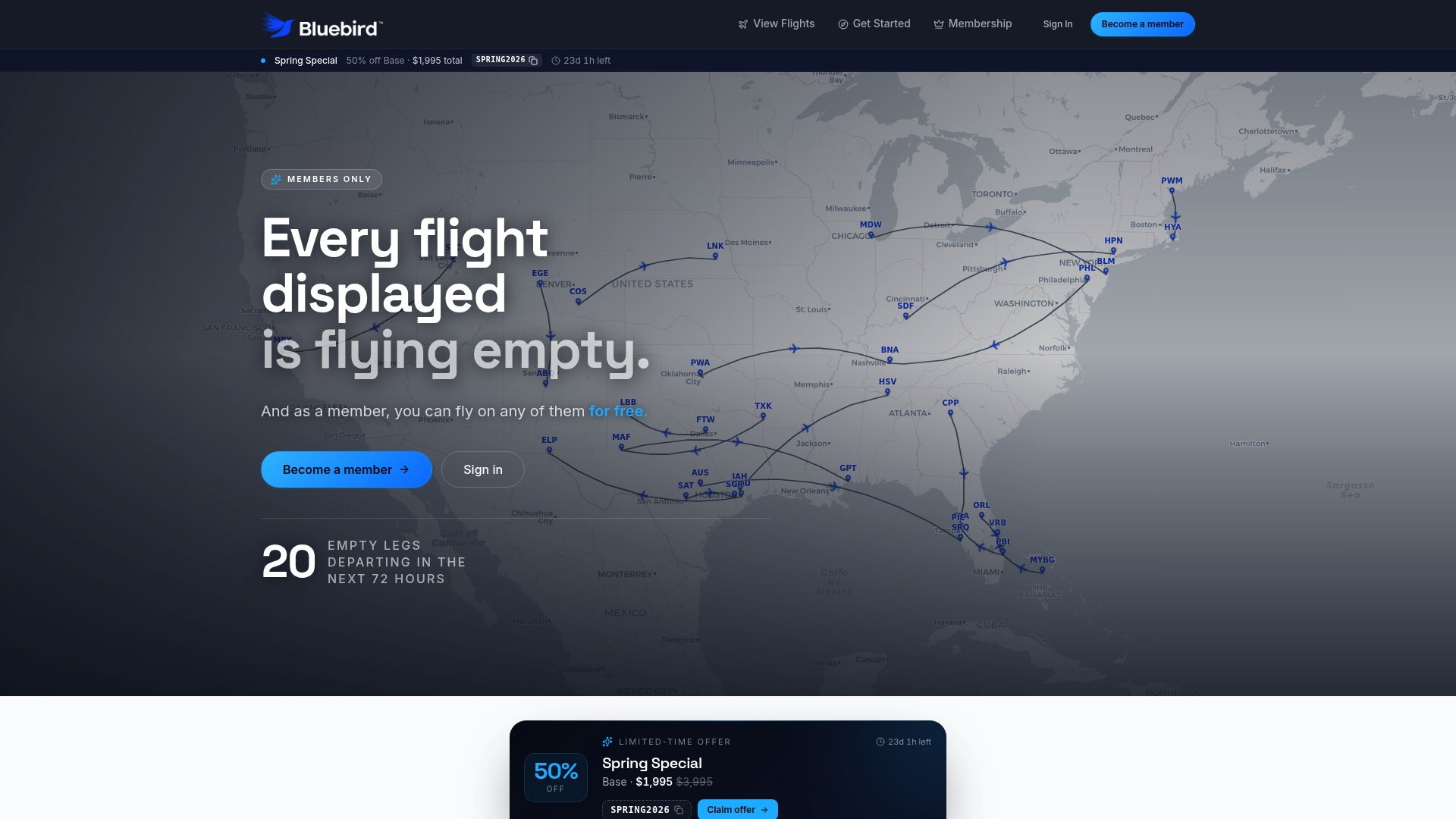
Members get first access to new listings, including legs like Chicago to Columbia and routes out of Las Vegas, before they hit the broader market. The membership is built for travelers who want to fly private without paying full charter rates. Browse current available flights or explore the Bluebirdjets membership to see what is available on your routes right now.
Key takeaways
Empty leg flights deliver the best savings when you combine platform breadth, fast action, and group-size optimization within the 12–48 hour booking window.
Point | Details |
|---|---|
Book in the 12–48 hour window | Discounts peak closest to departure, reaching up to 80% off standard rates. |
Check multiple platforms | Listings are fragmented; cross-checking Villiers Jets, Jettly, XO, and Instagram catches deals others miss. |
Fill the aircraft | Per-aircraft pricing means more passengers equals a lower per-person cost. |
Widen your airport search | Including regional airports within 60 miles significantly increases available options. |
Plan for cancellations | A 10–15% cancellation rate makes a refundable backup ticket a smart standard practice. |
FAQ
What is an empty leg flight?
An empty leg flight is a private jet repositioning trip sold at a discount because the aircraft must fly a route with no paying passengers. Discounts typically range from 30–75% off standard charter rates.
When is the best time to book an empty leg?
The 12–48 hour window before departure offers the deepest discounts, often 50–80% off. Listings can appear up to seven days in advance, but prices drop as departure approaches.
Can empty leg flights be canceled?
Yes. Cancellation rates run roughly 10–15% because the original client’s plans can change, eliminating the need for the repositioning flight. Always have a backup travel option in place.
How do i lower the per-person cost on an empty leg?
Empty leg pricing is per aircraft, not per seat. Adding more passengers up to the aircraft’s seating capacity directly reduces what each person pays, sometimes to business-class commercial levels.
Are empty leg prices negotiable?
Some are and some are not. Broker-mediated listings close to departure tend to have more flexibility. Direct operator postings often have fixed prices, but a reasonable offer near departure time is worth making if the leg has been listed for a while.