Affluent Travelers: Claim Intl Empty Legs in 7 Days With Membership

Affluent Travelers: Claim Intl Empty Legs in 7 Days With Membership
Yes, international empty leg flights exist, but they’re far less common than domestic repositioning routes and demand real flexibility. Savings are generally significant off standard one-way charter rates, with the trade-off being schedule and route rigidity that can shift on short notice. If you want to catch one, alerts and a membership with priority booking beat casual browsing every time.
TL;DR:
- Most international empty legs are last-minute listings that appear within a week, making fast response and alert monitoring crucial for securing deals.
- Cross-border flights are less frequent due to complex permissions, crew limits, and overflight rights, often occurring after European missions with return leg needs.
- The biggest risk is cancellation due to reliance on an original charter, so flexible booking conditions and backup plans are essential.
- Memberships offering early alerts and priority booking significantly increase the chances of catching rare international empty legs.
Table of Contents
- What Is an Empty Leg International Flight?
- Why International Empty Legs Are Rarer Than Domestic Ones
- How to Find and Book International Empty Legs
- What Do International Empty Legs Actually Cost?
- The Real Risks: Cancellations, Fixed Routes, and Operational Surprises
- Your Pre-Trip Checklist for Catching an International Empty Leg
- How Bluebirdjets Turns Alerts Into Actual Bookings
- When an Empty Leg Beats a Charter (and When It Doesn’t)
- Get Priority Access to Bluebirdjets International Empty Legs
- Sources
What Is an Empty Leg International Flight?
An empty leg, sometimes called a deadhead or repositioning flight, happens when a private jet needs to fly from point A to point B with no paying passengers aboard. Rather than absorb that cost entirely, operators sell the sector at a discount to recover fuel, crew, and landing fees they’d pay regardless.
You’re booking the whole aircraft, not a seat. That distinction matters more with international legs, where the plane itself may be a long-range jet worth flying half-empty across an ocean rather than dead-heading with zero revenue.
Most listings surface close to departure. Many empty legs get published within two weeks of the flight, and a large share appear inside seven days, which is exactly why speed matters more than patience here.
- Empty leg = repositioning flight, sold below charter rates
- You charter the aircraft, not individual seats
- Discounts commonly range from substantial percentages off standard one-way pricing, according to VOLO Aviation
- Listings often appear last-minute, rewarding fast responders
Pro Tip: Treat every empty leg listing like a flash sale. The gap between “available” and “booked” on a good international route can close in under an hour.
Why International Empty Legs Are Rarer Than Domestic Ones
Crossing borders adds friction that domestic repositioning simply doesn’t have. Crew duty-time limits, overflight permissions, and landing rights all narrow the window in which an operator can offer an international sector at a discount.
Most international empty legs appear for specific, predictable reasons. An aircraft finishing a European charter often needs to return to North America, or a jet based stateside gets tasked with a one-way mission overseas and needs to reposition back.
- Long-range and ultra-long-range jets (think Global or Gulfstream-class equipment) dominate intercontinental empty legs, since only they have the range to make the trip worthwhile
- Major hub airports like Teterboro, Van Nuys, and Opa-locka see disproportionate international repositioning traffic
- Seasonal shifts, such as clients moving from European summer bases back to US winter markets, create predictable windows
- Large events (a Grand Prix, a major art fair, a global summit) can spike demand in one direction and leave return legs open
International empty legs are less frequent because they depend on complex rotations and permissions, and they often surface when long-range aircraft finish European missions and need to reposition back toward North America.
How to Find and Book International Empty Legs
Finding a domestic empty leg is a numbers game. Finding an international one is a preparation game, and the difference shows in how fast serious flyers move once a listing appears.
- Monitor live-inventory platforms that update daily rather than weekly, since international legs move fast once published.
- Set corridor and airport alerts instead of browsing generally; a targeted alert for “New York to London” beats scrolling a general feed.
- Register for SMS or WhatsApp notifications so you see a new listing within minutes, not the next time you happen to check your inbox.
- Predefine your flexibility before you need it: which alternate airports you’d accept, how wide a date window you can work with, and how many guests are coming.
- Ask about small adjustments. Operators sometimes shift departure time by an hour or swap a secondary airport if you ask early and politely.
- Pair an empty leg with a paid feeder flight when the sector lands short of your actual destination, which is common on intercontinental routes.
Pro Tip: Widening your acceptable airport list from one to three within a metro area (say, Teterboro, Westchester, and Newark) roughly triples your odds of matching a live listing without changing your actual destination.
Setting corridor alerts and staying open to secondary airports is one of the most reliable ways to increase your match rate on international routes.
What Do International Empty Legs Actually Cost?
Pricing swings more on international routes than domestic ones, largely because the aircraft involved are bigger, the distances longer, and the imbalance in one-way demand more pronounced. A domestic corridor like New York to Miami might run $5,500 to $9,000 on an empty leg versus $15,000 or more for a standard charter. Intercontinental sectors scale up from there, but the discount percentage often holds steady.
- Aircraft type drives the base cost; a long-range Gulfstream repositioning across the Atlantic costs more to operate than a midsize jet hopping between US cities
- Route imbalance matters: a one-directional demand surge (everyone flying west after a European event) creates the empty return leg
- Short-notice timing usually means a steeper discount, since the operator has less time to find any buyer at all
- Additional fees for ground transfers, customs handling, or de-icing can add a few hundred dollars, so ask for an all-in quote before comparing to a premium commercial fare
Compare any empty leg quote against a one-way charter for the same route, not against a business-class ticket. That’s the real baseline, and it’s where the savings become obvious.
The Real Risks: Cancellations, Fixed Routes, and Operational Surprises
An empty leg exists because of an underlying charter, and that dependency is the single biggest risk you’re taking on. If the client who created the repositioning flight changes plans, your empty leg can vanish with little warning.
- Cancellation risk is structural, not incidental: every empty leg booking is contingent on the original mission it was built around
- Fixed route and time mean you take the exact airports and departure window offered, or you arrange a paid feeder flight yourself
- Maintenance, crew scheduling, and weather can all disrupt an empty leg the same way they’d disrupt any charter, just with less flexibility to rebook
- Refundable protections matter: look for clear refund or credit terms before you commit, and treat a nonrefundable hotel or nonrefundable connecting flight as a liability, not a convenience
Your Pre-Trip Checklist for Catching an International Empty Leg
Being ready before a listing appears is the entire game. Here’s the sequence that actually works.
- Set alerts across every channel you’ll realistically check, including membership notifications and SMS or WhatsApp.
- Predefine your parameters: acceptable airports, departure window, passenger count, and baggage limits, so you’re not deciding under pressure.
- Line up a fallback: a refundable hotel reservation or a standing paid-charter quote protects you if the empty leg falls through.
- Confirm passport and visa requirements for every country in your route well before you need to move.
- Have ground transport arranged on both ends, since international arrivals often land at smaller airports with fewer taxi or car options.
Pro Tip: Keep a “go bag” mentality: passport, chargers, and a packed carry-on ready at all times if you’re actively hunting international empty legs during a specific travel window.
Pairing a refundable hotel arrangement with active empty-leg monitoring is a standard risk-management move among frequent flyers who chase these deals seriously.
How Bluebirdjets Turns Alerts Into Actual Bookings
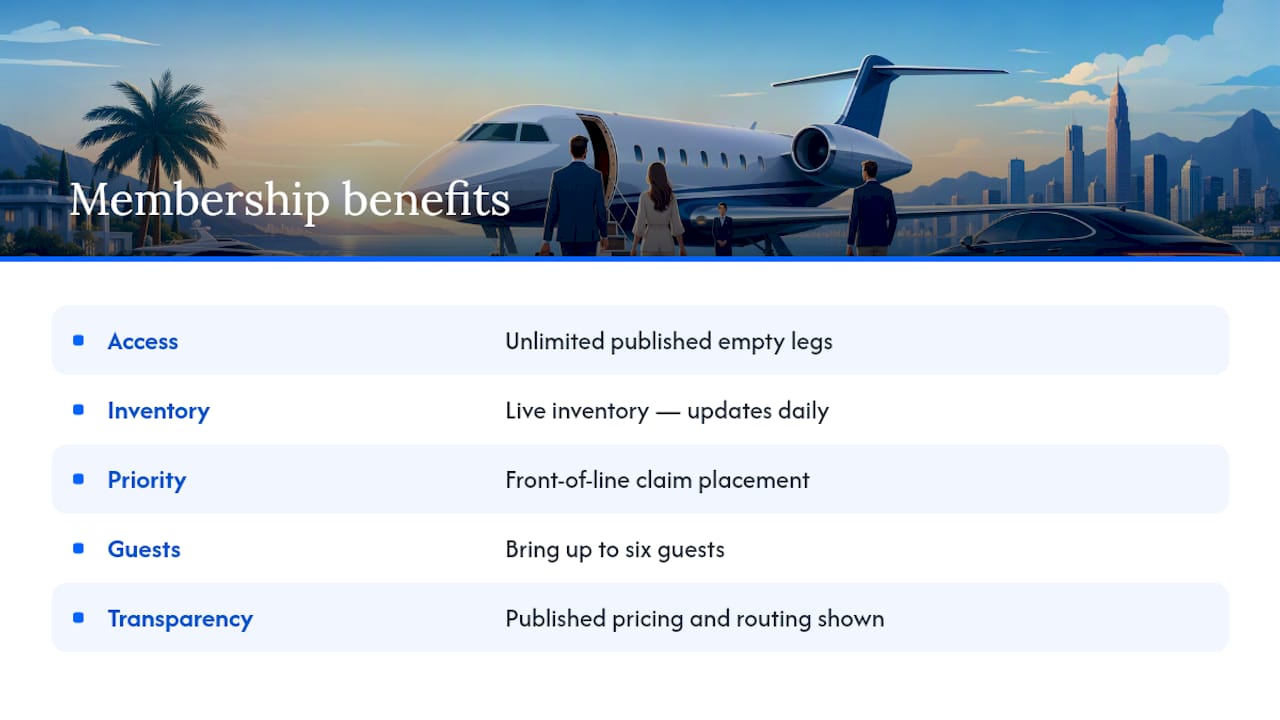
Bluebirdjets membership gives you unlimited access to published empty legs on operator-owned Learjet 60 aircraft, with live inventory that updates daily and priority queue placement when a listing you want appears. You can bring up to six guests per flight, which changes the math considerably if you’re traveling as a family or a small group.
A sample listing, like the JWY to PQL empty leg departing July 18, shows exactly how transparent the published pricing and routing already are before you ever commit. Membership doesn’t just tell you a deal exists; it puts you at the front of the line to claim it, which is where alert-only monitoring tends to fall short.
When an Empty Leg Beats a Charter (and When It Doesn’t)
The ideal empty-leg traveler values price and exclusivity over rigid scheduling and can absorb a canceled or shifted flight without real damage. If you have a fixed commitment, a nonrefundable event, or zero tolerance for schedule risk, book a standard charter instead. The decision rule is simple: when schedule control matters more than cost, pay for the charter; when flexibility and savings matter more, keep watching the empty legs.
— Nick
Get Priority Access to Bluebirdjets International Empty Legs
Watching alerts only gets you so far when a rare international leg can disappear within the hour. Bluebirdjets membership puts you ahead of that clock with unlimited access to live inventory, queue priority when a listing matches your route, and room to bring up to six guests without paying for extra seats.

Once you join, you start seeing every published route the moment it goes live, not after it’s already gone. That’s the practical difference between hoping for a match and actually catching one. Browse current flights to see what’s live right now, including listings like the JWY to PQL route, and set your alerts before the next international leg appears.