Empty Leg vs Charter Flight: What Travelers Must Know

An empty leg flight is a discounted repositioning flight that a private jet operator offers when an aircraft must fly empty to its next assignment. A charter flight, by contrast, is a fully private jet experience booked entirely on your schedule and route. The core difference in the empty leg vs charter flight debate comes down to one trade-off: cost savings versus schedule certainty. Empty legs can run 25%–75% cheaper than standard charter rates, but they come with fixed routes, fixed times, and real cancellation risk. Charters cost more and give you complete control.
How do empty leg flights work, and why do they exist?
Empty legs exist because of how private aviation operates. When a client books a one-way charter from New York to Miami, the aircraft still needs to return to its home base or fly to its next assignment. That return or repositioning flight would otherwise fly completely empty, generating zero revenue for the operator.
Operators price these repositioning flights to recover at least their direct operating costs. Typical direct operating costs for a light jet run approximately $2,000–$2,500 per flight hour. That floor sets the minimum price an operator will accept, and anything above it is a bonus. Operators rarely price empty legs below that threshold unless moving the aircraft is operationally necessary regardless.

The discount structure reflects urgency and route demand. A New York to Miami empty leg on a light jet might list at $3,000–$6,000, while the same aircraft on a full charter for that route costs $9,000–$14,000. That gap is real and significant. The catch is that the flight exists only because someone else booked the primary charter, and that primary booking drives everything about the empty leg’s timing.
Pro Tip: Check empty leg pricing mechanics before you book. Understanding what drives the discount helps you recognize a genuinely good deal versus a marginal one.
Route example | Empty leg cost | Full charter cost | Savings |
|---|---|---|---|
New York to Miami (light jet) | $3,000–$6,000 | $9,000–$14,000 | Up to 75% |
Light jet retail rate (general) | $6,000–$8,000 | $12,000–$15,000 | Up to 50% |
What are the key differences in flexibility, control, and risk?
Charter flights give you full control over every detail of your trip. You choose the departure airport, the destination, the departure time, and the aircraft type. If your meeting runs long or your plans change, you call the operator and adjust. That level of control is the defining charter flight benefit and the reason business travelers, medical transport teams, and event organizers default to charters.
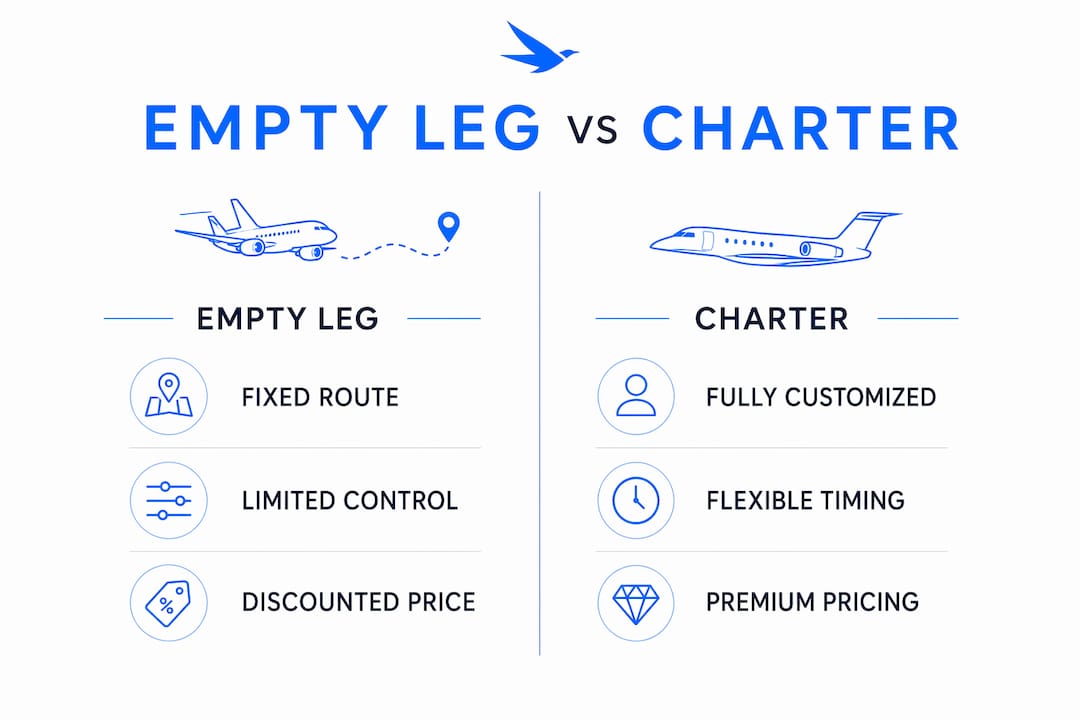
Empty legs operate on the operator’s terms, not yours. The route is fixed. The departure time is set by the aircraft’s repositioning schedule. Slight timing adjustments may be possible, but absolute timing guarantees do not exist because the flight must prioritize the primary charter. If the primary client changes plans, your empty leg changes too.
The cancellation risk is the sharpest distinction between the two options. Empty legs depend entirely on the primary charter booking. If that primary client cancels or reschedules with 12 hours’ notice, you may face the same disruption with little recourse. Charter passengers face no such dependency.
Scenarios where charters are the clear choice:
Business travel with fixed meeting times or board presentations
Medical transport where timing and reliability are non-negotiable
Weddings and events where the schedule is set months in advance
Group travel where multiple people’s plans depend on one departure
Scenarios where empty legs make sense:
Leisure travel with flexible dates and no hard commitments at the destination
Travelers with a backup plan who can rebook commercial if the empty leg cancels
Route-opportunistic travelers who happen to need the same city pair the operator is repositioning to
Pro Tip: Before booking an empty leg, confirm the cancellation policy in writing. Ask specifically what happens if the primary charter changes. Knowing your refund terms upfront prevents costly surprises.
How do costs compare, and what should you consider beyond price?
The headline discount on empty legs is real, but the total cost of travel tells a fuller story. A traveler who saves $6,000 on a flight but misses a critical meeting due to a last-minute cancellation has not saved anything. Marginal flight savings can be offset by logistical disruptions, making full charters the financially wiser choice in certain situations.
Full charter pricing covers more than the flight itself. The rate typically includes crew fees, landing fees, fuel surcharges, and catering coordination. Empty leg pricing is often leaner on these inclusions, and some operators charge separately for catering or ground handling. Always ask what the quoted price covers before you compare it to a charter rate.
The hidden costs of an empty leg disruption add up fast. A last-minute hotel night in an unfamiliar city, a commercial rebooking fee, or a missed business deal can easily exceed the original flight savings. When savings don’t significantly outweigh risk, a standard charter proves the better financial and logistical choice.
Run a simple cost-benefit check before booking:
What is the dollar difference between the empty leg and a full charter on the same route?
What is the cost of your worst-case disruption scenario (hotel, commercial flight, missed revenue)?
Does the empty leg savings exceed that worst-case cost by a meaningful margin?
Do you have a workable backup plan if the flight cancels within 24 hours?
If the savings are substantial and your backup plan is solid, the empty leg is worth it. If the margin is thin or the stakes are high, book the charter.
How and when can you find and book empty leg flights?
Timing is the most important factor in finding empty leg flights. Most empty legs appear within 7–14 days of departure, and many surface within 7 days or less. That short window is not a flaw in the system. It reflects the reality that operators only release empty legs once the primary charter is confirmed and the repositioning route is locked.
The fragmented nature of the market means no single platform shows every available empty leg. Expert travelers use aggregator platforms, email alerts, and direct operator contacts to maximize their chances of finding deals. Signing up for alerts from multiple sources dramatically increases your odds of catching a relevant route before it fills.
Follow these steps to book empty legs effectively:
Set up alerts on multiple platforms. No single source has complete inventory. Cast a wide net across aggregators and operator direct channels.
Be flexible on airports. If you can fly into a secondary airport 30 miles from your destination, your options multiply significantly.
Keep your dates loose. Empty legs appear on the operator’s schedule, not yours. A one-day flexibility window opens far more routes.
Read the cancellation policy before paying. Confirm what happens if the primary charter changes and whether you receive a refund or credit.
Have a commercial backup booked or identified. Know your fallback before you commit, not after the empty leg cancels.
Move fast when you find a match. Good empty legs at steep discounts sell quickly. Hesitation costs deals.
Bluebirdjets offers a membership that gives you unlimited access to empty legs on the platform. That model removes the friction of hunting across fragmented sources and puts a curated inventory in one place. For travelers who fly private regularly and want consistent access to discounted flights, a membership for empty legs changes the economics significantly.
Pro Tip: Read the booking best practices guide before your first empty leg booking. The details on cancellation terms and alert setup alone are worth the read.
Key Takeaways
Empty leg flights deliver real savings for flexible travelers, but charter flights remain the only reliable choice when your schedule cannot bend.
Point | Details |
|---|---|
Cost savings are real but conditional | Empty legs run 25%–75% cheaper than charters, but only when your plans align with the operator’s route. |
Charter flights buy certainty | Full charters give you complete control over timing, route, and aircraft, with no dependency on another booking. |
Cancellation risk is the key trade-off | Empty legs can be canceled or changed if the primary charter shifts, often with little notice. |
Total cost matters more than ticket price | Disruption costs like hotel nights and commercial rebooking can erase empty leg savings quickly. |
Timing and flexibility determine success | Most empty legs appear 7–14 days out; flexible travelers with backup plans get the most value. |
My honest read on the empty leg vs charter debate
I’ve watched travelers make the same mistake repeatedly. They see a 60% discount on an empty leg, book it without a backup plan, and then scramble when the primary charter cancels two days before departure. The savings were real on paper. The disruption cost was realer.
The mindset shift that matters is this: an empty leg is not a cheaper version of a charter. It is a fundamentally different product with a different risk profile. Choosing between them is not about finding the best deal. It is about matching the product to your actual travel situation.
For occasional leisure travelers with genuine schedule flexibility, empty legs are one of the best deals in private aviation. The short-notice availability is a feature, not a bug, if you can work with it. For anyone traveling on a fixed deadline, whether it is a board meeting, a wedding, or a medical appointment, the charter is not the expensive option. It is the correct option.
The smartest travelers I know use both. They book charters when the stakes are high and grab empty legs when the route and timing happen to align with their plans. That combination gives you private aviation access at a blended cost that is far lower than chartering everything.
— Nick
Bluebirdjets: access to empty legs and full charters in one place
Private aviation works best when you have access to both options without hunting across a dozen platforms.

Bluebirdjets offers a membership that gives you unlimited access to empty leg flights on the platform, so you stop missing deals because you found out too late. When your schedule demands certainty, full charter booking is available through the same platform. One membership, one place to search, and a team that knows the difference between a good empty leg deal and a risky one. Check the Bluebirdjets membership to see which plan fits how you fly.
FAQ
What is the main difference between an empty leg and a charter flight?
An empty leg is a discounted repositioning flight offered at a fixed route and time set by the operator. A charter flight is fully customized to your schedule, route, and aircraft preference.
How much cheaper are empty leg flights compared to charters?
Empty legs typically cost 25%–75% less than a full charter on the same route. A New York to Miami light jet charter runs $9,000–$14,000; the same route as an empty leg can cost $3,000–$6,000.
Can an empty leg flight be canceled after booking?
Yes. Empty legs depend on the primary charter booking, so if that client changes plans, your flight can be modified or canceled with little notice. Always confirm the cancellation policy before paying.
How far in advance do empty leg flights become available?
Most empty legs appear within 7–14 days of departure, often less than 7 days out. Availability depends on when the primary charter is confirmed by the operator.
When should I book a charter instead of an empty leg?
Book a charter when your schedule is fixed and the cost of disruption is high. Business meetings, medical transport, and event travel all require the reliability that only a full charter provides.