Best Empty Leg Sites for Spontaneous Private Jet Deals

Best Empty Leg Sites for Spontaneous Private Jet Deals
For frequent, spontaneous flyers, the best empty leg site is Bluebird, and the reason is simple: unlimited access to published empty legs on operator-owned Learjet 60 aircraft, live inventory updated daily, and the ability to bring up to six guests without paying per seat. Most competitors work like an app store search bar, showing you what a broker or marketplace happens to have listed that week. Bluebird works like a key you already own to the door. If your travel style is “I want to go Friday if a good route pops up,” a subscription model beats a marketplace model almost every time, because you’re not competing for the same seat against every other user of the same app.
Here’s the quick shortlist for anyone comparing options right now:
- Bluebird — best for frequent, spontaneous flyers who want unlimited empty-leg access and guest seats included in one annual membership.
- Aggregator apps (in the style of EmptyJet or Fly Vaunt) — best for travelers who want broad inventory across multiple operators without committing to one platform.
- Per-seat / waitlist marketplaces (like PrivJet) — best for solo travelers or couples who don’t mind sharing a cabin to cut the price further.
- Real-time feed services (such as GLOBAL™ JetStream) — best for data-driven flyers who want direct operator pricing and 24/7 monitoring rather than a curated list.
- Premium subscription apps — several charge around $360 a year for premium alert and purchase features, which is worth comparing against what a membership like Bluebird actually unlocks for that price range.
Key Takeaways
A Bluebird membership delivers unlimited access to empty legs on operator-owned aircraft, which beats per-flight marketplaces for anyone flying spontaneously more than a few times a year.
| Point | Details |
|---|---|
| Best pick for frequent flyers | Bluebird membership offers unlimited empty-leg access with up to six guests per flight included. |
| Best alternative for rare travel | Aggregator apps like EmptyJet or Fly Vaunt suit occasional flyers who want broad inventory without a subscription. |
| Watch for missing verification | Skip any platform that won’t disclose operator safety certification or vetting standards. |
| Watch for vague refund terms | Avoid booking with any site that doesn’t put cancellation and refund policy in writing before payment. |
| Booking tip | Set route-specific alerts instead of browsing full feeds, since empty legs usually surface 24 to 72 hours before departure. |
| Bluebird’s role in this category | Bluebird’s annual membership offers unlimited access to live empty-leg inventory on operator-owned Learjet 60s, positioning it as the strongest option for frequent, spontaneous flyers. |
Table of Contents
- What Are the Best Empty Leg Sites and Apps Right Now?
- How Do You Choose the Right Empty Leg Site for You?
- How Do Empty Leg Flights Actually Work?
- How Do You Book an Empty Leg and What Should You Expect to Pay?
- Why Does a Bluebird Membership Work Best for Frequent Flyers?
- Membership, Aggregator, or Broker: Which One Actually Fits You?
- How Do You Get Started With a Bluebird Membership?
- Sources
What Are the Best Empty Leg Sites and Apps Right Now?
The category splits into four real business models, and confusing them is the single biggest mistake shoppers make. A membership platform sells you guaranteed access. An aggregator sells you visibility. A per-seat marketplace sells you a discount in exchange for shared risk. A broker network sells you a phone call and a quote.
Here’s how the categories stack up against each other on the dimensions that actually matter when you’re trying to book something inside 72 hours.
| Category | Best for | Booking model | Coverage | Live booking vs. quote | App & alerts | Pricing model | Verification | Concierge support |
|---|---|---|---|---|---|---|---|---|
| Subscription membership platforms | Frequent spontaneous flyers | Annual membership, unlimited access | Operator-owned fleet, daily updated routes | Live booking | Yes, priority queue notifications | Flat annual fee, savings scale with usage | Operator-owned aircraft, direct vetting | Dedicated member support |
| Aggregator marketplaces | Travelers who want breadth over depth | Free browsing, pay per flight | Multiple operators, wide geographic reach | Mostly direct booking, some quote requests | Yes, standard push alerts | Per-flight pricing, varies by route | Varies by listed operator | Limited, app-based |
| Per-seat / waitlist marketplaces | Solo travelers, couples, budget-conscious flyers | Pay per seat, price drops as seats fill | Depends on route demand | Confirmed once seat threshold met | Yes, waitlist notifications | Lowest per-person price, but uncertain timing | Varies by operator | Minimal |
| Broker networks | Complex or custom itineraries | Request a quote, broker sources flight | Global, but manual | Brokered quote, not instant | Rarely app-based | Negotiated, less transparent | Broker-dependent | High-touch, phone/email |
| Real-time feed services | Data-driven, always-watching flyers | Direct operator pricing via live feed | Wide, updated continuously | Often live | Yes, AI-driven alerts | Market-rate, fluctuates | Operator-dependent | 24/7 in some cases |
A few notes on how the named products in this space actually behave, since app-store listings and marketing copy often blur the categories above.
Bluebird membership
- Unlimited access to published empty legs, not a per-flight fee.
- You can bring up to six guests on a single flight at no extra seat charge.
- Live inventory with daily updated routes means you’re not stuck refreshing five different apps.
- The tradeoff: it’s a subscription commitment, so it rewards frequency over one-off use.
Aggregator apps like EmptyJet or Fly Vaunt
- Wide inventory since they pull from multiple operators into one searchable feed.
- No subscription required, so there’s zero commitment if you fly private twice a year.
- The tradeoff: you’re competing with every other app user for the same seat, and pricing transparency varies by listing.
Per-seat marketplaces like PrivJet
- Waitlist features can drop the per-seat price significantly once enough passengers sign up.
- Custom flight requests give some flexibility beyond the published list.
- The tradeoff: you’re gambling on other people filling the cabin, which doesn’t suit a traveler who needs a guaranteed departure.
Pro Tip: If you fly private more than four or five times a year, run the math on subscription cost versus per-flight fees before assuming a marketplace is “cheaper.” A membership often wins once you account for guest seats you’d otherwise pay for separately.
For someone who wants to stop comparing five different tabs every weekend, Bluebird’s membership model solves the core problem: it turns “let’s see what’s available” into “let’s see what’s mine.”
How Do You Choose the Right Empty Leg Site for You?
If you fly spontaneously more than five or six times a year, a membership beats an aggregator on cost and convenience almost every time. The math changes only when your travel is rare, unpredictable in destination, or genuinely one-off.
Run through these criteria before deciding:
- Frequency of travel. Weekly or monthly flyers save the most through a flat-fee membership. Occasional flyers may do fine with a free aggregator app.
- Flexibility required. If your dates are locked to a specific weekend, live inventory matters more than a broad brokered network.
- Willingness to subscribe. A subscription only pays off if you’ll actually use it. Be honest about your real flight cadence.
- Aircraft type needs. Some platforms operate a specific fleet (like Bluebird’s Learjet 60s); others aggregate whatever operators list that week.
- Guest seating. If you regularly travel with a group, check whether guests ride free or cost extra per seat.
- Verification standards. Confirm the platform discloses operator safety certificates, not just a marketing claim of “vetted.”
- Concierge access. Last-minute changes happen. Know whether a human answers the phone or you’re stuck in an app queue.
Before committing to any platform, run through this list:
- Do you get live booking confirmation, or just a broker’s quote that could fall through?
- How far before departure can you cancel, and what’s the refund policy in writing?
- Is operator vetting disclosed, including safety certification and insurance coverage?
- Are guest seats included, or billed separately per passenger?
- Does the app send real-time push alerts for your saved routes, or only email digests?
- What’s the total annual cost versus your expected number of flights?
Watch for these red flags, since they show up more often than you’d expect in this category:
- No live inventory. Just “contact us for availability” is a broker in disguise.
- Vague or missing cancellation and refund terms.
- No mention of operator verification or safety certificates anywhere on the site.
- Pricing that changes noticeably between the initial listing and the final quote.
For a deeper look at how availability actually gets determined behind the scenes, Bluebird’s guide on what determines empty leg availability breaks down the operational side. And if you’re comparing membership models against marketplace alternatives more broadly, this rundown of membership versus marketplace business models is worth reading before you commit.
How Do Empty Leg Flights Actually Work?
An empty leg is a scheduled flight with no paying passenger, flown because the jet needs to be somewhere else, and it exists purely because charter aircraft rarely fly round trip with a full cabin both ways.

Picture a Learjet that flew a family from New York to Aspen for a ski weekend. The jet still has to get back to base, or reposition for its next charter. That return flight, or “deadhead leg,” would fly empty regardless. Selling those seats at a steep discount turns a cost center into revenue, and it’s why empty legs exist at all. The same logic applies to one-way charters, maintenance repositioning, and crew rotations.
Timing matters more than most first-time flyers expect.
Statistic Callout: Empty legs typically surface 24 to 72 hours before departure, though some operators post them further out depending on the route and season. Waiting until the last minute usually means better pricing but less certainty about exact departure times.
Not every corridor produces the same volume of opportunities. Routes tied to seasonal leisure travel, like ski destinations in winter or coastal cities in summer, generate far more empty legs than routes between two secondary cities with light charter traffic. Sports and entertainment circuits, think Super Bowl weekends or major golf tournaments, also spike empty-leg availability as jets reposition after dropping off attendees. Industry coverage of pandemic-era scheduling shifts showed just how sensitive charter scheduling is to demand swings, and that sensitivity is exactly what creates the empty-leg market today. Seasonality data on the busiest travel days reinforces the same pattern: holiday weekends and peak leisure windows push more jets into repositioning flights.
For spotting these deals reliably:
- Set mobile alerts on your specific routes rather than browsing the full feed daily.
- Save a watchlist of your two or three most common destinations.
- Favor platforms with live, continuously updated feeds over static listings that only refresh weekly.
How Do You Book an Empty Leg and What Should You Expect to Pay?
Yes, you can book an empty leg directly in many cases, but how fast that booking gets confirmed depends entirely on whether you’re using a live-inventory platform or waiting on a broker’s quote.
The process generally follows a predictable sequence:
- Spot the alert. A push notification or app listing shows a route, date, and price.
- Confirm seat availability. On live-inventory platforms, this happens instantly. On brokered networks, you’re waiting on a callback.
- Request or receive a quote. Membership platforms skip this step entirely since pricing is already published.
- Submit payment. Most platforms require payment at booking to hold the seat, especially for last-minute departures.
- Receive documentation. You should get a confirmation email with tail number, departure time, FBO location, and operator details.
- Show up prepared. Private terminals move fast, usually 15 to 30 minutes before departure, with far lighter security than commercial airports.
Statistic Callout: Premium empty-leg apps commonly charge around $360 per year for subscription-based alert and booking access, on top of whatever the individual flight costs. That’s worth weighing against a membership model where the annual fee is the only cost beyond the flight itself.
Pricing on empty legs runs well below full charter rates, though the exact discount depends on the route, the aircraft, and how close to departure you’re booking. Practical guides on using empty legs to fly private consistently point to this as the main appeal of the category, alongside the caveat that flexibility is the price you pay for the discount.
A few tips worth acting on:
- Ask about refund terms before you pay, not after. Cancellation windows vary wildly between operators.
- Pay by credit card when possible, since it gives you a dispute path if a flight falls through.
- Confirm operator verification and safety certification directly, rather than trusting a marketing badge on the listing.
- Expect tighter luggage limits than commercial flights. Ask about weight restrictions before you pack.
- Build in a buffer for schedule shifts. Empty legs can move by an hour or two if the inbound flight runs late.
For a full walkthrough of what to expect on the actual day of travel, Bluebird’s guide to empty leg booking best practices covers the details that most sites skip, and the breakdown of why empty legs cost less explains the pricing logic in more depth than a single callout can.
Why Does a Bluebird Membership Work Best for Frequent Flyers?
The core benefit is unlimited access to published empty legs on operator-owned Learjet 60 aircraft, which means you’re not paying per flight or competing against thousands of other app users for the same seat.
That single structural difference changes the math for anyone who flies private more than a handful of times a year. Here’s what membership actually includes:
- Unlimited access to daily updated empty-leg routes, not a capped number of bookings.
- Free last-minute flights for members on operator-owned Learjet 60s.
- Up to six guests per flight at no additional per-seat charge.
- Priority queue and booking features that put members ahead of non-members on popular routes.
- Optional paid custom charter requests for trips outside the published inventory.
Consider how this plays out for different travelers. A weekend leisure flyer who takes two or three ski trips a month benefits from not re-shopping five apps every Thursday night. An executive who needs to reach a client meeting Monday morning but doesn’t know until Friday whether the deal closes benefits from guaranteed access rather than hoping a broker calls back in time. A family that regularly travels with in-laws or friends benefits from the six-guest allowance instead of paying per seat on a marketplace.
Pro Tip: If your annual private jet spend already exceeds a few thousand dollars in one-off bookings, run the numbers on a membership. The guest allowance alone often closes the gap on cost, since most marketplaces charge full price per additional passenger.
There are real tradeoffs to weigh. A membership is a subscription commitment, so it rewards travelers who fly regularly, not someone booking one trip a year. If your travel dates and destinations are highly unpredictable and rare, a pay-per-flight aggregator might genuinely serve you better. For real examples of how different travelers have used empty-leg access, Bluebird’s travel experience examples walk through several actual use cases.
Membership, Aggregator, or Broker: Which One Actually Fits You?
If you fly spontaneously and often, membership wins. If you fly rarely but want maximum route choice, an aggregator app wins. If you have one complicated trip with a custom itinerary, a broker still has a place.
Here’s the honest breakdown for each traveler type.
Frequent spontaneous flyer. A subscription membership is the clear pick. The flat annual cost gets diluted across enough flights that per-trip cost drops below almost anything a marketplace can offer, and the guest allowance alone often justifies the fee.
Occasional splurge traveler. An aggregator app makes more sense here. You’re not flying often enough to justify a subscription, and the wider net of an aggregator increases your odds of finding something on the specific weekend you want to travel.
Pros and cons worth weighing for each channel:
- Membership: Guaranteed access and guest seats, but only pays off with regular use.
- Aggregator: No commitment and wide inventory, but you’re competing with every other user for the same listing.
- Per-seat marketplace: Lowest price per person, but timing depends on strangers filling the cabin.
- Broker network: Best for custom or complex routes, but slower and less price-transparent.
A single high-priority trip, say a wedding or a major event with no flexibility on dates, is really the only scenario where a broker’s manual sourcing earns its place. Everywhere else, live inventory beats a phone call.
How Do You Get Started With a Bluebird Membership?
Membership works like this: pay one annual fee, and it unlocks unlimited access to Bluebird’s published empty legs, plus priority booking ahead of non-members.
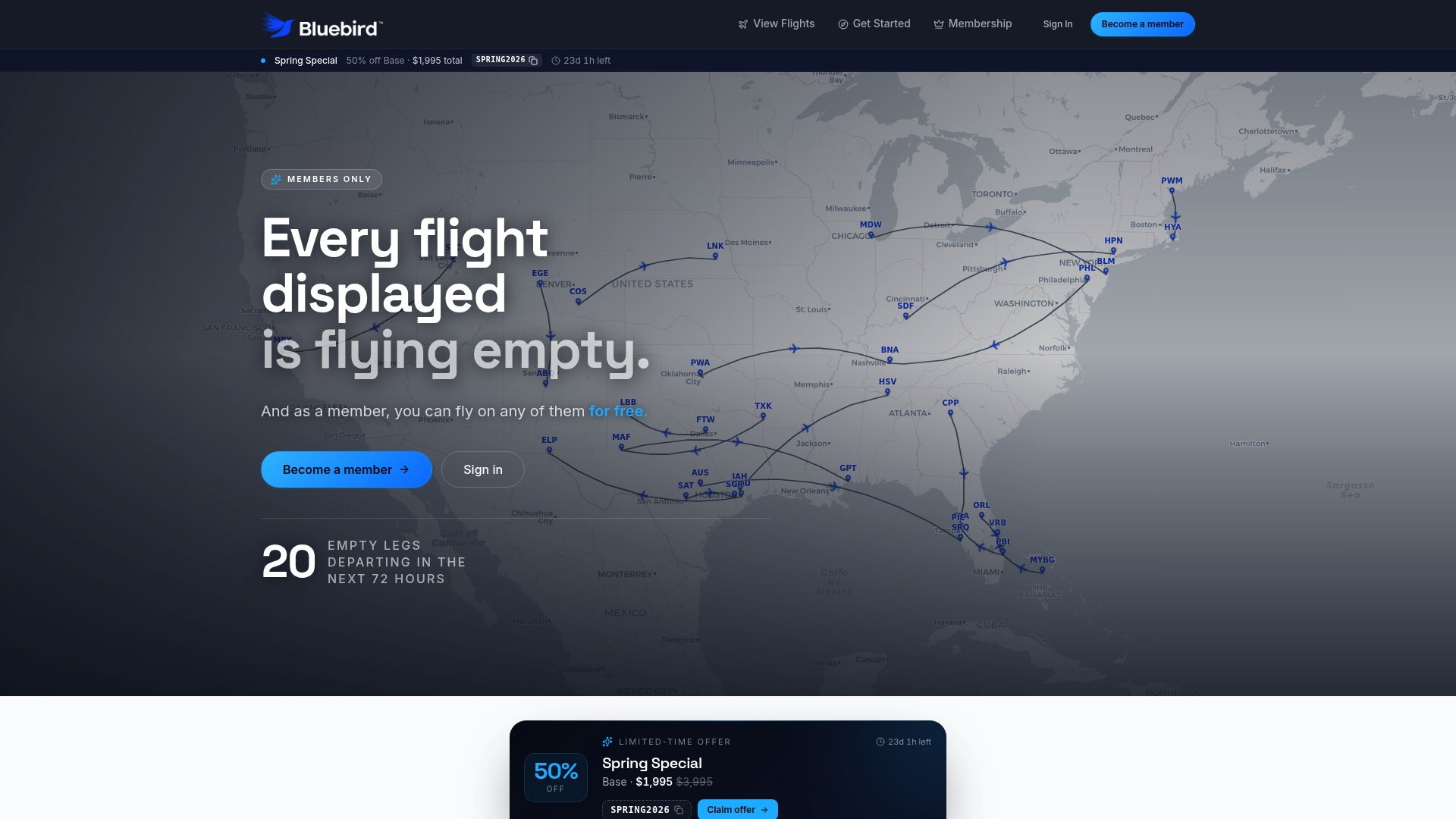
Here’s what’s actually included once you join:
- Unlimited access to empty legs on operator-owned Learjet 60 aircraft, with no per-flight fee.
- Free last-minute flights for members, updated daily as new routes get published.
- Up to six guests per flight at no added cost, which matters if you regularly travel with family or colleagues.
- Priority booking queue, so you’re ahead of the line when a popular route opens up.
- Optional “Skip-the-Line” upsell and custom charter requests for trips outside the standard inventory.
Getting started takes a few steps: visit the Bluebird membership page, choose the tier that matches your travel frequency, complete signup, and start browsing live flight inventory right away. Once you’re in, saved routes and priority alerts do most of the work, so you’re reacting to notifications instead of hunting through five different apps every week.
If you already fly private a handful of times a year and keep running into the same problem, competing with strangers for the same discounted seat, checking current availability on Bluebird’s flight listings is the fastest way to see whether membership pencils out for your actual travel pattern.