Is an Empty Leg Membership Worth It for Flexible Travelers?

Is an Empty Leg Membership Worth It for Flexible Travelers?
An empty-leg membership is worth it if you fly private multiple times a year, can shift your schedule by a day or two, and travel corridors with consistent repositioning traffic. Meet those three criteria and you can expect significant discounts off standard charter rates on the same aircraft, same crew, same FBO experience. Miss even one of them and the math turns against you fast.
The case for membership rests on a few specific advantages:
- Priority access to inventory before it hits public listings
- Queue and skip-the-line features that let members claim flights ahead of general notification subscribers
- Curated, live inventory updated daily rather than scraped from aggregators
- Per-flight booking friction drops to near zero once you’re inside the platform
The catch is real: empty-leg cancellations run a notable percentage industry-wide, triggered when the primary charter client changes plans or the operator repositions differently. This cancellation risk should be considered when planning. If your trip is mission-critical, a membership alone isn’t your answer.
Table of Contents
- What are empty leg flights, and how do memberships work?
- Real advantages and real drawbacks of empty-leg memberships
- How does the savings math actually work?
- What are the real booking timelines and cancellation risks?
- Is an empty-leg membership worth it for your specific trips?
- How do you increase your odds of finding useful empty legs?
- What does Bluebirdjets offer, and when is it the right choice?
- How do empty-leg memberships compare to other private aviation options?
- Key Takeaways
- The case for treating empty legs as a travel strategy, not a discount hack
- Bluebirdjets membership: the right fit for flexible private travelers
- Sources and further reading
What are empty leg flights, and how do memberships work?
A private jet creates an empty leg the moment it completes a one-way charter. The aircraft has to reposition somewhere — back to base, to the next client’s departure city, or to a maintenance facility. That repositioning trip is the empty leg, and operators would rather sell it at a steep discount than absorb the full cost of flying an empty jet.
These flights go by several names in the industry:
- Dead leg / deadhead flight: the repositioning trip itself, flown without revenue passengers
- Ferry flight: an unpiloted or crew-only repositioning, sometimes used interchangeably with dead leg
- Operator: the FAA-certificated company (Part 135) that owns or manages the aircraft and holds the air carrier certificate
- Part 135: the FAA operating certificate required for on-demand charter in the United States; every legitimate empty-leg operator holds one
An empty-leg membership is a paid annual subscription that grants access to a platform’s inventory of these repositioning flights, typically with priority booking features layered on top. That’s structurally different from a public aggregator, where anyone can browse listings with no fee and no priority. The membership model’s value proposition is speed and access: you see flights first, you book faster, and on platforms that actually control their own fleet, you may get inventory that never reaches the public marketplace at all.
One clarification worth making: almost all empty legs are whole-aircraft bookings. You charter the entire plane, not a seat. A small number of operators offer seat-based pricing on select routes, but that’s the exception. When you book an empty leg, you’re getting the full cabin for you and your group.

Pro Tip: Before paying for any membership, ask the platform directly: do you control the aircraft schedules, or are you aggregating from third-party operators? The answer determines whether “priority access” is a real contractual advantage or just an email notification.

Real advantages and real drawbacks of empty-leg memberships
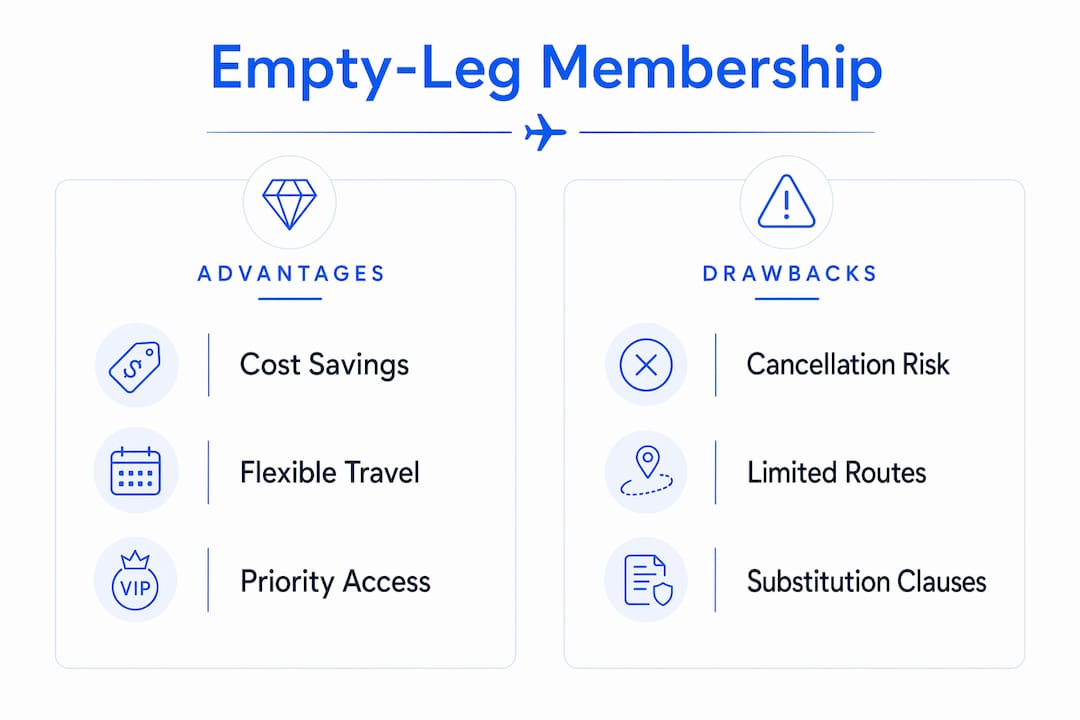
The benefits of empty leg flights are genuine, but they come with trade-offs that most marketing materials understate.
What works in your favor:
- Discounts off charter retail are consistent across the industry, not cherry-picked outliers
- You get the identical cabin, crew, and FBO experience as a full charter — the only difference is price and scheduling flexibility
- Members on platforms with real fleet control often see inventory that never reaches public marketplaces, because operators prioritize established relationships
- Group economics improve sharply: split a $6,000 light-jet empty leg among four travelers and you’re at $1,500 per person, well below first-class commercial on many routes
- No per-flight booking friction once you’re a member — confirm, pay, fly
What works against you:
- Cancellation risk is structural, not a platform failure. The primary charter client may cancel or the operator may reroute, resulting in your flight disappearing.
- Route and time rigidity is real. The aircraft goes where repositioning requires, not where you want to go.
- Booking windows are short. Most listings appear 2–14 days out; the best discounts show up within 48–72 hours of departure.
- Some membership programs are notification services dressed up as priority platforms — they don’t control fleet schedules and can’t actually guarantee you first access.
- Hidden costs can erode the discount: repositioning surcharges, FBO handling fees, catering add-ons, and non-refundable booking deposits all appear after the headline price.
Watch specifically for aircraft substitution clauses. A membership contract that allows the operator to swap your Learjet 60 for a smaller aircraft without a price adjustment is a meaningful downside risk, especially for groups of five or six.
Pro Tip: Ask for the platform’s cancellation and refund policy in writing before you subscribe. Specifically: if the operator cancels your confirmed empty leg, do you get a full refund or a credit? The answer tells you a lot about how much the platform actually controls its inventory.
How does the savings math actually work?
The 25–75% savings range is real, but where you land within that band depends on aircraft class, route, and how close to departure you book. Here’s what that looks like in practice.
Typical empty-leg price bands by aircraft class
| Aircraft Class | Full Charter (Typical) | Empty-Leg Range | Potential Savings |
|---|---|---|---|
| Light jet (e.g., Learjet 60) | $8,000 | $2,000–$6,500 | 25–75% |
| Midsize jet | $12,000–$18,000 | $4,000–$9,000 | 25–75% |
| Heavy jet | $38,000–$45,000 | $9,000–$25,000+ | 25–75% |
Three quick examples show how this plays out:
Weekend light-jet run (New York to Palm Beach, Friday afternoon): Full charter runs roughly $12,000–$14,000. An empty leg on the same route, booked 36 hours out, might list at $2,000–$6,500. Four travelers split that to $500–$1,625 each. That’s a meaningful number.
Midsize trans-regional (Dallas to Chicago, midweek): Full charter around $18,000. Empty-leg equivalent: $4,000–$9,000 depending on timing. Solo traveler still pays more than a first-class commercial ticket, but a group of three or four changes the calculus entirely.
Heavy jet repositioning (Los Angeles to New York, Sunday evening): Full charter $38,000–$45,000. Empty leg: $9,000–$25,000+. Even at the high end of the empty-leg range, that’s a $20,000+ discount on the same aircraft.
When does the annual membership fee pay off?
The break-even point for paid membership models generally starts at a moderate to high number of flight hours per year. Below that, opportunistic empty-leg bookings or ad-hoc charter usually are more cost-effective. Above that threshold, the priority access and reduced friction start to earn their keep, especially if you’re flying corridors with high repositioning traffic.
The math is straightforward: if your annual membership fee is, say, $2,000–$3,000 and you capture even one or two flights at a $5,000–$8,000 discount versus retail charter, the fee pays for itself in the first booking.
Pro Tip: Before committing to a membership, spend 3–4 weeks monitoring empty-leg listings on your preferred corridors. If you see five or more relevant flights in that window, the inventory density likely justifies a subscription.
What are the real booking timelines and cancellation risks?
Most empty legs appear 2–14 days before departure, but the pricing curve is steep. A listing that shows up ten days out might be 30% off retail. The same flight 24 hours before departure can hit 65% off. The operator needs to fill the seat or absorb the cost, and that urgency shows in the price.
That number matters for planning. The most common causes: the primary charter client cancels their trip, the operator picks up a different paying charter that changes the routing, or a maintenance issue grounds the aircraft. None of these are within your control.
Real costs beyond the headline price:
- Federal excise tax: 7.5% on domestic air transportation, applied to the charter price
- FBO handling fees: vary by airport, typically $150–$500 per landing
- Repositioning surcharges: some operators add a fee if the empty leg requires the aircraft to travel significantly out of its way to pick you up
- Catering: almost always quoted separately; budget $50–$200 per person for a standard service
- Non-refundable booking deposits: some platforms require a deposit that’s forfeited if you cancel, even when the operator cancels first
Mitigation checklist:
- Always have a backup travel plan (commercial first-class or a charter quote in hand) before confirming an empty leg
- Buy travel insurance that covers private charter cancellations specifically
- Keep ground logistics flexible: don’t book a non-refundable hotel or event ticket that depends on the empty leg arriving on time
- Confirm aircraft substitution terms in writing before paying
- For time-sensitive trips, use the empty leg for the leisure leg and a guaranteed charter or jet card for the return
Is an empty-leg membership worth it for your specific trips?
The honest answer is: it depends on a short list of factors you can evaluate in about ten minutes.
Decision checklist:
- You fly private three or more times per year
- At least half your trips are on routes with consistent repositioning traffic (NY–Florida, LA–Las Vegas, Texas–Northeast are the highest-volume corridors in the U.S.)
- You can shift departure by 12–48 hours without a business or personal penalty
- You’re comfortable with a 10–15% cancellation risk and have a backup plan
- Your group is two or more travelers (per-person economics improve significantly)
- You’re flying 25+ hours per year, or expect to reach that threshold
Score yourself: if you check four or more of those six boxes, a membership likely delivers net value. Three or fewer, and ad-hoc empty legs or per-trip charter will probably serve you better without the annual commitment.
Traveler profiles that benefit most:
- Weekend second-home commuters (Miami, Hamptons, Aspen) flying the same corridor four to eight times a year
- Seasonal leisure travelers who take three to six flexible private trips annually and can plan around availability
- Small business owners who mix mission-critical travel with opportunistic leisure flying
Profiles that should skip the membership:
- Travelers whose trips are primarily time-sensitive business commitments where a 10–15% cancellation risk is unacceptable
- Solo travelers flying fewer than ten hours per year — the per-flight economics rarely justify the subscription fee
- Anyone whose routes are highly idiosyncratic (small regional airports, international legs) where repositioning inventory is thin
The hybrid strategy is what operational experts actually recommend: keep a reliable charter or jet card for mission-critical travel, and use an empty-leg membership for opportunistic leisure trips. You get the cost advantage where flexibility allows and guaranteed access where it doesn’t. That combination is more practical than trying to run your entire travel calendar on empty legs alone. For a deeper look at why flexible schedules suit this model, the corridor and timing logic is worth understanding before you subscribe.
How do you increase your odds of finding useful empty legs?
Knowing the inventory exists is one thing. Actually capturing it before someone else does is another problem entirely.
Practical tactics that work:
- Set route-specific alerts on every platform you use. Broad “any flight” notifications are noise; narrow alerts for your two or three most-traveled corridors are signal.
- Be willing to shift your date or time by 24–48 hours. The traveler who can leave Friday instead of Saturday captures flights the rigid traveler misses.
- Focus on high-supply corridors. New York to Florida, Los Angeles to Las Vegas, and Texas to the Northeast generate the most repositioning inventory in the U.S. Flexible travelers on these routes have the best odds of consistent matches.
- Join one or two reputable membership platforms rather than spreading across five. Deep engagement with fewer platforms, especially those with priority queue features, beats shallow monitoring of many.
- Use skip-the-line or paid priority booking features when a flight is exactly what you need. Paying a small upgrade fee to jump the queue on a $4,000 empty leg that would otherwise cost $16,000 is straightforward math.
The best empty legs often sell privately within 24 hours through operator relationships, before they ever reach a public listing. That’s the real argument for building a direct relationship with one or two operators whose fleets cover your corridors. Call them. Introduce yourself. Tell them your typical routes and flexibility window. Operators who know you will call before they post.
Booking workflow checklist:
- Alert fires for a matching route and date
- Confirm you have a backup travel option before responding
- Verify aircraft type, departure FBO, and all-in price including taxes and fees
- Check aircraft substitution and cancellation terms
- Confirm ground logistics are flexible (no non-refundable commitments tied to this flight)
- Book and pay, then set a reminder to reconfirm 24 hours before departure
Pro Tip: The best booking practices include monitoring listings for 3–4 weeks before subscribing to any platform. That window tells you how frequently relevant inventory appears on your routes — and whether the membership fee is justified by actual supply.
What does Bluebirdjets offer, and when is it the right choice?
Bluebirdjets operates as a subscription travel platform built specifically around empty-leg access on operator-owned Learjet 60 jets. The membership model is straightforward: pay an annual fee, get unlimited access to every empty leg published on the platform, and use priority features to claim flights ahead of the queue.
Core membership features:
- Unlimited access to empty-leg flights for the duration of the annual subscription
- Bring up to six guests per flight — the economics of splitting a Learjet 60 among six travelers are hard to beat
- Live inventory with daily-updated routes, so you’re seeing current repositioning schedules, not stale listings
- Priority queue and skip-the-line booking features that give members a genuine first-mover advantage
- Optional custom charter requests for trips where no empty leg matches your schedule
The fleet control signal matters here. Bluebirdjets operates on operator-owned aircraft, which means the platform has a direct relationship with the aircraft schedules rather than acting as a pure aggregator. That’s the structural difference between a membership that delivers real priority access and one that just sends you the same notifications everyone else gets.
A live listing example: A recent Bluebirdjets listing shows a Learjet 60 repositioning from JWY to PQL on July 18, available to members at a fraction of the full charter cost for that route. That’s the kind of specific, dated, whole-aircraft availability that members see in the live inventory — not hypothetical routes, but actual flights with departure dates and aircraft confirmed.
When Bluebirdjets is the right membership for you
| Criteria | Bluebirdjets fit |
|---|---|
| Flight frequency | 3+ private trips per year on flexible dates |
| Group size | 2–6 travelers (maximizes per-person economics) |
| Route preference | Corridors with Learjet 60 repositioning traffic |
| Schedule flexibility | Can shift 12–48 hours around availability |
| Cancellation tolerance | Comfortable with backup plan in place |
| Charter need | Occasional; custom charter option available for gaps |
The membership makes most sense for travelers who want a single platform with live inventory, priority access, and the option to bring a full group without paying per-seat premiums. The live flights page shows current availability so you can verify inventory density on your routes before committing.
How do empty-leg memberships compare to other private aviation options?
Private aviation has four main product categories, and each solves a different problem.
Empty-leg membership (e.g., Bluebirdjets): Best for opportunistic, flexible leisure travel. You get the deepest discounts (25–75% off retail) and the same aircraft experience as a full charter, but you’re working around the operator’s repositioning schedule, not your own. The annual fee is low relative to per-flight savings, and priority features give members a real edge over public marketplace browsers. The trade-off is the 10–15% cancellation risk and the need for schedule flexibility.
Jet cards: Best for frequent flyers who need guaranteed availability on short notice. You prepay for a block of hours (typically 25 hours minimum) at a fixed hourly rate, and the operator guarantees the aircraft. Break-even for jet cards typically starts around 25–50 flight hours per year. Below that threshold, you’re paying for guaranteed access you may not fully use. Jet cards are the right tool for mission-critical business travel where a 10–15% cancellation risk is simply not acceptable.
One-off charter: Maximum flexibility on route and timing, no upfront commitment, no annual fee. You pay retail for each flight, which means no discount. The right choice for infrequent travelers (under ten hours per year) or for trips where the route is too specific for empty-leg inventory to match. Per-trip charter is also the natural backup when an empty-leg booking cancels.
Seat-based shared services: A small number of operators offer per-seat pricing on select routes, making the cost closer to a premium commercial ticket. These work well for solo travelers on high-frequency shuttle routes (New York to Boston, Los Angeles to San Francisco) but don’t offer the full-cabin privacy of a whole-aircraft booking.
Comparison summary:
- Empty-leg membership: lowest cost per flight, highest flexibility requirement, moderate cancellation risk, best for groups
- Jet card: highest upfront cost, guaranteed availability, zero cancellation risk, best for frequent mission-critical flyers
- Ad-hoc charter: mid-range cost, maximum route flexibility, no commitment, best for infrequent or highly specific trips
- Seat-based service: lowest per-person cost, limited routes, shared cabin, best for solo travelers on shuttle corridors
The hybrid strategy that operational experts recommend is to combine a jet card or charter account for guaranteed access with an empty-leg membership for opportunistic travel. You’re not choosing one product; you’re building a travel stack that matches the right tool to each trip type. For a direct breakdown of empty leg versus charter, the cost and flexibility differences are worth reviewing before you decide on your mix.
Key Takeaways
An empty-leg membership delivers genuine value for flexible, affluent travelers flying three or more times per year on high-traffic U.S. corridors, with savings of 25–75% off retail charter and a manageable 10–15% cancellation risk when a backup plan is in place.
| Point | Details |
|---|---|
| Savings range | Industry consensus puts empty-leg discounts at 25–75% off standard charter retail prices. |
| Cancellation risk | Expect a 10–15% cancellation rate; always have a backup travel option confirmed before booking. |
| Break-even threshold | Paid memberships typically start paying off at 25+ flight hours per year or 3+ flexible trips annually. |
| Hybrid strategy | Use an empty-leg membership for opportunistic leisure travel; keep a charter or jet card for mission-critical trips. |
| Bluebirdjets membership | Offers unlimited empty-leg access on operator-owned Learjet 60s, priority queue features, and up to six guests per flight. |
The case for treating empty legs as a travel strategy, not a discount hack
Most travelers who ask whether an empty-leg membership is worth it are really asking the wrong question. The better question is: what kind of traveler am I, and what does my travel calendar actually look like?
The data here is consistent. Savings of 25–75% off retail are real. Cancellation risk of 10–15% is real. The break-even math at 25+ hours per year is real. None of that is in dispute. What gets overlooked is the behavioral requirement: empty-leg travel rewards travelers who treat flexibility as a feature rather than a concession.
The travelers who get the most out of these memberships aren’t the ones chasing the deepest discount on any given flight. They’re the ones who’ve mapped their corridors, know which routes generate consistent repositioning inventory, and have built a travel rhythm that accommodates a 24–48 hour window. That’s a different mindset than booking a commercial flight, and it’s worth being honest with yourself about whether you actually operate that way.
The hybrid strategy isn’t a compromise. It’s the right answer for most affluent travelers with mixed travel needs. Keep your guaranteed access product for the trips where being there on time is non-negotiable. Use the membership for the trips where you have latitude. The cost savings on the opportunistic side can effectively subsidize the premium you pay for guaranteed access on the other.
One thing worth flagging: the quality of a membership depends almost entirely on whether the platform controls its own fleet or is acting as a notification aggregator. That single variable determines whether “priority access” is a real advantage or a marketing phrase. Ask the question before you pay the annual fee.
Bluebirdjets membership: the right fit for flexible private travelers
If you’ve run through the checklist in this article and you’re flying three or more times a year on flexible dates, traveling with a group, and focused on corridors where Learjet 60 repositioning traffic is consistent, Bluebirdjets is built for exactly that profile.
The membership gives you unlimited access to empty-leg flights on operator-owned aircraft, priority queue features so you’re booking ahead of the general pool, and the ability to bring up to six guests per flight. That last point matters more than it sounds: the per-person economics on a six-seat Learjet 60 at empty-leg pricing are genuinely competitive with premium commercial travel on many routes.

To evaluate whether the membership makes sense for your situation: check the live flights page and monitor it for two to four weeks. Count how many listings match your typical routes and travel windows. If you see consistent inventory, the annual fee pays for itself quickly. If the inventory is thin on your corridors, you’ll know before you’ve committed anything.
For trips where no empty leg matches your schedule, the optional custom charter request fills the gap. That’s the hybrid strategy in practice: one platform, two tools, matched to the trip type. Review the membership details and compare the annual cost against your expected flight frequency. The math is usually clear within five minutes.
Sources and further reading
The claims and figures in this article draw from the following sources. Each is worth reviewing if you want to go deeper on a specific topic.
- Empty Leg Flights: What They Are & How to Find Cheap Charter Deals — BLADE: industry overview of empty-leg mechanics and the 25–75% savings range
- Are Empty Leg Flights Worth It? An Honest Cost-Benefit — SkyAccess: source for the 10–15% cancellation rate estimate and cost-benefit framing
- SkyAccess analysis of empty-leg platforms: covers membership marketing pitfalls and the hybrid strategy recommendation
- Empty Leg Flights Explained — The Jet Finder: booking windows, operator relationship dynamics, and inventory timing
- Empty Leg Flights (2026) Complete Guide, Prices & Booking — Empty Leg Guide: price bands by aircraft class used in the savings table
- Private-jet membership comparison and break-even analysis — FlyCraft: break-even hour thresholds for membership vs. charter economics
- Empty Leg vs Private Charter Cost and Flexibility — JetScanner360: corridor data and flexibility requirements for the ideal empty-leg traveler
- Bluebirdjets live flights: current empty-leg inventory and listing examples
- Bluebirdjets membership page: subscription tiers, priority features, and membership terms
- Empty Leg Booking Best Practices — Bluebirdjets: step-by-step booking workflow and checklist for members