Empty Leg Routes Finding Guide for Smart Travelers

Empty leg flights are one-way repositioning flights that private jet operators must fly without passengers to reposition aircraft for the next booking. These flights typically cost 30–75% less than a full private charter, making them the most accessible entry point into private aviation for flexible travelers. This empty leg routes finding guide covers everything you need: what to prepare, where to search, how to book fast, and how to avoid the traps that cost travelers real money.
What is an empty leg routes finding guide, and why does it matter?
An empty leg, also called a “deadhead flight” or “ferry flight” in the industry, is a scheduled repositioning trip with no paying passengers on board. About 44% of all private jet flights worldwide are empty legs. That figure means nearly half of every private jet in the sky is flying with open seats that operators want to fill at a discount.
The appeal is straightforward. A route that costs $20,000 as a full charter can appear as an empty leg for $6,000 to $14,000. When split among four or five travelers, the per-person cost can rival a business-class commercial ticket on the same route. The catch is that these deals require speed, flexibility, and the right tools to find them before someone else does.

Travelers who treat empty legs as a fixed-schedule product almost always miss out. The ones who succeed treat them as a standby upgrade: they know their preferred routes, they have alerts set up, and they move fast when a deal appears.
What do you need before you start searching?
Preparation separates travelers who book empty legs from those who just browse them. Three things matter most before you open a single search platform.
Flexibility is your primary asset. Empty legs are listed on fixed routes with fixed dates. You cannot change the destination. What you can sometimes negotiate is a minor time shift of 12–24 hours if you ask the operator directly. That small window of flexibility can be the difference between a deal that fits your schedule and one that doesn’t.
Know your travel parameters in advance. Have your passenger count, a date range of at least five to seven days, your preferred departure region, and a budget ceiling ready before you search. Operators and brokers move fast. Showing up to a quote request unprepared adds friction and costs you the booking.
Use the right tools in combination. No single platform shows every available empty leg. The three main tool categories each serve a different purpose:
Tool category | What it does | Best for |
|---|---|---|
Aggregator platforms | Pull inventory from multiple operators; update frequently | Broadest search across routes and dates |
Direct operator sites | Show proprietary fleet listings only | Specific aircraft types or operators you trust |
Email and social media alerts | Push notifications for new listings | Speed; catching deals within minutes of posting |
Aggregator platforms update inventory as often as every 30 minutes, giving you the widest real-time view of available routes. Direct operator sites are narrower but sometimes list deals that never reach the aggregators. Email and social alerts are the fastest channel for high-demand routes.
Pro Tip: Sign up for alerts on at least two platforms simultaneously. Popular routes on the East Coast and Mountain West corridors sell out in under two hours, and a single alert source is rarely fast enough.
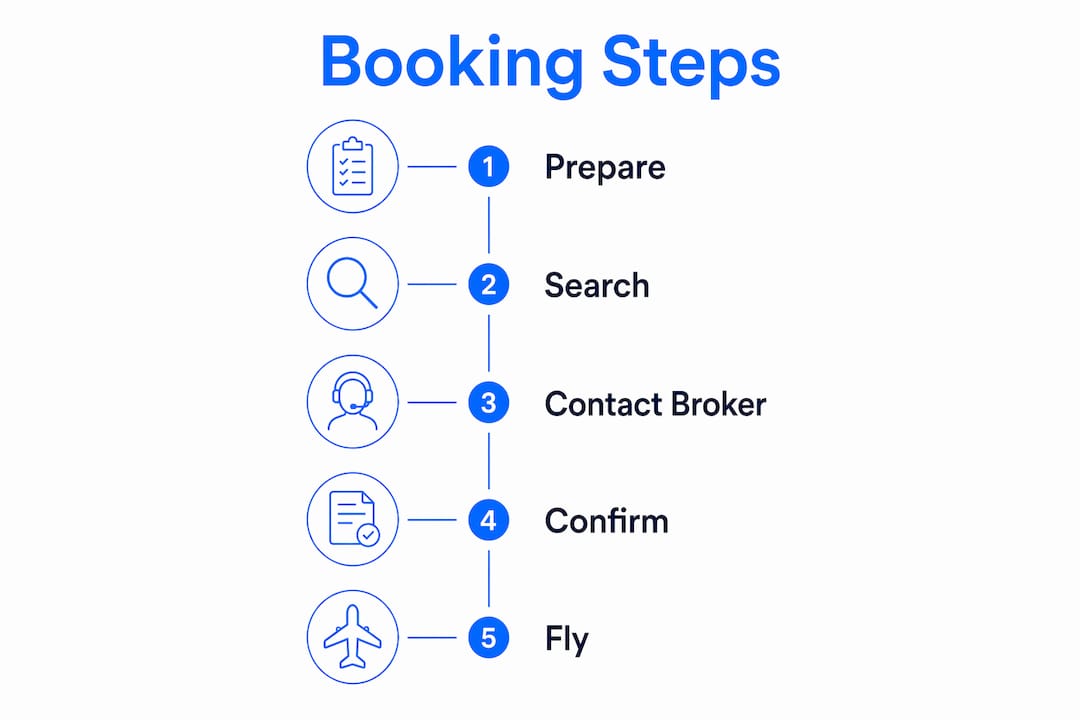
How do you find and book an empty leg flight, step by step?
The process from search to confirmed booking follows a clear sequence. Skipping steps costs you either money or the flight itself.
Set a flexible travel window. Choose a five to ten day range rather than a single date. The deepest discounts appear 48–72 hours before departure, so a wider window gives you more chances to catch peak savings.
Search multiple platforms at once. Open your aggregator of choice, check the direct listing pages for operators you have used before, and scan any active social media channels where operators post last-minute deals. More sources mean more inventory.
Set route and price alerts immediately. Do not rely on manual searching alone. Configure automated notifications for your preferred routes. Route alerts significantly increase the chance of capturing a deal before it sells out.
Request a quote within minutes of finding a match. Empty legs are not e-commerce. You submit a request, a broker or operator responds, and you confirm. That back-and-forth takes time. The faster you initiate, the better your position. Have your passenger details and payment method ready before you click “request.”
Read the cancellation and rescheduling policy before you confirm. Empty legs are frequently canceled when the originating charter changes. A reputable operator will disclose this risk upfront. Know whether you get a full refund, a credit, or nothing if the flight is pulled.
Pro Tip: When you find a listing that almost fits your schedule, call the broker directly and ask about a 12–24 hour adjustment. Operators sometimes allow minor scheduling shifts that never appear in the public listing. This works best on routes with flexible originating charters.
For more on timing strategies, the last-minute empty leg guide from Bluebirdjets covers demand patterns in detail.
What are the most common mistakes when booking empty legs?
Most failed empty leg bookings trace back to the same handful of errors. Knowing them in advance removes the friction.
Prime empty leg routes sell out in 1–4 hours after listing. Waiting until the next morning to respond to an alert you received at 9:00 PM is almost always too late. Speed is not optional on high-demand corridors like New York to Miami or Los Angeles to Las Vegas.
Hidden fees are the second most common problem. The listed price rarely includes landing fees, overnight crew charges, or fuel surcharges on longer routes. Always request a fully itemized quote before confirming. Itemized quotes protect you from cost surprises that can erase the savings you thought you were getting.
The third mistake is ignoring nearby airports. Being open to airports 60–90 minutes away from your preferred departure point can double or triple the number of matching routes. A traveler locked to one specific airport will miss the majority of available deals in their region.
Common pitfalls to avoid:
Waiting more than 30 minutes to respond to a promising alert
Accepting a verbal price without a written itemized breakdown
Ignoring the cancellation policy because the price looks good
Searching only one platform and assuming you have seen all available inventory
Booking for a fixed headcount without confirming the aircraft’s maximum capacity
Best practices for empty leg booking go deeper on each of these, including how to vet operators before you hand over payment.
Pro Tip: Contact brokers directly and ask about unpublished deals. Exclusive empty leg offers frequently exist outside public listings because operators prefer to fill seats through trusted broker relationships before posting publicly.
How do you maximize value from an empty leg booking?
Price is only one dimension of the value equation. The experience advantages of private aviation add real, measurable time savings that commercial travel cannot match.
Empty legs still cost tens of thousands of dollars in many cases, but they include access to Fixed Base Operators (FBOs) and private terminals. FBOs eliminate the standard commercial airport experience entirely: no TSA lines, no gate crowds, no 90-minute early arrival requirement. You arrive 15 minutes before departure and board directly. On a short-haul route, that time savings alone can justify a significant portion of the price difference versus commercial.
Shared bookings are the most underused tool for reducing per-person costs. A $10,000 empty leg split among five travelers costs $2,000 per person. On a route like New York to Miami, that figure competes directly with premium commercial options when you factor in the time saved and the experience delivered. Coordinate with a small group before you search, and you can target routes that would otherwise feel out of reach.
Choosing larger hub airports within driving distance also improves your odds. Major FBO hubs generate more repositioning traffic, which means more empty legs originating from or terminating at those locations. A traveler in a smaller market who drives 75 minutes to a regional hub will consistently find better availability and sharper pricing than one who insists on their nearest airport.
Travel type | Typical cost range | Check-in time | Terminal experience |
|---|---|---|---|
Empty leg (solo) | $6,000–$20,000+ | 15 minutes | Private FBO terminal |
Empty leg (shared, 5 pax) | $1,200–$4,000 per person | 15 minutes | Private FBO terminal |
Business class commercial | $800–$3,500 per person | 90+ minutes | Commercial terminal |
The table above reflects general market ranges, not guaranteed pricing. Actual empty leg costs vary by route, aircraft type, and timing.
Building a relationship with one or two brokers you trust pays dividends over time. Brokers with strong operator networks surface deals before they hit public platforms. They also know your preferences and can flag routes that match your travel patterns without you having to search manually every day. For a deeper look at how availability is determined, the empty leg availability guide from Bluebirdjets explains the logistics behind route listings.
Key Takeaways
Finding and booking empty leg flights rewards travelers who prepare in advance, move fast, and stay flexible on dates and airports.
Point | Details |
|---|---|
Savings are real but conditional | Empty legs cost 30–75% less than full charters, but only for travelers with flexible schedules. |
Speed determines success | Top routes sell out in 1–4 hours; set alerts on multiple platforms before you need a flight. |
Hidden fees erode savings | Always request a fully itemized quote before confirming any empty leg booking. |
Nearby airports expand options | Being open to airports 60–90 minutes away significantly increases available routes and better pricing. |
Shared bookings cut costs sharply | Splitting an empty leg among five travelers can bring per-person costs close to premium commercial fares. |
Why flexibility changed how I think about private travel
The first time I booked an empty leg, I almost missed it because I was too attached to a specific departure airport. The deal was 40 minutes away from where I wanted to leave, and I hesitated. By the time I decided to go for it, the flight was gone. That lesson cost me nothing financially, but it reshaped how I approach every search since.
The travelers I have seen get the most from empty legs are not the wealthiest ones. They are the most prepared. They have alerts running, they know their passenger count, and they treat a quote request like a reflex rather than a deliberation. The flexibility mindset is not just a tip. It is the entire strategy.
One thing most articles get wrong is framing empty legs as purely a budget product. They are not. The FBO experience, the 15-minute check-in, the ability to land at smaller airports closer to your actual destination: these are genuine advantages that add up on every trip. The price discount is the headline, but the time savings and convenience are what keep people coming back.
If you are serious about making empty legs a regular part of how you travel, the work happens before the deal appears. Build your search habits now, and the right flight will find you.
— Nick
Bluebirdjets: your access to active empty leg routes
Bluebirdjets offers a membership that gives you unlimited access to every empty leg listed on the platform, with real-time alerts the moment a new route goes live. That speed advantage matters most on high-demand corridors where flights disappear in hours.
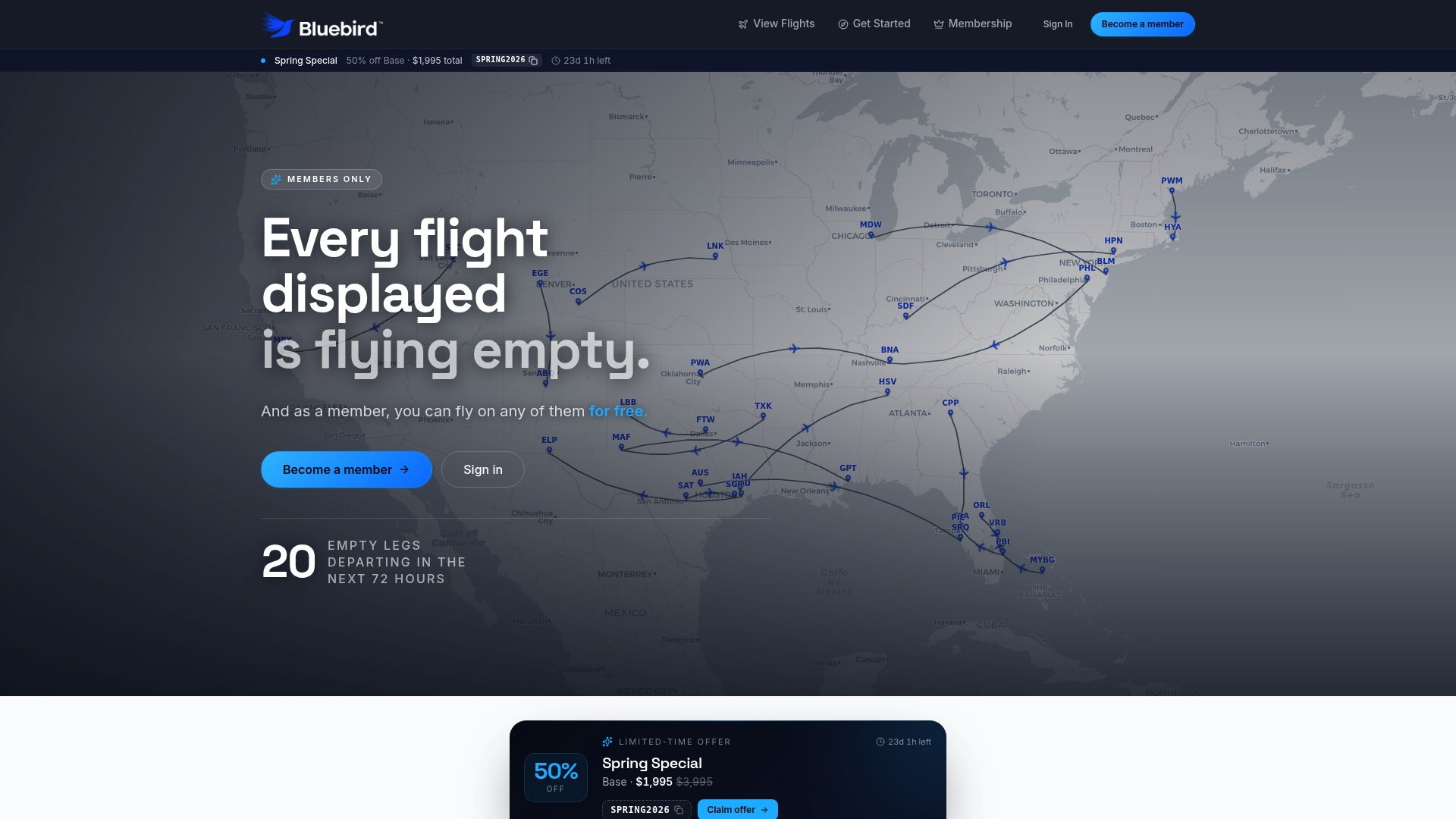
Active listings are updated continuously. Current routes include flights like the Aspen to Eagle leg on June 12 and the Eagle to Jackson leg on June 25, both available for spontaneous booking right now. Browse the full empty leg flight listings to see what is available on your preferred routes. For travelers who fly more than a few times a year, the Bluebirdjets membership pays for itself quickly in both savings and access.
FAQ
What is an empty leg flight?
An empty leg flight is a one-way repositioning trip a private jet must fly without passengers to reach its next charter booking. These flights are sold at a discount, typically 30–75% below full charter price.
How far in advance are empty legs listed?
Most empty legs are listed 2–14 days before departure, with the deepest discounts appearing in the 48–72 hour window before the flight.
How fast do empty leg deals sell out?
Popular routes sell out in 1–4 hours after listing. Setting automated alerts on multiple platforms is the most reliable way to catch deals before they disappear.
Are there hidden costs in empty leg pricing?
Yes. Landing fees, overnight crew charges, and fuel surcharges can add significant cost to the listed price. Always request a fully itemized quote before confirming a booking.
Can I change the date or route on an empty leg flight?
The route is fixed. However, operators sometimes allow minor scheduling adjustments of 12–24 hours when asked directly. Contact the broker or operator as soon as you find a listing that almost fits your schedule.