How Empty Leg Alerts Work: A 2026 Travel Guide

Empty leg alerts are automated notifications that tell you the moment a private jet repositioning flight matches your saved travel preferences, giving you a direct path to private aviation at a fraction of the standard charter price. Understanding how empty leg alerts work is the fastest way to stop missing deals that disappear within hours. These alerts filter by route, date window, nearby airports, and aircraft type, then fire the instant a match appears in an operator’s inventory. Bluebirdjets built its membership model around exactly this mechanic, giving travelers unlimited access to empty leg listings the moment they go live.
How do empty leg alert systems filter and notify flight matches?
An empty leg is a private jet flying without passengers because it needs to reposition after dropping off a charter client. The flight exists regardless of whether anyone books it, so operators list it at a steep discount to recover some operating cost. Alert systems sit on top of these listings and match them to your saved preferences in real time.
Alert filtering works by letting you save a preferred route, a date window, an aircraft category, and an airport radius. That radius detail matters more than most travelers realize. Setting a search to include airports within a 60km radius of your origin or destination significantly increases availability and reduces the number of deals you miss because a flight departs from a nearby field rather than your primary airport.

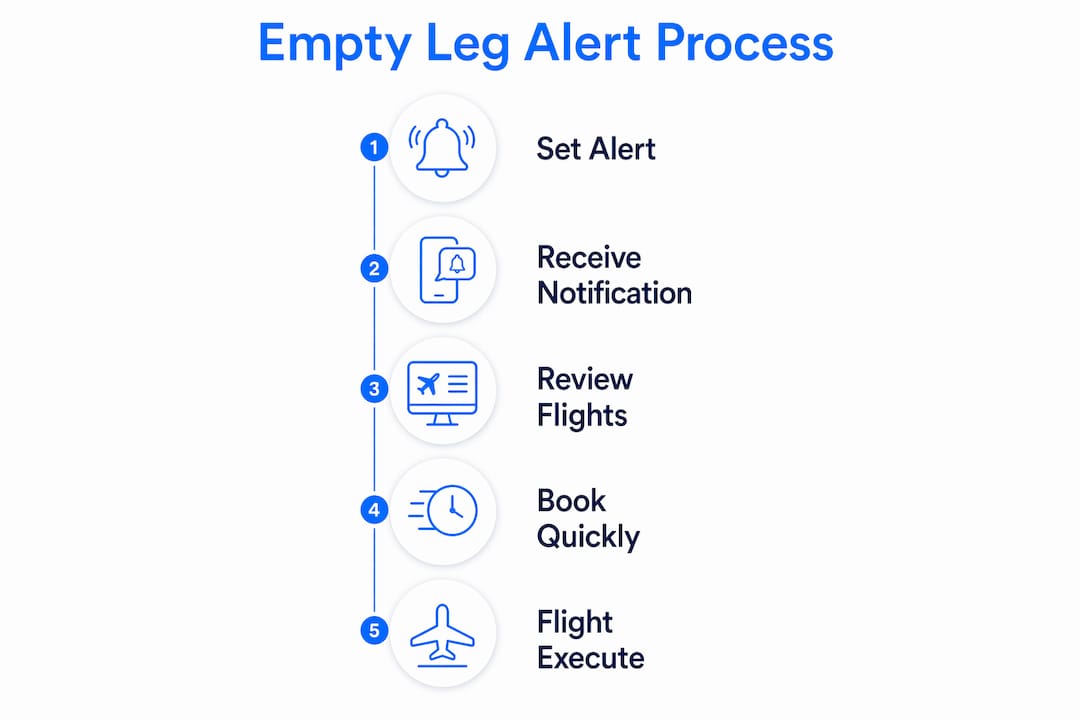
Delivery method determines how fast you can act. Push notifications reach travelers in seconds, while emails can be batched and delayed by hours. On a popular route where a listing sells within two hours of going live, that gap between push and email is the difference between booking and missing out entirely. Enable push notifications on any platform you use for empty leg flight alerts.
Alert fatigue is a real problem. Setting preferences too broadly floods your inbox with irrelevant flights and trains you to ignore notifications. The fix is specificity: define two or three core routes you genuinely want, set realistic date windows, and let the system work precisely. You can always add a second alert for a looser search if the first one produces too few matches.
Save multiple overlapping alerts across different route pairs
Include nearby airports within a reasonable radius for each alert
Choose push notifications over email wherever the platform allows
Set aircraft category filters only if you have a genuine preference, since filtering too tightly reduces matches
Pro Tip: Run separate alerts for each direction of a route. A New York to Miami alert and a Miami to New York alert are two different inventory pools, and both can surface deals worth booking.
When are empty leg flights listed and how quickly do they sell?
Timing is the defining constraint of the empty leg market. Most empty legs are listed within 2–14 days of departure, with a large share appearing within 7 days. That short window means travelers who wait until they feel a travel need before setting up alerts will consistently arrive too late.
The steepest discounts appear closest to departure. Best deals often surface 48–72 hours before the flight, when operators are most motivated to fill the seat rather than fly empty. The tradeoff is that the booking window is also shortest at that point.
Time before departure | Typical listing activity | Booking window |
|---|---|---|
14+ days | Occasional early listings | Moderate, a few days |
7–13 days | Increasing volume | 24–72 hours |
2–6 days | Peak listing activity | Hours to 1 day |
48–72 hours | Deepest discounts appear | Often under 12 hours |
Under 24 hours | Last-chance listings | Minutes to hours |
Popular routes and in-demand aircraft types sell fastest. A light jet on a common leisure route like Los Angeles to Las Vegas can disappear within hours of listing. A heavy jet on a less-traveled route may stay available for a day or two.
“Empty leg availability is confirmed only after the underlying charter booking finalizes. Alerts compensate for this information delay by notifying travelers the moment flights become available.” — AeroCorner
The practical implication is clear: set your alerts before you have a confirmed travel need, not after. Travelers who treat alert setup as a prerequisite to flexible travel planning capture far more deals than those who search reactively.
What are the best practices for setting up and responding to alerts?
Effective empty leg alert setup is less about technology and more about preparation. The alert gets you the information. What you do in the next 30 minutes determines whether you book the flight.
Set alerts before you need them. Configure routes and date windows at least two weeks before any potential travel period. Setting alerts proactively is consistently more effective because the best deals move before most travelers even start searching.
Include nearby airports. For every alert, add alternative departure and arrival airports within a reasonable driving distance. A flight from a regional airport 45 minutes away can still save you thousands compared to a standard charter.
Enable push notifications. Review every platform’s notification settings and switch from email to push wherever possible. Speed is the primary competitive advantage in this market.
Prepare your booking information in advance. Have your passenger count, preferred dates, and any special requirements ready before an alert arrives. Immediate inquiry with prepared information reduces the hesitation that causes most missed bookings.
Use multiple platforms simultaneously. Operator inventories differ by network. Running overlapping alerts across multiple apps diversifies your exposure and increases the probability of finding a match. Check the Bluebirdjets flights platform as a primary source, then supplement with additional alert sources.
Respond before you are certain. Submit an inquiry the moment you see a promising alert, even if you have not confirmed every detail of your trip. You can ask questions during the inquiry process. Waiting until you are 100% ready is the most common reason travelers lose deals.
Review the listing details carefully. The booking flow typically shows aircraft type, pricing where available, and departure details before you submit a request. Read these before inquiring so your questions are specific.
Pro Tip: Balance alert breadth carefully. Three well-defined alerts on routes you genuinely want will outperform ten broad alerts that generate noise. Quality of match beats quantity of notifications every time.
The fixed schedule of an empty leg is a constraint worth understanding before you book. The departure time and route are set by the operator’s repositioning need, not your preference. Alert systems match your criteria to fixed schedules rather than creating flexible options, so the traveler who adapts wins more deals than the traveler who negotiates.
What risks and limitations should travelers understand?
Empty leg alerts deliver real value, but they come with constraints that every traveler should understand before committing to a booking.
The most significant risk is cancellation. Empty leg flights can be canceled if the primary charter client changes plans, sometimes with only hours of notice. Unlike commercial aviation, there is no regulatory framework requiring compensation for passengers on a canceled empty leg. The flight exists because of someone else’s booking, and it disappears for the same reason.
Alert matches do not guarantee a seat. A listing can be removed between the moment you receive a notification and the moment you complete your inquiry. Treat every alert as an opportunity to pursue, not a confirmed reservation.
Key limitations to keep in mind:
Departure times and routes are fixed by the operator, not negotiable
Aircraft substitutions can occur if the originally listed jet becomes unavailable
Cancellation terms vary by operator and must be read before payment
Travelers with rigid schedules will find empty legs frustrating rather than useful
Overly broad alert settings create noise that reduces your responsiveness to genuine matches
The travelers who benefit most from empty leg deals share one trait: schedule flexibility. If you can adapt your plans when a cancellation happens or when a great deal appears on a route you had not planned, empty legs work well for you. If your schedule is fixed, the risks outweigh the savings.
Read the contract cancellation and refund terms before every booking. Operators differ significantly on what they offer when a primary client changes plans. Some provide full refunds; others offer credits or partial returns. Knowing this before you pay protects you from unpleasant surprises.
Key takeaways
Empty leg alerts give travelers a speed advantage in a market where the best deals sell within hours of listing.
Point | Details |
|---|---|
Set alerts proactively | Configure route and date alerts before you have a confirmed travel need. |
Push beats email | Push notifications reach you in seconds; email delays cost bookings on fast-moving deals. |
Include nearby airports | A wider airport radius increases match volume and reduces missed opportunities. |
Respond immediately | Prepare booking details in advance so you can inquire within minutes of receiving an alert. |
Understand cancellation risk | Empty legs can disappear if the primary charter client changes plans; always read contract terms. |
Why I think most travelers set up empty leg alerts the wrong way
Most travelers treat empty leg alerts like a passive subscription. They configure one route, leave email notifications on, and check their inbox when they feel like it. That approach almost never produces a booking.
The travelers I have seen actually land great deals treat alert setup as an active system they maintain. They run alerts on three or four routes they are genuinely open to flying. They have push notifications enabled. They keep a notes app with their passenger count, preferred dates, and a short list of questions ready to paste into an inquiry form. When an alert fires, they respond in under 15 minutes.
Speed is not just an advantage in this market. It is the market. A Gulfstream G450 on a Miami to New York route at 60% off standard charter pricing will not wait for you to finish a meeting. The deal goes to whoever responds first with a clear, complete inquiry.
The other mistake I see constantly is treating every alert match as a guaranteed flight. It is not. The underlying charter client is the real customer. If their plans change, your listing evaporates. Travelers who build backup plans and read cancellation terms before paying are the ones who stay calm when that happens. Everyone else is caught off guard.
The technology behind empty leg notification alerts has improved significantly. Platforms now offer flexible schedule tools and real-time inventory feeds that were not available a few years ago. Use them. But the technology only works if the human on the other end is ready to act.
— Nick
Bluebirdjets and empty leg access
Bluebirdjets offers a membership that gives you unlimited access to empty leg listings on its platform, with real-time notifications the moment a flight matches your saved preferences.
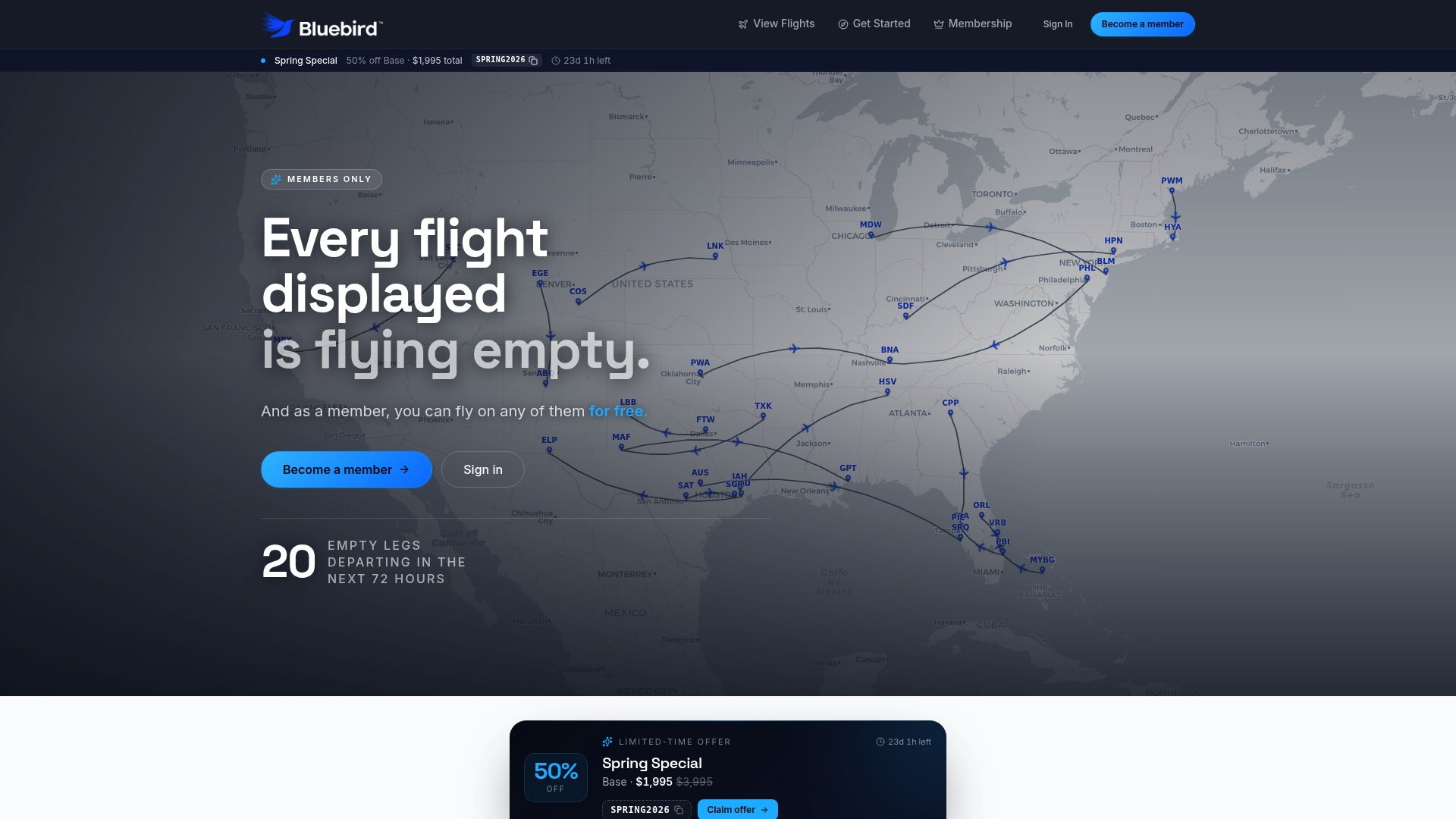
Members set customized alerts by route, date range, and aircraft type, then receive push notifications as matching flights go live. The platform connects directly to operator inventory, so listings are current and bookable without a third-party delay. For travelers who want private jet access without paying full charter rates, the membership model makes consistent deal capture realistic rather than occasional. Browse current available flights at Bluebirdjets flights and set your first alert today.
FAQ
What is an empty leg flight?
An empty leg is a private jet flying without passengers to reposition after completing a charter trip. Operators list these flights at reduced prices to offset operating costs.
How do empty leg alerts work?
Empty leg alerts notify you when a repositioning flight matches your saved route, date window, and aircraft preferences. Platforms deliver these notifications via push or email, with push being significantly faster.
How quickly do empty leg deals sell?
Popular routes and in-demand aircraft can sell within hours of listing. Deals appearing 48–72 hours before departure move fastest and carry the deepest discounts.
Can an empty leg flight be canceled after booking?
Yes. If the primary charter client changes or cancels their trip, the empty leg can be removed with little notice and no regulatory compensation requirement. Always read the operator’s cancellation terms before paying.
How many alerts should I set up?
Three to five well-defined alerts on routes you genuinely want to fly produce better results than a large number of broad alerts. Specificity reduces notification fatigue and keeps you responsive to real opportunities.