Open-Jaw Flight Routing: What Every Traveler Should Know

Open-jaw flight routing is defined as a round-trip itinerary where you fly into one city but depart home from a different one, leaving a geographic gap you cover yourself. That gap is the “open jaw.” Unlike a standard round-trip, this structure lets you move through a region without retracing your steps. Booking platforms like Google Flights, Kayak, and Expedia all support this format through their multi-city search tools. For travelers planning multi-destination trips, understanding open-jaw routing is one of the most practical skills you can develop.
What is open-jaw flight routing, exactly?
An open-jaw itinerary is a round-trip ticket where the arrival and departure cities differ, and the traveler handles the gap between them. That gap, the “open jaw,” is not a missed connection. It is a planned segment you fill with a train, car rental, or bus. Think of it as a built-in road trip between two flight legs.
The term comes from the visual shape of the route on a map. A standard round-trip looks like a straight line back and forth. An open-jaw route looks like a jaw with one side open. The concept is standard in the airline industry, and most major carriers price these tickets the same way they price round-trips.

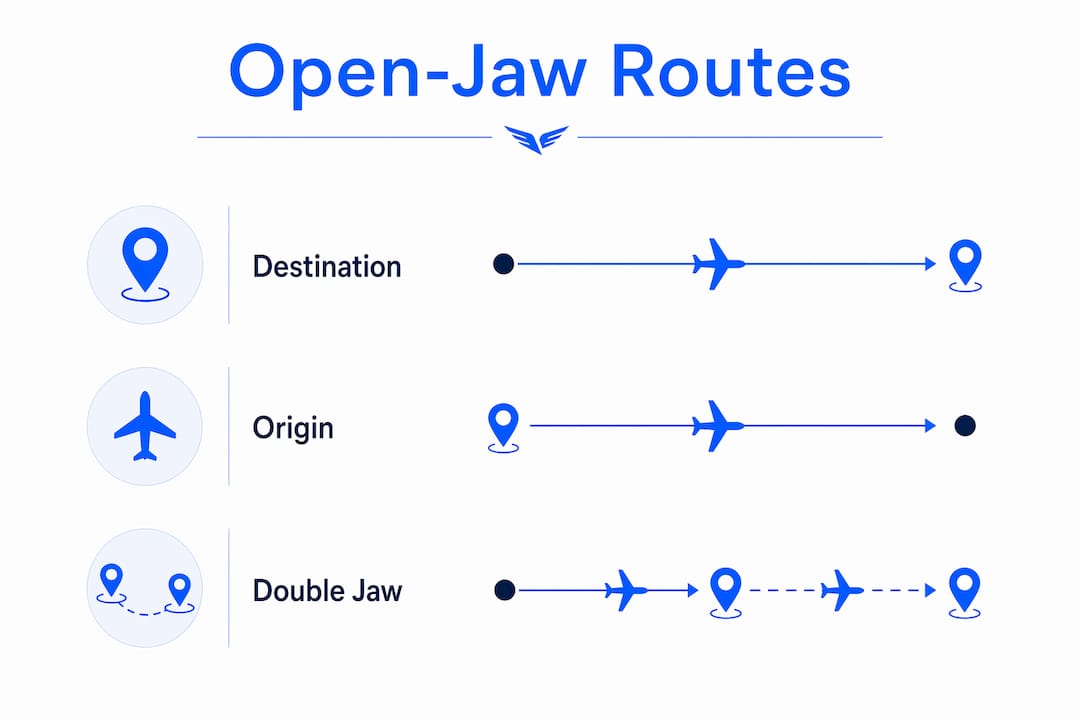
Three distinct configurations exist, and knowing which one fits your trip changes how you search and book.
Destination open jaw
A destination open jaw means you fly into one city at your destination but fly home from a different city in the same region. Example: you fly New York to Paris, travel overland through France, and fly home from Barcelona. New York is your single origin. Paris and Barcelona are the two destination cities.
Origin open jaw
An origin open jaw reverses the logic. You depart from one city at home and return to a different one. Example: you fly Los Angeles to Tokyo, then return from Tokyo to San Francisco. Tokyo is your single destination. Los Angeles and San Francisco are the two origin cities. This works well when you live between two airports or plan to drive between them.
Double open jaw
A double open jaw means both the origin and destination cities differ across the two flight legs. Example: you fly New York to Rome, travel through Italy, and fly from Milan back to Boston. No city repeats. This is the most flexible configuration and the one most useful for extended multi-country trips.
Pro Tip: When planning a double open jaw, sketch your route on a map first. The open segment should follow a logical geographic path, like a train corridor or a coastal drive, so the ground travel adds to the trip rather than eating into it.
Configuration | Departure | Arrival | Return Departure | Return Arrival |
|---|---|---|---|---|
Destination Open Jaw | New York | Paris | Barcelona | New York |
Origin Open Jaw | Los Angeles | Tokyo | Tokyo | San Francisco |
Double Open Jaw | New York | Rome | Milan | Boston |
How do you book open-jaw flights without overpaying?
The single biggest mistake travelers make is booking two separate one-way tickets instead of using a multi-city search. Booking as two one-ways is often more expensive internationally than using a multi-city round-trip booking option. Airlines price one-way tickets at a premium because they assume you are a last-minute or business traveler with less flexibility.
The correct method is to use the multi-city search function on any major booking platform. Google Flights, Kayak, and ITA Matrix all support this. You enter your outbound flight as Leg 1 and your return flight as Leg 2, with different cities on each end. The system prices the combination as a round-trip, which is almost always cheaper.
Here is the step-by-step process:
Open the multi-city search on your preferred booking platform.
Enter your outbound origin and destination as Leg 1.
Enter your return origin (different city) and your home airport as Leg 2.
Set your dates and search. Compare the combined price to two separate one-ways.
If prices seem high, use city airport codes instead of specific airport codes. Searching “NYC” instead of “JFK” surfaces results from LaGuardia and Newark too, which often reveals cheaper combinations.
Travel expert Scott Keyes has noted that open-jaw pricing parity with standard round-trips holds when you book through multi-city tools. The misconception that open-jaw tickets cost more comes almost entirely from travelers who price them as two separate one-ways.
Pro Tip: Always check the total price of your multi-city booking against a standard round-trip to your first destination. Sometimes the open-jaw version is actually cheaper because airlines compete harder on certain route combinations.
What are the real benefits of open-jaw flights?
The most direct benefit is time. Open-jaw flights save travel hours by eliminating the need to backtrack to your original arrival city. If you fly into Rome and want to end your trip in Paris, a standard round-trip forces you back to Rome for your flight home. An open-jaw lets you fly home from Paris directly. That can recover an entire travel day.
The second benefit is ground transportation savings. A train from Rome to Paris on Trenitalia or SNCF costs far less than an extra flight. You also get to see the countryside, which is the kind of travel experience no airport layover provides.
No backtracking: You move through a region in one direction instead of doubling back.
Lower ground costs: Trains, buses, and car rentals between open-jaw cities are often cheaper than an extra flight segment.
More destinations: You cover more ground on a single trip without adding flight legs.
Scenic ground travel: The open segment becomes an experience in itself. Experts suggest using high-speed trains or scenic drives to fill the gap.
Pricing parity: When booked correctly, open-jaw tickets match standard round-trip prices.
“The open portion of your itinerary is not a problem to solve. It is a feature. Use it to add a train journey, a coastal drive, or a ferry crossing that a purely air-based itinerary would never allow.”
The flexibility argument is especially strong for Europe and Southeast Asia, where dense rail and bus networks make ground travel between cities fast and affordable. A traveler flying into Bangkok and out of Singapore has dozens of overland options through Thailand, Malaysia, and the Malay Peninsula.
Open-jaw vs. stopovers vs. multi-city: what is the difference?
These three terms describe different itinerary structures, and confusing them leads to booking errors. Open-jaw flights differ from stopovers in one fundamental way: a stopover is a longer transit stay on the same continuous flight path, while an open jaw leaves a geographic gap that is not covered by any flight at all.
A stopover means your airline routes you through a hub city where you stay for more than 24 hours before continuing on the same ticket. Singapore Airlines famously offers free stopovers in Singapore on long-haul routes. You are still on one continuous itinerary. The airline handles the connection.
A multi-city itinerary is the broadest category. It covers any trip with more than two flight segments. An open-jaw is technically a type of multi-city trip, but the defining feature is the unflown gap between two of the cities. Passengers handle transportation between the open cities themselves, often by car or train.
Feature | Open-Jaw | Stopover | Multi-City |
|---|---|---|---|
Gap in flight legs | Yes, traveler covers it | No, airline covers it | Varies |
Booked as one ticket | Usually yes | Yes | Yes |
Cities visited | 3 or more | 3 or more | 3 or more |
Ground transport needed | Yes, between open cities | No | Sometimes |
Pricing vs. round-trip | Comparable | Sometimes extra fee | Higher |
Understanding this distinction matters most when you are using airline miles or points. Award tickets have specific rules about stopovers and open jaws. American Airlines AAdvantage, United MileagePlus, and Delta SkyMiles each treat these configurations differently, so reading the fare rules before booking with points is worth the extra ten minutes.
Key takeaways
Open-jaw flight routing is one of the most underused tools in travel planning, and booking it correctly through multi-city search keeps the cost in line with a standard round-trip.
Point | Details |
|---|---|
Three routing types | Destination, origin, and double open jaw each serve different trip structures. |
Book via multi-city search | Using multi-city tools avoids the one-way price premium and matches round-trip pricing. |
Time and cost savings | Eliminating backtracking saves travel hours and reduces ground transportation expenses. |
Open gap is a feature | Fill the unflown segment with trains, drives, or ferries to add depth to your trip. |
Not the same as a stopover | A stopover stays on one flight path; an open jaw leaves a gap the traveler covers independently. |
Why most travelers still miss this
I have watched travelers spend an extra $400 booking two one-ways for a trip they could have structured as a multi-city open jaw for the same price as a round-trip. The problem is not awareness. It is habit. Most people open a flight search, type in their home city and destination, and never consider that the return leg does not have to start where the outbound leg ended.
The open-jaw format rewards travelers who think about their trip as a route rather than a there-and-back. Once you start planning that way, you realize how many trips are better structured as open jaws. A week in Japan works beautifully as a fly-into-Tokyo, travel-south, fly-home-from-Osaka itinerary. A two-week Europe trip almost always benefits from entering one country and exiting another.
The one pitfall I see consistently is travelers who plan the open segment as an afterthought. They book the flights first and then realize the ground distance between their two cities is eight hours by train. Map the full route before you book anything. The flight availability dynamics on certain routes also shift seasonally, so checking both legs at the same time gives you a more accurate picture of total cost.
Private aviation adds another layer here. Empty leg flights, which are repositioning flights that would otherwise fly empty, often create natural open-jaw opportunities at a fraction of standard charter prices. If you are flying privately, the open-jaw structure is not just a convenience. It is often the most cost-efficient way to structure a multi-city trip.
— Nick
Plan your next multi-city trip with Bluebirdjets
Open-jaw routing is where private aviation genuinely shines. When you are not locked into commercial airline hubs, you can fly into any airport that fits your itinerary and depart from a completely different one without the routing constraints of scheduled service.
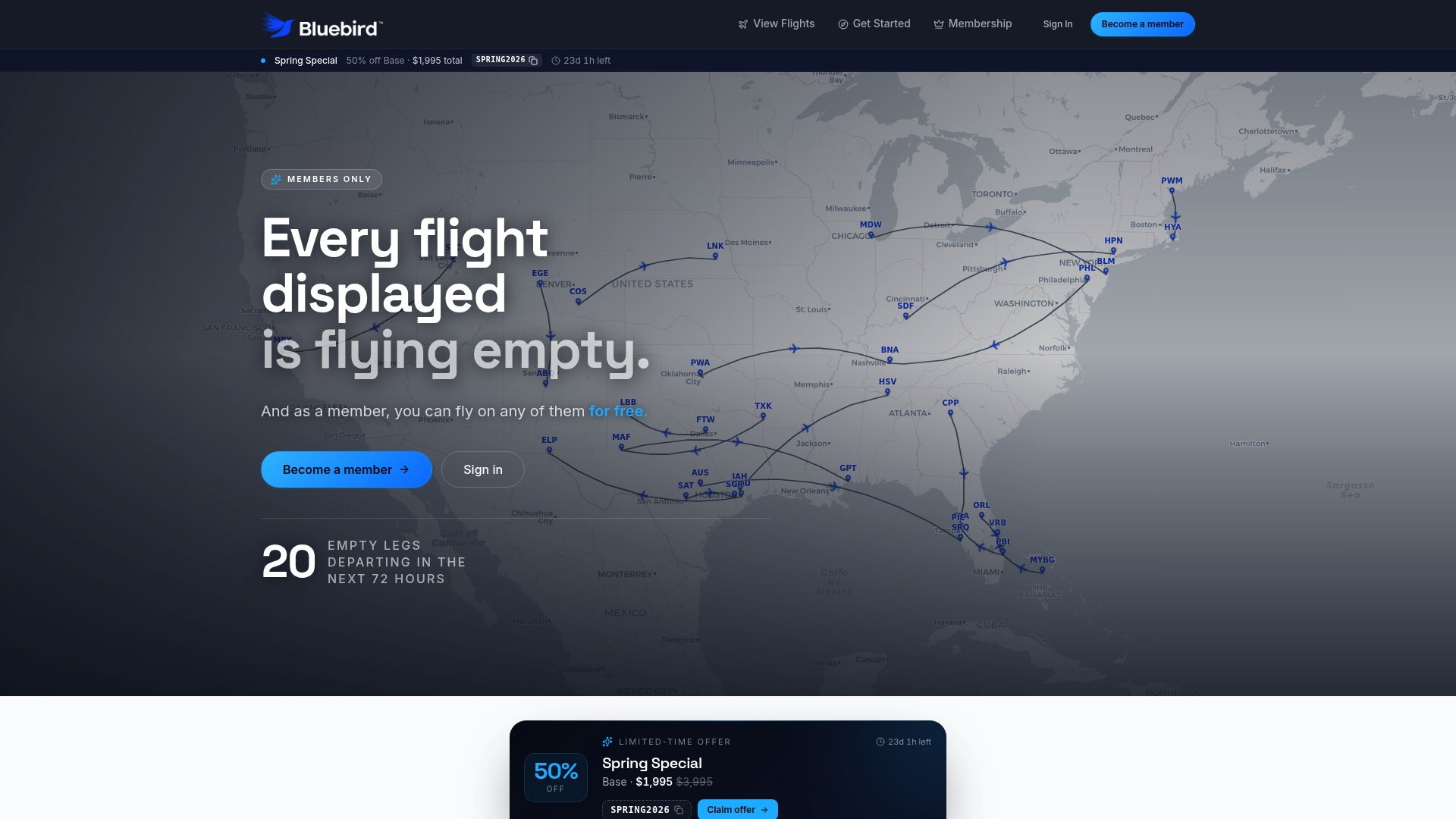
Bluebirdjets members get unlimited access to empty leg flights across the platform. Empty legs are repositioning flights that naturally create open-jaw opportunities. You fly one direction at a steep discount, cover the open segment by ground, and pick up another empty leg for the return. The Bluebirdjets membership is built for travelers who think in routes, not just destinations. If open-jaw itineraries are how you travel, this is the platform designed around that mindset.
FAQ
What is the open-jaw ticket definition in simple terms?
An open-jaw ticket is a round-trip flight where the arrival and departure cities are different, leaving a gap the traveler covers by ground transport. The airline industry treats it as a standard booking type.
How do open-jaw flights work when booking online?
Use the multi-city search function on platforms like Google Flights or Kayak, enter different cities for your outbound arrival and return departure, and the system prices the combination as a round-trip.
Are open-jaw flights more expensive than round-trips?
No. Travel expert Scott Keyes confirms that open-jaw pricing matches standard round-trips when booked through multi-city tools rather than as two separate one-way tickets.
What is the difference between an open jaw and a stopover?
A stopover keeps you on one continuous flight path with the airline handling the connection. An open jaw leaves a geographic gap with no flight covering it, and the traveler arranges their own ground transport between the two cities.
Can you book open-jaw flights with airline miles?
Yes, but the rules vary by program. American Airlines AAdvantage, United MileagePlus, and Delta SkyMiles each have specific policies on open-jaw award tickets, so reviewing the fare rules before redeeming points is the right move.