Empty Leg Private Jet Membership Tiers for Affluent Last Minute Flyers

Empty Leg Private Jet Membership Tiers for Affluent Last Minute Flyers
An empty-leg membership tier determines how fast you get access to discounted repositioning flights and how far up the queue you sit when a desirable route opens. For spontaneous, affluent flyers, a premium or priority tier is almost always the better fit because it grants faster alerts and higher booking placement when a Learjet 60 needs to reposition. The trade-off never disappears: you get pricing that beats charter by a wide margin, but no tier can promise a specific flight will exist on your date.
TL;DR:
- Priority and concierge tiers offer faster alerts, better queue positions, and higher guest allowances, which are crucial for spontaneous travelers who need timely access.
- Empty-leg flights typically post within one to two weeks of departure, with some appearing as early as 48 hours before, but cancellations remain a risk due to their dependent nature on underlying charters.
- Spending on a higher-tier membership can often be justified by savings on multiple trips, especially on last-minute routes that can undercut commercial premiums significantly.
- The main value lies in access speed and booking priority, not in guaranteed flight availability, which makes flexible planning and quick reactions essential.
- Always verify renewal, cancellation policies, and hidden fees such as upsell costs before committing to any membership tier.
Table of Contents
- What Are Private Jet Membership Tiers for Empty-Leg Access?
- How Do Membership Tiers Differ in Practice?
- Is a Membership Tier Actually Worth the Annual Fee?
- How Do You Choose the Right Tier for Your Travel Habits?
- How Reliable Is Empty-Leg Availability, Really?
- How Bluebird’s Tiers Line Up With What Actually Matters
- Why the “Guaranteed Access” Pitch Misses the Point
- Ready to See What’s Flying?
- Sources
- FAQ
What Are Private Jet Membership Tiers for Empty-Leg Access?
A private jet membership tier is a subscription level that controls how much priority, inventory access, and perk stacking you receive on published empty-leg flights. These are not jet cards. You are not buying guaranteed hours or a fractional slice of an aircraft. You are buying position in a queue for flights that already exist because an operator needs to move a Learjet 60 from one city to another anyway.
Most programs in this category structure themselves around three rough tiers, even when they use different branding:
- Entry or basic tier: lower annual fee, standard queue position, limited or delayed alerts on new inventory.
- Priority or premium tier: higher fee, front-of-queue booking, real-time alerts, larger guest allowance, and eligibility for paid upsells like skip-the-line placement.
- Concierge or top tier: everything in premium plus dedicated support for custom charter requests and often broader route or aircraft access.
An occasional flyer who takes two or three trips a year rarely needs more than the entry tier. Someone who wants to book a Friday flight on a Wednesday, bring five friends, and not lose the seat to another member usually needs the priority tier. Bluebird’s membership model was built around that second group.
How Do Membership Tiers Differ in Practice?
The differences between tiers show up in five places: fee, queue position, guest count, inventory visibility, and upsell access. Here is how that typically breaks down.
- Annual fee band. Entry tiers often require an annual fee. Priority and concierge tiers run higher, reflecting the added queue weight, alert speed, and opportunities for custom charter sourcing.
- Booking priority. Priority members generally get first crack at newly published legs, which matters because empty-leg pricing shifts as departure approaches and desirable routes can fill within hours of posting.
- Guest allowance. Entry tiers may cap guests at two or three; priority tiers often allow up to six, which changes the math entirely for a family or small group trip.
- Live inventory and alerts. Real-time aggregator platforms that display daily empty-leg inventory give priority members faster, more granular corridor alerts than entry members get.
- Skip-the-line and custom charter access. Paid upsells that jump you past other members in the queue, plus the ability to request a custom charter quote outside published inventory, are usually reserved for priority and concierge members.
Picture a Thursday afternoon when a light jet needs to reposition from Teterboro to Miami by Saturday. An entry-tier member sees the alert an hour after it posts. A priority-tier member saw it the moment it went live and already has a hold on the seat.
Pro Tip: If you fly on impulse more than twice a month, the fee difference between entry and priority tiers usually pays for itself in the flights you would otherwise miss by seeing alerts late.
Is a Membership Tier Actually Worth the Annual Fee?
The math starts with the discount. Operators list empty legs because any revenue offsets the cost of repositioning an aircraft that’s flying anyway, which is why discounts are commonly significant off a comparable one-way charter. That gap is the entire value proposition of membership.
Run the numbers plainly. If a typical empty leg saves you several thousand dollars versus booking that same route as a full charter, and your priority-tier membership costs a set annual fee, you likely break even in two to three trips. Flying multiple times a year can make the membership fee modest relative to savings.
On certain short routes, empty-leg pricing can undercut premium commercial fares entirely on some routes, especially when splitting the cost across a full cabin of guests.
Before you sign anything, verify these:
- Whether the annual fee auto-renews and what the cancellation window looks like.
- Whether “unlimited access” excludes certain aircraft categories or blackout routes.
- What the skip-the-line upsell costs per flight, since that’s a recurring cost layered on top of the membership.
- Whether custom charter quotes carry a booking fee separate from the flight cost itself.
For a deeper breakdown of how the discount economics actually work, the pricing logic behind empty legs is worth a read before you commit to a tier.
How Do You Choose the Right Tier for Your Travel Habits?
Start with an honest count of how often you actually fly on short notice. A checklist helps more than a gut feeling here.
- Frequency: fewer than three trips a year points to entry; six or more points hard toward priority.
- Schedule certainty needed: if a missed date ruins the trip, empty-leg membership at any tier is the wrong product, full stop.
- Typical party size: a guest allowance of six versus two changes which tier actually fits your real trips, not your average one.
- Common routes: dense corridors (Northeast to Florida, for instance) generate far more inventory than thin regional routes.
- Price sensitivity per flight: if the skip-the-line fee changes your booking decision, the priority tier’s included priority is worth more than the fee suggests.
When you talk to a provider, ask about queue rules directly: how ties are broken, how often alerts refresh, and what the refund terms are if a leg cancels before you fly. Ask for operator verification and don’t accept a vague answer.
Walk away from any program that won’t show you sample inventory before you pay, hides fees behind a sales call, or gives evasive answers about cancellation history.
Pro Tip: Ask specifically how many legs on your top three routes were published in the last 90 days. A provider that can’t answer that in real numbers probably doesn’t have the volume to make your tier worthwhile.
How Reliable Is Empty-Leg Availability, Really?
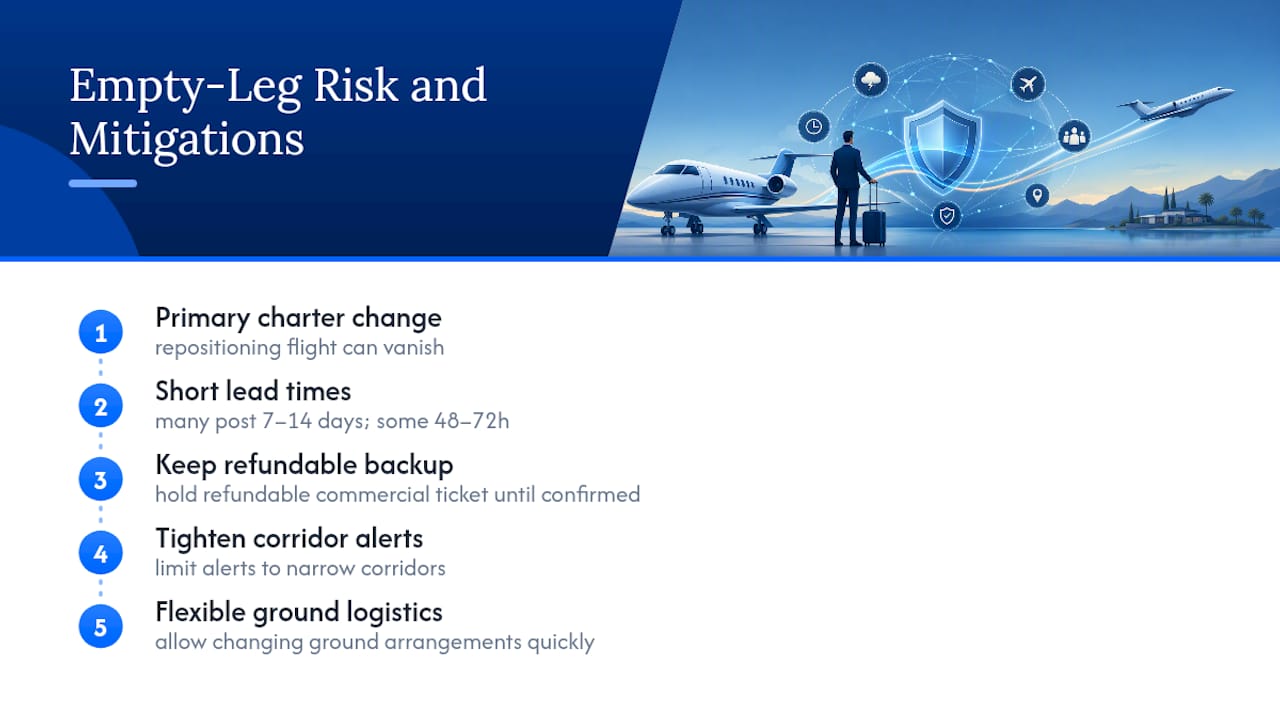
Cancellation risk is built into the product, not a flaw in how any single membership operates. An empty leg only exists because a primary charter created it, and if that charter changes, the repositioning flight can vanish with no obligation on the operator’s part to rebook you.
Lead times run short by nature. Many legs post within seven to fourteen days of departure, and a meaningful share appear inside 48 to 72 hours, sometimes same day. That’s the appeal for spontaneous flyers and the risk in the same breath.
The practical fix isn’t complicated: keep a refundable commercial backup until your flight is confirmed wheels up, tune your corridor alerts tightly rather than broadly, and keep ground logistics flexible enough to absorb a last-minute change. None of that eliminates the risk. It just keeps a canceled leg from wrecking your week.
How Bluebird’s Tiers Line Up With What Actually Matters
Membership programs for empty-leg flights generally include unlimited access to published empty legs on operator-owned Learjet 60 aircraft, live inventory that updates daily, and queue-based priority booking rather than a first-come free-for-all.
The priority profile this guide recommends for spontaneous, affluent flyers generally aligns with higher-fee tiers offered by providers: faster queue position, the ability to bring more guests per flight, and access to paid upsells like Skip-the-Line placement when a specific leg matters enough to jump ahead. Members who need something outside published inventory can request a custom charter quote rather than settle for available options that week.
Author Nick has covered the mechanics of this model in detail on Bluebird’s blog, where flight examples and member scenarios get broken down route by route.
Why the “Guaranteed Access” Pitch Misses the Point
Most marketing around private jet memberships oversells certainty. It shouldn’t. The honest way to think about an empty-leg tier is as a speed and access upgrade, not a booking guarantee. Nobody who sells this product can promise a flight will exist on your date, and any provider implying otherwise is setting you up for disappointment.
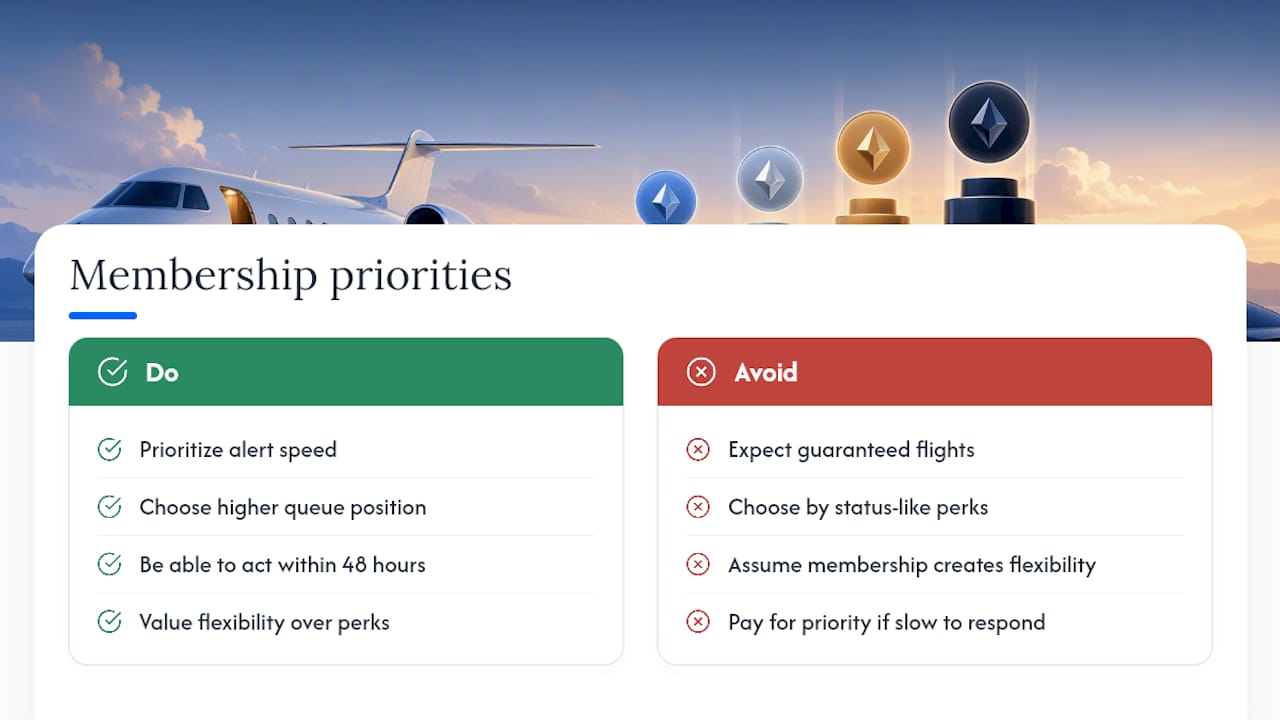
What the conventional advice gets wrong is treating tier selection like a loyalty program decision, comparing perks the way you’d compare airline status. That’s the wrong lens. The right question is narrower: how fast do you see new inventory, and how far up the queue do you sit when you see it? Everything else, guest counts, custom charter access, concierge touches, matters less than those two mechanics.
If you prioritize one thing, prioritize alert speed paired with genuine flexibility on your own end. A member who can fly on 48 hours’ notice and reacts fast to an alert gets far more value from any tier than someone paying for priority booking but still needing three weeks to clear their calendar. The membership doesn’t create flexibility. It rewards flexibility you already have.
— Nick
Ready to See What’s Flying?
Bluebird’s advantage over piecing together one-off empty-leg purchases is simple: you stop hunting broker sites and start seeing everything in one place, ranked by your queue position, updated daily.
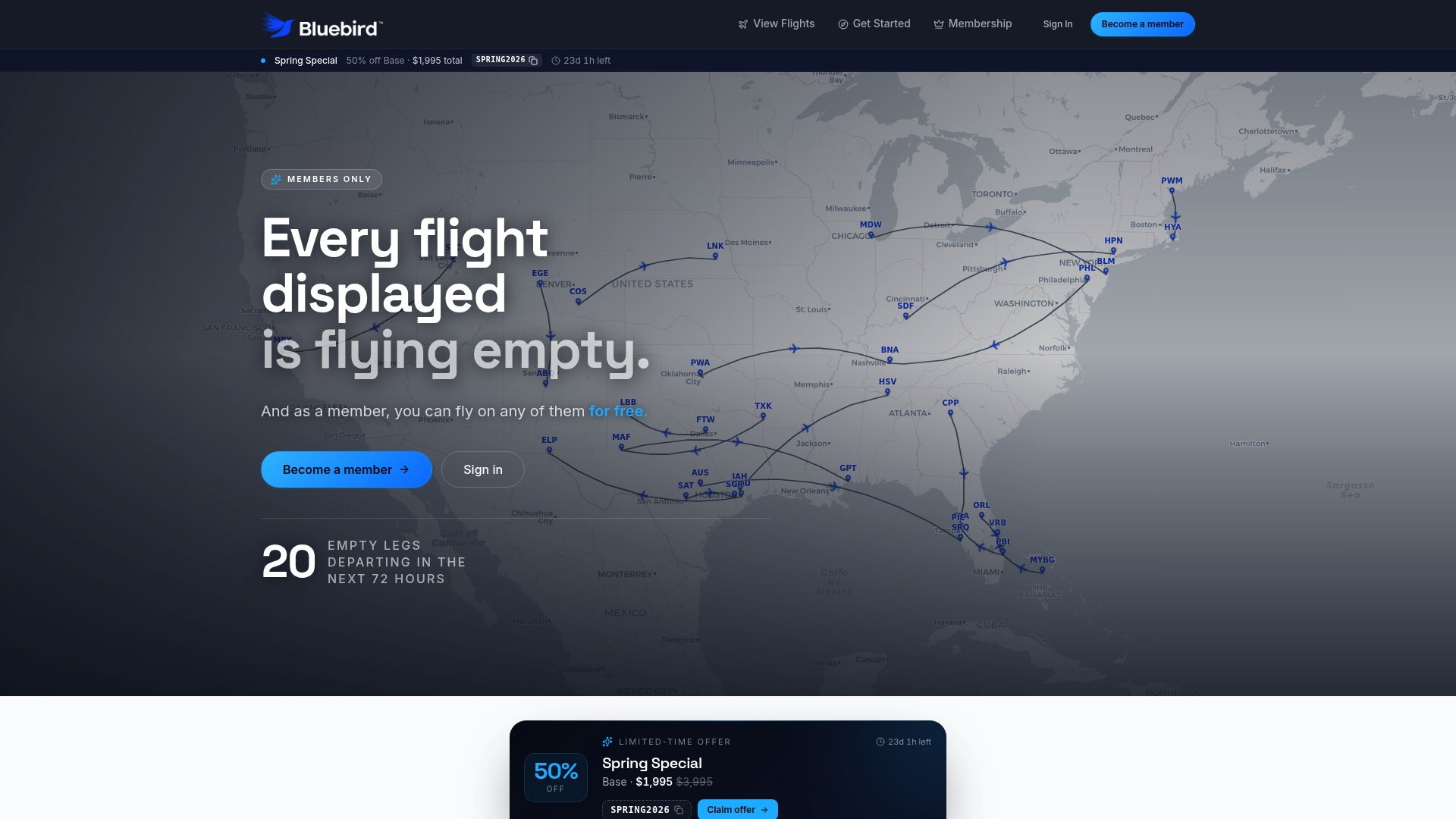
Start by checking current live inventory to get a feel for what’s actually posting on your routes this week. From there, compare tier details on the membership page and decide whether the priority tier’s faster alerts and six-guest allowance fit how you actually travel. If a specific date matters more than the discount, the Skip-the-Line upsell exists for exactly that moment. Every empty leg trades a lower price for some uncertainty about timing, and the right tier is the one that matches how much uncertainty you can actually live with. When you’re ready, sign up for membership and start watching the board.
Sources
- Empty leg flights: how they work (The Points Guy)
- Private jet empty legs guide (AeroCorner)
- Why empty leg flights exist and how operators price them (Private Jet Insider)
- Empty leg flights: how they work and how to book (Peak Aviation Solutions)
FAQ
How Far in Advance Do Empty Legs Usually Appear?
Many empty legs post within seven to fourteen days of departure, and a sizable share show up within 48 to 72 hours, with some appearing the same day.
Can an Empty-Leg Flight Get Canceled After I Book It?
Yes. Since the flight depends on an underlying charter, a change to that charter can cancel the repositioning leg with no obligation for the operator to rebook you.
How Many Guests Can I Bring on an Empty-Leg Flight?
It depends on the tier and aircraft, but premium tiers, including Bluebird’s, often allow up to six guests per flight.
Which Tier Is Best for a Spontaneous Occasional Flyer?
A priority or premium tier suits spontaneous flyers best because faster alerts and higher queue position matter more than any other feature when inventory can disappear within hours.
Are Membership Fees Refundable if I Don’t Fly?
Refund and cancellation terms vary by provider, so confirm the renewal window and cancellation policy before signing up rather than assuming a standard refund exists.