Affluent U.S. Flyers: Private Jet Fuel Surcharges Can Add $3,600

Affluent U.S. Flyers: Private Jet Fuel Surcharges Can Add $3,600
A fuel surcharge is an extra, benchmark-tied line item that private jet operators add to pass rising jet-fuel costs on to the customer. It can run a few thousand dollars on a short hop and climb into five figures on a long-haul mission. Before you book, ask for the all-in total and check the contract’s trigger price.
TL;DR:
- Fuel surcharges vary significantly depending on the benchmark price, trigger point, aircraft type, and route specifics, potentially adding thousands of dollars to a trip.
- The calculation involves comparing the current market fuel price to the trigger price, multiplying the delta by fuel burn and flight hours, then adjusting with an uplift factor and additional fees.
- Surcharge amounts can differ widely between similar trips due to aircraft size, route length, fuel stop locations, and fuel pricing timing.
- On-demand charters usually add surcharges directly to the invoice, but long-term memberships with fixed or predictable rates can mitigate these fluctuations.
- Always request detailed contract terms, including benchmark source, trigger price, reset frequency, and caps, to avoid surprises and consider using fuel caps or fixed-price agreements for cost certainty.
Table of Contents
- What is a private jet fuel surcharge?
- How operators calculate the surcharge on your quote
- What makes the surcharge bigger or smaller between trips
- Who actually pays: charter, jet cards, and fractional contracts
- How to budget for surcharges and protect yourself
- Where Bluebird Jets’ membership model fits into fuel exposure
- What I’d ask before signing any charter quote
- An alternative for flyers who want fewer fuel surprises
- Sources
- FAQ
What is a private jet fuel surcharge?
A fuel surcharge is a variable fee layered on top of the base charter rate whenever jet-fuel prices move past a set benchmark. Operators pick a reference price, often a spot or wholesale index, and compare it against a trigger point written into the charter agreement or jet card contract. When the benchmark price crosses that trigger, the surcharge kicks in and scales with how much fuel the trip burns.
Operators use surcharges because jet fuel is volatile and most charter companies cannot hedge every gallon months in advance. A sudden spike in crude oil or refining costs can erase a thin margin on a single flight, so the surcharge shifts that risk to the customer rather than the operator absorbing it outright.
This is different from a fuel excise tax, which is a statutory federal charge collected on aviation fuel and governed by IRS Publication 510. A surcharge is a private, contractual fee that varies by provider and market conditions. The tax is fixed by law and applies regardless of who you fly with.
- A surcharge is set by the operator or broker and tied to a market benchmark.
- An excise tax is a federal charge with rates defined in IRS guidance, not negotiable per trip.
- Surcharges can appear, disappear, or change size month to month; taxes stay structurally consistent.
How operators calculate the surcharge on your quote
The math behind a fuel surcharge follows a repeatable formula, even when operators dress it up differently on an invoice.
- Identify the benchmark price the operator uses, often a regional spot series like Gulf Coast kerosene-type jet fuel.
- Compare that benchmark to the trigger price written into your contract or jet card terms.
- Calculate the price delta per gallon between the current benchmark and the trigger.
- Multiply that delta by the aircraft’s fuel burn rate in gallons per hour, then by flight hours, then by an uplift factor that accounts for reserves and taxiing.
- Add or net out any into-plane fees and applicable excise taxes charged separately at the airport.
The formula in plain terms: surcharge equals fuel burn times flight hours times the price delta, adjusted by an uplift factor, plus or minus into-plane fees and taxes.
The EIA’s Gulf Coast kerosene-type jet-fuel spot series reported varied monthly values across the first several months of 2026, illustrating the volatility in fuel prices. EIA petroleum data shows how much that single input can swing, which is why the benchmark an operator chooses matters as much as the math itself.
Take a 1.5-hour light-jet trip burning about 150 gallons per hour, so 225 gallons total; for a detailed cost estimation, consider using this private-jet charter cost calculator. If the benchmark sits $1.00 above the contract’s trigger price, the raw surcharge is $225, before uplift adjustments or into-plane fees. Now take an 8-hour heavy-jet mission burning 450 gallons per hour, or 3,600 gallons total. The same $1.00 delta produces a $3,600 surcharge, and that number climbs quickly if the benchmark gap widens or the aircraft needs a fuel stop. This is why identical fuel-price moves can mean a modest add-on for one traveler and a five-figure shock for another.

What makes the surcharge bigger or smaller between trips
Several variables explain why two quotes for seemingly similar trips can carry very different surcharge amounts.
- Aircraft type drives the baseline: a light jet burns far less per hour than a midsize or heavy jet, so the same price delta produces a smaller dollar impact on smaller aircraft.
- Route length and reserve requirements add gallons beyond the direct distance, since operators must carry fuel for alternates and regulatory reserves.
- Airport-specific uplift fees and into-plane charges vary widely depending on the fixed-base operator and its supplier contracts at that field.
- Timing matters too: an operator that prebought or hedged fuel ahead of a spike may pass through a smaller adjustment than one buying at spot prices the day of the flight.
Pro Tip: Ask which airport the aircraft will refuel at and whether that field has a reputation for high into-plane fees; swapping the fuel stop can sometimes lower the total without changing your itinerary.
Route-planning choices around fuel stops connect directly to the positioning strategies covered later in this piece, since where a jet refuels often matters as much as how far it flies.

Who actually pays: charter, jet cards, and fractional contracts
How a fuel surcharge lands on your invoice depends heavily on the type of agreement you signed. On-demand charter customers typically see the surcharge calculated per trip and added to the final invoice, sometimes adjusted after the flight if fuel prices moved between quote and departure. Industry reporting notes that some large operators absorb fuel increases for jet-card holders rather than pass them through, while brokers handling one-off charters are more likely to bill the full adjustment to the customer.
Jet card and fractional ownership programs often use a periodic fuel formula instead of a per-trip calculation, adjusting rates quarterly or annually based on an agreed index. That structure smooths out short-term spikes but can lock you into a higher baseline if fuel prices climb and stay there.
Broker transparency is inconsistent industry-wide, which is part of why the Department of Transportation has pushed for clearer disclosure on total passenger cost rather than buried line items. Before signing anything, check the contract for these specifics.
- The exact benchmark source named in the agreement, such as a specific EIA series or regional index.
- The trigger price and how often it resets or gets reviewed.
- Whether there is a cap on how high the surcharge can climb regardless of fuel prices.
- The refund or adjustment process if fuel prices drop after you have already paid.
How to budget for surcharges and protect yourself
Treat the fuel surcharge as a negotiable variable rather than a fixed cost you have to accept as quoted.
- Request the all-in total, including the exact benchmark and trigger formula, before you confirm any booking.
- Ask for a fuel cap or a guaranteed price window, especially for trips booked more than a few weeks out.
- Consider a short fixed-price agreement if you fly the same route repeatedly, which locks the surcharge calculation for a defined period.
- Plan refueling around lower-fee airports when your itinerary allows flexibility on where the aircraft stops.
- Book early when possible, since last-minute charters often carry less room to negotiate surcharge terms.
Pro Tip: Keep a copy of the benchmark series and timestamp the operator cites on your quote; if the surcharge looks inflated later, you have a documented baseline to dispute it against.
Empty-leg inventory and membership access are worth considering here too, since flights that already exist on an operator’s schedule carry less repositioning fuel burden than a charter built from scratch, which is where membership models start to matter.
Where Bluebird Jets’ membership model fits into fuel exposure
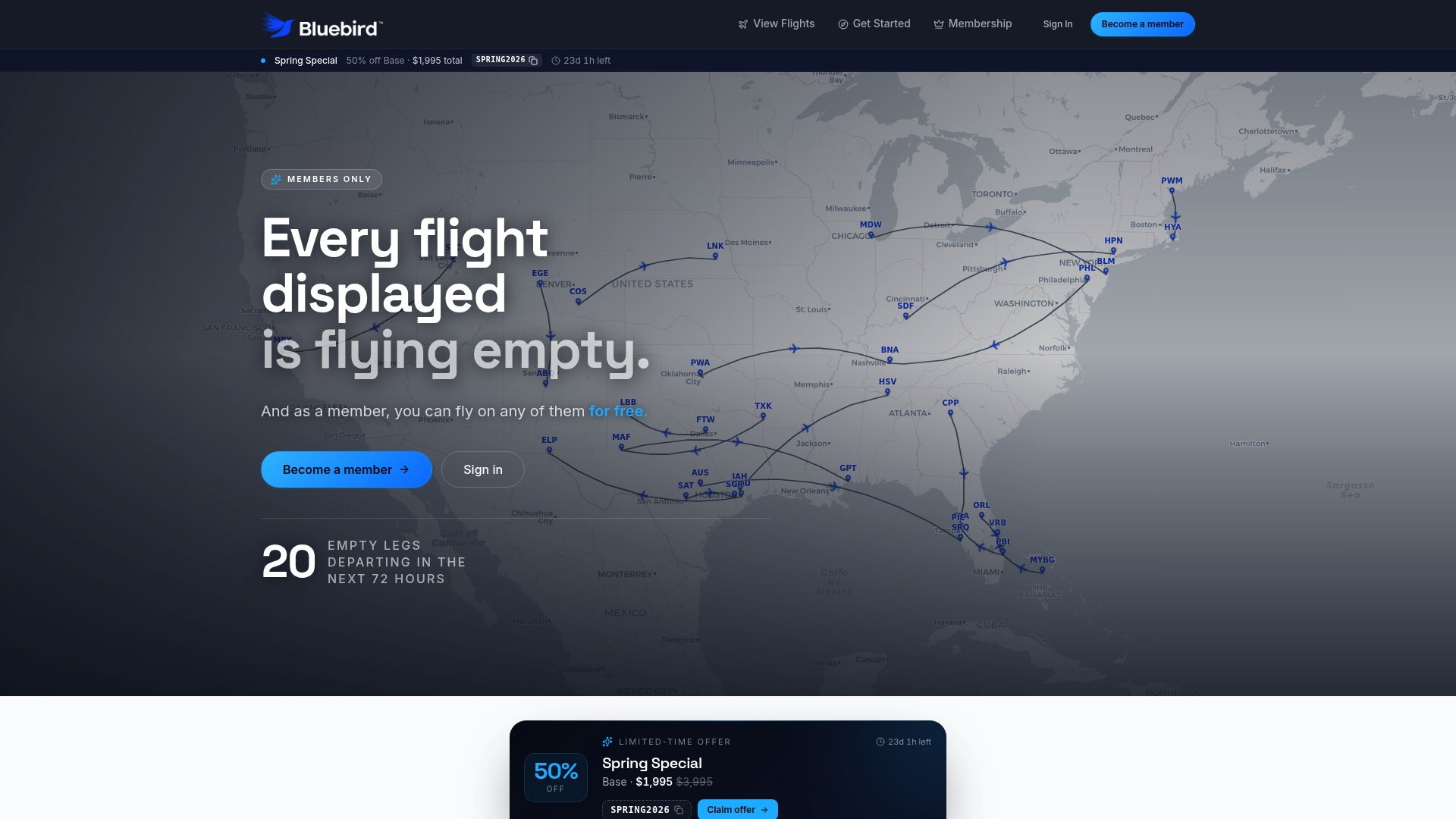
Bluebird Jets publishes live empty-leg inventory that members can book without broker markups. Because these are flights the aircraft is already flying, positioning fuel and uplift exposure tend to be lower than booking a charter that requires the jet to reposition from another city first.
- Frequent, flexible flyers benefit most, since Base and Plus membership tiers reward last-minute booking and route flexibility rather than fixed schedules.
- Travelers who need a guaranteed departure time on a specific date on short notice are less likely to see the same fuel-related savings, since empty legs depend on existing aircraft movements.
- Membership does not eliminate statutory excise taxes or third-party airport fees, which still apply regardless of how the flight was booked.
What I’d ask before signing any charter quote
The math is simple once you see it: fuel burn times hours times the price gap between benchmark and trigger. The harder part is getting operators to show their work. Contracts that hide the benchmark or skip the trigger price are the ones most likely to produce a surprise invoice.
Before you sign anything, ask three questions: what benchmark and trigger does this surcharge use, how often does it reset, and is there a cap or guarantee protecting me from an open-ended increase.
— Nick
An alternative for flyers who want fewer fuel surprises
If you fly often enough to feel these surcharges regularly, a membership built around empty legs changes the math in your favor. Bluebird Jets’ Base and Plus membership gives you unlimited access to empty-leg flights on operator-owned Learjet 60 aircraft, published daily with no broker markup layered on top.
This fits travelers who fly multiple times a year, can work with flexible routing, and would rather pay a predictable annual fee than negotiate a fuel formula on every single trip. It fits less well if you need a guaranteed date and route locked in months ahead, since empty legs depend on where the fleet is already flying. Members who want priority access to higher-demand routes can add the Skip-The-Line option. To decide if it’s a fit, weigh your flight frequency, your usual routes, and your tolerance for last-minute scheduling, then get started here.
Sources
Fuel-price benchmarks in this piece come from the EIA’s Gulf Coast jet-fuel spot series. Tax distinctions reference IRS Publication 510. Market-impact examples draw on CNBC and Forbes reporting, and transparency standards reference DOT guidance on fare advertising.
- EIA petroleum data — Gulf Coast kerosene-type jet-fuel spot series
- IRS Publication 510 — Excise Taxes (aviation fuel guidance)
- Private jet travel costs rise as fuel prices soar — CNBC (2026-04-03)
- Internet fare advertising, especially fuel surcharges — U.S. Department of Transportation
FAQ
What is a jet fuel surcharge?
A jet fuel surcharge is an extra fee operators add to a charter quote when a fuel-price benchmark rises above an agreed trigger point. It scales with the aircraft’s fuel burn and flight hours, so the same price increase affects short and long trips very differently.
Can you write off 100% of a private jet purchase?
Tax treatment of aircraft purchases depends on usage, depreciation rules, and how the aircraft is classified for business purposes, and it varies by taxpayer situation. IRS Publication 510 covers aviation fuel excise taxes specifically, but full write-off eligibility is a separate depreciation question best confirmed with a tax professional.
Will fuel surcharges affect charter pricing in 2026?
Surcharges respond to fuel-price movement, and the EIA’s 2026 monthly data shows Gulf Coast jet-fuel spot prices varying substantially across the year so far. Whether a specific quote carries a surcharge depends on your operator’s trigger price and contract terms, not a fixed yearly rate.
How much fuel does a large commercial jet hold?
Fuel capacity varies by aircraft model and is not the same question as a private jet fuel surcharge, which is calculated per trip based on burn rate and distance rather than total tank capacity. For private charter, the relevant figure is gallons burned per flight hour, which your operator should disclose on request.