Private Jet Travel Hacks for High-Income Flyers in 2026

Private Jet Travel Hacks for High-Income Flyers in 2026
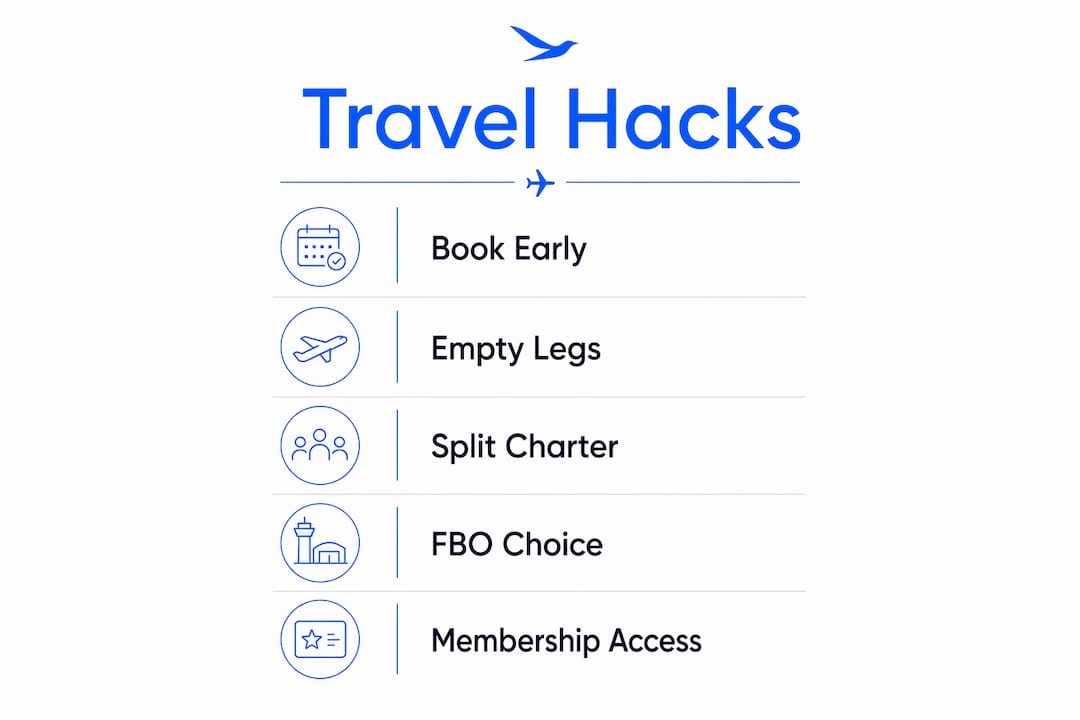
You can get meaningful private-jet access without buying a jet or spending like one: empty-leg flights cut standard charter prices by 30–75%, memberships unlock priority inventory for frequent flyers, and a few timing and airport choices can shave thousands off any private trip. The highest-value high-income travel hacks for private jets, ranked by impact:
- Empty-leg flights: Book a repositioning flight at 30–75% off retail. Requires date and route flexibility, usually confirmed 24–72 hours out.
- Membership/subscription programs: Pay an annual fee for unlimited access to published empty legs, priority booking, and live inventory. Best for travelers flying multiple times per year.
- Jet cards: Prepay for a block of hours at a locked rate. Makes sense once you’re flying roughly 25 hours or more per year.
- Split charters / semi-private seats: Share the aircraft cost across a group, or buy a single seat on a semi-private service. Lowest barrier to entry.
- Airport and FBO selection: Choosing a secondary airport or a less-congested fixed-base operator (FBO) reduces landing fees, cuts repositioning costs, and speeds up ground time.
The quick eligibility rule: Under 25 flight hours per year, on-demand charter or empty legs make the most financial sense. Between 25 and 75 hours, a membership or jet card pays off. Above 75 hours, fractional ownership or a dedicated aircraft starts to pencil out.
Table of Contents
- What are the best high-income travel hacks for private jets?
- How much does private flying actually cost?
- When should you book, and how does timing affect price?
- How FBOs and airport choice save you time and money
- Private jet etiquette and packing that actually matters
- Hidden fees and red flags to catch before you pay
- Why a Bluebirdjets membership works for many high-income travelers
- Key Takeaways
- The fastest path to private-jet access, honestly
- Bluebirdjets membership: what you get and how to start
- Useful sources for further research
What are the best high-income travel hacks for private jets?
The five tactics above each have a different risk/reward profile. Here is what actually matters when you pick one.
| Tactic | Best for | Typical cost | Availability / lead time | Flexibility | Capacity |
|---|---|---|---|---|---|
| Empty-leg flight | Flexible solo or small-group travelers | 30–75% off charter retail | 24–72 hrs before departure | Low (fixed route, one-way) | Up to aircraft max (often 6–8) |
| Membership program | Frequent flyers, 6+ trips/year | Annual subscription fee | Priority queue, daily inventory | High (unlimited access) | Up to 6 guests per flight (Bluebirdjets) |
| Jet card | Regular flyers, 25–75 hrs/year | — | Guaranteed, 24–48 hrs notice | Medium (contract terms apply) | Per aircraft type |
| Full charter | Groups, special occasions | $9,000–$13,000/hr | 48–72 hrs typical | High (custom routing) | 6–13 depending on aircraft |
| Semi-private seat | First-timers, short hops | A few hundred dollars per seat | Scheduled routes | Low (fixed schedule) | Shared cabin |
Empty legs are the insider move most high-income travelers overlook. When an operator flies a jet to reposition it for the next paying customer, that flight goes out empty unless someone books it. Operators price these aggressively because any revenue beats none. The catch: routes are fixed, timing is non-negotiable, and the deal can evaporate if the originating trip cancels.

Memberships flip the math for anyone flying more than a handful of times a year. Instead of hunting individual empty legs, you get standing access to a live inventory of them, often with a priority queue that puts you ahead of non-members on the same flight. The annual fee replaces the per-flight premium.
Jet cards suit travelers who need guaranteed availability and consistent aircraft type but aren’t ready for fractional ownership. You prepay for hours; the operator guarantees a plane within a set notice window. The trade-off is capital outlay and contract lock-in.
Empty-leg flights are the single fastest path to private-jet time for a flexible traveler. The route finds you — you just have to be ready to go.
Semi-private and seat-by-seat services are the lowest-friction entry point. One-way seat fares on semi-private routes often start at a few hundred dollars on short hops. You get the private terminal, no TSA line, and a 20-minute arrival window. You do not get a private cabin.
Pro Tip: If you’re flying with a group of four or more, split-chartering a light jet often costs less per person than buying semi-private seats on a scheduled route — and you control the departure time.
How much does private flying actually cost?
Hourly rates are the headline number, but they are rarely the whole invoice. Light jets run roughly $2,500–$4,000 per hour; midsize jets land between $4,000 and $8,000; heavy jets typically run $9,000–$13,000; ultra-long-range aircraft can exceed $13,000 per hour. Those figures cover the aircraft and crew. They do not cover everything else.
| Aircraft class | Typical hourly rate | Seats | Best for |
|---|---|---|---|
| Light jet | $2,500–$4,000 | 4–7 | Short hops, 1–4 passengers |
| Midsize jet | $4,000–$8,000 | 6–9 | 2–3 hr flights, small groups |
| Super-midsize | $4,000–$8,000 | 6–10 | Cross-country, stand-up cabin |
| Heavy jet | $9,000–$13,000 | 10–13 | Long routes, larger groups |
| Ultra-long-range | $13,000+ | 10–13 | Transatlantic, non-stop |
Empty legs cut into those numbers hard. A 30–75% discount on a midsize jet charter that would otherwise cost $12,000 brings the all-in price to somewhere between $3,000 and $8,400 before add-ons. That range is wide because the base quote rarely includes everything.
Add-on costs to budget for on every quote:
- Positioning fees: If the aircraft has to fly to your departure airport empty, you may pay for that leg.
- Federal Excise Tax (FET): A 7.5% federal tax applies to domestic charter flights.
- Passenger segment fees: A per-person, per-segment fee assessed on domestic flights.
- Overnight crew: If the crew stays overnight at your destination, expect a hotel and per-diem charge.
- De-icing: Seasonal, but it adds up fast in winter markets.
- Catering: Rarely included in the base rate unless specified.
Decision thresholds, simplified: Under 25 hours per year, on-demand charter or empty legs beat the overhead of a card or membership. At 25–75 hours, a jet card or membership subscription starts to pay for itself in per-hour savings and convenience. Above 75 hours, fractional ownership or a dedicated aircraft becomes worth the capital commitment. The empty-leg vs. charter comparison is worth running before every booking decision.
When should you book, and how does timing affect price?
Most empty-leg deals finalize 24–72 hours before departure. That window is not a flaw in the system — it is the system. Operators do not know their repositioning schedule far in advance, so the inventory appears late. If you need a specific date locked six weeks out, an empty leg is the wrong tool. If you can move on 48 hours’ notice, it is the best tool available.
Membership programs change this dynamic. Members with priority access see inventory as it posts and can queue ahead of non-members. Some tiers include a “skip-the-line” feature that effectively reserves your spot before the flight goes public. That priority is worth real money during high-demand periods.
Seasonality matters more than most travelers realize. The Northeast-to-Florida corridor sees a sharp demand spike every winter, and peak-event weekends (major golf tournaments, Formula 1 races, Art Basel) drive prices up across every booking method. Securing aircraft or membership access early avoids peak-day premiums and repositioning complications. For hard-to-get anchors, 6–8 months out is the right window.
How to monitor inventory without spending all day on it:
- Join a membership platform with live inventory and daily route updates — you get alerts without manual searching.
- Set up email or push notifications through your preferred operator or broker for your most-traveled routes.
- Build a relationship with one FBO at your home airport. Staff often know which operators are repositioning through their facility before listings go public.
- Check inventory on Tuesday and Wednesday mornings — operators tend to post weekend repositioning flights mid-week.
Pro Tip: Shifting your departure date by even one day can open up a completely different set of empty legs. Flexibility on a Thursday vs. Friday departure is often the difference between paying full charter and paying 50% of it.
How FBOs and airport choice save you time and money
Secondary airports are one of the most underused levers in private aviation. Choosing a less-congested airport reduces landing fees, cuts repositioning friction, and often puts you closer to your actual destination. Flying into Teterboro (TEB) instead of JFK, or Van Nuys (VNY) instead of LAX, typically means lower handling fees, faster ramp access, and no commercial-traffic delays.
FBOs are the private-aviation equivalent of a premium lounge, except they are also where your aircraft parks, fuels, and crews up. Knowing how to use them well saves time and occasionally money.
FBO advantages to use on every trip:
- Arrive 15–20 minutes before departure instead of two hours.
- Skip TSA screening entirely on domestic flights (carry valid government-issued ID).
- Access private lounges, conference rooms, and catering coordination.
- Arrange ground transport directly through FBO staff, who often have preferred vendor relationships.
- Store luggage securely if you arrive early or need a few hours before departure.
Ground transport strategy: A shared SUV booked through the FBO or your membership platform almost always beats calling a rideshare from the ramp. For groups of four or more, a single vehicle is cheaper and faster. If your meeting is within 20 minutes of the FBO, the time savings of private aviation compound — you land, clear the ramp, and walk into the room.
Day-of logistics checklist:
- Confirm tail number and departure gate with your operator the evening before.
- Carry a valid government-issued photo ID; international flights require a passport.
- Pack carry-on only when possible — private jets have limited baggage holds, and oversized bags can create ramp delays.
- Confirm catering and special requests 24 hours ahead, not day-of.
- Know the crew overnight implications if your return is the following morning — that cost should already be in your quote.
Pro Tip: Ask your FBO contact which operators regularly reposition through their facility. That relationship can surface empty-leg opportunities before they hit any public listing.
Private jet etiquette and packing that actually matters
Private aviation has fewer rules than commercial flying, but the ones that exist matter more because the crew-to-passenger ratio is high and everyone notices everything.
Dress and boarding:
- Business casual is the default. There is no formal requirement, but arriving in gym clothes to a Learjet with a catered setup reads as tone-deaf.
- Greet the crew by name when you board. They have your manifest and know who you are; reciprocating takes five seconds and sets the tone for the flight.
- Do not arrive late. A 20-minute window means 20 minutes, not 35. Crew schedules, slot times, and subsequent flights are all downstream of your departure.
Packing for private efficiency:
- Soft-sided bags load faster and fit in tighter holds than hard-shell luggage. Save the Rimowa for commercial.
- One carry-on per person is the practical limit on most light and midsize jets.
- Medications, electronics, and valuables travel in the cabin, not in checked bags stowed in the nose.
- Pack a layer regardless of destination — cabin temperatures on smaller jets vary more than on commercial aircraft.
In-flight service requests:
- Confirm catering preferences when you book, not when you board.
- If you are bringing guests, provide their names to the operator in advance for the manifest.
- Special requests (specific beverages, dietary restrictions, extra seating configurations) cost nothing to ask for early and can be expensive or impossible to arrange last-minute.
Dos and don’ts with operators:
- Do tip ground crew and catering staff — it is standard and remembered.
- Do not smoke on board or in the FBO without explicit permission.
- Do communicate itinerary changes as early as possible; last-minute route changes trigger repositioning costs.
- Do not assume the same aircraft is available for your return without confirming it separately.
Hidden fees and red flags to catch before you pay
The most common way a private-jet deal stops being a deal is a quote that excludes half the real cost. Verify these on every booking before you sign anything.
Hidden-cost checklist:
- Positioning fees (is the aircraft already at your departure airport, or does it need to fly there?)
- Federal Excise Tax (7.5% on domestic charters — confirm whether it is included or added)
- Passenger segment fees (per-person, per-leg federal assessment)
- Minimum flight-hour rules (many operators charge a two-hour minimum even on 45-minute legs)
- Overnight crew costs (hotel, per diem, and sometimes a deadhead return)
- De-icing and fuel surcharges (seasonal and market-driven)
- Catering and ground transport (almost never included in the base rate)
Operational red flags:
- No verifiable FAA Air Carrier Certificate or Part 135 operating authority. Any legitimate charter operator can provide this on request.
- Vague or missing cancellation policy. Know exactly what you get back if the operator cancels versus if you cancel.
- Pressure to pay in full before receiving a written contract with aircraft tail number, departure time, and included services.
- Brokers who cannot name the operating carrier. You have a right to know who is actually flying you.
Empty-leg-specific risks: The originating trip can cancel, which cancels your empty leg with it. This is not rare. Mitigate it by confirming the status of the originating booking 24 hours before departure and having a backup plan. Also confirm that the quoted price is all-in — empty-leg base prices frequently exclude FET, positioning, and catering.
Pro Tip: Always ask for the all-in price in writing before committing. “Base price” and “total invoice” are two different numbers, and the gap between them is where most surprises live.
Why a Bluebirdjets membership works for many high-income travelers
Subscription-based membership programs sit between one-off chartering and fractional ownership for travelers flying multiple times per year. Bluebirdjets’s model takes that concept further by making the membership specifically about empty-leg access — unlimited, not per-flight.
What a Bluebirdjets membership includes:
- Unlimited access to published empty-leg flights on operator-owned Learjet 60 jets
- Live inventory with daily updated routes, so you see what is available without calling a broker
- Priority queue and booking features that put members ahead of non-members on the same flights
- Up to six guests per flight at no additional per-seat charge
- Optional “Skip-the-Line” upgrade for even higher priority on high-demand routes
- Custom charter requests available as a paid add-on when you need a specific route not in the empty-leg inventory
Who benefits most from this model:
- Travelers flying 6 or more times per year who can work with flexible routing
- Small groups (up to 6 guests) where the per-person math on a full charter is painful
- Business travelers with variable schedules who can move on 24–72 hours’ notice
- Anyone who wants private-jet access without the capital commitment of a jet card or fractional share
Scenario example: A member flying New York to Florida four times over a winter season, each time with two colleagues, would pay full charter rates on every leg without a membership. With Bluebirdjets, those same legs — booked as empty-leg routes when the aircraft repositions — come at a fraction of the retail price, and the annual membership fee spreads across all four trips.
The Bluebirdjets model works because it aligns the member’s interest (cheap private flights) with the operator’s interest (any revenue on an otherwise empty repositioning leg). Both sides win when the member stays flexible.
Pricing architecture: Bluebirdjets operates on an annual subscription. A premium tier with higher priority is available at a higher fee. The Skip-the-Line feature and custom charter requests are monetized separately, so you only pay for what you actually use beyond the base membership.
Pro Tip: Check the live flight inventory before committing to any booking method. Seeing real routes and dates in the system gives you a concrete sense of whether the available empty legs match your typical travel patterns.
Key Takeaways
Empty-leg flights combined with a membership that prioritizes access over ownership deliver the best private-jet value for high-income travelers flying multiple times per year.
| Point | Details |
|---|---|
| Empty legs cut costs sharply | Savings of 30–75% off standard charter retail are typical, but require date and route flexibility. |
| Timing is the core variable | Most empty legs confirm 24–72 hours before departure; membership priority queues improve your odds significantly. |
| Add-ons inflate every quote | Budget for FET (7.5%), positioning, overnight crew, and catering on top of any base price. |
| Decision threshold matters | Under 25 hrs/year: on-demand or empty legs. 25–75 hrs: membership or jet card. Above 75 hrs: fractional. |
| Bluebirdjets membership | Provides unlimited empty-leg access on Learjet 60s, up to 6 guests per flight, live inventory, and priority booking. |
The fastest path to private-jet access, honestly
The conventional wisdom on private aviation is that you either own a jet or you pay full charter rates and wince. That framing misses the entire middle ground where most high-income travelers actually live.
Empty legs are real. The savings are real. The catch is that most people treat flexibility as a binary — either they can move on 48 hours’ notice or they cannot. The truth is more granular. You might not be able to flex your departure city, but you can flex your departure day. You might not be able to flex your return date, but you can flex your departure airport. Each of those adjustments opens a different set of deals.
The membership model matters because it removes the friction of hunting. When you have standing access to live inventory and a priority queue, the question shifts from “can I find an empty leg?” to “which one fits my week?” That is a fundamentally different relationship with private aviation — and for anyone flying more than a handful of times a year, it is the right one.
One honest caveat: if your schedule is genuinely rigid and your routes are highly specific, a jet card or fractional share will serve you better than any empty-leg-based approach. Memberships reward flexibility. When flexibility is not on the table, guaranteed availability is worth the premium.
Bluebirdjets membership: what you get and how to start
If the empty-leg model fits your travel pattern, Bluebirdjets is the most direct way to access it. The annual membership gives you unlimited empty-leg flights on Learjet 60 jets, live daily inventory, priority booking, and the ability to bring up to six guests per flight — no per-seat charge on top of the membership fee.
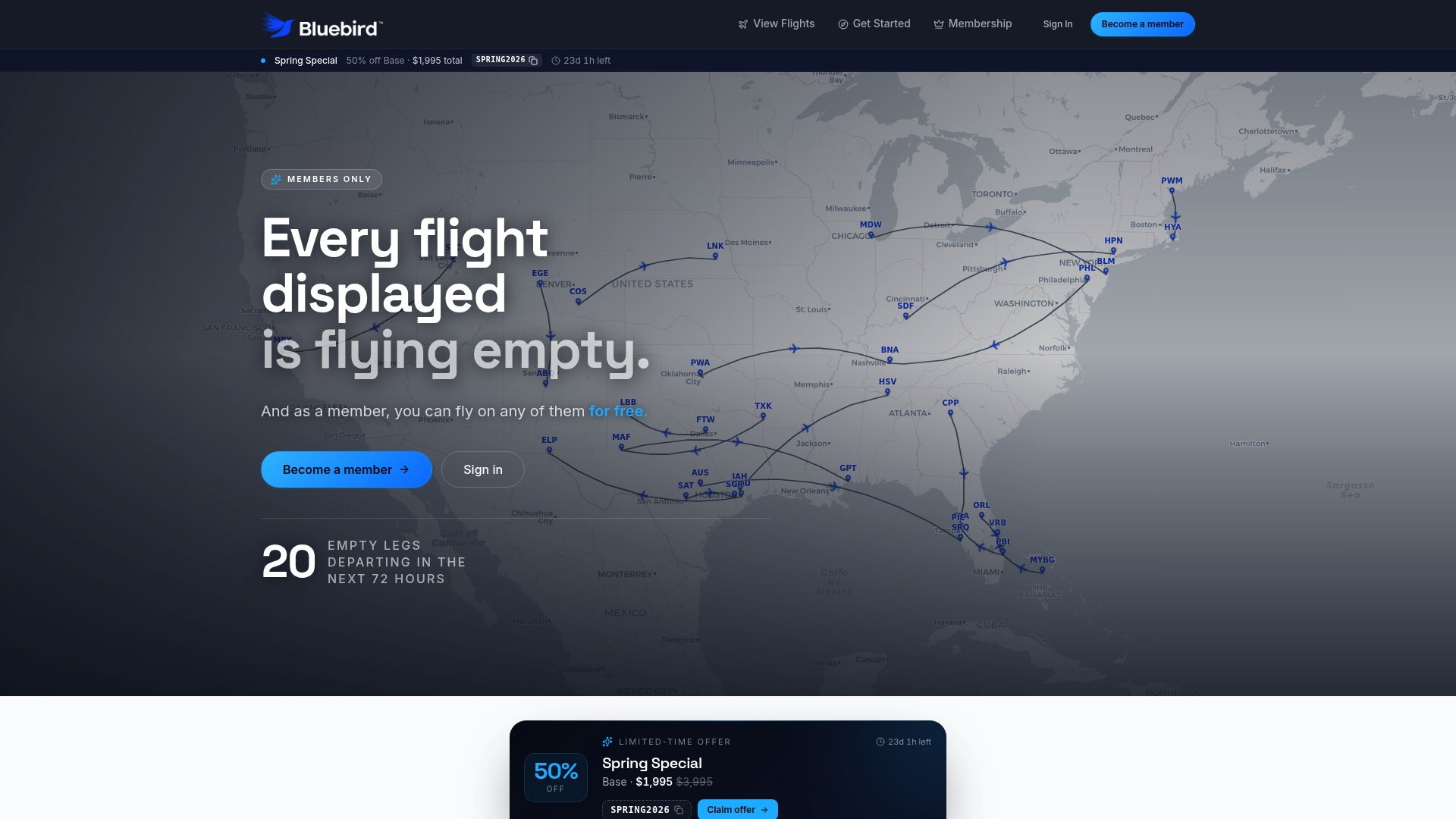
The optional Skip-the-Line upgrade puts you at the front of the queue on high-demand routes, and custom charter requests are available when you need a specific city pair that is not in the empty-leg inventory. The membership structure means you pay once and fly as often as the inventory allows, which changes the math entirely for frequent travelers.
View the membership details and check the current flight inventory to see which routes are live right now. If a route matches your next trip, you will know immediately whether the model works for you.
Useful sources for further research
The sources below cover private-jet pricing, empty-leg mechanics, and luxury travel planning in enough depth to verify any figure or decision threshold in this article.
- Element Aviation — Empty Leg Flights: Operator-side explanation of how empty legs are priced and listed; the 30–75% savings range comes from here.
- Beyond Baggage — Private Jet Travel for Beginners 2026: Hourly rate ranges by aircraft class with 2025–2026 estimates; useful for cost modeling.
- Condé Nast Traveler — How to Fly Private Without Overspending: Practical breakdown of semi-private seat pricing and the private-terminal experience.
- EmptyLegGuide — Cheap Private Jet Options: Overview of membership programs as a middle-ground between charter and fractional.
- Bluebirdjets — How Empty Leg Pricing Works: Platform-specific guide to how operators price and list empty legs on Bluebirdjets.
- Bluebirdjets — Why Empty Legs Suit Flexible Schedules: Timing and flexibility guide with 2026 booking examples.
- Bluebirdjets — How Empty Leg Routes Surprise Travelers: Member-outcome examples showing how live inventory produces real deals.
- Bluebirdjets — Fly Private Without Charter Cost: Practical cost-reduction strategies for high-income travelers who want private benefits without full-charter pricing.
- TSA PreCheck: Relevant for travelers who mix commercial and private legs; PreCheck does not apply at private FBOs but matters for hybrid itineraries.
- CBP Global Entry: For international private flights, Global Entry expedites customs clearance on arrival — worth having if you fly internationally even occasionally.
- Tasteful Voyages — Luxury Travel Planning Checklist 2026: Comprehensive planning timeline for luxury travel, including the 6–8 month anchor-booking window for peak-season private aviation.