Cut Private Jet Positioning Fees for Busy Flyers: 4 Proven Tactics
Cut Private Jet Positioning Fees for Busy Flyers: 4 Proven Tactics
A positioning fee is the cost of flying an empty aircraft to your departure airport before your trip starts, or away from your destination afterward, and it’s typically billed at the plane’s full hourly rate. On most charter quotes, that adds a significant portion to the total invoice. Before you sign anything, ask the operator for the exact positioning hours and the aircraft’s current base location.
TL;DR:
- Positioning fees are based on real expenses such as fuel, crew pay, landing fees, maintenance, insurance, and opportunity costs, and can significantly increase overall charter costs.
- These fees are billed at the same hourly rate as actual flight hours and can sometimes exceed the price of a short passenger trip, especially for larger jets.
- Buyers should verify aircraft location and calculation methods by requesting itemized quotes and comparing estimated distances and speeds to avoid overpaying.
- Matching trips to empty legs or nearby airport bases can significantly reduce positioning costs, with empty-leg access offering a cost-free repositioning alternative for frequent flyers.
- Standing fees are often more economical for multi-day stays, while repositioning is more cost-effective for shorter trips, with the decision depending on trip duration and aircraft type.
Table of Contents
- What Positioning Fees Cover and Why Operators Charge Them
- How Positioning Costs Are Calculated (And Typical Ranges by Aircraft Class)
- Real Route Examples: Seeing Positioning Fees in Action
- How to Read and Verify a Positioning Line Item on Your Quote
- Four Proven Ways to Cut Your Positioning Costs
- When Standing Fees Beat Flying the Jet Home and Back
- How Empty-Leg Membership Access Changes Positioning Economics
- What I’ve Learned From Watching Charter Quotes Go Wrong
- Skip the Positioning Math Entirely With Bluebirdjets
- Sources
What Positioning Fees Cover and Why Operators Charge Them
Positioning fees aren’t padding. They’re the real cost of moving a jet worth $5 million to $70 million to wherever you happen to be standing.
When you book a charter, the aircraft you’re flying on is rarely sitting idle at your local airport. It’s finishing another trip somewhere else, or parked at its home base three states away. Getting it to you costs money, and that cost lands on your invoice as the positioning fee, also called a repositioning charge, deadhead leg, or ferry flight depending on who’s writing the quote.
The line item covers several real expenses:
- Fuel for the empty flight hours, which for a midsize jet can run $2,000 to $3,500 per hour on its own.
- Crew pay and per diems, since pilots still earn duty time whether passengers are aboard or not.
- Landing, FBO, and handling fees at the positioning airport, often invisible to the client but very real to the operator.
- Maintenance and wear on airframes and engines, which accrue on every flight hour regardless of who’s in the cabin.
- Insurance and opportunity cost, since that aircraft can’t earn revenue elsewhere while it’s flying to reach you.
Positioning can get billed in either direction. Flying the jet to your origin airport is inbound positioning; flying it back to base (or its next job) after dropping you off is outbound positioning, and plenty of operators bill both.
FAR Part 135 duty-time rules also shape these costs. If a repositioning leg pushes a crew past its legal duty window, the operator has to swap crews or pay for an overnight, and that expense usually flows straight into your quote.
Many Part 135 operators fold positioning into an all-in hourly rate, averaging the cost across typical routes rather than itemizing it. The other 40% break it out as a separate line, which is why two quotes for the same trip can look wildly different even when the underlying math is similar, according to The Jet Finder’s pricing analysis.
How Positioning Costs Are Calculated (And Typical Ranges by Aircraft Class)
The math behind a positioning fee is simpler than most quotes make it look. You can run it yourself in under a minute.
- Find the aircraft’s hourly rate. This is the same rate the operator charges for your actual flight, listed on the quote or available on request.
- Estimate flight time to reach you. If the jet is based 400 nautical miles away and cruises at 450 knots, that’s roughly 53 minutes of positioning time, one way.
- Multiply hours by rate, then double it if outbound positioning also applies. A 1-hour inbound leg on a $4,500 hourly-rate midsize jet adds $4,500 before your trip even starts.
Working ranges vary widely by category, and these figures are estimates, not guarantees:
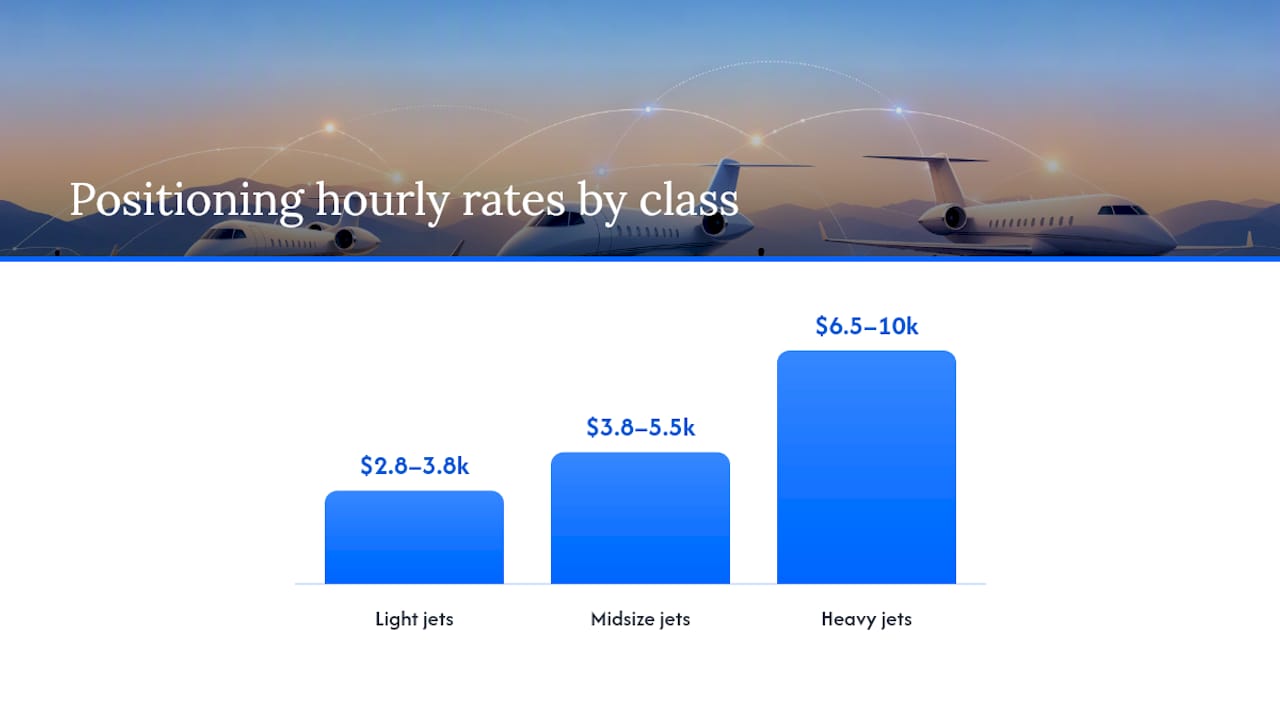
- Light jets (Citation CJ2, Phenom 100): roughly $2,800 to $3,800 per hour, so even a 30-minute repositioning leg can add $1,400 to $1,900.
- Midsize jets (Learjet 60, Hawker 800): roughly $3,800 to $5,500 per hour.
- Heavy jets (Gulfstream G450, Challenger 604): roughly $6,500 to $10,000 per hour, where a single positioning hour can rival the cost of a short passenger leg entirely.
Here’s the part that catches first-time charterers off guard: repositioning legs are billed at the exact same hourly rate as your revenue flight, and on short trips that math gets ugly fast. A 45-minute hop from a regional airport to a nearby city might only take 20 minutes of flying, but if the nearest available aircraft is 90 minutes away, positioning cost alone can exceed the entire billed passenger flight, per Uncompromised Travel’s breakdown of repositioning economics.
How this shows up on paper matters too. Some operators quote a single “one-way price” that has already absorbed an assumed positioning cost, while others show a bare flight-hour rate plus a separate repositioning line. Neither approach is wrong, but comparing a bundled one-way quote against an itemized quote without adjusting for the difference will make one operator look artificially cheaper than the other. Bluebirdjets has written previously about one-way charter pricing and how bundled versus itemized quotes can mislead buyers who don’t ask the right question up front.
Real Route Examples: Seeing Positioning Fees in Action
Short hop, big surprise. A client wants a 40-minute flight between two regional airports on a light jet. The nearest available aircraft is based 75 minutes away by air. The operator has to fly it in empty, then either fly it back empty or wait on the ground burning a standing fee. The positioning time alone, at roughly $3,200 an hour, adds close to $4,000 to a trip that might otherwise price out at $3,000. The positioning line costs more than the flight itself.
Midsize regional trip. A family books a midsize jet for a three-hour round trip, departing from a smaller airport with no based aircraft. The operator quotes inbound positioning of 50 minutes and outbound positioning of 50 minutes after dropoff, both at the aircraft’s $4,800 hourly rate. That’s roughly $8,000 in positioning cost stacked on top of the actual flight hours, nearly doubling what the trip would cost if the jet had already been sitting at the departure airport.
Resort season pressure. Ski destinations and beach resorts see this constantly. During peak weekends, every operator’s aircraft in the region gets pulled toward the same handful of airports, so positioning distances (and prices) spike right when demand is highest. A trip that costs $9,000 in the shoulder season can jump past $13,000 during a holiday weekend purely on repositioning pressure.
For any of these, ask the operator directly:
- Where is the aircraft based right now, and how many positioning hours does that require?
- Are the positioning hours itemized separately, or bundled into the quoted price?
- Does the quote include applicable taxes and fees, such as Federal Excise Tax on air transportation, or are those added later?
How to Read and Verify a Positioning Line Item on Your Quote
Most positioning fees are legitimate. A few are inflated because nobody bothered to check the math. Here’s how to tell the difference before you sign.
- Request an itemized breakdown. Ask specifically where the aircraft is currently based and how many positioning hours were used to build the quote. A reputable operator will answer this without hesitation.
- Run your own sanity check. Look up the distance between the aircraft’s stated base and your departure airport, divide by the aircraft type’s typical cruise speed (roughly 400 to 500 knots for most jets), and compare that estimate against the hours you were quoted.
- Watch for red flags. An operator who won’t disclose the aircraft’s location, or who quotes positioning hours that don’t match any plausible base airport, is worth pushing back on. Private Jet Insider’s guide to positioning legs notes this is one of the most common areas where buyers get overcharged simply because they never ask.
If a quote still looks high after you’ve itemized it, follow a three-step playbook: get a second quote from a different operator on the same route, ask whether an alternate nearby airport would put you closer to an already-based aircraft, and check whether an empty leg happens to be running your route that week.
Pro Tip: Keep a simple note of average cruise speeds by aircraft class (roughly 400 knots for light jets, 470 for midsize, 500+ for heavies). It takes ten seconds to convert a stated distance into a rough flight-time estimate, and it’s often all you need to catch a padded positioning number.
Four Proven Ways to Cut Your Positioning Costs
You have more control over this line item than most first-time charterers realize.
- Match your trip to an empty leg. When an aircraft already needs to fly your route to reposition for another job, the operator can sell that seat at a substantial discount off retail, because the flight is happening anyway and passengers are close to marginal cost. Bluebirdjets has broken down the pricing logic behind empty legs in more detail.
- Consider a nearby alternate airport. Driving a moderate distance to a different airport can put you at a location where an aircraft is based, sometimes cutting positioning cost significantly.
- Compare standing fees against two positioning legs. For multi-day trips, paying the aircraft to wait at your destination can beat flying it home and back.
- Shop brokers and platforms that show real-time aircraft positions. Fleet visibility lets you pick an operator whose plane is already close to you, according to Vomos’s analysis of repositioning economics.
Empty-leg pricing works because it reflects genuine marginal-cost economics: once an operator commits to flying an aircraft somewhere, filling seats on that leg costs them almost nothing extra. That’s a real opportunity for flexible flyers, not a gimmick.
When Standing Fees Beat Flying the Jet Home and Back
Standing fees are a daily charge for keeping an aircraft (and often its crew) parked at your destination instead of flying it back to base and returning later. Instead of paying two full positioning legs, you pay a flat daily rate while the jet waits.
The math tends to favor standing fees for shorter stays and favor repositioning for longer ones. The crossover point generally falls somewhere between 3 and 7 days, depending on aircraft type and how far the plane would otherwise have to fly, per Vomos’s breakdown of standing fee economics.
When requesting a quote for a multi-day trip, ask for both numbers side by side:
- The per-day standing fee to keep the aircraft on the ground at your destination.
- The cost of two full repositioning legs (flying home, then flying back for pickup).
A weekend trip usually flips the decision toward standing fees. A two-week stay usually flips it back toward repositioning, since accumulated daily charges eventually exceed the cost of two ferry flights.
How Empty-Leg Membership Access Changes Positioning Economics
Positioning fees exist because operators have to move aircraft to meet demand. A membership model built around empty-leg access flips that equation in your favor instead of against you.
Bluebirdjets works by giving members unlimited access to empty legs on operator-owned Learjet 60 aircraft, meaning you’re booking flights the jet was already going to fly. There’s no positioning fee to negotiate because the repositioning cost was never yours to begin with; it’s baked into the operator’s existing schedule.

This model fits a specific profile best: frequent, spontaneous flyers who value cost predictability over guaranteed exact timing. If you can work with a live, daily-updated inventory of routes rather than dictate an exact departure hour, membership access sidesteps the entire positioning conversation.
There are real trade-offs worth naming honestly:
- Empty legs run on the operator’s schedule, not yours, so timing flexibility matters more than it would with a dedicated charter.
- Members can bring up to six guests per flight, and priority booking features help secure seats on in-demand routes.
- For trips that need guaranteed, fixed departure times, Bluebirdjets also supports optional paid custom charter requests, which behave more like traditional charter booking.
What I’ve Learned From Watching Charter Quotes Go Wrong
The two mistakes I see most often: clients never ask where the aircraft is based, and they accept a positioning number without requesting the hours behind it. Both take thirty seconds to fix.
Use these three lines with any broker: “Where is this aircraft based right now?” “Can you itemize the positioning hours separately from the flight hours?” “What would this cost with an alternate airport or an empty leg instead?” Most operators answer honestly when asked directly. The ones who dodge the question are telling you something too.
— Nick
Skip the Positioning Math Entirely With Bluebirdjets
Every tactic in this piece, matching empty legs, comparing standing fees, shopping alternate airports, is a workaround for the same problem: paying to move someone else’s aircraft. Bluebirdjets removes that problem from the equation. Membership gives you unlimited access to empty legs already flying your region’s routes, so there’s no repositioning line to itemize, question, or negotiate.
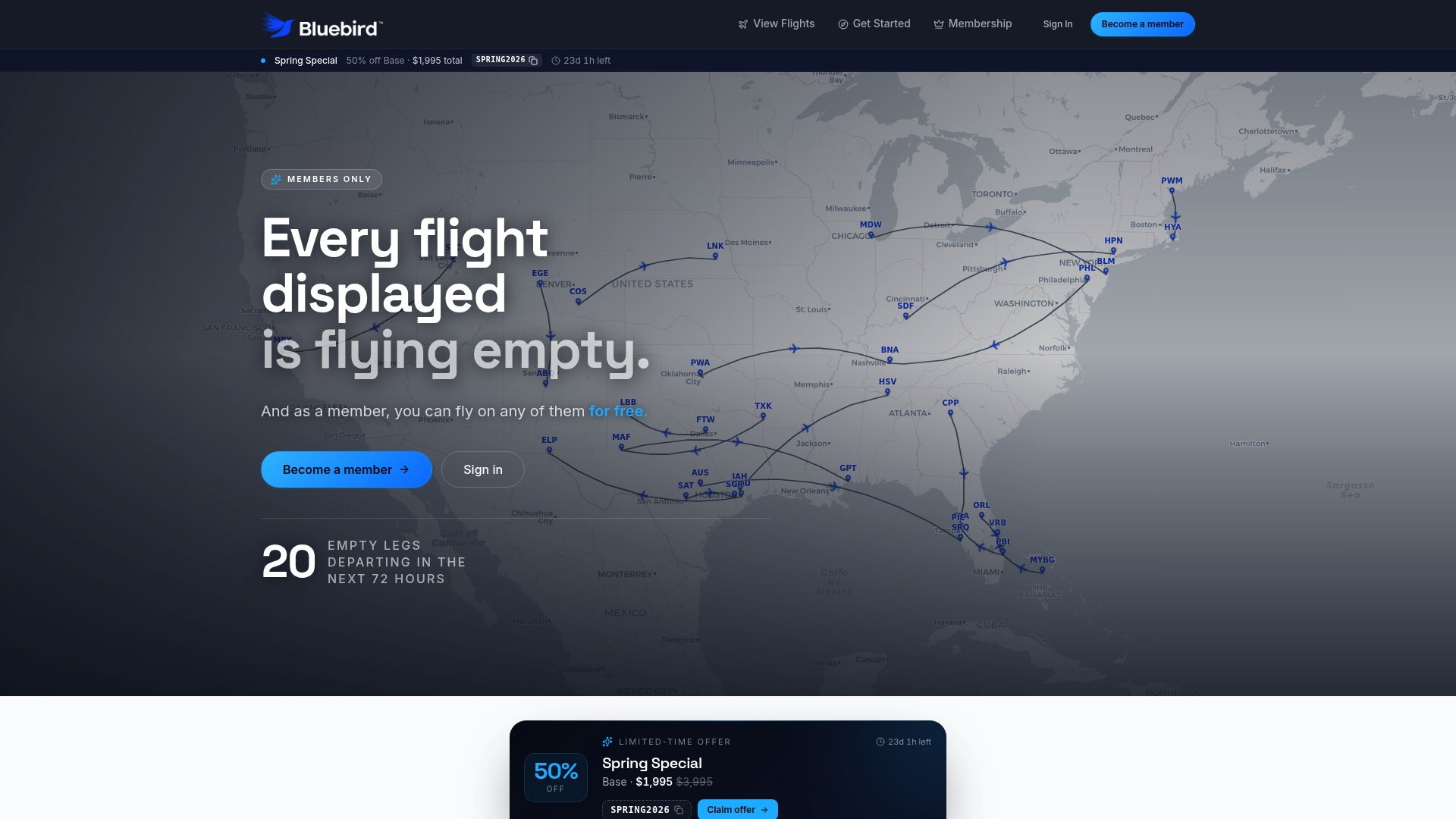
This trades a fixed departure time for a meaningfully lower and more predictable cost, which is exactly the swap frequent, flexible flyers have been making for years without a formal way to access it. You get live inventory updated daily, priority booking, and room for up to six guests per flight. When a trip absolutely needs a guaranteed schedule, the optional custom charter request still gets you there, just without pretending positioning costs don’t exist. Check current empty-leg availability and membership details to see what’s flying near you this week.
Sources
- Electronic Code of Federal Regulations — Title 14 Part 135
- IRS: Air transportation guidance
- Repositioning & deadhead fees explained | Uncompromised Travel
- Repositioning and deadhead fees explained | Vomos