Private Aviation Cost Breakdown Examples: 2026 Guide

What does private aviation actually cost? A clear snapshot
Flying private in 2026 costs far more than the hourly rate on any charter website. The real number comes from stacking fixed ownership expenses, per-flight variable costs, and a layer of secondary fees that most brokers mention only after you ask. Understanding those layers is the whole game.
Here is what you are actually paying across the main aircraft categories:
Very Light Jets (Phenom 100, Cirrus Vision Jet): $2,000–$3,500 per hour, 4–6 passengers, best for city pairs under two hours
Light Jets (Citation CJ3+, Phenom 300E): hourly rates typically in the low thousands of dollars range, 6–8 passengers, the most popular category for domestic routes
Midsize Jets (Citation XLS+, Hawker 900XP): midrange jet hourly rates, 7–9 passengers, coast-to-coast capable
Heavy Jets (Gulfstream G450, Challenger 605): higher hourly rates typical for transatlantic capable jets, 10–14 passengers
Ultra-Long-Range Jets (Gulfstream G650ER, Bombardier Global 7500): $13,000–$20,000+ per hour, 12–19 passengers, nonstop intercontinental
Those hourly rates are just the starting point. Secondary fees add 20–40% on top of the base rate once you factor in positioning, federal excise tax, landing fees, and crew costs. Most operators require minimum billable flight times of about two hours per leg, so short flights carry minimum charges accordingly.
Representative trip costs in 2026:
New York to Miami, light jet, one way: $14,500–$19,500
Los Angeles to New York, super midsize jet, one way: $30,000–$45,000
New York to London, heavy jet, one way: $95,000–$130,000
Chicago to Aspen, super midsize, one way during ski season: $32,000–$42,000
How fixed and variable costs split in private aviation
Private aviation expenses fall into two distinct buckets, and confusing them is the fastest way to misread a budget.
Fixed costs recur whether the aircraft flies or not:
Crew salaries and training: $200,000–$400,000+ per year for a two-pilot crew
Insurance: costs vary widely, often estimated as a small percentage of hull value annually
Hangar fees: can be significant monthly expenses at major airports
Maintenance reserves: set aside per flight hour to cover future maintenance
Management and administrative overhead for owned aircraft
Variable costs scale with each trip:
Fuel: the single largest variable expense, often accounting for roughly a third of operating costs
Landing and FBO handling fees: vary widely depending on airport and services used
Catering: $50–$300 per person
De-icing: $500–$3,000 in winter at northern airports
Crew per diems and overnight hotel costs on multi-day trips
Cost Category | Light Jet (annual) | Midsize Jet (annual) |
|---|---|---|
Crew salaries | typically $180,000–$250,000 annually | typically multiple hundred thousand dollars annually |
Insurance | typically $40,000–$70,000 annually | varies widely, often tens to hundreds of thousands yearly |
Hangar and admin | substantial annual costs depending on airport | substantial annual costs depending on airport |
Fuel (300 hrs/yr) | typically $250,000–$350,000 | significant fuel expenses scaling with usage |
Maintenance reserves | considerable annual reserves for maintenance | considerable annual reserves for maintenance |
Annual total | $700,000–$1.2 million for a light jet flying 300 hrs | estimated annual operating costs into low millions |
The billing model matters as much as the rate itself. Point-to-point billing charges only for occupied flight time, while an all-in model also bills the empty repositioning legs flown to reach you. Two quotes at the same hourly rate can produce very different final numbers depending on which model applies.
How costs scale across every jet category
Aircraft category is the single biggest lever on your per-flight cost. A heavy jet on a short route burns disproportionately high fixed costs per hour because its ownership overhead is spread across fewer flight hours than the mission justifies. Matching the aircraft to the trip is not just a preference; it is the most direct way to control spending.

Aircraft Category | Typical Charter Rate Range | Seats | Typical Route |
|---|---|---|---|
Very Light Jet | lower thousands per hour range | 4–6 | short city pairs |
Light Jet | low thousands per hour range | 6–8 | domestic 2–3 hr trips |
Midsize Jet | mid thousands per hour | 7–9 | coast-to-coast US |
Super Midsize | higher mid thousands per hour | 8–10 | transcontinental routes with larger cabins |
Heavy Jet | high thousands to around ten-thousands per hour | 10–14 | transatlantic flights |
Ultra-Long-Range | very high thousands to twenty-thousands per hour or more | 12–19 | nonstop intercontinental flights |
A few category-specific notes worth knowing:
Very Light Jets like the Phenom 100 or Eclipse 500 work well for 2–4 passengers with light bags. Anything beyond a 2-hour leg pushes them past their comfort zone.
Light Jets dominate the US charter market. The Phenom 300 is the most-chartered private jet in North America, running $3,000–$3,800 per hour.
Midsize Jets hit the sweet spot for groups of 5–9 on longer domestic legs. The Citation XLS benchmarks at $4,000–$5,000 per hour.
Heavy Jets carry full galleys, sleeping areas, and the range for transatlantic routes. Annual operating costs for a heavy jet at 300 hours can reach $1.15–$2.15 million.
Ultra-Long-Range Jets like the Gulfstream G650ER or Bombardier Global 7500 are built for nonstop intercontinental missions. Fuel alone runs $3,000–$5,000 per flight hour at 2026 Jet-A prices.
For a deeper look at how each category fits different missions, the private jet categories guide from Bluebirdjets covers the tradeoffs in detail.
What does a real charter trip actually cost? A line-by-line example
Take a one-way New York (Teterboro) to Miami flight on a light jet. Flight time is roughly 2.5–3 hours. Here is how the bill builds:
Base hourly rate: $4,000/hr × 3 hours = $12,000
Fuel surcharge (8–14% of base): ~$1,200
Federal Excise Tax (7.5% on domestic charters): ~$990
Segment fees (~$5 per passenger, 4 passengers): $20
Landing and FBO handling fees: $800
Catering: $400 (4 passengers)
Crew per diem (day trip, no overnight): $150
Line Item | Estimated Cost |
|---|---|
Base hourly rate (3 hrs at $4,000) | $12,000 |
Fuel surcharge | $1,200 |
Federal Excise Tax (7.5%) | $990 |
Segment fees | $20 |
Landing and FBO handling | $800 |
Catering | $400 |
Crew per diem | $150 |
Total | ~$15,560 |
That $15,560 assumes the aircraft is already positioned at Teterboro. Add a repositioning leg and the total climbs toward $18,000–$19,500. Trip duration directly drives cost because operators bill by occupied flight time, so a 2.75-hour flight is billed as 2.75 hours, not rounded down.
Round-trip bookings often cost less per leg than two separate one-ways. When the aircraft stays with you, the operator avoids a second repositioning flight, and that saving usually passes through to the quote.
Pro Tip: Always ask whether the quote uses point-to-point billing or includes repositioning. The same aircraft, same route, and same hourly rate can produce a $3,000–$5,000 swing depending on the answer.
Secondary fees that quietly inflate your charter bill
The base hourly rate is the headline. The fees below it are where budgets get surprised. Secondary fees typically add 20–40% to the base rate, and several of them are entirely avoidable with the right booking approach.
Repositioning fees: When the aircraft is not already at your departure airport, you pay for the empty leg to reach you. On a popular route this can add $3,000–$8,000.
Federal Excise Tax: 7.5% on all domestic US charter flights, applied to the total transportation cost. Non-negotiable.
Segment fees: Roughly $5 per passenger per leg under current federal regulations. Small but real.
Overnight crew fees: $500–$1,500 per night when the aircraft stays over. On a multi-day trip with two pilots, that adds up fast.
De-icing: $500–$3,000 at northern airports in winter, charged only when conditions require it.
International handling and overflight permits: $1,500–$5,000 for customs and ground handling on international trips, and up to $8,000 for complex international itineraries with multiple overflight permits.
Peak event surcharges: During major events like the Super Bowl, Art Basel, or Aspen ski season, seasonal demand can double or triple standard charter rates due to limited aircraft availability and higher airport congestion fees.
Wi-Fi charges: $100–$300 per flight on older aircraft without built-in satellite connectivity.
Ground transportation: Ramp-side car service runs $150–$400 per leg at most FBOs.
The practical rule: budget an extra 15–25% on top of the quoted hourly rate to arrive at a realistic out-the-door number. On a $20,000 base quote, that means planning for $23,000–$25,000.
Federal excise tax and US tax considerations for private jet costs
The 7.5% Federal Excise Tax applies to every domestic US charter flight and is calculated on the total transportation cost, not just the base rate. It is not optional, and it is not something operators can waive. Segment fees of roughly $5 per passenger per leg stack on top of it.
On the ownership side, the tax picture gets more complex. The IRS allows 100% bonus depreciation on aircraft purchases, but qualifying requires meeting strict business-use conditions. The aircraft must be used primarily for qualified business purposes, and the IRS scrutinizes aviation deductions closely. Key requirements include:
The aircraft must be used predominantly for business, not personal travel
Detailed flight logs documenting business purpose for each trip are required
Mixed personal and business use requires careful allocation to avoid disallowance
Charter operators and management companies have different tax treatment than direct owners
Pro Tip: Aviation tax law is genuinely specialized. The difference between a properly structured deduction and a disallowed one can run into hundreds of thousands of dollars. Work with a tax attorney or CPA who focuses specifically on aircraft taxation, not a generalist who handles it occasionally.
The bonus depreciation rules have shifted multiple times in recent years, and the IRS has challenged aggressive aviation deductions in several high-profile cases. Getting this right from the start is cheaper than correcting it after an audit.
How to reduce what you spend on private aviation
Cost control in private aviation comes down to a handful of decisions made before you book, not after.
Match the aircraft to the mission. A heavy jet on a 90-minute domestic hop burns the same fixed-cost overhead as it would on a transatlantic flight, but you only get 90 minutes of value from it. Putting the right-sized aircraft on each route is the single most effective cost lever available.
Get at least three quotes. Rates on the same aircraft type can vary by $2,000+ per hour between operators on identical routes. Never book off a single quote.
Book round-trip when possible. Round-trip bookings eliminate one repositioning leg, which directly reduces the total bill.
Fly out of secondary airports. Choosing Teterboro over JFK, or Van Nuys over LAX, cuts FBO fees and often reduces repositioning costs because more aircraft are already based there.
Use empty legs when your schedule allows. Empty leg flights can reduce charter costs by 30–75%, though they require flexibility and carry the risk of last-minute cancellation if the primary booking changes. Understanding how empty leg pricing works helps you evaluate whether a given deal is genuinely discounted or just marketed that way.
Consider jet card programs for 25–100 annual flight hours. A 25-hour jet card at $50,000 plus a $12,997 enrollment fee, with flights billed from $3,528 per hour, can offer price certainty that on-demand charter cannot. The math works when you fly predictable routes on a regular schedule.
Avoid peak travel windows. Flying the week after Thanksgiving rather than the day before, or booking Aspen in early January rather than peak holiday week, can cut costs significantly.
Pro Tip: Hourly rate comparisons are misleading without normalizing for billing model, minimum hours, and positioning rules. Two quotes at the same rate can differ by 30% in final cost. Always ask for a fully burdened estimate before comparing.
For a broader look at booking decisions that affect total cost, the 2026 booking best practices guide from Bluebirdjets covers the current market dynamics in detail.
Maintenance reserves and depreciation: the costs most buyers underestimate
Maintenance reserves are the money set aside per flight hour to cover future scheduled inspections, engine overhauls, and avionics upgrades. They are not optional for any aircraft operated seriously. For a light jet, that reserve runs $200–$400 per flight hour. At 300 annual hours, that is $60,000–$120,000 per year going into a fund you will eventually spend.
Scheduled maintenance costs for a light jet run $150,000–$250,000 annually. For a heavy or ultra-long-range aircraft, routine maintenance and engine overhaul programs can reach $300,000 to over $1 million per year. These figures cover scheduled checks; unscheduled repairs add to them.
Depreciation is the other side of the equation. Aircraft values do not hold steady. Popular models like the Phenom 300 or Citation CJ3+ hold value better than older platforms, but every aircraft depreciates over time, and the rate accelerates as the airframe ages and avionics become outdated. Owners who plan to sell after five to ten years need to factor depreciation into their true cost of ownership, not just annual operating expenses.
The combined effect of maintenance reserves and depreciation is why annual ownership costs are typically estimated at 10–20% of the aircraft’s market value for actively used jets. On a $10 million midsize jet, that is $1–$2 million per year before you account for fuel or crew.
Airport and hangar fees: what you pay on the ground
Ground costs are easy to overlook when building a private aviation budget, but they add up quickly, especially at high-demand airports.

Hangar fees for large-cabin aircraft at major hubs like Teterboro, Van Nuys, or Luton run $150,000–$400,000 annually. For a light jet at a regional airport, hangar costs are more manageable at $30,000–$60,000 per year. The difference reflects both the physical size of the aircraft and the real estate premium at busy airports.
Landing fees and FBO handling charges vary widely by airport. Aspen, Teterboro, and Van Nuys are among the most expensive FBOs in the US. A single stop at a premium FBO can cost $1,500–$3,000 in handling fees alone. Choosing a secondary airport nearby, when the mission allows it, is one of the cleaner ways to trim ground costs without compromising the trip.
For aircraft owners, parking fees during trips add another layer. If the aircraft stays at a destination airport for several days, daily parking fees at a busy FBO accumulate. Some operators factor this into their overnight crew fee structure; others bill it separately. Always confirm which approach your operator uses before a multi-day trip.
Ownership versus charter: which one actually costs less?
The honest answer depends almost entirely on how many hours per year you fly.
For fewer than 150–200 annual flight hours, charter is cheaper than ownership by a wide margin. Owning a midsize jet costs $1.5–$3 million per year in fixed costs covering crew, hangar, insurance, and maintenance before a single gallon of fuel is purchased. At a $6,000 per hour charter rate, that fixed cost alone buys 250–500 hours of charter time. A CEO booking a same-day New York to Chicago round trip on a light jet might pay $18,000–$25,000 total, compared to the $700,000+ annual cost of owning a comparable aircraft.
Above 300 annual flight hours, the math shifts. Ownership spreads fixed costs across enough hours that the per-flight cost drops below what charter operators charge. Business-use tax treatment through bonus depreciation can accelerate that crossover point, but only when the IRS conditions are genuinely met.
Fractional ownership sits between the two. A 1/16 share in a midsize jet starts at $500,000 upfront plus monthly management fees and an occupied hourly rate. The break-even versus charter typically falls around 50–100 annual flight hours, depending on the aircraft category and how predictable your routes are.
Access Model | Best For | Approximate Annual Cost |
|---|---|---|
On-demand charter | Under 25 hrs/year | Pay per trip, no fixed cost |
Jet card (25-hr) | 25–100 hrs/year | $150,000–$300,000 upfront |
Fractional ownership | 100–300 hrs/year | $500,000+ share plus fees |
Whole aircraft ownership | 300+ hrs/year | $700,000–$2.15 million |
The depreciation risk in ownership is real and often underweighted. Charter and fractional programs carry no residual value exposure. When an aircraft model falls out of favor or a new platform launches, the owner absorbs the value loss. Charter users simply book the next available aircraft.
Bluebirdjets membership: a different way to access private aviation
Most of the costs covered in this article assume you are either chartering on demand or carrying the full weight of ownership. Bluebirdjets offers a third path.
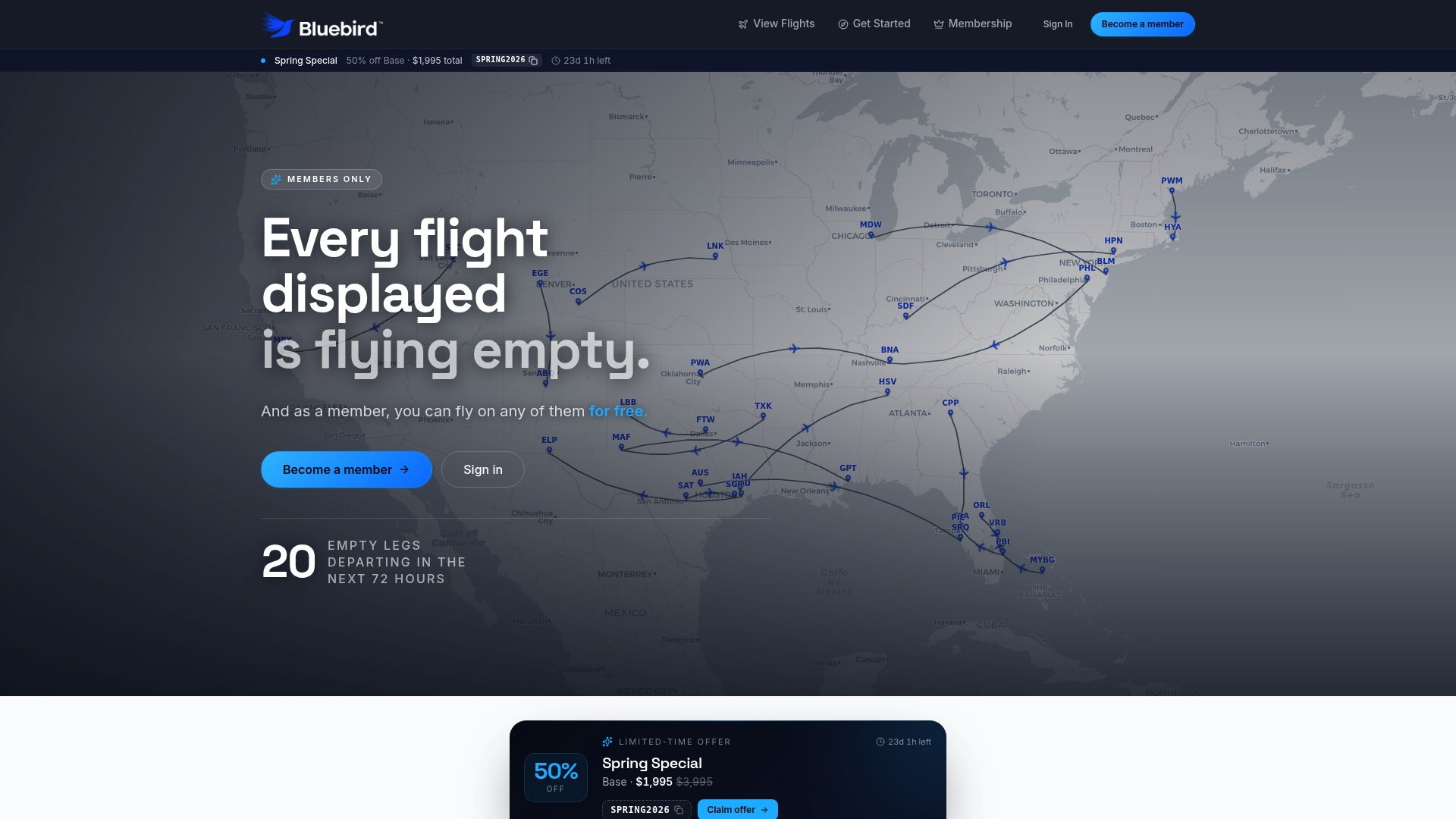
The Bluebirdjets membership gives you unlimited access to empty leg flights on the platform. No ownership commitment, no fixed annual overhead, and no repositioning fees on the flights you book. Empty legs are the repositioning flights operators need to fly regardless, which means the aircraft is moving whether you are on it or not. Bluebirdjets connects you to those flights at a fraction of standard charter rates, with the cost transparency and booking experience you would expect from a premium platform.
For travelers who fly 10–50 hours per year and can work with some schedule flexibility, this model cuts through the complexity of jet cards, fractional shares, and on-demand charter math. You get access to private flights without the overhead that makes ownership prohibitive for most people. The membership pays for itself quickly when compared to even a handful of standard charter bookings at full market rates.
Key Takeaways
Private aviation costs in 2026 range from under $3,000 per hour for very light jets to over $20,000 per hour for ultra-long-range aircraft, with secondary fees adding 20–40% on top of every base rate.
Point | Details |
|---|---|
Secondary fees are unavoidable | Budget 20–40% above the base hourly rate for taxes, positioning, landing fees, and crew costs. |
Aircraft matching cuts costs most | A heavy jet on a short route wastes fixed-cost overhead; right-sizing the aircraft is the most direct savings lever. |
Ownership requires 300+ hours to pencil out | Annual ownership costs run $500,000–$2.15 million; charter beats ownership below 150–200 annual flight hours. |
Empty legs offer 30–75% savings | Discounts are real but require schedule flexibility and acceptance of last-minute cancellation risk. |
Bluebirdjets membership | Unlimited empty leg access with no ownership overhead, built for travelers flying 10–50 hours per year. |