How Empty Leg Pricing Works: A Traveler's Guide

Empty leg pricing is the discounted rate operators charge for private jet repositioning flights that would otherwise fly without passengers. When a charter operator flies a jet from New York to Miami to pick up a client, that outbound flight is a cost the operator must absorb. Selling that seat at a discount recovers some of those costs without requiring a full retail fare. Understanding how empty leg pricing works gives you a real edge when searching for private jet access at a fraction of the standard rate. Platforms like Bluebirdjets have built their entire model around this pricing structure, offering members unlimited access to these discounted flights.
How empty leg pricing works: the core economics
Empty leg pricing exists because operators price against incremental costs, not full charter rates. The aircraft must reposition regardless of whether anyone is on board. Fixed costs like crew salaries, insurance, and aircraft depreciation are already committed. The operator only needs to recover the variable costs triggered by carrying passengers.
Those variable costs typically include:
Fuel: The largest incremental cost, varying by aircraft type and route distance
Landing fees: Charged per arrival at each airport
Handling fees: Ground services including towing, fueling, and ramp access
Catering: Optional but often included in quoted prices
Broker or platform commission: Usually a percentage of the sale price
Operators discount empty legs because incremental revenue is better than zero revenue. They will not price below their direct operating cost without a specific strategic reason, such as building a new client relationship. That floor is what prevents empty legs from becoming giveaways.
Pro Tip: Ask the operator or broker to separate the base flight cost from fees like handling and catering. The headline price rarely includes everything.
The pricing reflects marginal cost recovery covering fuel, handling, landing fees, and commission. Fixed positioning costs are sunk and do not factor into the empty leg quote. This is why the same route can cost dramatically less as an empty leg than as a standard one-way charter.
What drives the discount range on empty leg flights?
Empty leg discounts typically range from 30% to 75% off the equivalent standard one-way charter rate. That wide band reflects several variables that shift constantly. Route popularity, aircraft category, and timing all push the discount up or down.

The table below shows how these factors interact:
Factor | Effect on discount |
|---|---|
Popular route (e.g., New York to Miami) | Smaller discount; demand is higher |
Remote or one-way route | Larger discount; fewer buyers |
Light jet, short flight | Moderate discount; lower absolute cost |
Heavy jet, long flight | Larger absolute savings; discount varies |
Booking 2+ weeks out | Smaller discount; operator has time to find buyers |
Booking within 48 hours | Deeper discount; operator prefers revenue over empty seat |
Timing is the single biggest lever. Empty leg listings are time-sensitive inventory that can disappear or reprice sharply as departure approaches. An operator who listed a flight at 40% off two weeks ago may drop it to 65% off the day before if no buyer has appeared.
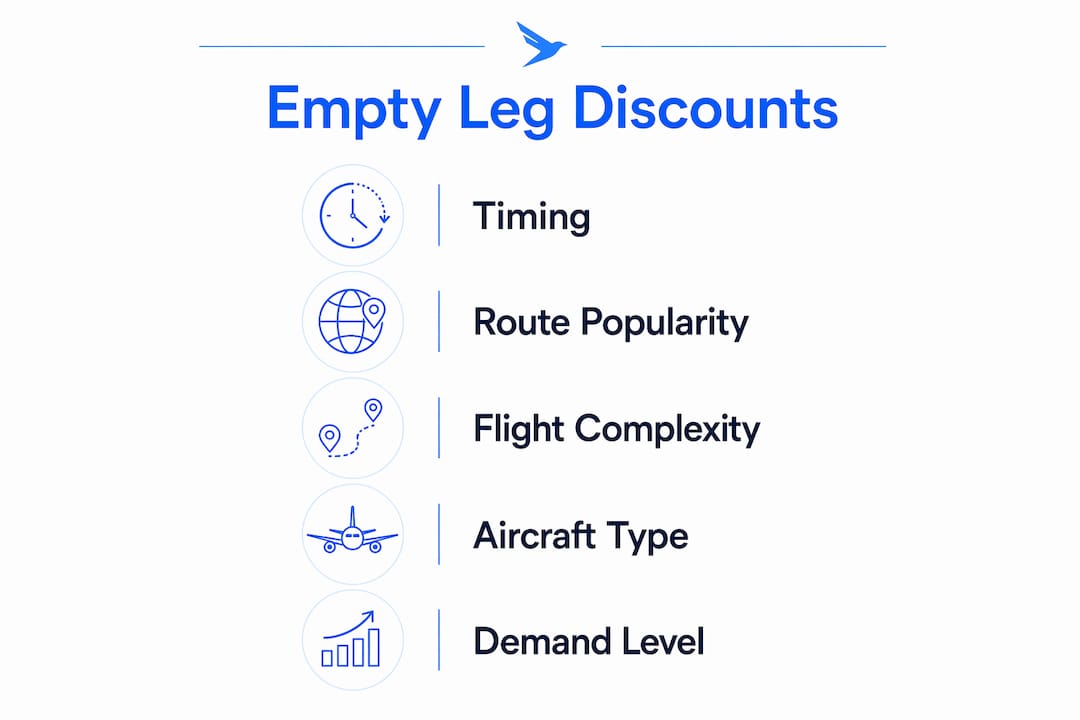
Route complexity also matters. A simple point-to-point repositioning on a busy corridor like Los Angeles to Las Vegas prices differently than a multi-stop repositioning across less-traveled routes. The latter involves more handling fees and crew time, which narrows the discount.
Pro Tip: Set alerts on platforms like Bluebirdjets for routes you travel regularly. Prices on the same corridor can vary by thousands of dollars depending on when you check.
Aircraft category shapes the absolute dollar savings even when the percentage discount is similar. A 50% discount on a light jet might save you $3,000. The same percentage on a large cabin jet could save $20,000 or more. Travelers who understand this dynamic focus on the dollar value of the deal, not just the percentage.
What are the booking constraints on empty leg flights?
Empty legs come with real limitations that standard charters do not have. Departure airports and routes are fixed by the primary charter booking. You cannot ask the operator to adjust the route to suit your schedule. The aircraft is going where it needs to go.
The key constraints travelers face include:
Fixed origin and destination: You fly the route the operator needs, not necessarily the one you want
Schedule dependence: If the primary charter changes, your empty leg can shift or disappear entirely
Limited negotiation: Core parameters like departure time and airport are rarely flexible
Short booking windows: Many listings appear within days or hours of departure
Cancellation risk: The flight can be pulled if the original charter is modified or canceled
Cancellation and refund policies vary by contract and are often strict. Unlike commercial airlines, private charter contracts carry no regulatory compensation guarantees. A deeply discounted empty leg may offer only a credit, not a cash refund, if the flight is canceled. Travelers who book empty legs without reading the cancellation terms often absorb that loss.
Experienced travelers treat empty legs as opportunistic, not primary, transportation. They keep a refundable backup option, whether that is a commercial flight or a flexible hotel booking, until the empty leg departs. The operational dependency on the primary charter means the flight could shift even after confirmation. That is not a flaw in the system. It is the nature of the product.
How do you evaluate whether an empty leg deal is genuine?
The most reliable way to check an empty leg price is to compare it against the aircraft’s standard hourly rate multiplied by the flight hours. A genuine deal prices close to the aircraft’s hourly rate times flight time, with minimal surcharges. If the quoted price is close to what a standard one-way charter would cost, the “discount” is not real.
Here is a practical evaluation process:
Get the aircraft type and tail number. This lets you look up standard hourly rates for that category.
Calculate the baseline. Multiply the standard hourly rate by estimated flight time. That is your reference point.
Request an all-in quote. Taxes, landing fees, and handling are often charged separately and can add significantly to the headline price.
Ask about de-icing, overnight crew costs, and catering. These fees can appear in the final invoice even when not mentioned upfront.
Confirm the cancellation policy in writing. Know whether you get a cash refund or only a credit if the flight is pulled.
Compare to a standard one-way charter on the same route. The empty leg should be meaningfully cheaper after all fees are included.
The comparison table below shows how to read a quote:
Line item | What to ask |
|---|---|
Base flight cost | Is this the full aircraft cost or per seat? |
Fuel surcharge | Is it included or added separately? |
Landing and handling fees | Per leg or round trip? |
Catering | Included or optional add-on? |
Cancellation terms | Cash refund or credit only? |
All-in pricing details matter because quotes can look attractive until fees are added. A $4,000 headline price can become $6,500 once landing fees, handling, and catering are included. Always confirm the final number before signing.
The empty leg availability guide from Bluebirdjets breaks down how route and timing affect what listings appear and when. Reading it before you search saves time and sets realistic expectations.
Key Takeaways
Empty leg pricing delivers real savings only when travelers understand the cost structure, confirm all-in pricing, and accept the scheduling constraints that come with repositioning flights.
Point | Details |
|---|---|
Pricing reflects incremental costs | Operators recover fuel, fees, and commission, not full charter rates. |
Discounts range from 30% to 75% | Deeper discounts appear on less popular routes and closer to departure. |
Timing changes the price | Listings reprice dynamically; last-minute deals can be steeper but riskier. |
All-in pricing matters | Always confirm fees for landing, handling, and catering before committing. |
Cancellation terms vary | Many empty legs offer credits, not cash refunds, if the flight is pulled. |
What I’ve learned about empty leg pricing after years in private aviation
The biggest misconception I see is that travelers treat the discount percentage as the whole story. A 60% discount sounds extraordinary. But if the operator is quoting a heavy jet on a route that takes 45 minutes, the “discounted” price might still be $12,000 after fees. That is a real saving compared to the standard charter rate, but it is not a budget flight. Knowing the baseline changes how you read every quote.
The second thing I have noticed is that the travelers who get the best deals are not the ones who wait for the perfect listing. They are the ones who stay flexible and move fast. Empty leg inventory is genuinely perishable. An operator would rather sell at 65% off than fly empty. That urgency is your advantage, but only if you are ready to book within hours, not days.
The risk side is underappreciated. I have seen travelers book a deeply discounted empty leg, skip the cancellation terms, and then lose the booking when the primary charter changed. The refund was a credit with a 12-month expiry. That is not a disaster, but it is a lesson. Read the contract. Confirm the policy. Keep a backup plan until wheels are up.
Bluebirdjets built its membership model around this reality. Unlimited access to empty legs means you can search broadly, move fast when a deal appears, and absorb the occasional schedule change without losing money on a one-off booking. That structure fits how empty leg pricing actually works.
— Nick
Bluebirdjets: access to empty leg flights in one place
Bluebirdjets offers a membership that gives you unlimited access to empty leg listings across its platform. Instead of monitoring multiple brokers and operators separately, members see available flights in one place with transparent pricing.
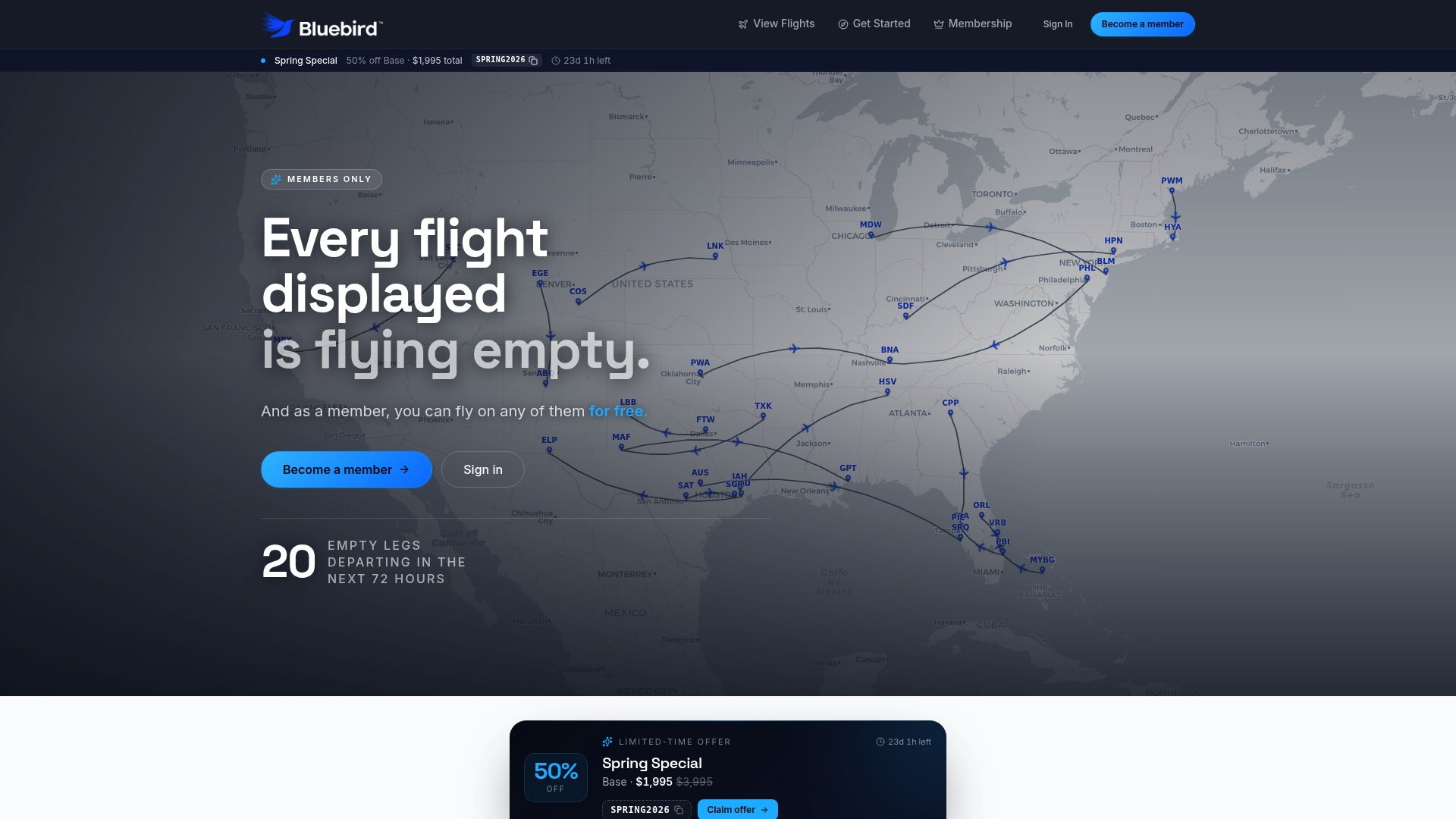
The Bluebirdjets membership is built for travelers who want to fly private without paying standard charter rates every time. The platform connects members directly to operator-listed empty legs, with pricing that reflects the real economics described above. You can browse available flights now and see current listings across routes and aircraft categories. Transparent, all-in pricing is the standard, not the exception.
FAQ
What is empty leg pricing?
Empty leg pricing is the discounted rate an operator charges for a private jet repositioning flight that would otherwise fly without passengers. The discount reflects incremental cost recovery rather than full charter rates.
How much can you save on an empty leg flight?
Discounts typically range from 30% to 75% off the equivalent standard one-way charter rate. Deeper discounts appear on less popular routes and closer to departure.
Can an empty leg flight be canceled?
Yes. If the primary charter booking changes, the empty leg can be modified or canceled. Cancellation policies are contract-driven and often offer credits rather than cash refunds on deeply discounted flights.
How do you know if an empty leg price is a real deal?
Compare the quoted price to the aircraft’s standard hourly rate multiplied by flight hours. A genuine deal prices close to that baseline. Always request an all-in quote that includes landing fees, handling, and catering before committing.
How do you book empty leg flights?
You can book through operators directly, through brokers, or through platforms like Bluebirdjets that aggregate listings. Confirm all-in pricing and cancellation terms before signing any contract.