How Private Jet Operators Recover Costs Through Empty Legs

How Private Jet Operators Recover Costs Through Empty Legs
Operators recover costs on repositioning flights by selling the empty sector to paying passengers at a price that covers fuel, landing fees, handling, catering, and broker commission. Those are the only costs that actually change when someone boards. Crew salaries, depreciation, and insurance are already committed whether the plane flies empty or full. A substantial share of private jet flights are repositioning legs, which means the industry generates significant empty-leg inventory daily. Memberships like Bluebirdjets convert that inventory into a predictable revenue stream for operators, and into priority access at steep discounts for members. The catch: availability, route, and timing are always dictated by the primary charter client’s schedule, not yours.
Table of Contents
- What is an empty leg and why does it exist?
- How costs break down: sunk versus recoverable
- How operators price empty legs in practice
- How unlimited membership platforms change the economics
- What members should realistically expect
- Where operators list empty legs and what booking looks like
- Worked example: how one empty leg offsets operator costs
- Is an unlimited empty-leg membership right for you?
- Key Takeaways
- The empty-leg model rewards patience, not assumptions
- Bluebirdjets gives you first access to empty-leg inventory
- Useful sources
What is an empty leg and why does it exist?
An empty leg (also called a repositioning flight or deadhead sector) is a flight a private jet must make to get back to its base or to reach the next charter client’s departure airport. The aircraft has to fly regardless. No passenger revenue is expected. The operator’s only decision is whether to sell seats on that sector or absorb the variable costs entirely.
Repositioning flights exist for three main operational reasons:
- A charter client books a one-way trip, so the aircraft must return empty.
- The next charter departs from a different airport, requiring a base-to-base transfer.
- Scheduled maintenance or crew rotation requires the aircraft to move to a specific facility.
This article focuses exclusively on empty-leg sales and membership access as cost-recovery channels. Fractional ownership, aircraft management contracts, and full charter pricing are separate revenue models with different economics.
How costs break down: sunk versus recoverable
The distinction between fixed and variable costs is what makes empty-leg pricing rational rather than just cheap.
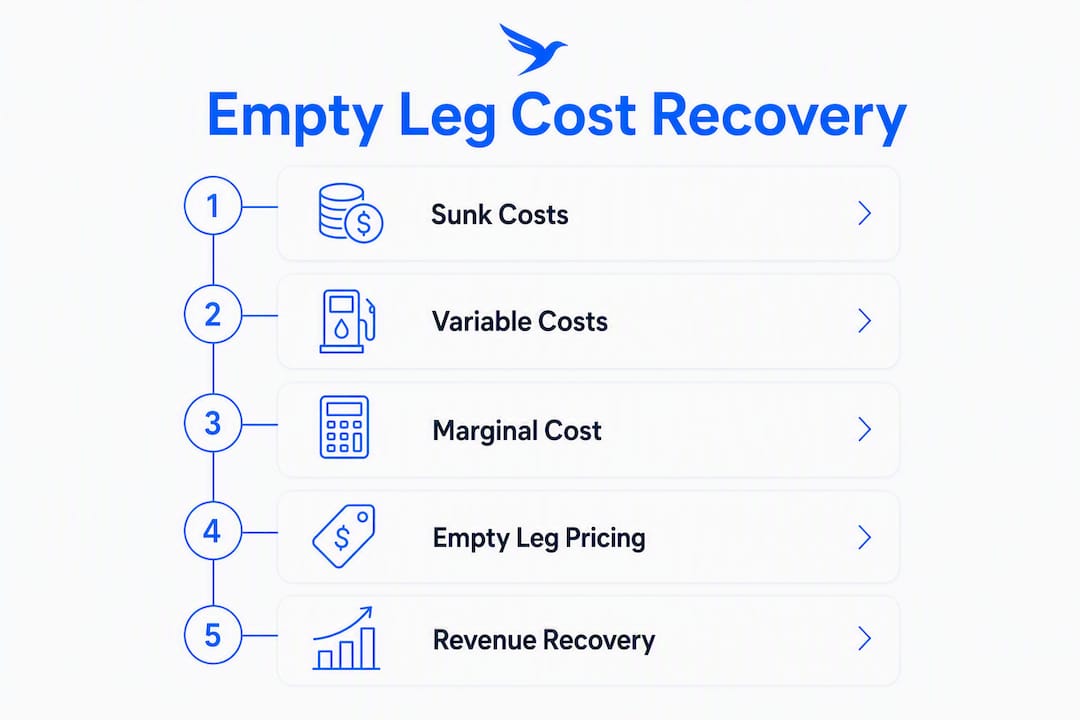
Fixed costs are sunk. Whether the jet flies empty or carries six passengers, the operator pays crew salaries (pilots are rostered regardless), aircraft depreciation, hull and liability insurance, and scheduled maintenance reserves. These costs do not move with a single additional sector.
Variable costs are what the operator actually recovers by selling an empty leg. These include:
- Sector fuel burn (the single largest variable item)
- Landing and handling fees at both departure and arrival airports
- Catering and cabin services
- Crew per diems tied to the additional passenger service
- Broker or aggregator commission on the sale
The economic logic is clean: any revenue above true marginal cost is incremental gain compared with flying empty. The operator was going to incur those variable costs anyway. Selling the sector turns a pure expense into partial or full cost recovery.
Pro Tip: Routes between high-traffic airport pairs (think Teterboro to Miami or Van Nuys to Las Vegas) have lower marginal-cost floors because fuel burn is predictable and handling fees at those airports are well-established. Less common routes carry more pricing uncertainty, which is why discounts on obscure city pairs can be steeper or shallower than you’d expect.

How operators price empty legs in practice
Pricing an empty leg is not arbitrary. Operators work from a marginal-cost floor and adjust upward based on market conditions.
The factors that move the price:
- Marginal cost floor: fuel, landing/handling, catering, and commission set the minimum viable price.
- Route demand: a popular leisure corridor commands a higher asking price than a thin business route.
- Time to departure: prices often drop as the departure window closes and the risk of flying empty increases.
- Aircraft type: a Learjet 60 carries different fuel burn and handling costs than a heavy cabin jet.
- Broker commission: most empty legs are distributed through brokers and aggregator platforms, and their commission is baked into the consumer-facing price.
Discounts relative to a standard charter rate typically vary widely, depending on route, timing, and how urgently the operator wants to fill the seat. Last-minute bookings often yield the steepest discounts because an operator approaching departure with an empty cabin faces a binary choice: take something or take nothing.
The operator sets the price. Where it gets sold determines how much of the discount actually reaches you. Direct operator listings preserve more of the margin; broker marketplaces add a commission layer that narrows the discount slightly without eliminating it.
How unlimited membership platforms change the economics
A membership model does something a one-off booking cannot: it converts uncertain, last-minute demand into predictable annual revenue. When operators know a pool of vetted, committed members is watching their inventory, they have stronger incentives to list and price empty legs attractively rather than absorb the variable costs quietly.
Memberships raise the probability that a listed empty leg converts to a sale. That probability shift is what justifies lower per-flight pricing for members — the operator trades per-flight margin for volume and revenue certainty.
Bluebirdjets is built around this dynamic. The platform runs on operator-owned Learjet 60 jets and gives members unlimited access to published empty-leg flights at no per-flight charge. The features that matter most to both sides of the transaction:
- Live inventory with daily-updated routes so members see real availability, not stale listings.
- Priority booking queue that puts members ahead of the general public on new listings.
- Premium tier with Skip-the-Line for members who want first access on high-demand routes.
- Up to six guests per flight on a single membership, which changes the per-person economics dramatically.
- Optional paid custom charter requests for trips that don’t match available empty legs.
One important balance: memberships improve access and booking priority, but they do not change where empty legs come from. The primary charter client’s schedule still drives availability. A membership buys you a better position in the queue, not a guaranteed departure.
Some operators also weigh maintenance and utilization risk when deciding how aggressively to monetize repositioning sectors. Higher utilization accelerates maintenance intervals, and a mechanical issue on an empty-leg flight carries reputational cost. Membership platforms that work with vetted operators reduce that friction.
What members should realistically expect
Empty-leg travel rewards flexibility. The members who get the most value are the ones who treat it as a spontaneous upgrade rather than a scheduled itinerary.
Set realistic expectations first:
- Sectors are one-way. Plan your return separately.
- Routes and times are fixed by the primary charter. You adapt to the schedule, not the reverse.
- Last-minute changes or cancellations tied to the primary client do happen.
- Baggage and guest allowances vary by aircraft configuration.
Practical steps to improve your match rate:
- Keep your geographic range wide. Members locked to one city pair will miss most inventory.
- Enable push notifications so you see new listings the moment they post.
- Use the priority queue or Skip-the-Line feature on routes you know are competitive.
- Confirm ground transport and handling at the arrival airport before you book.
- Verify the guest count and baggage limits for each specific listing.
Flexible schedules are the single biggest predictor of empty-leg success. Members who can move a meeting by a few hours or shift a weekend trip by a day capture opportunities that rigid planners miss entirely.
Where operators list empty legs and what booking looks like
Empty legs reach consumers through four main channels, each with different price transparency and booking friction.
Operator direct listings offer the cleanest price because no intermediary commission is layered in. The trade-off is that you need a relationship with the operator or access to their booking system.
Broker marketplaces aggregate inventory from multiple operators. Convenient for comparison, but the commission structure means the listed price is slightly higher than what the operator would charge directly.
Aggregator platforms cast a wider net and are useful for discovery, though notification speed and booking workflow vary considerably. By the time a listing appears on a large aggregator, the best inventory may already be gone.
Membership platforms like Bluebirdjets offer priority early access before listings hit public channels. The booking workflow is tighter, cancellation policies are clearer, and the concierge layer helps members handle logistics that a raw aggregator listing leaves to you.
Timing matters across all channels. A listing that appears 72 hours before departure and sits unsold will often see a price reduction at the 24-hour mark. Members with notifications enabled and a flexible calendar are positioned to catch those drops.
Worked example: how one empty leg offsets operator costs
The numbers below are illustrative. Actual figures vary by aircraft type, route, and market conditions. For detailed cost-category breakdowns, see Bluebirdjets’s private aviation cost breakdown guide.
| Cost item | Illustrative amount |
|---|---|
| Total marginal cost floor | $4,830 |
| Operator asking price (empty leg) | $6,500 |
| Member discount vs. charter | ~59% |
| Operator incremental recovery above floor | $1,670 |
Without a sale, the operator absorbs $4,830 in variable costs and recovers nothing. Selling the sector at $6,500 covers every variable cost and returns $1,670 above the floor. Multiply that across a fleet flying multiple repositioning sectors per week and the cash-flow effect on monthly operations is meaningful. The member, meanwhile, flies private at roughly 59% below the standard charter rate for the same route.
These figures are illustrative and do not represent any specific Bluebirdjets route or aircraft.
Is an unlimited empty-leg membership right for you?
The value of a membership scales directly with how you travel. Frequent, flexible flyers gain the most; infrequent or route-specific travelers may find pay-as-you-go empty-leg booking or traditional charter more practical.
A membership makes strong financial sense when you:
- Take four or more spontaneous trips per year and can flex on timing.
- Travel in groups of two to six people (the per-person economics improve sharply).
- Have multiple potential departure cities rather than one fixed home airport.
- Value priority access and concierge support over hunting listings manually.
Stick to pay-as-you-go or charter when you:
- Need a specific route on a specific date with no flexibility.
- Travel infrequently enough that the annual fee exceeds your likely flight savings.
- Require guaranteed departure times that empty-leg availability cannot promise.
One structural point worth understanding: the annual membership fee is part of what makes operators willing to list and price empty legs attractively. Members collectively subsidize availability by providing the platform with predictable revenue, which the platform uses to maintain operator relationships and inventory quality.
Key Takeaways
Operators recover marginal costs through empty-leg sales, and memberships convert that uncertain inventory into predictable revenue for operators while giving members priority access at discounts that can be as much as approximately 59% off standard charter rates, based on illustrative examples.
| Point | Details |
|---|---|
| Marginal cost recovery | Empty-leg sales cover fuel, handling, catering, and commission — fixed costs remain sunk regardless. |
| Discount range | Members can often see substantial discounts off charter rates; last-minute timing drives the steepest discounts. |
| Membership trade-off | Priority access and early inventory visibility improve match rates but cannot guarantee specific routes or times. |
| Flexibility is the key variable | Members with wide geographic range and flexible schedules capture significantly more inventory than rigid planners. |
| Bluebirdjets membership | Unlimited empty-leg access on Learjet 60 jets, with live inventory, priority queue, and up to six guests per flight. |
The empty-leg model rewards patience, not assumptions
Most of the misconceptions I see about empty-leg memberships come from the same place: people expect the discount to come with control. They assume that paying an annual fee means they can name a route, pick a time, and get a price that beats charter. Sometimes that’s exactly what happens. Often it doesn’t, and the members who feel burned are the ones who never adjusted their expectations to match how the model actually works.
The economics are honest. Operators are not running a charity. They’re selling a seat that would otherwise cost them money to fly empty. The discount exists because the alternative is zero revenue, not because the operator is being generous. Understanding that changes how you use a membership. You stop trying to force it into your existing travel habits and start building travel habits that fit the inventory.
The members I’ve seen get genuine, consistent value from unlimited empty-leg access share one trait: they treat it as a first-look opportunity rather than a guaranteed booking. They watch the inventory, they move when something fits, and they plan their returns separately. That’s not a limitation of the model. That’s the model working as designed.
Bluebirdjets gives you first access to empty-leg inventory
Every empty leg on Bluebirdjets is a real repositioning sector on an operator-owned Learjet 60, priced to recover marginal costs and nothing more. Members get unlimited access to those flights at no per-flight charge, with live inventory updated daily so you’re never looking at stale listings.

The priority booking queue puts members ahead of public listings the moment a new sector posts. The premium tier’s Skip-the-Line feature goes further, giving you first position on high-demand routes before the queue opens. Bring up to six guests on a single membership, and the per-person math on a group trip starts to look very different from anything charter can offer. When an empty leg doesn’t match your plans, the optional custom charter request fills the gap.
View current empty-leg inventory or explore membership tiers to see which level of access fits your travel patterns.
Useful sources
- How empty legs are reshaping the business aviation ecosystem — Business Airport International
- Why Empty Leg Flights Are Cheaper Than Charter — AeroCorner
- Why One Private Jet Broker Wants To Keep Empty Legs Empty — Forbes
- Why empty legs suit flexible schedules — Bluebirdjets
- Private aviation cost breakdown examples — Bluebirdjets
The worked example in this article uses illustrative figures only. Actual costs vary by aircraft type, route, airport, and market conditions. This article is general information, not financial or legal advice — confirm current pricing and terms directly with operators or a qualified aviation advisor.