Why Private Jets Have Spare Seats: A Traveler's Guide

Private jets have spare seats because operators must fly repositioning flights, known in the industry as empty legs, without any paying passengers on board. These flights happen after dropping off a client or before picking up the next one. The aircraft has to move regardless, so the seats are empty by default. Operators sell those seats at a steep discount to recover at least some of the unavoidable costs. Understanding why private jets have spare seats is the first step to accessing private aviation at a fraction of the standard price.
Why private jets have spare seats: the empty leg explained
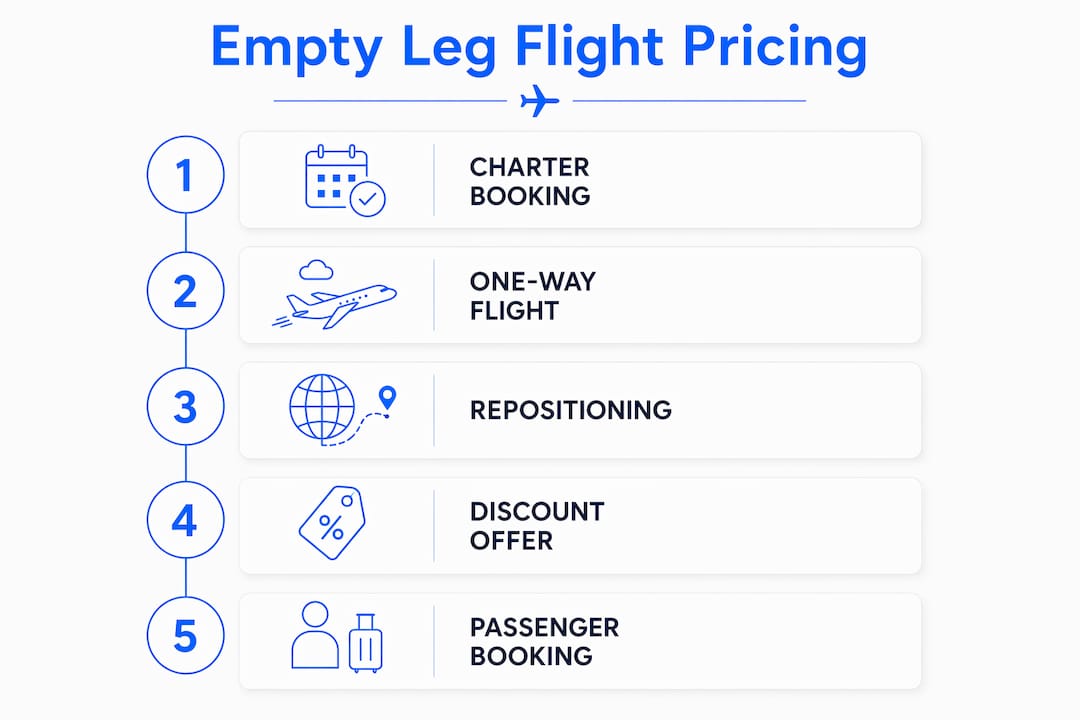
Empty legs are the direct result of one-way charter bookings. A client charters a jet from New York to Miami, flies down, and the trip ends there. The aircraft still needs to return to its home base or travel to the next client’s departure city. That return or repositioning flight carries no passengers unless the operator actively sells the seats.
The term “empty leg” is the standard industry phrase for this phenomenon. You may also hear “deadhead flight” or “ferry flight” in aviation circles. All three describe the same thing: a private jet flying a scheduled route with spare capacity on board.

Operators at companies like NetJets, VistaJet, and smaller regional charter firms all face this same structural issue. The more one-way charters they fly, the more repositioning flights they generate. A busy operator running dozens of charters per week can produce a significant number of empty legs across their fleet at any given time.
Pro Tip: The best empty leg deals appear on routes between major business hubs like New York, Los Angeles, Miami, and Chicago, where charter volume is highest and repositioning flights are most frequent.
How does empty leg pricing actually work?
The economics behind discounted spare seats are straightforward once you understand fixed versus marginal costs. When an operator prices a standard charter, the fee covers crew salaries, aircraft depreciation, insurance, fuel, landing fees, and a profit margin. On a repositioning flight, those fixed costs are already covered by the primary charter that created the empty leg.
Marginal costs on a repositioning leg typically include fuel, crew per diem, landing fees, and handling charges. On a mid-size jet, those figures might look like this:
Cost item | Typical range |
|---|---|
Fuel | $3,200 |
Crew per diem | $500–$800 |
Landing and handling | $400–$600 |
Standard charter equivalent | $14,000–$18,000 |
The gap between those two numbers explains why empty legs are discounted 50% to 75% compared to a standard charter. The operator is not being generous. Selling the seat at marginal cost is simply better than flying empty and recovering nothing.
“Any revenue from selling empty leg seats offsets otherwise unrecoverable repositioning costs, with no effect on aircraft quality or service standards.” — AeroCorner
Operators never price below their direct operating costs unless there is a strategic reason, such as building a relationship with a new client. Direct operating costs for a light jet typically run $2,000–$2,500 per flight hour. That floor sets the absolute minimum price you will ever see on a legitimate empty leg listing.
Empty leg pricing also behaves like dynamic inventory management. Prices tighten as the flight date approaches and another buyer enters the picture. If the primary charter gets canceled or rescheduled, the empty leg disappears entirely. Speed and flexibility are not optional when booking these seats.
What are the trade-offs when booking spare seats?
Empty legs are not a flexible travel product. They are an opportunistic one. The route, departure time, and aircraft type are all fixed by the operator’s existing schedule. You adapt to the flight, not the other way around.
Availability is unpredictable, and cancellations can happen within hours of departure if the primary charter changes. Booking conditions are typically non-refundable. That combination of inflexibility and cancellation risk is the real cost of the discounted price.
The travelers who benefit most from empty legs share a few traits:
They have flexible calendars and can move quickly when a deal appears.
They are not locked into specific departure times or airports.
They understand that the route is fixed and they cannot request changes.
They are comfortable with non-refundable bookings and last-minute adjustments.
They treat empty legs as a bonus opportunity, not a primary travel plan.
Retirees, digital nomads, and flexible business owners consistently get the most value from empty leg deals. A salaried professional with a fixed meeting schedule will find the constraints frustrating. The product simply does not fit a rigid itinerary.
Pro Tip: Always have a backup commercial flight booked when you rely on an empty leg for a time-sensitive trip. Cancellations are real, and the savings disappear fast if you miss a critical meeting.
How can you find and book spare seats on private jets?
The most direct way to find spare seats is through empty leg flight listings on operator and broker platforms. These databases update in real time as new repositioning flights are scheduled. The best deals often require daily checking and the ability to book immediately when something matches your plans.
Some operators sell individual seats on empty legs rather than the full aircraft. This semi-shared model gives you the private jet experience, including the same aircraft and crew service as a standard charter, without the full charter price. You get the leather seats, the quiet cabin, and the private terminal. The only difference is the fixed schedule.
Here is what to focus on when searching for spare seats:
Check multiple platforms. Listings appear on operator websites, broker aggregators, and dedicated empty leg databases. No single source has every flight.
Focus on high-traffic routes. Corridors like New York to Miami, Los Angeles to Las Vegas, and Atlanta to Fort Lauderdale generate the most empty legs because charter demand on those routes is consistently high. You can browse live options like the Atlanta to Fort Lauderdale empty leg on Bluebirdjets right now.
Act fast on last-minute listings. A flight departing in 48 hours will carry a deeper discount than one listed two weeks out. The urgency is real, and so is the savings.
Work with a broker. Private jet brokers who specialize in empty legs often have access to unlisted inventory. They know which operators run specific routes regularly and can alert you before a flight hits the public database.
Consider a membership platform. Services like Bluebirdjets aggregate empty leg inventory and give members consistent access to spare seat listings without the need to monitor dozens of individual operator sites.
The empty leg availability guide on Bluebirdjets breaks down exactly how scheduling decisions at the operator level affect what shows up in listings. Understanding that process helps you predict where deals will appear before they go live.
Key Takeaways
Private jets have spare seats because repositioning flights are an unavoidable byproduct of one-way charters, and operators sell those seats at marginal cost to recover what would otherwise be zero revenue.
Point | Details |
|---|---|
Empty legs are structural | Every one-way charter creates a repositioning flight that generates spare seats. |
Discounts reflect marginal cost | Savings of 50%–75% off standard charter rates are common because fixed costs are already covered. |
Flexibility is required | Routes, times, and aircraft are operator-determined; cancellations can happen within hours. |
Service quality stays the same | You get the same aircraft and crew as a standard charter, just with a fixed schedule. |
Speed wins deals | Empty leg pricing is dynamic; the best listings disappear fast and reward quick decisions. |
My honest read on the empty leg market
The private jet industry has done a poor job explaining empty legs to the traveling public. Most coverage treats them as a quirky discount product rather than what they actually are: a structural feature of how private aviation operates. Every operator with a busy charter schedule generates empty legs constantly. The supply is real and consistent.
What I find underappreciated is the service parity. Travelers assume a discounted seat means a compromised experience. It does not. The aircraft is identical to what a full-paying charter client boards. The crew is the same. The catering is the same. The only thing that changes is who controls the schedule, and on an empty leg, that is the operator, not you.
The market is also maturing fast. A few years ago, finding empty legs meant cold-calling operators or knowing a broker personally. Now platforms aggregate listings in real time, and membership models give frequent travelers consistent access without the daily hunt. That shift genuinely opens private aviation to a wider group of travelers, not just the ultra-wealthy.
My advice: treat empty legs as a layer in your travel strategy, not a replacement for planning. If you have flexibility built into your calendar and you fly routes that see heavy charter traffic, you will find deals that feel almost too good to be real. The real pricing logic behind empty legs makes those deals entirely rational once you understand the economics.
— Nick
Bluebirdjets membership: your access to empty leg seats
Bluebirdjets sells a membership that gives you unlimited access to empty leg listings on its platform. Instead of monitoring multiple operator sites and broker databases, you get a single feed of curated spare seat flights updated in real time.

The Bluebirdjets membership is built specifically for travelers who want consistent access to discounted private jet seats without the friction of one-off searches. Current listings include routes like Pittsburgh to Dulles and Bedford to Teterboro, with new flights added as operators schedule repositioning legs. Browse the full Bluebirdjets flights catalog to see what is available on your routes right now.
FAQ
What is an empty leg flight on a private jet?
An empty leg is a repositioning flight that a private jet must complete without paying passengers, typically after dropping off a charter client or before picking up the next one. Operators sell seats on these flights at a discount to offset unavoidable operating costs.
Why are empty leg flights so much cheaper?
Empty leg discounts of 50%–75% are standard because the fixed costs of the flight are already covered by the primary charter. Operators only need to recover marginal costs like fuel, landing fees, and crew per diem.
Can empty leg flights be canceled?
Yes. Cancellations can happen within hours of departure if the primary charter that created the empty leg is changed or canceled. Bookings are typically non-refundable, so travelers should treat empty legs as opportunistic rather than guaranteed.
Who is the ideal traveler for spare seats on private jets?
Travelers with flexible schedules who can make fast decisions get the most value from empty legs. Retirees, digital nomads, and business owners with adaptable calendars consistently find the best deals because they can match their plans to the operator’s fixed schedule.
Do you get the same service on an empty leg as a full charter?
Yes. The aircraft, crew, and service standards on an empty leg are identical to a standard charter. The only difference is that the route and departure time are set by the operator, not the passenger.