Break Even Math: Membership vs Charter & Empty Leg for Affluent Flyers

Break Even Math: Membership vs Charter & Empty Leg for Affluent Flyers
Occasional flyers with unpredictable schedules do best on on-demand charter, while travelers who fly 50 or more hours a year with consistent routes usually save money on a jet card or prepaid membership. Spontaneous flyers who can bend their dates around available inventory often find the best value in an empty-leg membership like Bluebird. The right answer depends on your verified charter quotes and the specific program terms, so run the break-even math before you commit, and confirm the operator holds a valid FAA Part 135 certificate with proper DOT broker disclosures.
TL;DR:
- For fly less than 50 hours annually, on-demand charter is usually cheaper due to lack of fixed program fees.
- Jet cards are cost-effective above roughly 50 hours per year, with break-even depending on the specific rates and fixed costs.
- When comparing offers, include all fees such as fuel surcharges, repositioning, taxes, and minimums to calculate the true hourly cost.
- Guarantee of availability is typically offered by memberships and jet cards within certain conditions, but on-demand charter has no guaranteed lift.
- Empty-leg memberships suit flexible travelers who can accept routing and timing constraints for significantly lower per-flight costs.
Table of Contents
- At-a-glance comparison: membership types vs on-demand charter
- Cost and break-even: how to run the numbers
- Availability and booking: lead times, peak days, and guaranteed lift
- Service inclusions and contract fees to verify
- Safety and regulation: the buyer’s verification checklist
- Decision framework: which option fits you (hours, routes, capital)
- Bluebird’s empty-leg membership: when a subscription to empty legs makes sense
- Typical length and commitment requirements for memberships versus charters
- Overview of cancellation and refund policies for both membership and charter services
- Comparative analysis of service quality and additional perks (e.g., concierge, aircraft variety)
- Author perspective: practical next steps and common pitfalls
- Bluebird membership: a membership route for spontaneous, affluent flyers
- Sources
- FAQ
At-a-glance comparison: membership types vs on-demand charter
Three distinct models cover most of the private aviation market, and confusing them leads to overpaying. A jet card is a prepaid block of flight hours at a fixed hourly rate, typically 25 hours or more, purchased upfront. A membership or subscription usually involves recurring dues or a deposit and may bundle in perks like empty-leg access, guaranteed pricing, or priority booking. On-demand charter is the simplest: you request a specific trip and receive a quote, with no ongoing commitment.
Each model trades commitment for price certainty in a different way.
- Jet cards lock in an hourly rate for a defined number of hours, offering price predictability but requiring a large upfront deposit.
- Prepaid memberships often add guaranteed availability windows in exchange for annual dues, fitting flyers with consistent, moderate usage.
- On-demand charter carries zero commitment and the highest flexibility, but pricing varies trip to trip and availability isn’t guaranteed.
- Empty-leg memberships trade guaranteed lift for a much lower marginal cost per flight, working best when your dates can flex around published routes.
Cost and break-even: how to run the numbers
Before choosing between a membership and charter, define four variables: H is your annual flight hours, C is your blended on-demand charter cost per hour, R is the program’s hourly rate (for jet cards) or effective rate, and F is the program’s annualized fixed cost, meaning membership dues, deposits, or minimums that don’t scale with hours flown.
The standard break-even formula is:
break-even hours ≈ F ÷ (C − R)
Below that number of annual hours, on-demand charter is usually cheaper. Above it, the prepaid program wins. The formula assumes C and R stay stable across the year, which rarely holds exactly, so treat the result as a planning estimate rather than a guarantee.
Two illustrative examples show how this plays out:
- Say a flyer books 20 hours a year, charter runs $9,000 an hour blended, and a card’s hourly rate is $7,500 with $15,000 in annual fixed costs. Break-even lands at 10 hours, so at 20 hours the card wins clearly.
- Say a flyer books only 8 hours a year with the same rates. The card still breaks even at 10 hours, so this flyer is better off staying on charter until usage climbs.
Every membership or card comparison should use your own dated, itemized quotes rather than published headline rates. Brokers advise normalizing every offer to an all-in hourly cost before comparing programs, since headline rates rarely include the extras that move the real number.
Line items to normalize across offers include Federal Excise Tax at 7.5%, fuel surcharges, repositioning or deadhead legs, daily minimums, and taxi time billed as flight time. Skipping any of these when comparing quotes will make a card or membership look cheaper than it actually is.

Availability and booking: lead times, peak days, and guaranteed lift
Booking windows differ sharply between models. Jet cards and prepaid memberships often promise guaranteed availability with as little as 10 to 24 hours’ notice, though “guaranteed” typically comes with conditions: a maximum number of peak days per year, blackout dates around major holidays, and a defined service area. On-demand charter has no such promise. You request a trip and the broker or operator searches live availability, which can mean same-day lift or no aircraft at all depending on the market.
Several factors change the practical value of any guarantee:
- Peak-day surcharges apply around holidays and major events, and a program’s fine print determines how many peak days you get per year before extra fees kick in.
- Service area limits can exclude international legs or remote airports from your guaranteed-access terms.
- Daily minimums mean a short trip can cost as much as a much longer one, since the aircraft is billed for a minimum flight time regardless of distance.
- One-way trips often cost more per hour than round trips because the operator absorbs a repositioning leg with no paying passenger.
Pro Tip: Build your itinerary around available empty legs when your dates are flexible, and reserve on-demand charter quotes for trips where the date truly cannot move.
Service inclusions and contract fees to verify
Every program bundles some services and bills others separately, and the split is rarely obvious from a marketing page. Concierge support, catering, and ground transportation coordination are commonly included. Aircraft category guarantees, meaning a promise of a specific cabin class rather than a specific tail number, vary widely and should be confirmed in writing.
Recurring fees to ask about before signing anything:
- Repositioning or deadhead charges for flying the aircraft to your departure point.
- De-icing and handling fees, which spike seasonally and by airport.
- Federal Excise Tax at 7.5% on the base charter cost, which some quotes bury or omit.
- Overnight crew costs, including hotel and per diem when a trip requires the crew to stay over.
- Administrative or booking fees charged per leg or per year on top of dues.
Escrow and refund terms matter as much as the sticker price. Industry guidance warns buyers to confirm who holds prepaid funds and whether they are refundable, since deposits without clear escrow protection can be lost if a program shuts down or changes terms. For a deeper look at contract traps specific to membership deposits, see this guide to avoiding common contract pitfalls.
Pro Tip: Ask every provider to state expiry dates, refund conditions, and fund custody in writing before you send a deposit, not after.
Safety and regulation: the buyer’s verification checklist
Every legitimate charter or membership flight operates under a Part 135 certificate, and confirming this before you fly is non-negotiable.
- Request the operator’s FAA Part 135 certificate and Air Carrier number. Operational control belongs to the certificated Part 135 operator, not the broker arranging your trip.
- If a broker is involved, confirm they comply with DOT disclosure rules under 14 CFR Part 295, which require the broker to state clearly whether they act as your agent or the carrier’s, and to identify the direct air carrier operating the flight.
- Ask for current insurance limits, crew qualification records, and evidence of a drug and alcohol testing program.
A missing Federal Excise Tax line or a vague operator identity on an invoice is a red flag. DOT and FAA guidance recommends buyers request an itemized invoice and walk away if an operator or broker won’t confirm certificate status in writing.
Decision framework: which option fits you (hours, routes, capital)
Annual hours flown is the single strongest signal for which model fits, though it isn’t the only one.
- Under roughly 50 hours a year, on-demand charter usually wins on total cost since fixed program dues have little volume to spread across.
- Between roughly 50 and 100 hours, a jet card or membership often starts to pay off, though the exact crossover depends on your specific R and F. Independent industry analysis places this band as a common rule of thumb, while stressing that precise break-even requires your own numbers.
- Above roughly 100 hours, fractional ownership starts to make sense for some flyers, though that comparison sits outside membership versus charter.
Route consistency matters almost as much as hours. A flyer who repeats the same city pair benefits from a card locked to that lane, while a flyer with scattered, unpredictable routes gets more value from charter’s trip-by-trip flexibility. International travel, larger cabin needs, and a preference for guaranteed tail numbers all push toward more structured programs.
When speaking with any provider, ask these questions directly: What is the availability service level agreement in writing? Are deposits refundable, and who holds the funds? How is taxi time billed? What exactly counts as a peak day? Model your true all-in cost per hour, including every fee above, before signing anything.

Bluebird’s empty-leg membership: when a subscription to empty legs makes sense
Some empty-leg memberships give access to published empty-leg flights on operator-owned aircraft, with live inventory updated daily and a queue system for priority booking. Such memberships may also allow guests per flight and offer paid custom charter requests for trips outside published empty-leg routes.
The trade-off is straightforward: marginal cost per flight is low because you’re filling a leg the aircraft was already flying, but timing and routing are set by the aircraft’s existing schedule rather than your preferred date. This model fits flyers who can accept standby-style flexibility in exchange for lower per-trip cost, particularly for short-notice leisure trips or one-way repositioning flights where a fixed departure city and date aren’t essential. A closer look at whether the annual fee pays off for typical usage patterns is covered in this analysis of empty-leg membership value.
Typical length and commitment requirements for memberships versus charters
On-demand charter carries no term commitment at all. You pay for the trip you book and owe nothing beyond that flight, which is why it remains the default choice for flyers who fly only occasionally or unpredictably.
Membership programs and jet cards work differently. Jet cards typically require purchasing a block of hours, often 25 or more, that must be used within a defined window, commonly 12 to 24 months, after which unused hours can expire depending on the contract. Subscription-style memberships, including empty-leg models, generally run on an annual term with recurring dues rather than a depleting hour balance.
The commitment length matters because it determines your exposure if your travel needs change. A jet card locks capital into a block of hours that may go unused if your schedule shifts, while an annual membership dues structure resets each year and typically carries less capital risk than a large prepaid hour block. Before committing to any term, confirm in writing what happens to unused hours or dues if you cancel partway through the period, since this varies significantly between providers and is rarely spelled out clearly in marketing materials.
Overview of cancellation and refund policies for both membership and charter services
Charter cancellation terms are typically trip-specific and time-based: cancel with sufficient notice and you may owe nothing, while cancelling close to departure can mean forfeiting some or all of the trip cost. These windows vary by operator and should be confirmed at the time of booking, not assumed.
Membership and jet card cancellation is more complex because it involves a standing deposit or dues payment rather than a single trip charge. Some programs offer prorated refunds if you cancel mid-term, while others treat dues as fully earned once paid, with no refund regardless of usage. Unused prepaid hours on a jet card may or may not be refundable depending on the contract, and expiry dates can forfeit that value entirely if you don’t fly enough within the term.
The safest practice is to get cancellation and refund terms in writing before paying anything, and to ask specifically what happens to unused funds or hours. Industry guidance advises buyers to confirm who holds prepaid funds and whether those funds sit in escrow, since programs without clear refund protection have left members exposed when a provider changed terms or ceased operating.
Comparative analysis of service quality and additional perks (e.g., concierge, aircraft variety)
Service quality differences between membership and charter usually show up in three areas: concierge support, aircraft consistency, and extras like catering or ground coordination.
Membership programs often bundle concierge service as a standing benefit, meaning a dedicated point of contact handles booking without a fresh negotiation each time. On-demand charter can offer similar concierge-style service through a broker, but it’s typically negotiated per trip rather than guaranteed as part of an ongoing relationship.
Aircraft variety cuts the other way. Charter brokers can typically access a wide range of aircraft categories and tail numbers across their network, giving flyers more choice on cabin size and range for any single trip. Membership programs, particularly single-fleet models, offer consistency in aircraft type and cabin experience but less range of choice, since you’re accessing a defined set of aircraft rather than an open market. Which matters more depends on whether you value knowing exactly what aircraft you’ll fly or having the widest possible selection for each trip.
Author perspective: practical next steps and common pitfalls
Start by auditing your actual annual hours flown, not your guess. Collect dated, itemized charter quotes for your real routes, and request FAA Part 135 and DOT broker disclosures before paying anyone. The biggest pitfall I see is flyers locking large deposits into a card or membership without clear refund and expiry terms in writing. If you’re unsure, fly charter for a year, track your real usage, and revisit membership once your hours justify the math.
— Nick
Bluebird membership: a membership route for spontaneous, affluent flyers
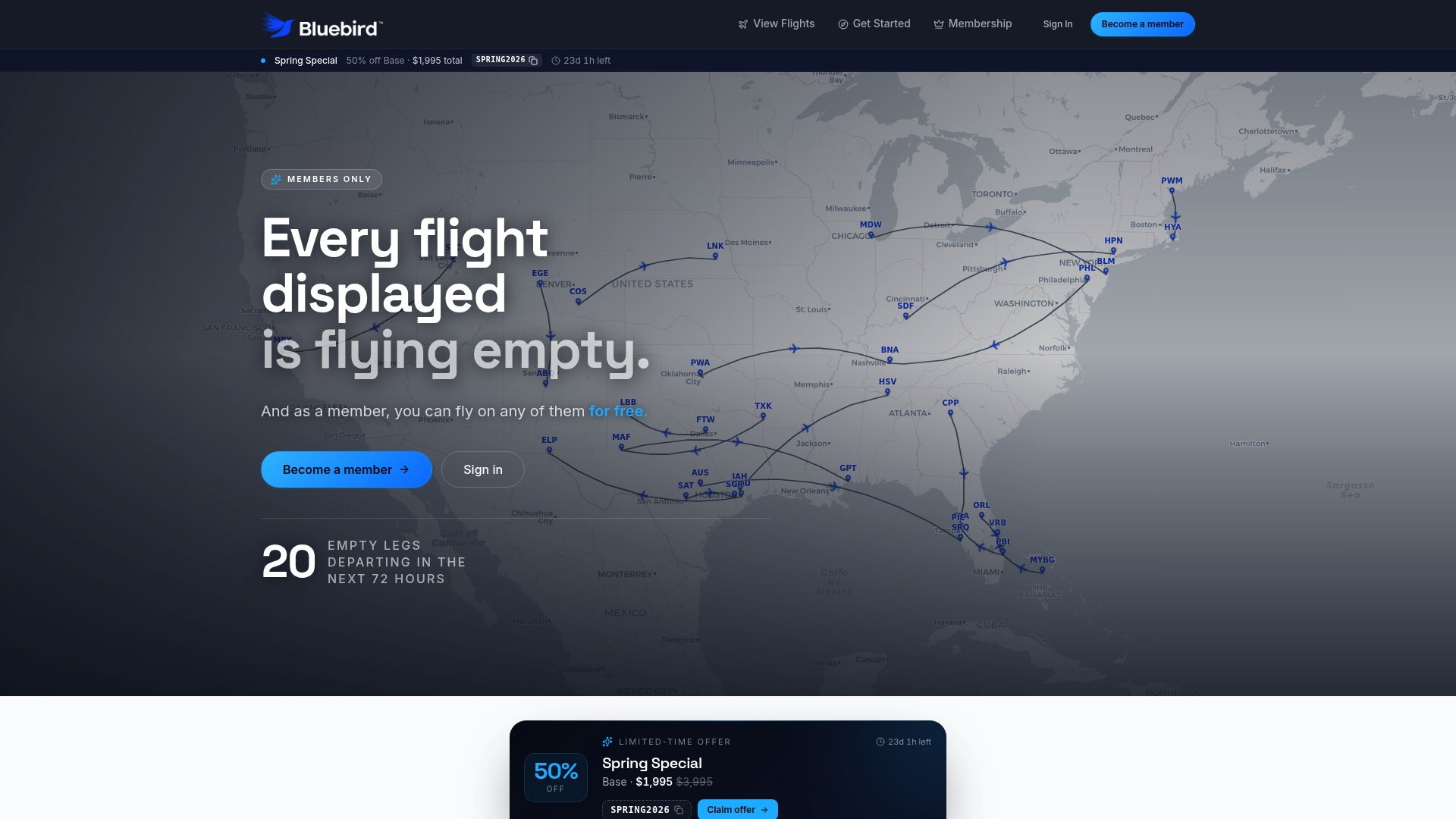
If your travel pattern leans spontaneous rather than scheduled, some memberships turn that flexibility into savings instead of a scheduling headache. Members get unlimited access to published empty-leg flights on operator fleets, with live inventory updated daily, a priority queue for booking, and room to bring guests per flight. For trips outside published routes, an optional paid custom charter request may be available, along with potential upsells for faster booking priority.
This fits flyers who can flex their dates around available inventory rather than those who need a guaranteed departure on a fixed day. Check current plan details on the Base and Plus membership page, or start the onboarding process to see live empty-leg inventory for yourself.
Sources
Buyers should verify operator certification and broker disclosure through FAA Part 135 rules and DOT broker disclosure rules.
- 14 CFR Part 135 — Operating Requirements: Commuter and On Demand Operations and Rules Governing Persons On Board Such Aircraft
- Private jet membership cost vs. charter — Flyius
FAQ
What does charter membership mean?
Charter membership generally refers to a subscription or dues-based program that gives members recurring benefits like guaranteed availability, priority booking, or empty-leg access, distinct from booking a single on-demand charter trip with no ongoing relationship. The specific benefits vary significantly by provider, so terms should always be confirmed in writing.
What are the drawbacks of charter flights?
On-demand charter offers no guaranteed availability, meaning last-minute requests can fail to find an aircraft, especially during peak travel periods. Pricing also varies trip to trip since there’s no locked-in rate, which makes budgeting harder for frequent flyers compared with a prepaid card or membership.
What are the three types of charters?
There isn’t one universal three-type framework, but the common categories in the industry are on-demand charter, jet cards, and prepaid or subscription memberships, which may include empty-leg access. Each model differs mainly in commitment length and how availability is guaranteed.
Is a charter member the same as a founding member?
No, these terms refer to different things. A charter member of a membership program simply means someone who joined during an early enrollment period, while “charter” in the flight sense refers to on-demand or membership-based private jet travel, so the terms shouldn’t be confused when comparing aviation programs.