Is an Empty-Leg Membership Worth the Annual Fee?

Is an Empty-Leg Membership Worth the Annual Fee?
For a flexible traveler who can shift departure times and swap nearby airports, an annual empty-leg membership like Bluebirdjets typically pays for itself fast: memberships unlock flights priced significantly below standard charter rates. If your calendar is rigid or you’re booking for a wedding you cannot miss, skip it and charter direct instead.
TL;DR:
- An empty-leg membership typically costs several thousand dollars annually, with additional expenses for upgrades, taxes, fees, and customized charters.
- Members who fly flexibly four or more times a year, especially on repositioning routes or group trips, can achieve significant savings compared to direct charter costs.
- Success depends on quick decision-making, monitoring live inventory, and accepting nearby airports or flexible departure times to maximize flight capture.
- Membership is less advantageous for travelers with fixed schedules, solo flyers with few trips, or those unwilling to accept short-notice booking requirements.
- Regularly setting alerts for preferred routes and using queue upgrades sparingly can improve the value and efficiency of an empty-leg membership.
Table of Contents
- What Private Jet Cost per Year Actually Looks Like With a Membership
- When Does Membership Beat Charter or a Jet Card?
- Who Actually Gets Their Money’s Worth?
- How the Booking Process Actually Works
- Three Annual Scenarios, With the Real Numbers
- How I’d Actually Use One of These Memberships
- Ready to Check Membership Tiers and Live Routes?
- Sources
What Private Jet Cost per Year Actually Looks Like With a Membership
Forget the ownership math you’ve seen elsewhere. When affluent travelers ask about private jet cost per year in the context of empty-leg access, the real number is the membership fee plus whatever you spend on upgrades and incidentals across the flights you actually book.
Entry-level empty-leg memberships have historically launched at four-figure annual price points, according to The Points Guy, with higher tiers adding faster alerts, better queue position, and more guest allowances. Bluebirdjets structures its membership around unlimited access to published empty legs on operator-owned Learjet 60 aircraft, with room for up to six guests per flight.
Beyond the annual fee, three cost categories determine your real yearly total:
- Skip-the-Line upgrades. A paid priority upgrade that jumps you to the front of the queue for a specific empty leg has been reported at roughly $2,000 per flight.
- Taxes and airport fees. Federal excise tax, segment fees, and handling charges at smaller FBOs still apply even on a discounted leg.
- Custom charter requests. If no empty leg matches your route, most platforms let you request a quoted charter, priced separately from membership.
Pro Tip: Budget for one Skip-the-Line upgrade per year in your mental math. It’s the line item that turns “great deal” into “break even” if you use it more than once.
When Does Membership Beat Charter or a Jet Card?
The math changes based on how often you fly and how much certainty you need. Here’s a framework built around three traveler types.
- The opportunist. Flies four to eight times a year with no fixed dates. Membership wins almost every time, since capturing even half those trips at a substantial discount against retail charter rates covers the annual fee several times over, per The Jet Finder’s pricing analysis.
- The occasional flyer with some fixed dates. Splits trips between must-make events and flexible getaways. A hybrid approach works: membership for the flexible half, direct charter or a jet card for anything nonnegotiable.
- The frequent, date-certain flyer. Books ten-plus trips a year, most tied to business meetings or family commitments that can’t shift. A jet card or fractional share offers more scheduling control, even if it costs more per hour.
Compare across five dimensions: annual cost, per-flight certainty, scheduling control, predictability, and total yearly flight hours. Membership wins on annual cost and per-flight discount. Jet cards and charter win on certainty and control. Neither wins on all five, which is exactly why matching the model to your calendar matters more than the sticker price.
Pro Tip: If you fly a mix of flexible and fixed trips, don’t force one model to do both jobs. Layer a membership on top of occasional charter bookings instead of picking a single solution.
Who Actually Gets Their Money’s Worth?
The ideal member treats every captured flight as a bonus, not a guarantee. That mindset alone separates satisfied members from frustrated ones.
You’re a strong fit if you:
- Can shift departure or return by a day or accept a nearby airport instead of your first choice
- Take four or more discretionary trips a year to places served by common repositioning routes
- Travel with a group of up to six and can split the annual fee’s value across multiple seats
- Have no recurring must-make dates tied to weddings, closings, or board meetings
You’re a weaker fit if your trips are locked to specific dates with no room to move, or if you’re flying solo often enough that per-seat savings shrink. Amalfi Jets’ guidance on choosing a charter strategy makes the point plainly: treat empty legs as found money, not scheduled transportation.
How the Booking Process Actually Works
Live inventory is the engine behind any empty-leg membership. Bluebirdjets updates routes daily, so members scanning the map regularly catch flights that vanish within hours of posting.
Here’s what governs whether you actually capture a flight:
- Queue position. When multiple members want the same leg, priority tiers and Skip-the-Line upgrades decide who gets the seat.
- Notice windows. Most empty legs post with short lead times, often just days out, which rewards members who can move fast.
- Nonrefundable terms. Once booked, an empty leg is typically locked in. Cancellation risk sits with you, not the operator.
- Aircraft substitutions. Mechanical issues or scheduling shifts can swap the tail number, though the route and timing usually hold.
Pro Tip: Set alerts for two or three airport pairs you’d actually use, not just your home airport. Widening your net is the single biggest lever on your capture rate.
Three Annual Scenarios, With the Real Numbers
Low-use scenario. You capture two empty legs a year, each averaging a significant discount off a typical retail charter rate, per Jet Finder’s breakeven analysis. That’s roughly $18,000 in charter value for $12,000 out of pocket, against a membership fee in the mid four-figure range. Net savings still land in the thousands, but one missed flight or a single $2,000 Skip-the-Line upgrade eats a meaningful chunk of that margin.

Moderate-use scenario. You capture five legs a year at similar discount rates. Even with one upgrade fee factored in, the math tilts firmly positive: five discounted legs can generate meaningful retail-value savings compared to membership costs.
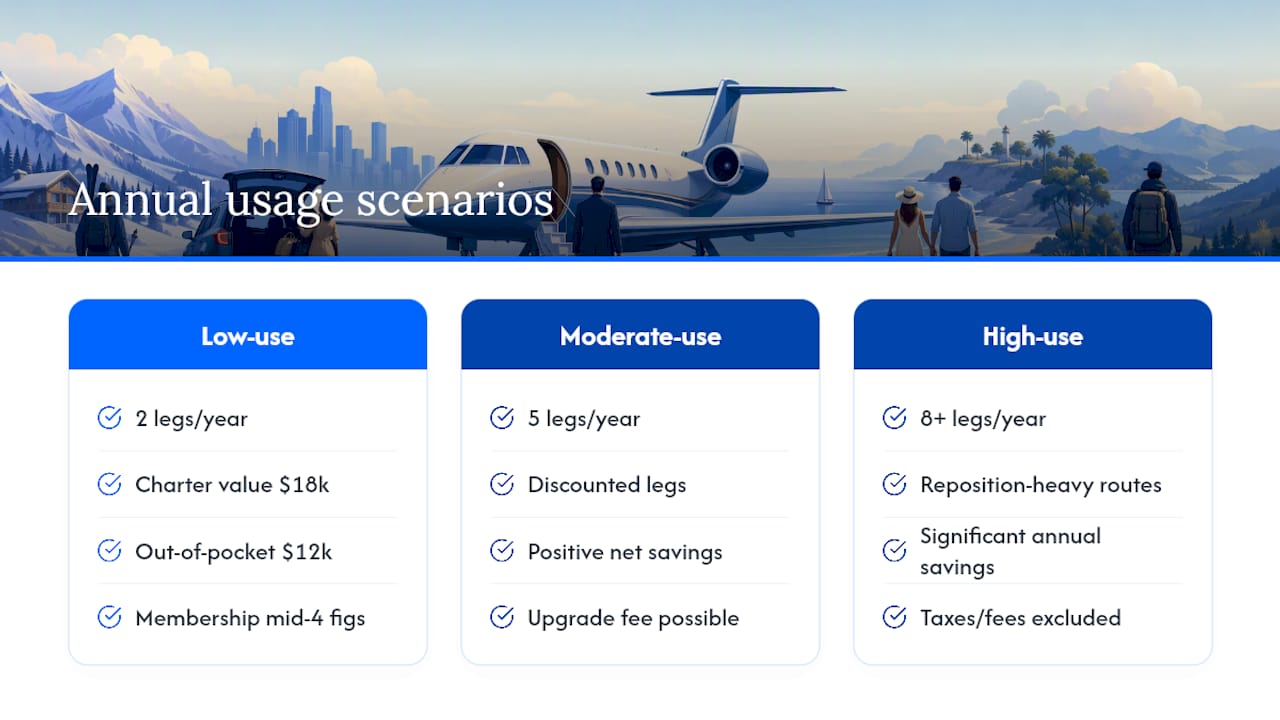
High-opportunistic-use scenario. You capture eight or more legs, often on repositioning-heavy routes like New York to South Florida or Los Angeles to Las Vegas. At this volume, membership savings can be significant annually compared with booking each trip through a broker, according to Jettly’s analysis of membership economics. Taxes, catering, and airport fees still apply on top and aren’t part of the discount.
How I’d Actually Use One of These Memberships
Treat the membership like a standing lottery ticket for good travel days, not a transportation guarantee. The moment you start planning around an empty leg for something you can’t miss, you’ve inverted the entire value proposition.
My honest advice: set alerts on two or three route pairs you’d genuinely use, check the live map a few times a week rather than obsessively, and use queue priority sparingly, saving the paid Skip-the-Line upgrade for a trip that actually matters to you. If a flight falls through, shrug and wait for the next one. That’s the deal you signed up for, and it’s a good one, as long as you never let a membership talk you into skipping a backup plan for a date you truly cannot move.
— Nick
Ready to Check Membership Tiers and Live Routes?
Bluebirdjets is built for exactly the traveler this article describes: flexible, opportunistic, and tired of paying full charter rates for trips that could wait a day. Unlimited access to empty legs on operator-owned Learjet 60 aircraft, daily-updated live inventory, queue and priority booking, and room for up to six guests per flight are all part of the standard membership.

Before you buy, compare tiers on speed of alerts and queue priority, confirm the cancellation and refund terms for your tier, and decide whether the optional Skip-the-Line upgrade fits your travel habits. When you’re ready, browse current empty-leg availability to see what’s flying this month and pick the membership tier that matches how often you actually plan to fly.
Sources
- Jetvia adds empty leg membership, drops fractional, card programs
- Empty Leg Flights Explained | The Jet Finder
- Worldwide jet charter | Jettly
- Empty leg flights: How they work and how to book one | The Points Guy