Remote Destination Access: Private-Jet Empty-Leg Membership

Remote Destination Access: Private-Jet Empty-Leg Membership
Remote destination access, in the context of private aviation, means an annual membership that gives you unlimited, prioritized access to empty-leg flights on operator-owned Learjet 60 aircraft. These are repositioning flights that would otherwise fly empty between charter commitments. Bluebirdjets packages that inventory into a subscription, so members get live route alerts, queue placement, and the option to bring up to six guests per flight. If you travel spontaneously, stay flexible on timing, and want private-jet access to remote runways without paying full charter rates, this model was built for you. If you need guaranteed departures on fixed dates, it is not.
Key Takeaways
Remote destination access through an annual empty-leg membership gives spontaneous, flexible travelers private-jet access to remote runways at a fraction of full charter cost, with the core tradeoff being schedule flexibility in exchange for significant savings.
| Point | Details |
|---|---|
| What it is | An annual membership granting unlimited access to operator repositioning flights on Learjet 60 aircraft. |
| Core tradeoff | Routes and times are fixed by operator schedules; flexibility is required, guaranteed timing is not. |
| Discount range | Empty-leg pricing runs 25%–75% below standard charter rates, with deepest discounts near departure. |
| Who it fits | Travelers flying two or more times per year with flexible schedules and remote runway destinations. |
| Bluebirdjets | Offers Base and Plus tiers with live inventory, queue mechanics, Skip-the-Line, and up to six guests per flight. |
Table of Contents
- What is remote destination access and how do empty legs work?
- What does a Bluebirdjets membership actually give you?
- What limits should you plan around?
- How to use the membership to reach remote destinations reliably
- How membership pricing works and whether it pays for itself
- What safety and transparency signals should you expect?
- Is a remote destination access membership right for you?
- What contract terms and commitment length look like
- How membership compares to traditional charter
- What additional costs exist beyond the base membership?
- An editorial perspective on why this model works
- Bluebirdjets membership: how to evaluate joining
- Sources
What is remote destination access and how do empty legs work?
An empty leg is a repositioning flight: the aircraft has to move from point A to point B to pick up its next paying charter, and the operator sells that segment at a discount because partial revenue beats flying empty. You’ll also hear it called a deadhead or ferry leg. The route and departure window are fixed by the next booking, not by you.
That constraint shapes everything. Departure windows are typically tight, often one to three hours, and the route cannot be negotiated. What changes with a membership is visibility. Instead of stumbling across a one-off deal, members see a live interactive map of posted legs updated daily, receive corridor alerts, and can join a queue before a leg fills.
Timing matters more than most new members expect. Discounts on empty legs commonly run 25%–75% below standard charter pricing, but the deepest cuts tend to concentrate close to departure. A leg posted ten days out may be priced near retail. The same leg, 48 hours before wheels-up, may drop sharply.
Pro Tip: Set corridor alerts for your most-traveled city pairs and check the map every morning. The best-priced legs rarely sit available for more than a day.
Private jets can access thousands more airfields than commercial airlines, which is the core reason remote destination access matters. A Learjet 60 can land at shorter runways that commercial carriers never touch, putting coastal strips, mountain airports, and island fields within reach.

What does a Bluebirdjets membership actually give you?
Membership converts published inventory into structured access. The core features across both tiers include unlimited access to posted empty legs, a live interactive map, daily updated routes, a queue system, and the ability to bring up to six guests per flight.
The priority mechanics are where the tiers diverge. The Base tier gives domestic empty-leg access and standard queue placement. The Plus tier adds international legs and higher queue priority. On top of either tier, the Skip-the-Line feature lets you pay a one-time per-flight fee to guarantee your slot on a specific posted leg, bypassing the queue entirely.
| Feature | Base | Plus |
|---|---|---|
| Domestic empty legs | Unlimited | Unlimited |
| International empty legs | Not included | Included |
| Queue priority | Standard | Higher |
| Skip-the-Line (per flight) | Available | Available |
| Guests per flight | Up to 6 | Up to 6 |
| Live inventory map | Yes | Yes |
Sample legs posted on Bluebirdjets’s live inventory illustrate the range: routes connecting smaller regional airports to coastal destinations, cross-country repositioning legs, and occasional international segments. These are real flights, not hypothetical routes.
What limits should you plan around?
The tradeoffs are real and worth stating plainly. Routes are fixed by the operator’s next charter commitment. You cannot request a specific destination on a specific date and expect a match. You work with what the schedule produces.
Cancellation risk is the other variable. If the primary charter that created the empty leg is modified or canceled, the posted leg can disappear, sometimes within hours of departure. Experienced members treat empty legs as opportunistic travel rather than guaranteed transport, which is the right mental model. Hard-deadline commitments belong on a full charter.
The Learjet 60 itself has runway and range characteristics that shape which remote fields are reachable. It performs well on shorter strips, but extreme-altitude airports or very short gravel runways may fall outside its operational envelope. Worth checking before you plan around a specific remote field.
For time-sensitive plans, the practical rule is simple: always have a backup. A commercial ticket or a flexible ground option gives you an exit if a leg cancels inside 24 hours.
How to use the membership to reach remote destinations reliably
The members who get the most out of this model treat it as a system, not a lottery.
- Define your corridors. Identify the three to five city pairs or regions you travel most. These become your alert filters.
- Set corridor alerts. Configure the membership platform to notify you when a leg appears within your defined radius.
- Monitor the live map daily. A quick morning check takes two minutes and catches legs that post without triggering your exact filter.
- Decide on queue vs. Skip-the-Line. For a route you’d take any week, standard queue placement is fine. For a specific leg on a specific date, pay for Skip-the-Line.
- Confirm and prepare fast. Confirmation windows can be short. Have your passport current, ground transport flexible, and alternate dates in mind before you hit confirm.
- Passport and visa status current for all international legs
- Flexible ground transport at both ends (rental, car service, not a fixed shuttle)
- Alternate travel dates identified before committing
- Carry-on only when possible, since repositioning legs may have weight limits
Pro Tip: If a route you want shows up in the queue and you’re not Plus tier, check whether the Skip-the-Line fee is less than the cost of upgrading your membership for the year. For one critical trip, it usually is.
Corridor alerts combined with smart route monitoring are what separate members who fly regularly from those who wait months for the right leg.
How membership pricing works and whether it pays for itself
Bluebirdjets operates on an annual subscription model. The Base tier covers domestic legs; Plus adds international access and higher queue priority at a higher annual fee. Skip-the-Line is a separate per-flight charge on top of either tier.
The value math is straightforward. A single private charter on a mid-size jet can run $8,000–$25,000 depending on route and aircraft. Empty-leg pricing through a membership sits well below that, given the 25%–75% discount range typical of repositioning flights. Two or three trips per year can cover the annual membership fee many times over, particularly for group travel where the per-seat cost drops across six passengers.
The value checklist:
- You fly privately at least two to four times per year
- Your schedule allows flexibility of one to three days around a preferred date
- You travel with a group that fills the cabin, lowering per-person cost
- You have remote runway destinations that commercial carriers don’t serve
- You can absorb a last-minute cancellation without a hard consequence
If most of those apply, the membership pays for itself. If you need guaranteed departures every time, a full charter comparison is the more honest starting point.
What safety and transparency signals should you expect?
A credible empty-leg membership should be transparent about its fleet, its vetting, and its cancellation rules before you pay a dollar.
- Operator fleet disclosure: you should know the aircraft type, tail number, and operator before confirming any leg
- Third-party safety audits: look for operator-level vetting, not just platform-level claims
- Crew duty-time compliance: repositioning flights follow the same FAA duty-time rules as any other Part 135 operation
- Insurance coverage: confirm the operator carries adequate liability coverage per flight
- Explicit cancellation policy: the membership terms should state exactly when and how a leg can be pulled and what recourse you have
Pro Tip: Ask for the operator’s Part 135 certificate number before your first flight. Any legitimate operator will provide it without hesitation.
Bluebirdjets publishes live sample legs with dates, routes, and departure windows. That operational transparency is a meaningful signal: a platform with real, timestamped inventory has something to show. One without it doesn’t.
Is a remote destination access membership right for you?
Run through these questions honestly:
- Do you take two or more private flights per year?
- Can you shift your departure by one to three days if a better leg appears?
- Do you travel to destinations that commercial carriers don’t serve well?
- Are you comfortable with occasional cancellations and have a backup plan?
- Is your group size two to six people, making per-seat cost favorable?
- Can you budget for an annual membership plus occasional priority fees?
If you answered yes to four or more, a membership almost certainly fits your travel profile. If guaranteed timing is non-negotiable on most trips, a traditional charter is the more reliable tool, though it costs significantly more per flight.
What contract terms and commitment length look like
Bluebirdjets operates on an annual membership cycle. You pay once per year for access to the full inventory tier you select. There is no per-flight commitment beyond the optional Skip-the-Line fee. The membership does not guarantee any specific number of flights or routes. What it guarantees is access to whatever the operator schedule produces during your membership year.
Renewal is annual. There are no multi-year lock-ins publicly listed. The membership terms cover cancellation policy for individual legs, not for the membership itself, so read those terms before signing up if mid-year cancellation matters to you.
How membership compares to traditional charter
Traditional charter gives you a guaranteed aircraft on a guaranteed date at a guaranteed price. You pay for all of that certainty, typically $8,000–$25,000 or more per flight depending on aircraft and route. You also negotiate directly with an operator or broker, which takes time.
A membership flips the model. You pay once annually for access to inventory the operator was already going to fly. The pricing logic is fundamentally different: you’re buying access to surplus capacity, not a guaranteed service. The tradeoff is real, but for spontaneous travelers, the cost difference is substantial enough to justify the flexibility requirement.
Charter is the right tool when timing is fixed. Membership is the right tool when timing is flexible and frequency is high.
What additional costs exist beyond the base membership?
The annual membership fee is the floor, not the ceiling. Budget for:
- Skip-the-Line fees: a per-flight charge to guarantee queue placement on a specific leg
- International access: only available on the Plus tier, so Base members pay to upgrade or miss those legs
- Ground transport: remote airports rarely have commercial car services; private transfers add cost
- Catering and in-flight extras: some operators include basics; others charge separately
- Positioning for customs/immigration: international legs may require additional processing time and associated fees at certain airports
None of these are hidden, but they add up. A realistic annual budget should include the membership fee plus an allowance for Skip-the-Line on two to three flights per year and ground logistics at remote fields.
An editorial perspective on why this model works
The membership model for empty-leg access isn’t just a pricing play. It solves a structural problem in private aviation: repositioning inventory was always there, but it was invisible to most travelers. Operators had no efficient way to surface it, and travelers had no reliable way to find it. Memberships, with live maps and queue systems, fix both sides of that gap simultaneously.
What members consistently find most valuable isn’t the discount itself. It’s the access to routes that commercial aviation simply doesn’t serve. A Learjet 60 landing at a coastal strip in the Florida Keys or a mountain airport in Montana is doing something a commercial carrier cannot do at any price. That’s the real value proposition, and it’s one that a per-flight marketplace can’t replicate because the inventory is too fragmented and too time-sensitive to browse casually.
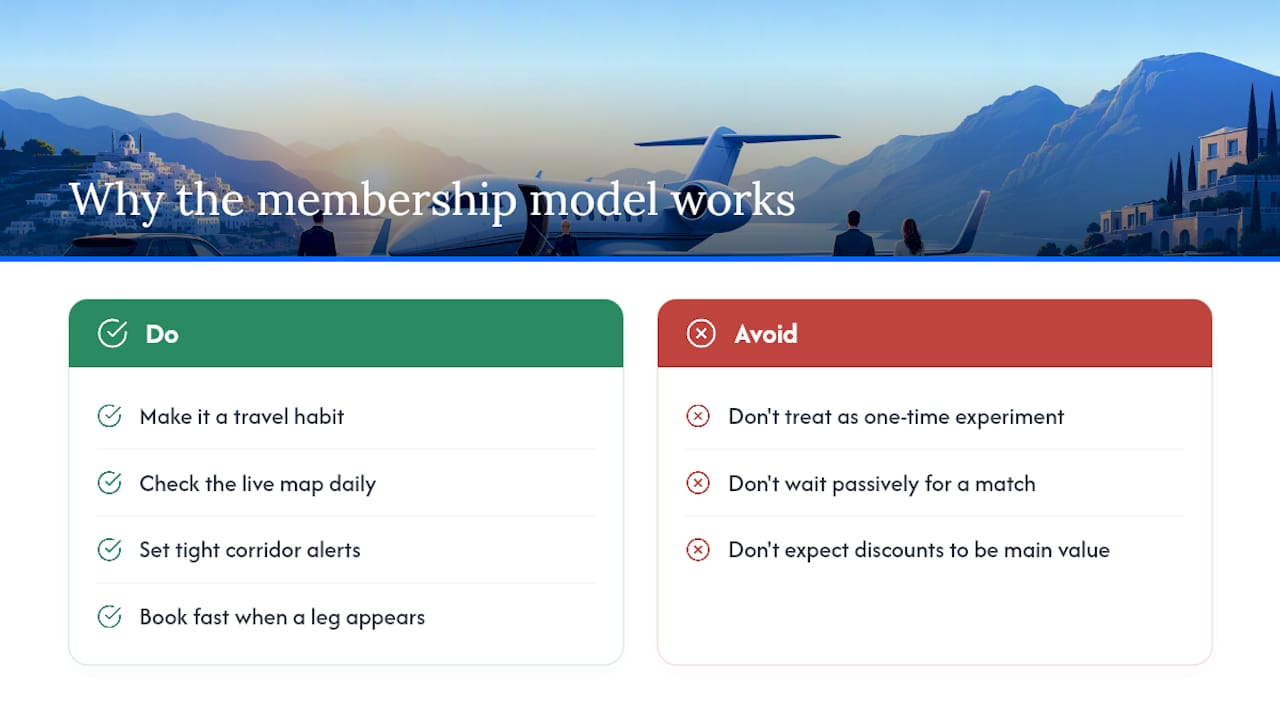
The honest caveat: this model rewards members who treat it as a travel habit, not a one-time experiment. The members who fly most are the ones who check the map daily, set tight corridor alerts, and book fast when the right leg appears. Passive members who wait for a perfect match tend to be disappointed. The inventory is real, but capturing it takes a light daily discipline.
Bluebirdjets membership: how to evaluate joining
Bluebirdjets gives you unlimited access to empty-leg flights on an operator-owned Learjet 60 fleet through a single annual membership fee. Base covers domestic legs with standard queue priority. Plus adds international routes and higher queue placement. Both tiers include the live inventory map, daily updated routes, and guest access for up to six people per flight. Skip-the-Line is available on either tier for flights where you need guaranteed placement.
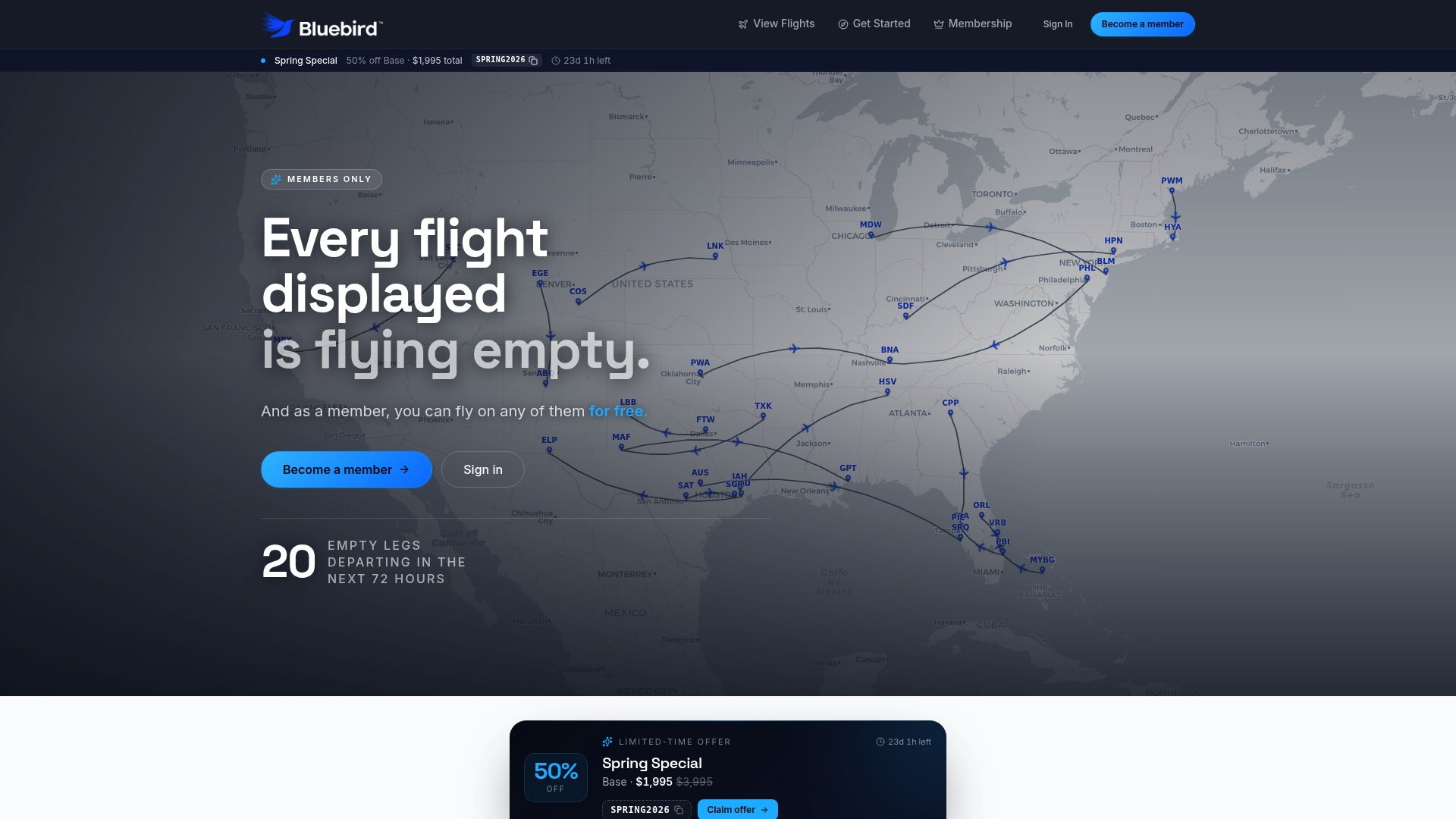
To evaluate whether it fits: count your private flights per year, identify your most-traveled corridors, and check whether your schedule allows one to three days of flexibility around preferred dates. If the math works, the membership page lays out the current tier pricing and terms. The live flights inventory shows exactly what’s posted today, which is the fastest way to judge whether the routes match where you actually want to go.
Sources
- Jetvia adds empty leg membership, drops fractional, card programs
- What Is an Empty Leg Flight? A Broker Explains
- Global Access: How Private Jets Bridge the Gap to Remote Destinations - Today News
- Private Jet Empty Legs: How to Find & Book Discounted Flights