Bring Up to Six Guests: What Private Jet Guest Policy Requires

Bring Up to Six Guests: What Private Jet Guest Policy Requires
Private jet guest policy generally allows hosts to bring invited travelers along, but every operator requires guests to be pre-cleared and listed on the flight manifest before boarding. Guests must follow crew instructions, conduct rules, and pet, smoking, and alcohol restrictions set by the operator’s terms of carriage. Skip a step, like submitting an ID or ignoring a crew directive, and you risk fines, removal from the aircraft, or denial of boarding altogether.
TL;DR:
- Guests must be listed on the manifest before boarding, with full legal names and ID details submitted in advance for international flights.
- Operator rules prohibit smoking, vaping, and often restrict alcohol and pet travel, with strict escalation for violations including removal or fines.
- Liability insurance generally covers injuries and baggage during the flight, but does not protect against trip cancellations or medical issues unrelated to the flight.
- Last-minute guest additions, pet paperwork, and failure to confirm details 48 hours before departure are the main mistakes causing delays or issues.
- Bluebird Jets members can bring up to six guests per flight and benefit from significant savings on pet travel costs, with flexible last-minute booking options.
Table of Contents
- Who Counts as a Guest vs. a Passenger for Hire?
- Common Operator Guest Policies You Should Expect
- What Happens at the Manifest and Boarding Stage?
- How Does Liability and Insurance Work for Guests?
- Private Jet Etiquette Every Guest Should Follow
- If You’re Denied Boarding or Fined, What Should You Do?
- How Bluebird Jets Handles Guest Policy for Members
- The Guest Mistakes That Cause the Most Trouble
- Ready to Simplify Guest Logistics on Your Next Flight?
- Key Resources for Verifying Operator Guest Policies
- Sources
- FAQ
Who Counts as a Guest vs. a Passenger for Hire?
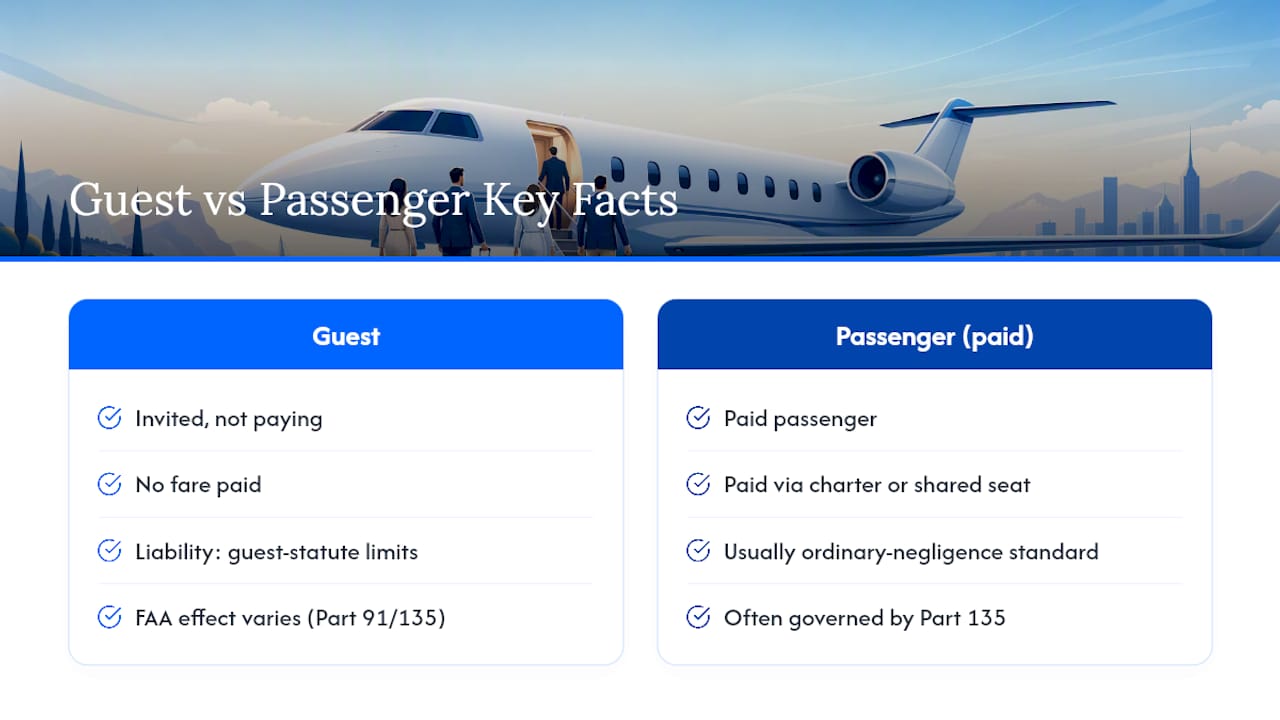
A guest is someone invited onto a private flight without paying a fare directly. A passenger for hire is someone who has purchased transportation, whether through a charter contract or a shared seat. That distinction shapes duty of care and legal exposure if something goes wrong in the air.
Historically, some U.S. guest statutes limited an operator’s liability to cases of willful or gross negligence when the injured party was an invited guest rather than a paying passenger. Many states have since abolished those statutes, moving toward ordinary negligence standards for everyone aboard. But the patchwork still matters. Where a guest statute survives, a host’s guest may have a harder path to recovery after an incident than a paying passenger would.
Federal classification adds another wrinkle. The FAA distinguishes Part 91 operations from Part 135 operations based largely on who holds operational control of the flight. Part 91 covers private, noncommercial flying with lighter regulatory requirements; Part 135 governs on-demand commercial charter with stricter training, maintenance, and passenger protections. A flight that looks the same from the cabin can carry very different legal protections depending on which rule applies.
Common Operator Guest Policies You Should Expect
Operator terms of carriage read like a short rulebook, and the crew has final say once the door closes. Sample charter agreements spell out prohibited conduct, required cooperation with crew, and the operator’s right to refuse service. The specifics vary by operator, but the pattern is consistent across the industry:
- Smoking and vaping are typically banned outright, though some operators document an exception process for cigars or specific requests.
- Alcohol brought aboard is often restricted or subject to crew discretion, especially before takeoff.
- Pets are usually welcome with advance notice and documentation, while service animals fall under separate accommodation rules.
- Age limits and restraint requirements apply to infants and young children, and most aircraft cap the number of guests per booking based on seating.
- Harassment, intoxication, or interference with crew duties can trigger immediate removal from the flight.
Consequences for breaking these rules escalate quickly. Operators can deny boarding on the spot, charge cleaning fees for pet or alcohol incidents, and in serious cases apply cancellation fees that fall on the host who booked the flight. The person who invited the guest is usually the one who answers for that guest’s behavior.
What Happens at the Manifest and Boarding Stage?
Getting a guest from invitation to seat involves more paperwork than most first-timers expect, but the sequence is straightforward once you know it.
- Submit legal names and ID details early. Manifests require full legal names and passport information for international routes, since customs and border agencies often need advance passenger data.
- Arrive within the recommended window. Private terminals move faster than commercial ones, but most operators still ask guests to arrive 30 to 45 minutes before departure for domestic flights and longer for international legs, following FBO check-in practices.
- Expect a security check. Guests consent to baggage and person screening, and refusing that screening is grounds for denial.
- Confirm additions early, not at the curb. Last-minute guests can throw off weight and balance calculations or trigger fresh customs paperwork, and operators sometimes refuse to add a name once the flight plan is filed.
How Does Liability and Insurance Work for Guests?
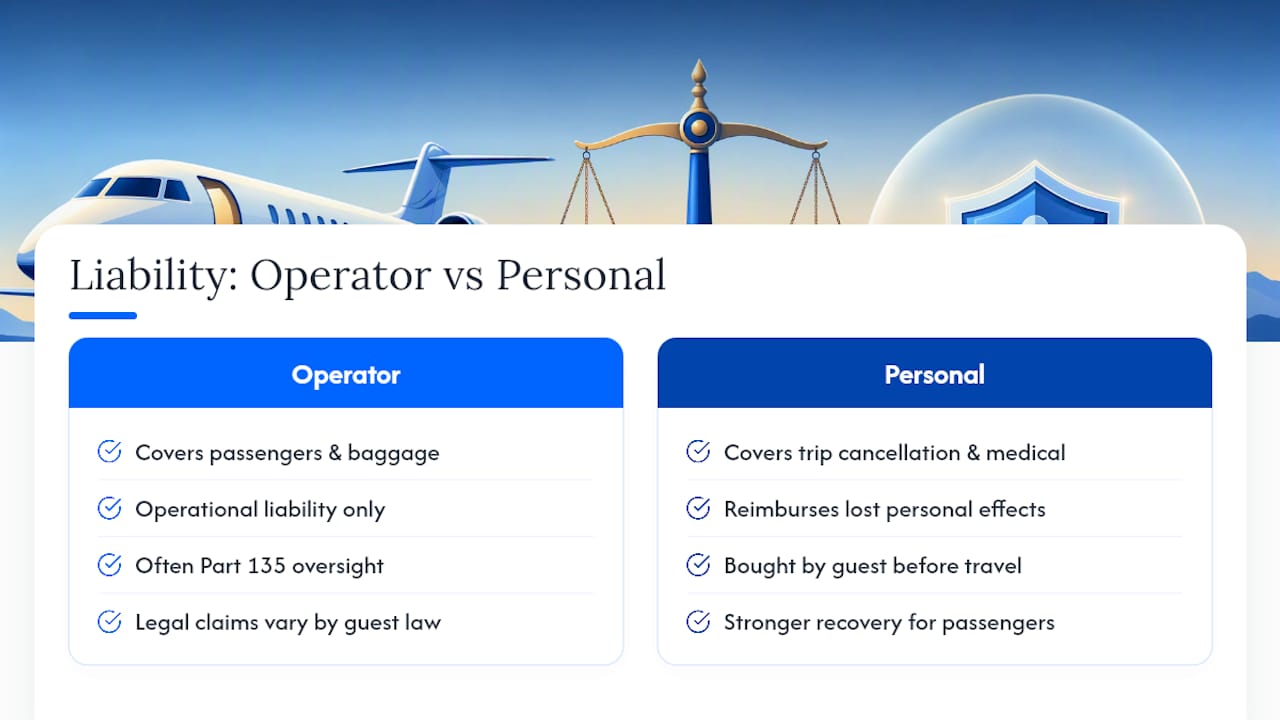
Operators are generally expected to carry liability insurance that covers passengers and their baggage during the flight. If you are the host, it is worth asking the operator or your broker for a certificate of insurance and confirming whether the flight operates under Part 135, since that classification often correlates with stricter insurance and safety oversight.
That operator coverage is not the same as personal travel insurance. Operator policies address operational liability, things like injury during flight or damage to checked bags. They typically do not reimburse a guest for a canceled trip, a missed connection, or a medical emergency unrelated to the flight itself. Personal travel insurance fills that gap, covering trip cancellation, medical costs abroad, and lost personal effects.
The guest versus passenger distinction resurfaces here too. Where a state’s guest statute still applies, an invited guest injured aboard a privately operated flight may face a higher bar to recover damages than a fare-paying passenger on a Part 135 charter would. Before flying, it costs nothing to ask your host or the booking platform for the insurer’s name and the operator’s certificate details. It is a two-minute question that can save weeks of frustration later.
Private Jet Etiquette Every Guest Should Follow
Good etiquette on a private flight is mostly about respecting a small, closed environment where everyone notices everything.
- Submit your name, ID, and any special luggage needs as soon as your host confirms the invitation.
- Arrive on time. Private aviation runs on tighter windows than commercial travel, and a late guest can delay an entire flight plan.
- Defer to your host on seating, catering requests, and cabin preferences unless the crew directs otherwise.
- Ask before photographing fellow passengers, crew, or the aircraft’s tail number. Etiquette guides consistently flag privacy as one of the most overlooked guest obligations.
- Pack light and declare anything unusual, like sporting equipment or specialty electronics, before the flight.
- Follow crew safety instructions immediately, even if the request seems minor.
Pro Tip: If you’re bringing a pet, confirm health and vaccination paperwork with your host at least 48 hours out, and ask whether a cleaning fee applies. Operators increasingly expect pet documentation in advance, and sorting it early avoids an awkward conversation at the FBO.
If You’re Denied Boarding or Fined, What Should You Do?
Start by asking for a written explanation of the denial or fine, including the specific contract clause the operator cites. Photograph any property damage and keep every receipt tied to the incident.
Next, contact the operator’s customer service line and, if you booked through a membership platform or broker, escalate through that channel too. If the situation involves a real injury or something criminal, bring in legal counsel rather than trying to resolve it yourself. Whether you were classified as a guest or a paying passenger, and whether the flight operated under Part 91 or Part 135, will shape what legal options are actually available to you.
How Bluebird Jets Handles Guest Policy for Members
Bluebird Jets membership builds guest flexibility into the booking itself. Members can bring up to six guests on a single empty-leg flight, which covers most family trips or small group outings without extra negotiation. That allowance still runs through the same operator rules covered above: guests need to be submitted and cleared before departure, just like on any other private flight.
Pet travel is where the membership shows a clear financial edge. Bluebird’s structure is built to cut pet travel costs by 30 to 75 percent compared to booking pet transport independently, though members still need to supply the standard health and vaccination documentation operators require.
Because Bluebird publishes live, daily-updated empty-leg inventory with queue and priority booking, members can react to last-minute guest additions faster than a traditional charter booking allows. If you need specifics on smoking exceptions or age requirements for a particular route, Bluebird’s own guides on smoking policy and age requirements walk through the documentation process member by member.
The Guest Mistakes That Cause the Most Trouble
The single most common problem is not rule breaking. It’s timing. Guests get added the morning of a flight, pet paperwork shows up at the FBO instead of days earlier, and a garment bag turns into three overpacked suitcases nobody mentioned in advance.
Three habits fix most of it: confirm every guest and pet at least 48 hours out, ask your host what “light packing” actually means for that specific aircraft, and read the operator’s conduct rules once instead of assuming they mirror commercial air travel. None of that requires experience. It just requires treating the invitation as seriously as the flight itself.
— Nick
Ready to Simplify Guest Logistics on Your Next Flight?
Bluebird Jets is built around the exact friction points this article covers: last-minute guest additions, pet paperwork, and the scramble to confirm details before departure. A Bluebird Jets membership gives you unlimited access to published empty-leg flights, room for up to six guests per booking, and live inventory that updates daily so you’re not stuck waiting on a broker’s callback.
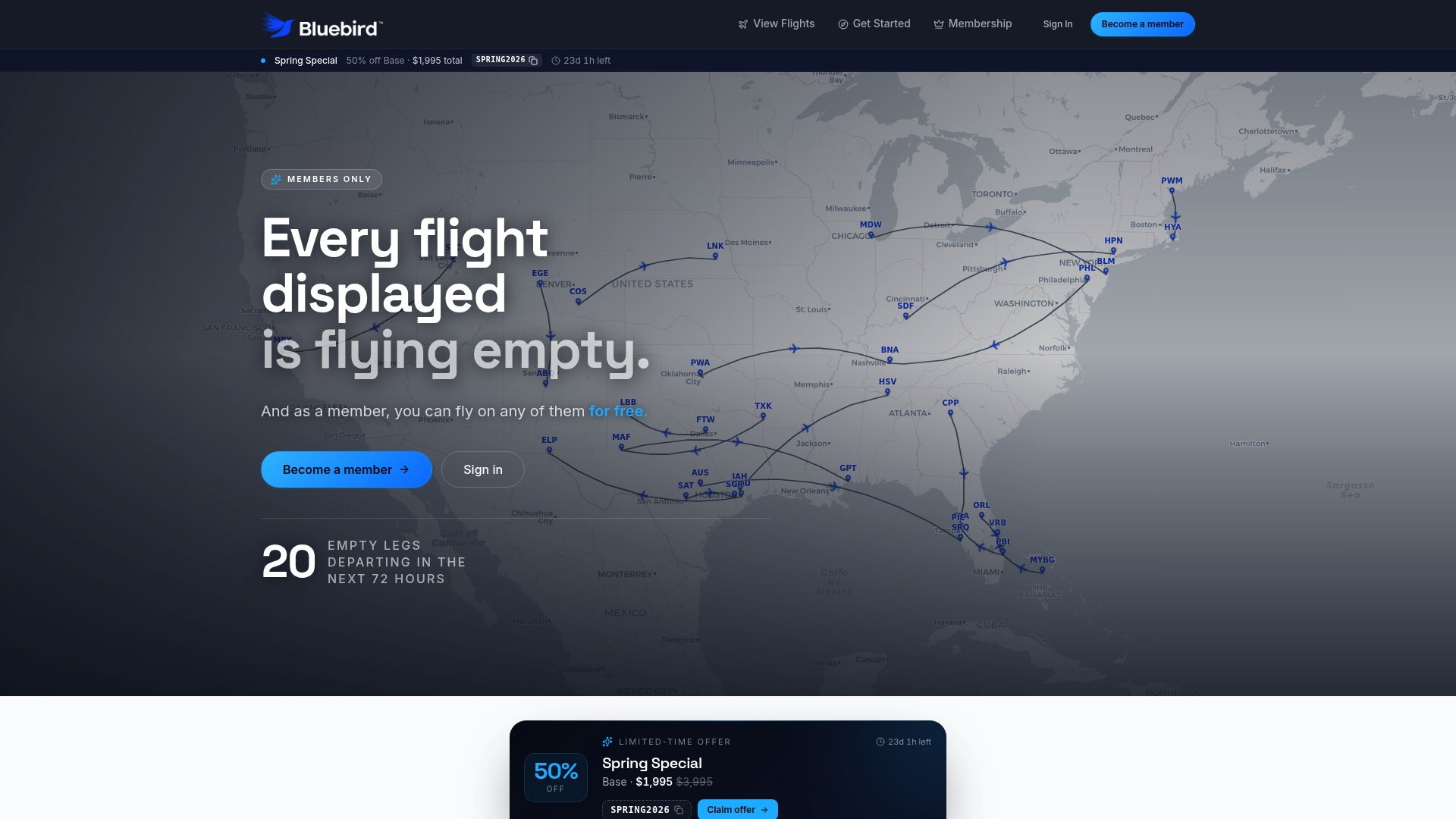
Members also see documented savings of 30 to 75 percent on pet travel costs, which matters if you regularly fly with animals and want to skip the usual per-trip pet fees charged by traditional charter. The Base plan runs $3,995 per year, and the Plus plan runs $9,995 per year for higher-priority booking access, both detailed on the membership page. If you’d rather skip the queue entirely on a specific flight, the Skip-The-Line option is available for a $2,000 one-time fee through the get-started page, where you can also browse current empty-leg listings and see what’s flying this week.
Key Resources for Verifying Operator Guest Policies
For further reading, the sample charter agreement, Part 91/135 guidance, and insurance overview cited above are good starting points for verifying any operator’s specific terms. If your guest is carrying spare lithium batteries or other electronics, this battery carriage rules guide covers what’s typically restricted.
This article is general information, not a substitute for advice from a qualified lawyer. Consult a qualified legal professional about your own circumstances before acting on anything here.
Sources
- Aero-News: Guest statutes and liability in aviation
- XO/JetSmarter sample passenger rules of conduct and charter agreement
- Part 91 vs Part 135 overview and operational-control guidance
- Private-jets-connect: Private jet insurance and liability overview
- Iconic Jet Club: Private jet etiquette
FAQ
Can I Bring Guests on a Private Jet I Didn’t Book?
Yes, as long as the person who booked the flight submits your name and documentation to the operator in advance. Operators require every guest on the manifest before departure, and showing up unlisted is grounds for denial of boarding.
What Happens if a Guest Breaks Operator Rules?
Consequences range from a warning to immediate removal from the flight, plus possible cleaning or cancellation fees charged to the host. Serious misconduct, like interfering with crew duties, can result in the operator refusing to fly that guest again.
Does Operator Insurance Cover Me as a Guest?
Operators are generally expected to carry liability insurance covering passengers and baggage during the flight, but that coverage doesn’t extend to trip cancellation or unrelated medical costs. Personal travel insurance fills that gap if you want broader protection.
How Many Guests Can I Bring on a Bluebird Jets Flight?
Bluebird Jets members can bring several guests on member empty-leg flights, though each guest still needs to be submitted and cleared under standard operator procedures. Membership pricing starts at $3,995 per year for the Base plan, listed on the membership page.
Is There a Difference Between Part 91 and Part 135 Flights for Guests?
Yes. Part 91 covers private, noncommercial flights with lighter regulatory oversight, while Part 135 governs commercial charter with stricter training and maintenance standards. The classification can affect the level of protection a guest has if something goes wrong during the flight.