Affluent Flyers: How Members Source Private Jet Smoking Exceptions
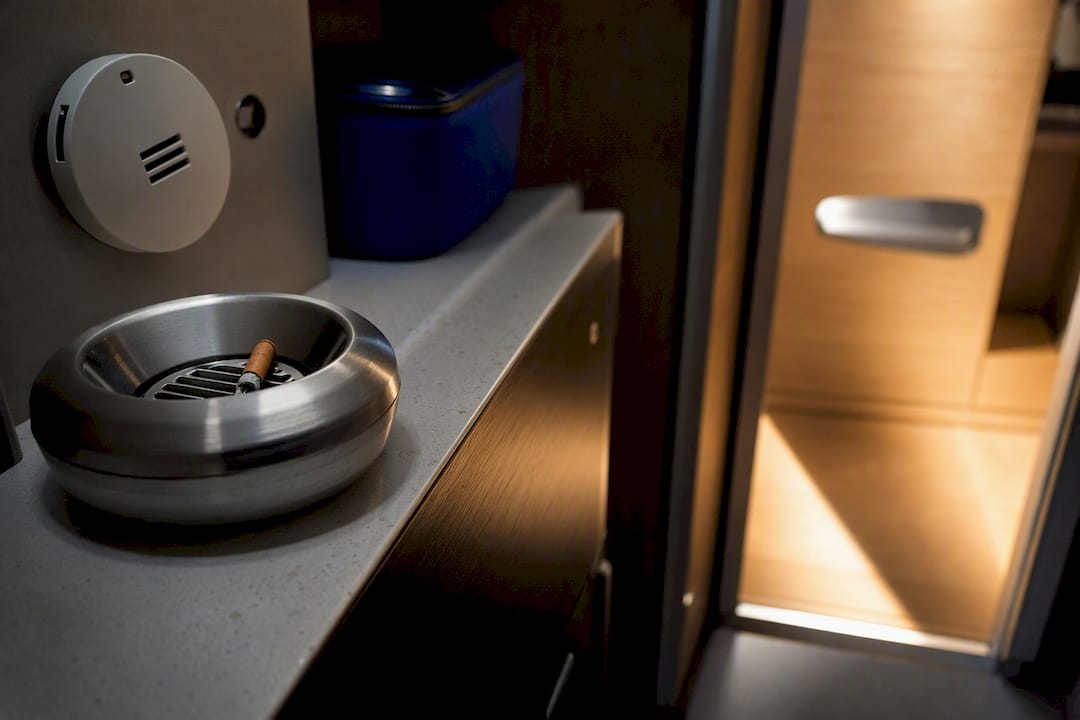
Affluent Flyers: How Members Source Private Jet Smoking Exceptions
The short answer is no. Nearly every charter operator prohibits smoking outright, regardless of what the aircraft’s owner might personally allow. The rare exceptions happen only on owner-flown aircraft with explicit written approval, and even then, the pilot in command can override that approval mid-flight for safety reasons. Cannabis and lavatory smoke detector tampering are off the table everywhere, no exceptions.
TL;DR:
- Most charter operators enforce a strict no-smoking policy because insurance, maintenance, and safety concerns outweigh any owner or passenger allowance.
- The pilot in command retains the legal authority to prohibit smoking during flight, regardless of prior approval or aircraft ownership, especially if safety or air quality becomes an issue.
- Federal law explicitly bans tampering with smoke detectors and allows smoke-related violations to lead to serious regulatory and operational consequences.
- Vaping is banned by most operators due to smoke detector activation and lithium battery risks, while cannabis remains federally prohibited on all private flights.
- Legitimate exceptions exist only for owner-flown legacy jets with prior written approval and crew consensus, but these are rare and subject to strict conditions.
Table of Contents
- Who Actually Decides a Private Jet Smoking Policy?
- What Do FAA Rules Say About Smoking on Aircraft?
- Are Vaping and Cannabis Treated the Same as Smoking?
- When Is Smoking Actually Permitted on a Private Jet?
- What Happens If You Smoke Without Approval?
- How Do You Request Smoking Approval Before You Fly?
- What Are Your Options If Smoking Isn’t Allowed?
- How Bluebirdjets Handles Smoking-Related Flight Requests
- Book Your Next Empty Leg With Confidence
- Where to Verify These Rules Yourself
- Sources
Who Actually Decides a Private Jet Smoking Policy?
Three parties have a say in whether smoking happens on any given flight, and they don’t always agree.
The aircraft owner sets the baseline. On an owner-flown jet, that person can technically allow smoking in their own cabin, the same way they might allow it in their own living room. Charter operators are a different animal entirely. When you book through a management company or broker, you’re flying on an asset that belongs to a fleet, gets reused by dozens of other clients, and carries insurance terms written around a no-smoking baseline. That’s why nearly every operator maintains a blanket ban, according to charter-industry reporting on why most operators still say no to smoking requests.
Then there’s the pilot in command, who holds the real trump card. Even if an owner has approved smoking in writing, the PIC retains authority to prohibit it during flight if conditions warrant, since 14 CFR §135.127 frames smoking permission as conditional, not automatic. A crew member who smells something unusual, notices a passenger fumbling near a lavatory, or simply judges the cabin air quality to be a problem can shut the request down without discussion.
The insurer sits quietly behind all of it. Smoke damage claims are expensive, residual odor tanks resale value, and underwriters price policies around the assumption that cabins stay clean. That’s the real reason so many operators default to zero tolerance:
- Owner-flown jets: owner sets the rule, PIC can still override it
- Charter operators: company policy governs, almost always a full ban
- Insurance carriers: pricing assumes no smoking, penalizing violations heavily
- Maintenance contracts: many specify smoke-free cabins as a condition of coverage
What Do FAA Rules Say About Smoking on Aircraft?
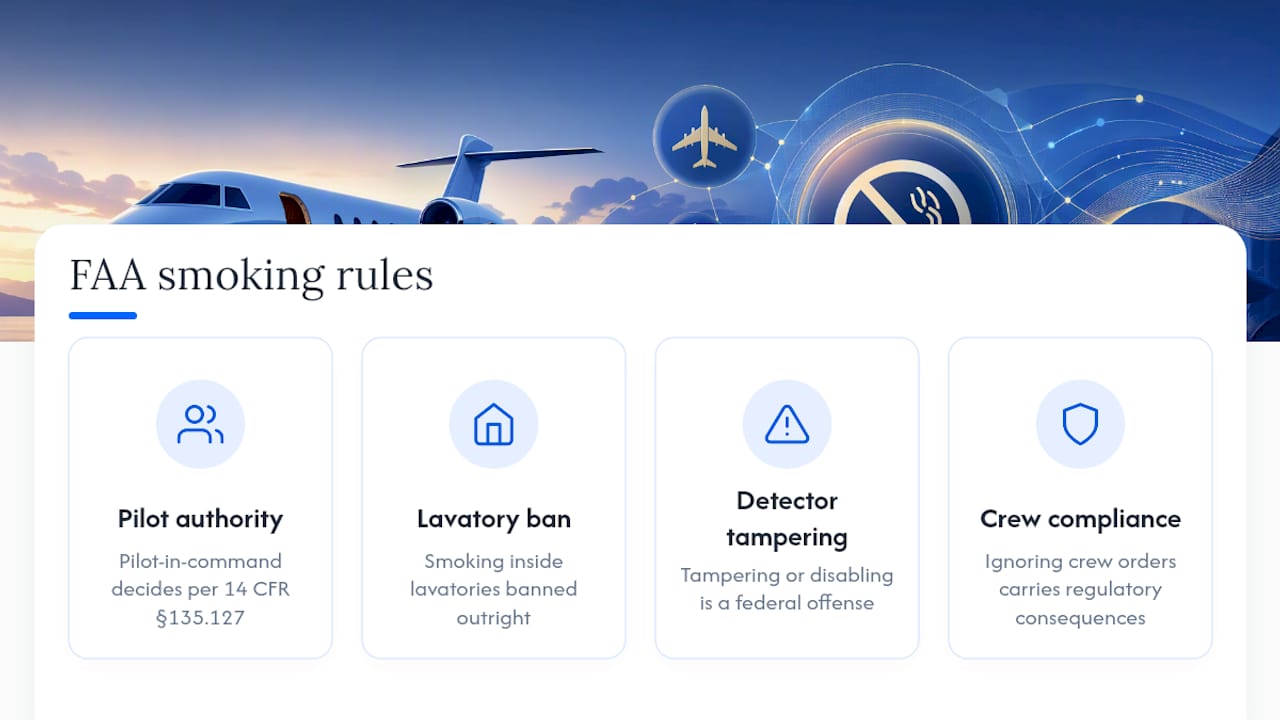
Federal law doesn’t leave this to guesswork. 14 CFR §135.127 requires operators to display “No Smoking” signage where applicable, bans smoking inside lavatories outright, and makes it a federal violation to tamper with or disable a smoke detector. The regulation also caps when a pilot in command can authorize smoking at all, tying that authority to specific operational conditions rather than passenger preference.
By the Numbers: Federal aviation law gives the pilot in command, not the passenger and not even the aircraft owner, final say over whether smoking happens during a given flight, per 14 CFR §135.127.
This is where the legal exposure gets serious. Disabling a lavatory smoke detector to sneak a cigarette isn’t a matter of an operator being annoyed. It’s a federal offense, and crews are trained to treat any detector interference as a security event, not a customer service issue. Ignoring a crew instruction to stop smoking compounds the problem, since failure to comply with crew directives during flight carries its own regulatory consequences separate from the smoking violation itself.
Context matters here too. Commercial airlines phased in uniform smoking bans that were fully in place across U.S. scheduled flights by 2000, according to historical reporting on the airline smoking ban. Private aviation never got that same blanket federal mandate, because non-scheduled flights operate under owner and operator discretion rather than a single uniform passenger-safety rule. That gap in the law is exactly why so many people assume private jets are a smoking free-for-all. They’re not. Operators simply chose to apply their own version of the commercial ban voluntarily, largely for the insurance and maintenance reasons above.
Are Vaping and Cannabis Treated the Same as Smoking?
Mostly yes, and in cannabis’s case, it’s actually worse. Vaping gets banned right alongside cigarettes on most charter aircraft, and the reasoning holds up better than a lot of passengers expect. Vapor triggers the same smoke detectors that cigarette smoke does, according to reporting on why operators ban vaping, which means an e-cigarette can trip a lavatory alarm and force the same emergency response as an actual fire.
There’s a second issue that has nothing to do with vapor: batteries. Most vape devices run on lithium cells, and FAA and DOT guidance around lithium battery carriage has pushed many operators toward a strict policy of “carry it powered off, don’t charge it inflight.” That’s not an arbitrary inconvenience. Lithium battery fires are a recognized aviation hazard, and a device charging in a seatback pocket at 40,000 feet is not a risk any operator wants to underwrite.
Cannabis sits in its own category entirely. Federal law governs the airspace above every state, including ones where marijuana is legal on the ground. The FAA is explicit that transporting or using marijuana on any aircraft can expose passengers and crew to federal prosecution, full stop, regardless of state legality.
- Vaping: banned on most operators due to detector activation and residue
- Cannabis: federally prohibited on all flights, no state-legality exception
- Lithium devices: carriage generally fine, inflight charging usually restricted
Pro Tip: If your travel plans genuinely require cannabis access, plan around your destination rather than your flight. Nothing about legal status on the ground changes what’s allowed in the cabin.
When Is Smoking Actually Permitted on a Private Jet?
The exceptions exist, but they’re narrower than most people assume.
- Privately owned legacy heavy jets. Older long-range aircraft with a genuinely private owner and no charter management arrangement occasionally retain a designated smoking section, usually a holdover from decades when smoking was standard on business aircraft.
- Explicit owner sign-off, documented in advance. Even on an owner-flown jet, permission has to be established before departure. Nobody should assume tacit approval just because it’s a private aircraft.
- Crew concurrence on the day of flight. Written owner approval doesn’t bind the pilot. If cabin conditions, ventilation, or a co-passenger’s health concerns make smoking impractical, the crew can and will say no.
Even where the aircraft technically allows it, cabin layout matters enormously. A cigarette in a well-ventilated cabin with a smoking zone near the aft galley is a different proposition than a cigar filling a compact light jet with dense smoke and lingering odor. That distinction explains why operators, when they do carve out exceptions, treat cigarettes far more leniently than cigars, whose heavier residue and smell are much harder to fully remove according to industry commentary on smoking exceptions.
Contracts built around these rare exceptions typically include a security deposit, a pre-agreed cleaning fee, and language limiting the approval strictly to that one leg. None of it rolls over to your next flight automatically.
What Happens If You Smoke Without Approval?
The financial exposure is the part most people underestimate. Cabin materials in private jets, leather, suede headliners, wood veneer, are chosen for appearance, not for resisting smoke odor, and restoration after unauthorized smoking can run into the thousands or reach five figures depending on the aircraft, according to operator-side reporting on cleaning costs.
By the Numbers: Charter operators routinely report smoke-damage restoration bills can be very expensive per incident, a cost that typically lands on the passenger’s security deposit rather than the operator’s insurance.
Beyond the bill, there’s the operational disruption. A triggered lavatory smoke alarm doesn’t get a polite warning; it triggers the same emergency checklist crews use for an actual onboard fire, which can mean an unplanned diversion to the nearest suitable airport. That’s a delay measured in hours, not minutes, and it applies to every other passenger on the flight, not just the person who lit up.
The consequences that outlast any single trip matter more for frequent flyers:
- Loss of deposit and additional invoiced cleaning charges
- Formal incident report filed with the operator and potentially the aircraft’s insurer
- Placement on an operator’s do-not-serve list, which can follow you across affiliated fleets
- Difficulty booking future charters once brokers flag the account
How Do You Request Smoking Approval Before You Fly?
If smoking genuinely matters for your trip, the fix is disclosure, not improvisation.
- Tell your broker or operator at the quoting stage, not after the aircraft is confirmed. Brokers can only source a suitable aircraft, an owner-flown option or one with a documented exception, if they know what you need before matching you to a tail number.
- Specify exactly what you’re asking for. Cigarette, cigar, and vape are three different conversations with three different odds of approval, and lumping them together as “smoking” gets you a vague answer.
- Get the approval in writing, tied to that specific leg. A verbal “should be fine” from a sales rep is not a contract term, and it won’t protect you if the crew disagrees on the day of the flight.
- Confirm the cleaning fee and deposit terms up front. Ask for a cap, not an open-ended liability clause, so you know your maximum exposure before you board.
Pro Tip: Ask the operator directly, “What does your written smoking exception clause say, and does it survive if the crew changes?” A confident, specific answer is a good sign. A vague one means you should assume the answer is no.
Booking through a service familiar with private aviation booking practices makes this whole process faster, since experienced brokers already know which operators even entertain the conversation.
What Are Your Options If Smoking Isn’t Allowed?
Most flights fall into this category, so plan around it rather than against it.
Nicotine gum, lozenges, and patches handle the inflight window without any detector risk, and they’re the most reliable option for a flight of a few hours. Some travelers keep a vape charged and simply accept that it stays in a bag until landing, since the device carriage itself is fine even when use isn’t.
The better move is scheduling around the flight instead of fighting it. Most FBOs allow smoking breaks on the ramp before boarding and after landing, so a flight plan that builds in even fifteen minutes on each end solves the problem without any onboard risk at all.
- Nicotine gum or patches for the flight itself
- Vape carried powered off, used only on the ground
- A scheduled FBO smoking break before boarding and after arrival
- Immediate disclosure to the crew if a violation happens accidentally
Basic etiquette matters here too. Disclose your needs before departure, comply immediately if a crew member raises a concern, and if something goes wrong by accident, tell the crew right away rather than hoping nobody notices. That single decision affects whether an incident becomes a minor note or a permanent flag on your account, and it’s covered in more depth in general guidance on private jet etiquette for first-time flyers.
How Bluebirdjets Handles Smoking-Related Flight Requests
Most of what gets written about private jet smoking policy treats it as a yes-or-no legal question. It’s really a sourcing problem. The aircraft that might accommodate a smoking request exist, they’re just rare, owner-specific, and not something a standard charter search surfaces.
That’s where membership access to a broader inventory earns its keep. Members are helped to set realistic expectations early, before a request turns into a day-of-flight disappointment, with approvals documented in writing rather than left as verbal assumptions. When a member has a genuine need, whether that’s a smoking accommodation or another special request, the priority booking structure gives Bluebirdjets room to source appropriately rather than scrambling.
The honest reality is that most flights, including most Bluebirdjets empty-leg opportunities, will carry the standard no-smoking policy every operator defaults to. Members who understand that going in have a far smoother experience than those who assume private automatically means permissive.
— Nick
Book Your Next Empty Leg With Confidence
Bluebirdjets gives you something a one-off charter search can’t: a live, daily-updated feed of empty-leg flights on operator-owned Learjet 60 aircraft, with unlimited access built into a single annual membership instead of a per-trip fee every time you fly.

This structure matters most when travel plans include a special request, smoking accommodations included. Instead of starting from scratch with a new broker every trip, members work from an established relationship where expectations, deposit terms, and written confirmations are already familiar territory. Members may have features such as guest allowances, queue and priority booking to lock in timing, and the option to request custom charter quotes when the published empty-leg inventory doesn’t fit their route.
If smoking matters for an upcoming trip, don’t leave it to a same-day conversation with an unfamiliar crew. Browse current empty-leg inventory and start the conversation with Bluebirdjets before you book, so any special terms are settled in writing well ahead of departure.
Where to Verify These Rules Yourself
The regulatory claims in this guide come from primary federal sources, not secondhand summaries, and you should check them directly before relying on them for a specific trip.
- 14 CFR §135.127, the federal regulation governing smoking signage, lavatory prohibitions, and pilot authority
- FAA guidance on transporting marijuana, which applies regardless of state-level cannabis laws
- Novajet’s breakdown of why most operators still ban smoking, for industry-side cost and policy context
- Amalfi Jets’ explainer on vaping and disclosure practices, for broker-side booking advice
For travelers chartering specialized trips beyond standard aviation, providers like luxury safari charter operators offer a useful comparison point for how special-request logistics get documented in adjacent luxury travel sectors.
Sources
- 14 CFR §135.127 — Passenger information requirements and smoking prohibitions
- FAA — Transporting marijuana (FAA guidance)
- Can You Smoke on a Private Jet? What the Rules Actually Say and Why Most Operators Still Say No — Novajet
- Can You Smoke on a Private Jet? The Honest Answer — Amalfi Jets