Private Jet Etiquette for First Timers: Quick Guide

Private Jet Etiquette for First Timers: Quick Guide
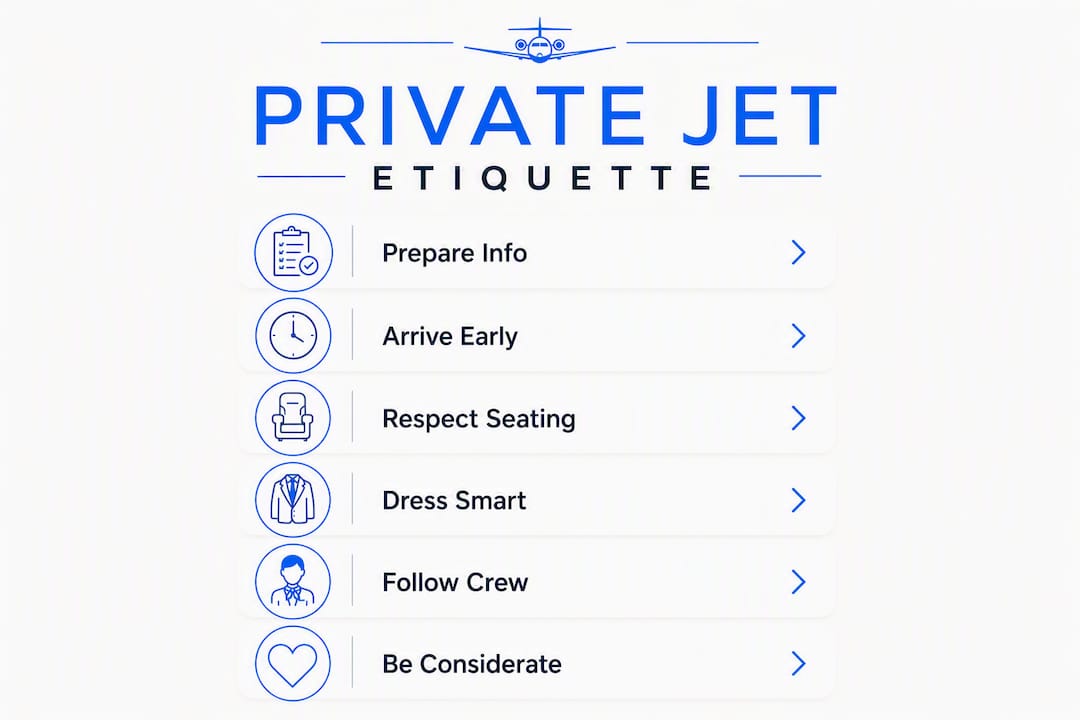
For first-time private jet passengers, the rules are short: arrive on time, declare your luggage and needs in advance, follow the crew’s instructions, and protect everyone’s privacy. Get those four right and your flight will go smoothly.
Here is what that looks like in practice:
- Arrive at the FBO 15–30 minutes before departure for domestic flights (30–45 minutes for international). Check-in at an FBO typically takes under 5 minutes, so you will not be waiting in a line.
- Tell your operator your passenger names, luggage count, dietary needs, and any special requirements at least 24–48 hours before departure.
- Use soft-sided bags. Rigid suitcases can be difficult to fit in light-jet holds.
- Follow the crew without question. The pilot-in-command has final authority on everything safety-related.
- Ask before photographing crew, other passengers, or the aircraft registration.
Pro Tip: Save a simple “trip brief” document on your phone with passenger names, luggage count, dietary preferences, and any mobility needs. You can send it to any operator in 30 seconds.
Table of Contents
- What should you tell the operator before your flight?
- How early should you arrive at the FBO?
- How should you behave on board a private jet?
- What luggage and clothing work best on a private jet?
- What are the crew’s rules, and what safety rules apply?
- What about alcohol, bathrooms, and taking photos?
- Is tipping expected on a private jet?
- What mistakes do first-timers most commonly make?
- How does Bluebirdjets membership change what you should prepare?
- Key Takeaways
- The part most guides skip
- Bluebirdjets membership for first-time private flyers
- Useful sources and further reading
What should you tell the operator before your flight?
Tell your operator the exact legal names of all passengers, the number and dimensions of bags, any pets traveling with you, dietary preferences, and medical or mobility needs. Send this at least 24–48 hours before departure. For international flights, customs documentation requirements make early submission even more critical.
The reason operators need this information is practical, not bureaucratic. Weight-and-balance calculations, catering orders, and customs manifests all depend on accurate passenger and luggage data. A last-minute surprise, like an undeclared oversized bag or a nut allergy, creates real operational friction.
A useful timeline:
| When | What to submit |
|---|---|
| At booking | Passenger names, rough luggage count, pet declaration |
| 48 hours out | Confirmed luggage dimensions, dietary needs, ground transport details |
| 24 hours out | Final headcount, any changes to pickup time or FBO address |
Confirm your ground transport pickup address when you book. Missing or incorrect pickup details at the destination are one of the most common operational failures on private flights.
Pro Tip: Keep a reusable trip brief as a note on your phone or in a shared doc. Update it before each trip rather than starting from scratch. Operators appreciate passengers who can brief them in one message.
How early should you arrive at the FBO?
The industry standard for domestic private departures is 15–30 minutes before scheduled departure; international flights typically call for 30–45 minutes. Your operator’s final briefing will give you the exact time. Follow that instruction over any general guidance.
| Flight type | Recommended arrival | Typical check-in time |
|---|---|---|
| Domestic | 15–30 minutes early | Under 5 minutes |
| International | 30–45 minutes early | — |
The FBO is a private terminal with its own address, separate from the commercial terminal. Navigate to the FBO address your operator provides, not the main airport entrance. This is the single most common navigation mistake first-timers make.
Once you arrive:
- A handler will meet you and take your bags directly to the aircraft.
- ID checks happen quickly at the FBO desk, not at a security line.
- Wait in the lounge until the crew invites you to board.
- Boarding order: the lead passenger boards first; guests follow when invited.
Private flights still face weather and ATC constraints. Build a small buffer for city traffic when planning your drive to the FBO, and check the final briefing for any last-minute timing changes.
How should you behave on board a private jet?
Behave as you would in a quiet private meeting. Keep your voice at a moderate level, avoid photographing others without permission, and respect any requests for privacy. Private jet cabins average around 62 dB, compared to 79–84 dB on commercial aircraft, so voices carry more than passengers expect.
The cabin is a shared space, even when it feels like yours alone. The people around you may be closing a deal, recovering from a red-eye, or simply valuing silence. Read the room before you start a conversation.
Seating works differently than on commercial flights. There is no assigned seat number, but the lead passenger picks first. Wait until they are seated before choosing your spot. On smaller jets, the crew may direct you to a specific seat for weight-balance reasons.
On device use: follow the crew’s instructions on when to use Wi-Fi or cellular. At cruise altitude, private jets commonly fly at 41,000–51,000 feet, where connectivity can be intermittent depending on the aircraft’s equipment.
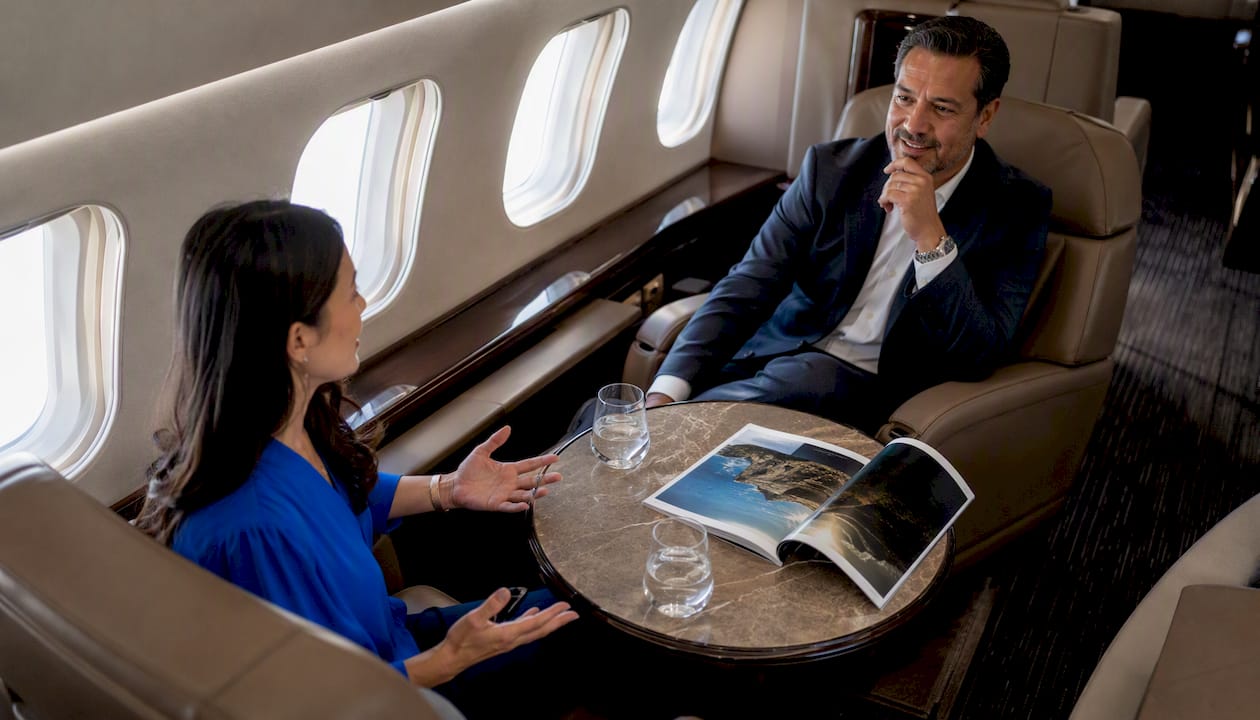
Pro Tip: Traveling with a mixed group, say business colleagues and family? Agree on a “quiet zone” seat before boarding. It avoids awkward mid-flight negotiations and keeps everyone comfortable.
What luggage and clothing work best on a private jet?
Soft-sided, squashable duffel bags are the right call for most light jets. Rigid suitcases often cannot fit in smaller aircraft holds. Confirm hold dimensions with your operator before you pack, especially for oversize gear like golf clubs or skis, which must be declared in advance.
A practical packing checklist:
- Passport or government-issued ID (required even for domestic flights at some FBOs)
- Medications in your carry-on, not in checked bags
- A light layer for the cabin (temperatures vary by aircraft)
- Phone charger and any adapters you need during the flight
- Any work materials you will need during the flight
On clothing: there is no formal dress code for private aviation. Dress for your destination and the purpose of the trip. A board meeting calls for business attire; a weekend trip to a resort does not. One practical note on footwear: the ramp and aircraft steps can be slippery, so avoid open-toed shoes or very high heels when boarding.

What are the crew’s rules, and what safety rules apply?
The pilot-in-command and cabin crew have final authority on boarding, seating, baggage placement, and all safety procedures. Follow their instructions without negotiation, even when the tone is casual and conversational.
Seatbelt instructions on a private jet are safety directives, not suggestions. The informal delivery does not change their authority. Buckle up when asked, and keep the belt fastened during cruise if turbulence is possible.
Common safety rules first-timers should expect:
- Seatbelts: fasten when instructed, including during cruise on turbulent routes.
- Controls: never touch the cockpit controls or door handles without crew direction.
- Bags: do not move large bags in the cabin without asking; placement affects weight distribution.
- Smoking and vaping: prohibited on virtually all private jets unless the operator has explicitly confirmed otherwise for that specific aircraft.
Treat the aircraft as a safety-critical workspace. Crew balance courtesy with operational needs, and they will always prioritize the latter. If a crew member asks you to do something, the correct response is compliance, not a conversation about why.
What about alcohol, bathrooms, and taking photos?
Catering and alcohol are arranged in advance and served at the crew’s discretion. Do not bring your own alcohol aboard without checking with the operator first. If you have specific catering requests or timing preferences for meals, submit them with your pre-flight brief.
Practical do’s and don’ts:
- Do ask the crew when food or drinks will be served if you are unsure.
- Do notify the operator in advance if you need a specific meal (halal, vegan, allergy-restricted).
- Don’t assume alcohol is unlimited or self-serve; the crew manages it.
- Don’t photograph other passengers, crew members, or the aircraft’s registration without asking. Privacy is a core norm in private aviation culture.
- Don’t post identifying details (tail numbers, passenger names, location tags) on social media without confirming everyone on board is comfortable with it.
On lavatories: smaller jets have compact lavatories. Use them considerately, keep them tidy, and be aware that on very short flights the crew may advise against use during certain phases of flight.
Wi-Fi availability varies by aircraft. If connectivity matters for your work, confirm it with the operator before you book, not after you board.
Is tipping expected on a private jet?
Tipping is optional and there is no universal standard in private aviation. Practices differ by region and operator. If you are unsure, ask your broker or coordinator before the flight.
Common approaches:
- Cabin attendants: a discreet cash tip at the end of a long or service-intensive flight is appreciated but not required.
- Pilots: many operators have policies that discourage or prohibit passengers from tipping the flight crew directly. A written compliment sent to the operator’s operations team often means more.
- Handlers at the FBO: a small cash tip for bag handling is common and always welcome.
Pro Tip: If a last-minute charge or incidental fee comes up on the day of travel, do not try to resolve it at the aircraft door. Send a quick message to your coordinator or broker and let them handle it. That is exactly what they are there for.
What mistakes do first-timers most commonly make?
Late arrival without notice, undeclared oversized luggage, navigating to the commercial terminal, and assuming airline-style services are guaranteed are the four biggest errors. Each one is avoidable.
Red flags and fixes:
- Arriving late: if you are running behind, call the operator immediately. Slots and crew duty limits are real constraints, and a late arrival without notice can cost you the flight.
- Wrong terminal: save the FBO address in your navigation app before you leave home, not when you are already in the car.
- Undeclared luggage or pets: declare everything at booking. Surprises at the ramp cause delays and can result in bags being left behind.
- Assuming services are guaranteed: catering, Wi-Fi, and specific aircraft configurations are confirmed at booking, not assumed. Ask in advance.
- Pressuring the crew: never ask crew to waive a safety rule. They will not, and asking puts everyone in an uncomfortable position.
Ground transport at the destination is another common failure point. Confirm your pickup address and the contact details for whoever is meeting you when you book, not when you land.
How does Bluebirdjets membership change what you should prepare?
Bluebirdjets empty-leg membership gives you access to last-minute flights, which compresses the usual prep timeline. That makes a reusable trip brief and ready-to-go documents more valuable, not less.
With empty-leg access, the window between booking and departure can be short. The passengers who handle it smoothly are the ones who already have their documents, passenger names, and luggage sorted before they search for a flight.
Practical preparation for Bluebirdjets members:
- Keep your passport and ID current and accessible at all times.
- Save a pre-filled passenger profile with legal names and contact details for each regular guest.
- Pack a soft-sided bag you can grab quickly for short-notice trips.
- Use the priority booking and queue features to secure flights early when inventory is tight.
The guest policy (up to six guests per flight) means you may be coordinating a group on short notice. Brief your guests on arrival time and the FBO address before they leave home.
Pro Tip: Check the live flight inventory regularly if your schedule is flexible. Empty legs update daily, and the best routes go quickly.
Key Takeaways
First-time private jet passengers who arrive on time, brief the operator accurately, follow the crew, and respect privacy will have a smooth flight every time.
| Point | Details |
|---|---|
| Arrive at the FBO on time | Domestic flights: 15–30 minutes early; international: 30–45 minutes early. |
| Brief the operator in advance | Submit passenger names, luggage details, and dietary needs at least 24–48 hours before departure. |
| Pack soft-sided bags | Rigid suitcases often do not fit in light-jet holds; confirm hold dimensions for oversize gear. |
| Follow the crew without question | The pilot-in-command has final authority on all safety and operational decisions. |
| Bluebirdjets membership | Gives unlimited access to empty-leg flights on Learjet 60s; keep documents and a reusable trip brief ready for short-notice bookings. |
The part most guides skip
Most first-timer guides spend their energy on dress codes and tipping percentages. Those details matter less than one thing almost nobody mentions: the crew needs accurate information more than they need social pleasantries.
A polished outfit and a generous tip will not compensate for a passenger who shows up with an undeclared oversized bag, the wrong terminal address, or a dietary allergy they forgot to mention. The crew’s job is to run a safe, efficient flight. Your job is to give them the information they need to do that.
The etiquette that actually matters is operational: declare everything, arrive as instructed, and follow directions without negotiating. Everything else, the conversation topics, the seating choices, the photography questions, flows naturally once those fundamentals are in place. First-timers who treat the flight as a safety-critical environment rather than a luxury experience tend to enjoy it far more, because the crew can focus on service instead of managing surprises.
Bluebirdjets membership for first-time private flyers
First-time private flyers often face the same friction: high per-flight costs, complex booking processes, and no easy way to fly spontaneously. Bluebirdjets membership cuts through that by giving you unlimited access to empty-leg flights on operator-owned Learjet 60 jets, with no per-flight charge beyond your annual membership.
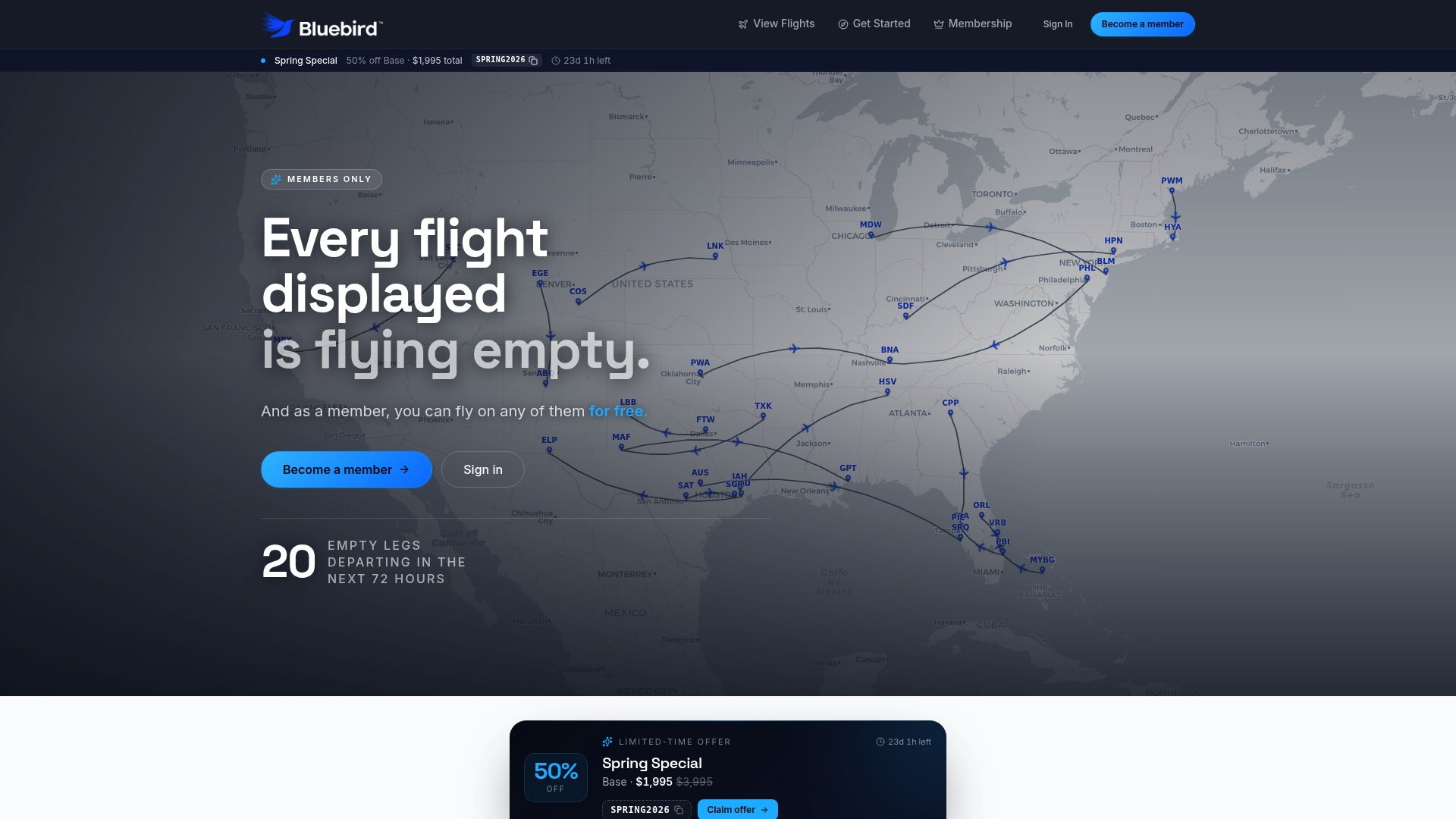
You can bring up to six guests per flight, browse live inventory that updates daily, and use priority booking to secure routes before they fill. For first-timers who want to build a habit of flying private without committing to full-charter pricing on every trip, it is a practical starting point. Check available flights now and see what is departing near you.
Useful sources and further reading
- First-time private jet flight checklist — LUKS Aviation
- What to expect on your first private jet flight — Uncompromised Travel
- First-timer’s cheat sheet: etiquette & expectations — Simple Flying
- Empty leg booking best practices — Bluebirdjets
- Private aviation booking best practices — Bluebirdjets