Avoid a Surprise Renewal: Private Jet Members, Cancel 10 Business Days Early

Avoid a Surprise Renewal: Private Jet Members, Cancel 10 Business Days Early
Canceling a private jet membership is almost always possible, but the deadline and refund depend entirely on your written contract, not general consumer instinct. Most agreements auto-renew unless you send written notice by a specific cutoff, and initiation fees are rarely refundable once that window closes. Your first move: pull up your membership contract and find your renewal anniversary date and the notice-period clause before you do anything else.
TL;DR:
- Canceling a private jet membership requires strict adherence to the specific notice period and delivery method outlined in the contract, often ten business days before renewal.
- Initiation fees are almost always non-refundable once paid, and auto-renewal is triggered unless proper written notice is received by the deadline.
- Missing the notice window usually results in a full-year charge, making early, documented cancellation critical for preventing unwanted billing.
- Statutory cooling-off rules may apply for new members within a 14-day window, offering a chance for full refunds regardless of the contract, depending on jurisdiction.
- If a renewal charge is posted after proper notice, immediate documentation and dispute escalation are essential steps to recover funds or prevent ongoing charges.
Table of Contents
- What Private Jet Membership Cancellation Actually Means
- Common Clauses and Fees You’ll Actually See in the Contract
- When to Act: Deadlines, Anniversaries, and Cooling-Off Rules
- How to Cancel a Membership Without Leaving Loose Ends
- What to Do if a Renewal Charge Hits Your Card Anyway
- Real Scenarios: What Actually Happens When You Cancel
- How Bluebird Jets’ Membership Model Shapes Your Cancellation Decision
- What Happens to Unused Flight Credits After You Cancel
- Does Canceling Cost You Future Booking Privileges or Points?
- The Fine Print That Decides Whether You Owe a Penalty
- If Your Provider Goes Bankrupt or Restructures
- Timing Your Cancellation to Keep the Most Money
- How Cancellation Policies Compare Across Providers
- What I’d Actually Do in Your Position
- Bluebird Jets: A Membership Built Around Flexibility, Not Lock-In
- Sources
- FAQ
What Private Jet Membership Cancellation Actually Means
Canceling a membership is a fundamentally different transaction than canceling a single charter flight. A charter cancellation involves one contract, one flight, and a penalty schedule tied to how close you are to departure. A membership cancellation involves an ongoing subscription relationship, an annual billing cycle, and a notice clause that has nothing to do with whether you’ve flown recently.
Membership access fees pay for the right to book, not for flights themselves. That distinction matters because providers structure agreements so the “access” portion is treated as earned and consumed the moment your membership year begins, regardless of how many empty legs you actually flew.
Three contract elements shape what happens when you cancel:
- Initiation fees — often one-time and non-refundable, covering onboarding and account setup.
- Annual access fees — recurring charges that renew automatically unless you cancel in writing before the deadline.
- Termination language — some contracts allow “termination for convenience” with notice; others only permit exit for cause, such as the operator breaching service terms.
Reading which category your agreement falls into tells you whether you’re negotiating a graceful exit or fighting an uphill battle.
Common Clauses and Fees You’ll Actually See in the Contract
Most private jet membership contracts share a recognizable skeleton, even when the branding differs. Knowing the pattern lets you scan your own agreement in minutes instead of hours.
Auto-renew notice windows are the single most important clause. Wheels Up’s published membership terms require written notice, delivered by email or certified mail, received at least ten business days before your membership anniversary to stop automatic renewal. Miss that window and you’re billed for another full year before you can exit.
Non-refundable fee framing shows up almost everywhere. JetSmarter-style membership agreements typically state that initiation fees and annual fees are non-refundable once paid, with renewal triggered automatically on the anniversary date unless the member sends notice. The legal logic: you’re paying for the right to access inventory, not for a guaranteed number of flights, so the provider considers that access “delivered” the moment your term starts.
- Auto-renew notice: commonly 10 business days before your anniversary
- Initiation fees: usually forfeited on cancellation, regardless of usage
- Annual fees: refund eligibility narrows sharply once the renewal has processed
Peak-date and lead-time penalties apply differently to single charters than to memberships. Industry reporting from Jettly on charter cancellation penalties puts typical charter cancellation fees somewhere between 10% and 100% of the trip cost, depending on how close to departure you cancel and whether the date falls during a peak travel period. That range doesn’t apply to membership fees themselves. It applies to the individual flights you book through the membership, which is a separate financial exposure entirely.
When to Act: Deadlines, Anniversaries, and Cooling-Off Rules
Your membership anniversary is the trigger date for everything. Find it on your original enrollment confirmation or first invoice, then work backward from there.
- Locate your anniversary date. This is the date your membership year began, not the date you first flew.
- Count back your notice period. If your contract specifies 10 business days, mark that date on a calendar with a hard reminder, not a mental note.
- Send notice before the deadline, not on it. Delivery delays with certified mail or email server issues have burned members who mailed notice the day it was technically due.
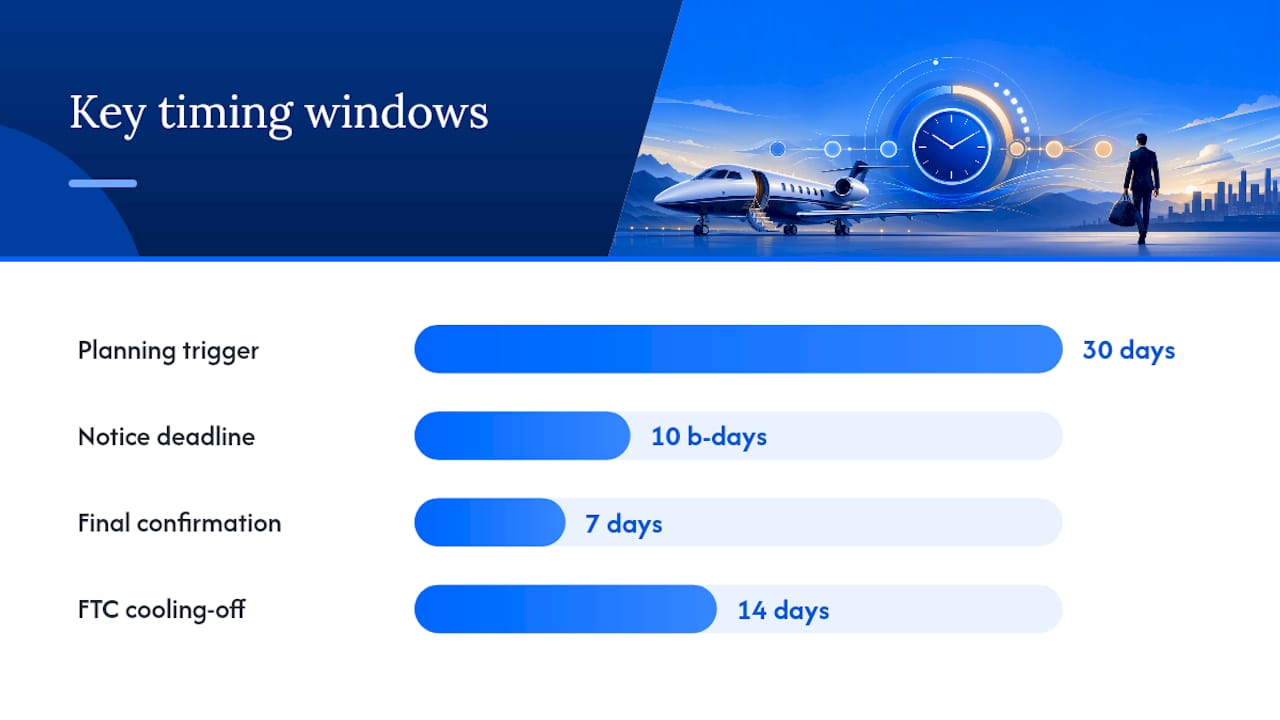
The passive renewal trap catches more affluent members than you’d expect, precisely because they’re busy and assume a provider will remind them. Providers have no obligation to remind you. A simple 30/10/7 rule works well: mark the anniversary 30 days out as your planning trigger, send written notice at least 10 business days before the deadline, and do a final confirmation check 7 days before to make sure the notice was received.
Pro Tip: Set two calendar reminders, not one. The first goes 30 days before your anniversary to decide whether you’re renewing. The second goes the day after you send notice, so you can follow up if you don’t get written confirmation within a week.
Statutory cooling-off protections can override contract terms in limited situations. The Federal Trade Commission’s cooling-off rule grants a 14-day window for certain new subscription purchases in some jurisdictions, letting a new member cancel and receive a full refund without justification. Whether it applies depends on how and where you enrolled, so check state-specific consumer protection rules alongside your contract.
How to Cancel a Membership Without Leaving Loose Ends
Canceling cleanly means creating a paper trail a provider can’t dispute later. Skip a step here and you risk an unwanted renewal charge that takes months to unwind.
- Pull the agreement and confirm the clause. Find the exact notice period and delivery method your contract requires. Some accept email; others insist on certified mail.
- Draft written cancellation notice. Include your full name, account or membership ID, original enrollment date, and explicit language: “This letter serves as notice that I do not wish to renew my membership.”
- Send it two ways. Use the email address on file with the account, and back it up with certified mail or another recorded delivery method.
- Keep every piece of proof. Save delivery receipts, read confirmations, and screenshots of sent emails in one folder with dated file names.
If a renewal charge still posts after you’ve done all four steps:
- File a refund request immediately, referencing your notice date and delivery proof.
- Document every call, email, and response date in a simple timeline.
- Escalate to a formal dispute only after giving the provider a reasonable window, typically 5 to 10 business days, to respond.
What to Do if a Renewal Charge Hits Your Card Anyway
A posted renewal charge after you’ve sent proper notice isn’t the end of the road, but your next move depends on how strong your paper trail is.
Start by contacting the provider directly with your documentation attached. Most billing disputes get resolved faster through direct negotiation than through a bank chargeback, because the provider avoids the chargeback fee and reputational hit that comes with disputed transactions.
If direct negotiation stalls, a bank dispute or chargeback becomes the next lever. Card networks generally give you a window of 60 to 120 days from the statement date to file, so don’t wait until you’ve exhausted every email exchange with the provider first.
Before escalating, read your agreement’s dispute resolution clause carefully:
- Arbitration clauses often waive your right to sue in court, routing disputes into private arbitration instead. This can limit your remedies and shift costs onto you.
- Venue clauses specify which state’s courts or arbitration bodies have jurisdiction, which matters if the provider is based somewhere other than where you live.
- Class-action waivers frequently appear alongside arbitration clauses, meaning you can’t join a group claim even if other members faced the same issue.
Build your evidence file before you need it: the signed agreement, timestamped copies of your cancellation notice, delivery confirmations, and screenshots of your account status on the date you canceled. A clean, dated record turns a “he said, she said” dispute into a quick resolution far more often than an angry phone call does.
Real Scenarios: What Actually Happens When You Cancel
Three timing scenarios cover most of what happens in practice.
- You cancel 30 days before renewal. This is the clean exit. Send written notice through both required channels, request written confirmation of cancellation, and verify your final invoice shows no renewal charge. Expect no dispute if you followed the notice window correctly.
- You miss the 10-business-day notice window and get charged. This is the most common failure mode. Your next step is a direct refund request citing the missed date, followed by a bank dispute if the provider doesn’t respond within a reasonable window. Expect some friction, but a documented late cancellation often still results in a partial or full refund if you act fast.
- You’re a new member canceling within a statutory cooling-off period. If your enrollment falls under a 14-day cooling-off rule and you’re within that window, you may be entitled to a full refund regardless of what the membership contract says, though this depends heavily on your state and how the purchase was made.
Each scenario hinges on documentation. The member who cancels 30 days out with certified mail proof rarely has a problem. The member who calls once and assumes it’s handled almost always does.
How Bluebird Jets’ Membership Model Shapes Your Cancellation Decision
Memberships for private jet access are often structured around unlimited access to empty-leg flights on operator-owned aircraft, with live inventory updates, priority booking, and various guest privileges. That’s worth understanding before you decide whether canceling makes sense for your situation.
The math on canceling often comes down to usage. If you’ve flown even a handful of empty legs, the per-flight value of unlimited access frequently outweighs the sunk cost of your initiation fee, especially against last-minute charter pricing. Members who haven’t used their access much face a tougher call, since the initiation fee doesn’t come back regardless.
If you do decide to cancel:
- Log into your account and locate the membership settings page before contacting support.
- Confirm your renewal anniversary date against your original enrollment confirmation.
- Submit written cancellation notice through the membership management page well ahead of your renewal deadline.
What Happens to Unused Flight Credits After You Cancel
Most membership agreements treat unused access, not stored flight credits, as the thing you’re paying for. That distinction matters more than it sounds.
Unlike airline mileage programs or prepaid flight-hour blocks, empty-leg membership access typically isn’t redeemable for cash value or transferable credits once your membership term ends. If your contract offered you unlimited booking access rather than a fixed number of prepaid flights, canceling generally forfeits any remaining access for the current term, not a stored balance you can claim later.
Some providers structure premium tiers or add-on packages differently. A prepaid block of guaranteed-availability hours, for instance, might carry its own separate refund schedule distinct from your base membership fee. Always check whether you purchased any add-on that isn’t governed by the same auto-renew clause as your core membership.
The practical takeaway: if you’re mid-membership-year and considering cancellation, look at how many empty legs you’re likely to book in the remaining months before pulling the trigger. Canceling in month two of a twelve-month term forfeits ten months of access you already paid for, unless your specific agreement includes a pro-rated refund clause, which most do not.
Read the fine print on any “credit rollover” or “banking” language specifically. Some contracts allow unused priority-booking slots to carry forward if you renew, but that provision usually evaporates entirely on cancellation rather than converting into a payout or account credit.
Does Canceling Cost You Future Booking Privileges or Points?
Canceling a membership generally ends your priority booking status immediately, and any queue position you held resets if you rejoin later. That’s the most immediate practical consequence beyond the financial one.
Private jet memberships built around empty-leg access don’t typically run traditional loyalty point programs the way airlines do. Instead, the “reward” is booking priority itself: access to live inventory before non-members, guaranteed seat holds, or faster confirmation windows. Cancel, and you lose that priority tier the day your membership officially ends, not at some later point.
Rejoining later almost never restores your old standing automatically. Most providers treat a lapsed member as a brand-new enrollment, meaning you’d pay the initiation fee again and start at the bottom of any priority queue, even if you were a member for years previously. A few providers offer loyalty pricing or waived re-enrollment fees for former members who cancel in good standing, but that’s a courtesy, not a contractual right, so ask explicitly rather than assuming.
If your membership included guest privileges, such as bringing companions on flights at no extra charge, that benefit disappears the moment your access ends. Any flight booked before cancellation typically still honors those terms, but you can’t book new flights under member guest rules once you’ve formally exited.
Before canceling, check whether your provider distinguishes between a “pause” and a full cancellation. Some contracts allow a temporary suspension, preserving your enrollment date and priority tier, which costs less in the long run than fully canceling and re-enrolling months later.
The Fine Print That Decides Whether You Owe a Penalty
Two clauses do more to determine your financial exposure than anything else in a membership contract: minimum term length and early termination penalties.
Minimum membership terms lock you into a set period, often 12 months, regardless of when you signed up. Cancel before that term ends and many agreements charge you the remaining balance of the contracted period, not just forfeit your initiation fee. This differs sharply from a simple non-renewal, where you’re just declining to continue past your current term.
Early termination penalties stack on top of minimum-term clauses in some agreements. Rather than just losing your fees, you might owe a flat penalty, sometimes calculated as a percentage of your remaining contract value, for breaking the agreement mid-term rather than waiting for the natural renewal date.
Watch for these specific clause types when reading your contract:
- Termination for convenience clauses let either party exit with proper notice and no penalty beyond forfeited fees. This is the best-case scenario for a member who wants out.
- Termination for cause clauses only permit exit if the other party breaches the agreement, such as the provider failing to deliver promised access or committing a material contract violation.
- Automatic term extension clauses, distinct from simple auto-renewal, can extend your minimum commitment period every time you use certain premium features or book above a threshold number of flights.
The gap between “I’m not renewing” and “I’m terminating mid-term” is often the difference between losing an initiation fee and owing a penalty worth thousands. Read your minimum term clause before you assume non-renewal and mid-term exit carry the same cost.
If Your Provider Goes Bankrupt or Restructures
A provider entering bankruptcy or restructuring changes your legal position from contract dispute to creditor claim, and that shift matters enormously for what you can realistically recover.
Once a company files for bankruptcy protection, your membership contract typically becomes subject to an automatic stay, a legal freeze that halts most collection actions and contract enforcement while the case proceeds. Practically, this means you generally cannot simply cancel and expect an immediate refund the way you would outside bankruptcy. Instead, you become an unsecured creditor in most cases, filing a claim alongside other members for whatever portion of your prepaid fees might eventually be recoverable.
Recovery rates for unsecured creditors in aviation bankruptcies vary enormously and are often a fraction of what’s owed, since operators, lenders, and lessors typically have priority claims ahead of members. Don’t expect a full refund of remaining membership value just because the company shut down owing you access.
Your practical steps if a provider files for bankruptcy:
- File your proof of claim promptly with the bankruptcy court once notified, using your membership agreement and payment records as documentation.
- Stop any pending payments immediately, including canceling auto-pay authorizations tied to the account, since a bankrupt company’s billing systems don’t always stop charging cleanly.
- Watch for restructuring emails offering “continuity” deals, where a successor company offers to honor memberships at a discount. Read these carefully. They’re not obligated to match your original terms.
A travel insurance policy with cancellation coverage, like those offered through Sail Armada, can sometimes offset losses tied to a provider going under, depending on your policy’s specific triggers and exclusions.
Timing Your Cancellation to Keep the Most Money
The single biggest lever you control is when you send notice, not how you word it. Timing decisions fall into three practical categories.
Cancel well before your notice deadline, not at it. If your contract requires 10 business days’ notice, send it at 20 or 25 days out instead. Mail delays, email filtering issues, and provider processing backlogs have turned “on-time” notices into “late” ones more than once.
Time cancellation around your usage cycle, not the calendar year. If you’ve booked several empty legs in the past few months and expect to travel again soon, riding out the remainder of your paid term often delivers more value than canceling early and losing access you already paid for.
Avoid canceling during peak booking seasons if you’re unsure. Holiday periods and major event weekends often carry stricter cancellation penalties on individual flight bookings tied to your membership, separate from the membership fee itself. If you have flights already booked during a peak window, resolve those bookings first before triggering a membership cancellation that might complicate customer service response times.
If you’re on the fence about renewing versus canceling, the smartest move is often a mid-term usage audit. Count how many flights you’ve actually booked against your annual fee, compare that to charter pricing for the same routes, and let that math, not renewal-date anxiety, drive the decision. A membership that’s paid for itself twice over in six months rarely deserves a rushed cancellation just because a deadline is approaching.
How Cancellation Policies Compare Across Providers
Published membership agreements in the private aviation space share more similarities than differences, even though the branding varies widely.
Wheels Up’s published terms require written notice at least 10 business days before your anniversary, delivered by email or certified mail, to stop automatic renewal. This 10-day window has become something close to an industry default, showing up in similar form across multiple membership structures.
JetSmarter-style agreements, as documented in published membership terms, treat initiation fees and annual fees as non-refundable once paid, with renewal triggered automatically unless the member sends written notice. The legal reasoning behind this pattern is consistent: providers frame membership fees as payment for access rights already delivered, not for a specific number of future flights, which limits refund claims even when a member barely used their account.
What varies more is the delivery method requirement. Some contracts accept email notice alone; others insist on certified mail or a signed physical letter, and treat email-only notice as invalid even if you sent it well before the deadline. Always confirm which delivery method your specific contract requires rather than assuming email is sufficient just because it’s convenient.
The consistent thread across nearly every membership agreement in this space: notice periods are calculated in business days, not calendar days, and non-refundable fee language applies regardless of how much you actually flew.
What I’d Actually Do in Your Position
Stop the renewal first, worry about the refund second. Every dollar you might recover from a past charge matters less than preventing a new one from posting while you’re still figuring out your next move.
My three-step version: confirm your anniversary date today, send written notice through both required channels this week, and file everything, confirmations, receipts, timestamps, in one folder before you forget where you put it.
On disputes: accept a small loss, a partial fee, a minor delay, rather than escalate to arbitration over a few hundred dollars. Save the fight for a renewal charge that hit despite documented, on-time notice. That’s worth pursuing. A missed deadline of your own making usually isn’t.
— Nick
Bluebird Jets: A Membership Built Around Flexibility, Not Lock-In
Unlike contracts loaded with rigid minimum terms and steep early termination penalties, Bluebird Jets is built for members who want empty-leg flexibility without the anxiety of a renewal trap sneaking up on them. Membership gives you unlimited access to live empty-leg inventory on operator-owned Learjet 60 aircraft, priority booking, and room for up to six guests per flight, all without the guesswork that comes from opaque per-flight charter pricing.

If you’re already a member and thinking about whether to renew, the smartest first step is checking your current empty-leg listings against what you’ve actually flown this term. If the math still works in your favor, staying enrolled almost always beats paying charter rates for the same routes. If you’ve decided it’s time to step away, visit your membership account page today and confirm your renewal date before your notice window closes.
Sources
- Federal Trade Commission — cooling periods and similar rules
- Wheels Up — Membership agreement excerpt (published membership terms)
FAQ
Can You Write Off 100% of a Private Jet on Taxes?
Business use of a private jet can sometimes qualify for accelerated depreciation deductions under federal tax rules, but the percentage you can deduct depends on business-use percentage, timing, and current tax law, so consult a tax professional before assuming full deductibility.
Does Travis Kelce Own a Private Jet?
Public reporting on celebrity jet ownership varies and isn’t something this article can verify, so treat any specific ownership claim about a public figure with caution unless confirmed by a primary source.
How Much Does a NetJets Membership Cost?
Fractional ownership and jet card pricing from major operators varies widely by aircraft category and annual hour commitment, and specific current pricing isn’t something this article tracks, so check directly with the provider for current rates.
How Much Does a Bluebird Jets Membership Cost?
Bluebird Jets prices its annual membership based on the tier selected, with a premium tier available for higher booking priority; check the membership page for current pricing details.
What Happens if I Miss My Membership’s Notice Deadline?
Missing the notice deadline, commonly 10 business days before your anniversary in agreements like Wheels Up’s, typically triggers automatic renewal and a new charge, after which your best options are a direct refund request or a bank dispute.