Types of Private Aviation Access: A Practical Guide

Types of Private Aviation Access: A Practical Guide
Private aviation access is defined as the method by which an individual secures the right to fly on a private aircraft, ranging from a single pay-per-trip charter to full aircraft ownership. Four primary access models exist in the industry: on-demand charter, jet cards, fractional ownership, and whole aircraft ownership. Each model serves a different flight frequency, budget, and flexibility need. The right choice depends almost entirely on how many hours per year you fly and how much pricing certainty you want. Understanding these private flight access types before committing to any program saves you from paying for access you will never use.
1. Types of private aviation access: the four core models
The private aviation industry organizes access into four recognized structures, each with a distinct cost profile and commitment level. Annual flight volume is the single most important factor in choosing between them. On-demand charter suits travelers flying fewer than 50 hours per year. Jet cards and fractional ownership align with 50–100+ hours annually, while whole ownership is reserved for the most frequent flyers with stable, predictable routes.
Knowing which category fits your life before you speak to any provider puts you in a far stronger position. Providers are incentivized to sell you the product with the highest margin, not the one that fits your actual usage. Your mission profile, not the aircraft, should drive every decision.

2. On-demand charter: the no-commitment entry point
On-demand charter is the most flexible private jet option available. You book a flight per trip, sign no long-term contract, and pay live market rates. Flights can be arranged within 3–5 hours, making it the fastest entry point into private aviation. No upfront capital is required.
The trade-off is pricing variability. Market rates shift with demand, season, and aircraft availability. A midsize jet from New York to Miami might cost $12,000 on a Tuesday and $22,000 on the Friday before a holiday weekend. You have no pricing protection.
Key advantages of on-demand charter:
- Zero upfront commitment or deposit
- Access to a wide range of aircraft types per trip
- No annual minimums or contract penalties
- Ideal for testing private aviation before committing to a program
- Fastest booking lead time of any access model
Key disadvantages:
- Pricing fluctuates with market demand
- Availability gaps during peak travel periods
- No guaranteed aircraft or pricing consistency
Pro Tip: Book on-demand charter for one-way trips where empty leg pricing applies. You can often access private flights at a fraction of the standard rate by flying in the direction an aircraft is already repositioning.
On-demand charter works best for travelers flying fewer than 25 hours per year or those who want to experience private aviation before making a larger financial commitment.
3. How jet cards offer prepaid access and predictable pricing
A jet card is a prepaid block of flight hours purchased at a fixed hourly rate. You pay upfront, and the provider guarantees that rate for the duration of your card. Minimum purchases typically start at 25 flight hours, with upfront costs ranging from $150,000 to $500,000 or more depending on aircraft category.
The core appeal is pricing certainty. You know exactly what each hour costs before you book. Most jet card programs also guarantee availability within 24–48 hours, which is a meaningful upgrade over on-demand charter during busy travel seasons.
What jet cards do well:
- Fixed hourly rates protect you from market price swings
- Guaranteed availability windows with short notice booking
- No aircraft management responsibilities
- Consistent aircraft category across all flights
Where jet cards fall short:
- High upfront capital requirement
- Peak period caveats on availability guarantees often go unread
- Unused hours may expire or carry rollover restrictions
- Surcharges for fuel, de-icing, and peak days can erode fixed-rate savings
Pro Tip: Read the peak day calendar before signing any jet card agreement. Providers define peak days differently. Some list 25 days per year; others list 60. Those days often carry surcharges or reduced availability, which changes the real cost of the card significantly.
Jet cards suit travelers flying 25–50 hours per year who want pricing predictability without the multi-year commitment of fractional ownership. They are the most popular entry point for first-time private aviation program buyers.
4. What fractional ownership programs offer and who should consider them
Fractional ownership means buying a share of a specific aircraft, typically ranging from 1/16th to 1/4th of the total asset. A 1/16th share corresponds to roughly 50 flight hours per year, while a 1/4th share provides 200 or more hours annually. A professional management company handles all scheduling, maintenance, crew, and operations on your behalf.
The financial commitment is substantial. You pay an acquisition cost for your share, a monthly management fee, and an occupied hourly rate when you fly. Multi-year contracts are standard, typically running three to five years. Exiting early carries financial penalties.
What fractional ownership includes
- Guaranteed access to your aircraft category at any time, including short-notice requests
- Professional operations management covering crew, maintenance, and regulatory compliance
- Fixed monthly costs that make annual budgeting more predictable
- Equity position in a physical asset, though resale values vary
- Consistent aircraft type across all flights within your program
The real trade-offs
Fractional ownership costs more per hour than on-demand charter for low-frequency flyers. The model only becomes cost-efficient when you fly enough hours to spread the fixed monthly fees across meaningful usage. Travelers flying fewer than 50 hours per year typically overpay in a fractional program.
The long-term contract is the biggest risk for travelers aged 25–50 whose travel patterns change. A new job, a relocation, or a shift in business needs can leave you locked into a program that no longer fits. Matching your access model to your current mission profile, not your aspirational one, is the most important financial discipline in private aviation.
5. What whole aircraft ownership entails and when it is justified
Whole aircraft ownership gives you complete control over a specific aircraft. You decide when it flies, how it is configured, and who is on board. Whole ownership is typically justified by very high annual flight usage and stable, predictable travel patterns. Executives flying 400+ hours per year on consistent routes often find ownership cheaper per hour than any program alternative.
The operational burden is significant. You are responsible for crew hiring and management, maintenance scheduling, hangar costs, insurance, and regulatory compliance. Many owners hire a flight management company to handle operations, which adds cost but removes the day-to-day complexity.
Whole ownership advantages:
- Maximum scheduling flexibility with no availability restrictions
- Full customization of the cabin, livery, and onboard services
- Potential to offset costs by chartering the aircraft when not in use
- No per-hour program fees or peak day surcharges
Whole ownership disadvantages:
- Highest fixed cost structure of any access model
- Full operational and regulatory responsibility
- Aircraft depreciation is a real financial exposure
- Requires significant management attention or a dedicated flight department
Pro Tip: If you are considering ownership primarily for status or occasional use, a fractional program or jet card will almost always deliver better value. Ownership makes financial sense only when your annual hours and route consistency are high enough to justify the fixed cost base.
6. How to choose the right access model for your mission profile
Your mission profile is defined by four variables: how often you fly, how many passengers typically travel with you, which airports you use, and how much pricing predictability you need. Getting these four numbers right before evaluating any program prevents the most common and expensive mistake in private aviation: buying access for the traveler you want to be rather than the traveler you are.
Use this framework to match your profile to the right model:
| Mission attribute | Best-fit access model |
|---|---|
| Fewer than 25 hours per year | On-demand charter |
| 25–50 hours per year, pricing certainty needed | Jet card |
| 50–200 hours per year, multi-year commitment acceptable | Fractional ownership |
| 200+ hours per year, stable routes | Whole aircraft ownership |
| Flexible budget, maximum variety | On-demand charter or aviation membership |
Airport access is an underrated factor. Private aviation opens roughly 5,000 airports in the United States that commercial airlines do not serve. If your travel regularly involves smaller regional airports, on-demand charter or fractional programs with guaranteed aircraft categories give you the most consistent access. Jet cards tied to specific aircraft types can create problems at airports with weight or runway restrictions.
Pricing predictability matters more as your flight frequency increases. A traveler flying 10 hours per year can absorb market rate variability. A traveler flying 80 hours per year cannot. At that volume, a 20% price swing on charter rates represents a meaningful budget exposure. That is the point where a fixed-rate program pays for itself.
Pro Tip: Track your actual commercial flight spend for 12 months before evaluating private aviation programs. Include business class upgrades, lounge memberships, and time lost to connections. The real cost comparison often surprises people and clarifies exactly which private access model makes financial sense.
Key takeaways
The most cost-efficient private aviation access model is the one that matches your actual annual flight hours, not your ideal travel frequency.
| Point | Details |
|---|---|
| Annual hours drive the decision | Fly under 25 hours per year and on-demand charter is almost always the right choice. |
| Jet cards offer pricing certainty | Fixed hourly rates protect frequent flyers from market swings, but peak-day caveats matter. |
| Fractional ownership requires commitment | Multi-year contracts and monthly fees only pay off above 50 flight hours per year. |
| Whole ownership suits very high usage | Full control comes with full operational responsibility and high fixed costs. |
| Mission profile comes first | Define your passenger count, frequency, airports, and budget before evaluating any program. |
Why most people choose the wrong access model
The most common mistake I see travelers aged 25–50 make is choosing an access model based on the aircraft rather than the mission. Someone books a fractional share in a large-cabin jet because it feels like the right status signal, then flies 30 hours a year on short regional trips where a light jet would have been faster, cheaper, and more practical.
Private aviation is not a single product. It is a spectrum of access structures, and the financial gap between the right model and the wrong one is significant. I have seen travelers spend three times more than necessary because they committed to a fractional program before honestly auditing their travel patterns.
The travelers who get the most value from private aviation are the ones who start with on-demand charter, track their booking patterns, and upgrade their access model only when the data supports it. That discipline is rare, but it is the most financially sound approach.
One trend worth watching: aviation membership plans that provide access to empty leg flights are changing the entry-level math. For travelers who can fly with some schedule flexibility, empty leg access can deliver private aviation at a fraction of standard charter rates. That model suits a specific traveler profile, but for the right person, it is the most efficient access structure available.
— Nick
Bluebirdjets and your private aviation access options
Private aviation does not have to start with a six-figure commitment. Bluebirdjets offers a membership that gives you unlimited access to empty leg flights on the platform, which is the most cost-efficient way to fly private when your schedule has flexibility.
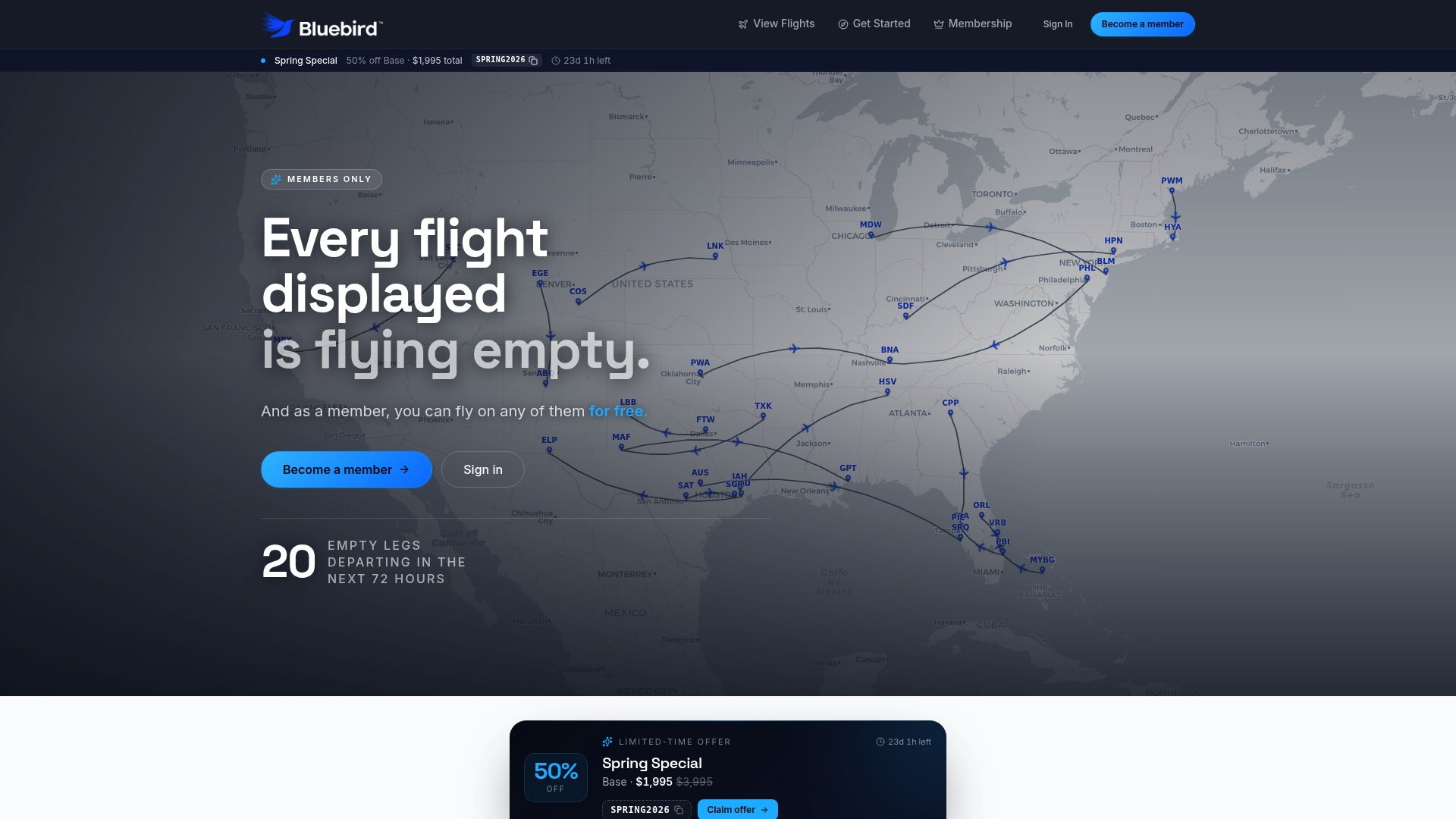
For travelers who want on-demand access without a long-term contract, Bluebirdjets charter connects you to private flights with no upfront program fees. For those ready to commit to a structured access plan, Bluebirdjets membership delivers prepaid benefits with the pricing predictability of a jet card at a lower entry point. Both options are built for travelers who want private aviation to fit their life, not the other way around.
FAQ
What are the four types of private aviation access?
The four recognized access models are on-demand charter, jet cards, fractional ownership, and whole aircraft ownership. Each model differs by commitment level, upfront cost, and annual flight hour suitability.
How many hours per year do I need to justify a jet card?
Jet cards are best suited to travelers flying 25–50 hours per year who want fixed pricing and guaranteed availability. Below 25 hours annually, on-demand charter typically costs less overall.
What is an empty leg flight?
An empty leg is a repositioning flight where an aircraft travels without paying passengers. These flights are available at significantly reduced rates and are the foundation of aviation membership plans like Bluebirdjets.
Is fractional ownership worth it?
Fractional ownership delivers value for travelers flying 50–200 hours per year who need guaranteed access and consistent aircraft quality. Below 50 hours annually, the monthly management fees make it more expensive than charter or jet card alternatives.
What does “guaranteed availability” mean on a jet card?
Guaranteed availability means the provider commits to sourcing an aircraft within a defined lead time, typically 24–48 hours. Most programs include caveats for peak travel periods, where surcharges apply or lead times extend, so reading the peak day terms before purchasing is critical.