Why Flight Subscriptions Suit Travelers Who Fly Often

Why Flight Subscriptions Suit Travelers Who Fly Often
Flight subscriptions are membership-based programs that grant frequent travelers predictable flight access and bundled perks for a recurring fee. The airline subscription market is projected to reach $4.2 billion by the end of 2026, a figure that reflects genuine demand rather than hype. Understanding why flight subscriptions suit travelers comes down to one core question: does your actual travel behavior match what the subscription rewards? For travelers aged 25–45 who fly regularly and value flexibility over rigid booking windows, the answer is often yes. But the math only works when you go in with clear eyes.
Why flight subscriptions suit travelers who fly frequently
The travelers who get the most from subscriptions are not occasional vacationers. Frequent, predictable travelers such as commuters, regional business flyers, and people with consistent monthly routes extract the most value from subscription structures. The model rewards repetition.
Three categories of travelers benefit most:
- High-frequency commuters flying the same route three or more times per month. Subscriptions built around commute products eliminate per-ticket pricing and reduce total monthly spend.
- Business travelers who need same-day flight changes. Single same-day changes on popular routes typically cost $200–$400. Unlimited same-day changes in a business-tier subscription can erase that cost entirely.
- Spontaneous travelers who book on short notice and want to avoid last-minute fare spikes. Subscriptions with flexible access tiers give these travelers a fixed cost ceiling.
Infrequent travelers, by contrast, rarely break even. Airlines price subscriptions assuming high utilization. If you fly twice a year, no subscription math works in your favor.
Pro Tip: Before signing up, count your actual flights from the past 12 months. Not the trips you planned. The trips you took. That number is your baseline.
Subscription models fall into three distinct types: flexible access products, commute products, and fee-relief products. Each type suits a different travel profile, and mismatching the type to your habits is the most common and costly mistake travelers make.
How do flight subscriptions work and what do you actually get?
A flight subscription charges a monthly or annual fee in exchange for bundled flight access and ancillary perks. The structure varies by tier, but the core value components are consistent across most programs.
The three main value layers
Flight access is the foundation. Depending on the tier, this means discounted fares, priority access to available seats, or a set number of included flights per month. The booking window is typically shorter than standard ticketing, which rewards travelers who can move quickly.
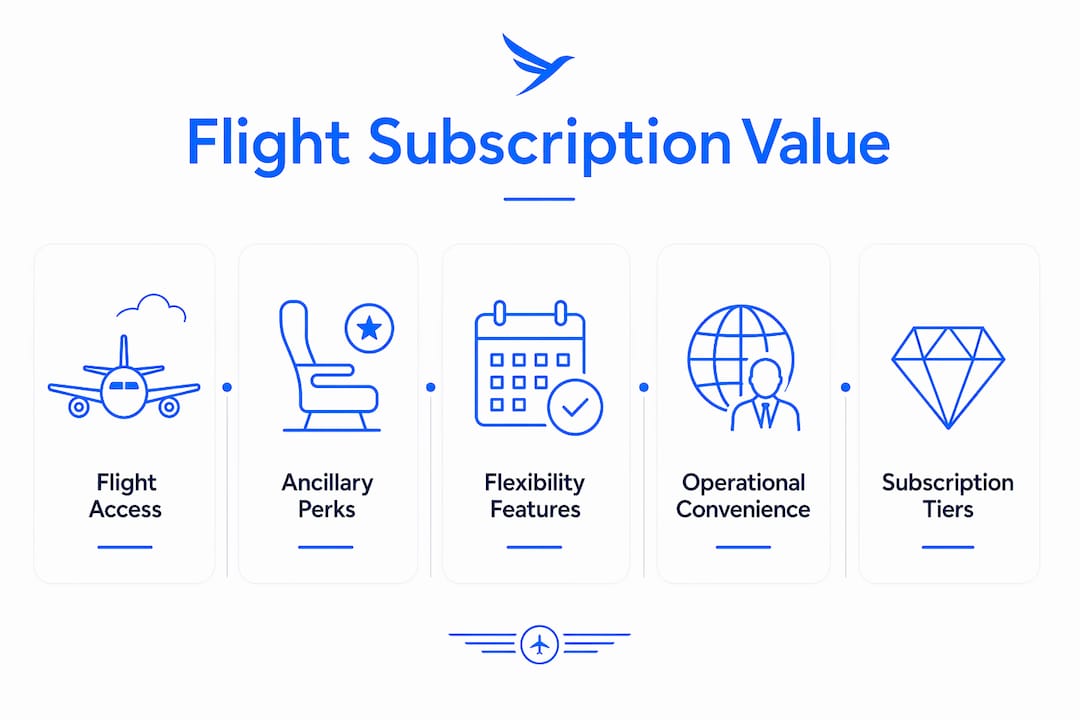
Ancillary perks add up faster than most travelers expect. Waived baggage fees, priority boarding, and free seat selection each carry real dollar value. A realistic monthly estimate combining these perks across regular usage reaches roughly $242 in combined value, according to cost-benefit modeling for 2026 subscriptions.

Flexibility features are the differentiator for business-tier products. Same-day changes, standby access, and no-fee cancellations convert a rigid ticket into something closer to an open travel pass.
Flight deal subscription clubs, a separate but related category, charge between $25 and $199 annually and now serve user bases of 2–3 million members each. These programs focus on surfacing discounted fares rather than bundling perks, making them better suited to leisure travelers than frequent business flyers.
| Subscription type | Best for | Core benefit |
|---|---|---|
| Flexible access | Spontaneous travelers | Short booking windows, fare access |
| Commute product | Route-consistent flyers | Fixed monthly cost on set routes |
| Fee-relief product | Frequent flyers with high ancillary spend | Waived baggage, seat, and change fees |
Pro Tip: Calculate your average monthly ancillary spend before choosing a tier. If you pay for checked bags, seat selection, and changes regularly, a fee-relief product often pays for itself within two trips.
Successful subscription models prioritize simplicity and flexibility over deep discounts. Travelers who value being ready to fly without friction get more from subscriptions than those chasing the lowest possible fare on each individual ticket.
Common misconceptions that cost travelers money
The biggest misconception about flight subscriptions is that they function like unlimited flying passes. Most programs restrict timing, routes, and seat availability to protect airline margins. Treating a subscription as open-ended access leads to frustration and wasted fees.
Watch for these specific pitfalls:
- Blackout dates. Peak travel periods, holidays, and high-demand weekends are frequently excluded. Read the blackout clause before signing.
- Route limitations. Route coverage critically impacts subscription usefulness. Travelers outside a carrier’s core network often find the subscription expensive and impractical.
- Aspirational math. Most travelers buy subscriptions based on travel they plan to take, not travel they actually take. Airlines price subscriptions knowing that real usage rates fall below projected usage.
- Limited refund policies. Many subscriptions are non-refundable after the first billing cycle. Canceling mid-year rarely returns prorated value.
- Loyalty program confusion. Subscriptions are not a replacement for loyalty programs. Subscriptions cover convenience; loyalty points maximize rewards. Treating them as interchangeable wastes both.
Frequent travelers booking three or more complex itineraries per year can achieve real savings, but inattentive subscribers face customer service friction and refund difficulties that erode any gains. Engagement matters as much as frequency.
How to calculate your break-even point before committing
The break-even calculation is the only honest way to evaluate a subscription. Analysts consistently caution against signing up without running this math first.
- Pull your actual flight history. Count flights taken in the past 12 months. Divide by 12 for a monthly average.
- Record your average ticket cost. Include taxes and fees. Use the actual amount paid, not the base fare.
- List your ancillary spending. Add up what you paid for bags, seat selection, and changes over the past year. Divide by 12.
- Apply realistic usage percentages. True subscription value requires weighting benefits by realistic usage rates, not assuming full utilization every trip. If you check a bag on 60% of flights, apply 60% to the baggage fee waiver value.
- Sum the monthly value. Add discounted fare savings plus weighted ancillary value.
- Compare to the subscription fee. If your monthly value exceeds the fee, you break even. If it exceeds the fee by 20% or more, the subscription is worth it.
| Step | What to calculate |
|---|---|
| Flight frequency | Actual trips per month from past 12 months |
| Ticket cost baseline | Average paid fare including taxes |
| Ancillary spend | Monthly average on bags, seats, changes |
| Weighted perk value | Each perk value multiplied by realistic usage rate |
| Break-even threshold | Monthly value vs. subscription fee |
Pro Tip: Add a 15% buffer to your subscription fee when calculating break-even. That buffer accounts for months when travel drops due to illness, work changes, or schedule shifts. If the math still works, the subscription is solid.
Route compatibility is the final filter. Check that the subscription covers your most-traveled routes before committing. A subscription built around a hub you rarely use delivers almost no value regardless of how often you fly. For travelers exploring how to budget spontaneous flights, route flexibility is the deciding factor.
Practical tips for getting the most from a subscription in 2026
Getting value from a flight subscription requires active management, not passive enrollment. These habits separate travelers who profit from those who overpay.
- Stay flexible on dates. Subscriptions reward travelers who can shift departure by a day or two. Rigid date requirements push you toward peak availability windows where subscription access is most restricted.
- Monitor booking windows. Most subscription programs open seats within a shorter window than standard ticketing. Check availability early in that window, not at the last minute.
- Layer your benefits. Combine subscription perks with a travel rewards credit card and an active loyalty program. Subscriptions and loyalty programs work best as a complementary pair, not as substitutes for each other.
- Plan around blackout periods. Book peak-season travel through standard channels. Reserve your subscription for shoulder-season and off-peak trips where availability is highest.
- Review your usage quarterly. Subscriptions convert travel into an ongoing relationship with predictable costs. Reviewing usage every three months lets you catch underutilization before it compounds across a full year.
For travelers interested in private aviation options, understanding empty leg pricing logic adds another layer of flexibility that standard subscription programs rarely offer.
Key takeaways
Flight subscriptions deliver real value only when your actual travel frequency and routes match the program’s structure.
| Point | Details |
|---|---|
| Frequency threshold | Subscriptions pay off most reliably for travelers flying three or more times per month. |
| Break-even math | Calculate weighted perk value against the subscription fee before committing to any program. |
| Route compatibility | A subscription covering routes you rarely fly delivers little value regardless of how often you travel. |
| Loyalty programs | Use subscriptions for operational convenience and loyalty programs for high-value reward redemptions. |
| Active management | Review subscription usage quarterly to catch underutilization before it costs you a full year’s fee. |
What I’ve learned from watching travelers get subscriptions wrong
The pattern I see most often is not bad math. It’s optimism. Travelers sign up for a subscription based on the version of themselves they want to be: the person who flies every week, books spontaneously, and squeezes every perk. The actual self flies eight times a year and checks a bag maybe four times.
Subscriptions are not aspirational products. They are operational tools. The travelers I’ve seen get genuine value from them treat subscriptions the way a contractor treats a tool belt. They know exactly which tools they use, how often, and what each one costs to replace. They do not carry tools they never pick up.
The hybrid approach works best in practice. Use a subscription for the routine, predictable legs of your travel life. Use loyalty points for the trips that matter most, the ones where an upgrade or a free business-class seat changes the experience. Neither tool does everything well. Together, they cover most situations.
One more thing worth saying: revisit your subscription every three months. Travel patterns shift. A job change, a new client city, or a move can make a previously valuable subscription irrelevant overnight. The travelers who stay ahead of that are the ones who treat their subscription like a recurring expense that needs to earn its place, not a set-and-forget membership.
— Nick
Bluebirdjets membership for frequent travelers
Frequent travelers who want subscription-style access without the restrictions of commercial airline programs have a different option worth considering.

Bluebirdjets offers a membership for frequent flyers that provides unlimited access to empty leg flights on the platform. Empty legs are repositioning flights that would otherwise fly empty, which means members access private aviation at a fraction of standard charter rates. The booking model rewards flexibility: members who can move on short notice get the best availability. There are no blackout dates tied to peak commercial demand, and the available flights update in real time. For travelers who have already done the break-even math and want a subscription that rewards spontaneity rather than penalizing it, Bluebirdjets membership is worth a close look.
FAQ
What are flight subscriptions?
Flight subscriptions are membership programs that charge a recurring fee in exchange for bundled flight access and perks such as waived baggage fees, priority boarding, and same-day change privileges.
Are flight subscriptions worth it for occasional travelers?
No. Subscriptions are priced assuming high utilization, so travelers who fly fewer than two or three times per month rarely break even on the annual or monthly fee.
How do I calculate if a flight subscription saves me money?
Add your average monthly ticket savings and weighted ancillary perk value, then compare that total to the subscription fee. If the value exceeds the fee by a meaningful margin, the subscription pays off.
Can I use a flight subscription alongside a loyalty program?
Yes, and the combination works better than either alone. Subscriptions cover operational convenience like changes and baggage, while loyalty programs deliver high-value redemptions like upgrades and free flights.
What is an empty leg flight and how does it relate to subscriptions?
An empty leg is a private jet repositioning flight that would otherwise fly without passengers. Subscription platforms like Bluebirdjets give members access to these flights at reduced rates, offering a flexible alternative to commercial subscription programs.