Why Last-Minute Flights Are Cheaper (Or Are They?)

Last-minute flights are generally more expensive than booking in advance, not cheaper. Airlines use yield management, a revenue strategy that raises prices as seats fill and departure approaches, to extract maximum value from every flight. The popular belief that waiting pays off comes from a pre-digital era of package holidays, not modern airfare. Understanding why last-minute flights are cheaper in specific cases, and far more expensive in most others, is the difference between a great deal and an overpriced seat.
Why are last-minute flights usually more expensive?
Yield management is the core reason last-minute airfare costs more. Airlines divide each cabin into fare bands, releasing the cheapest seats first and holding back higher-priced inventory for late bookers. As seats sell and the departure date closes in, the algorithm automatically raises prices. Booking 21 days in advance is consistently cheaper than booking at 14 or 7 days out.
The business traveler is the key figure in this system. Business travelers book late, fly frequently, and are far less sensitive to price than leisure travelers. Airlines know this and price accordingly. Airlines prefer selling fewer seats at high prices to business travelers rather than filling planes with discounted leisure fares. That preference shapes every pricing decision made in the final two weeks before a flight.

Price hikes follow a predictable schedule. Prices increase significantly at the 21-day, 14-day, and 7-day marks before departure, especially during peak seasons. Each threshold acts as a trigger for the airline’s revenue management software to push remaining inventory into a higher fare band. Waiting past any of these windows almost always costs more money.
Pro Tip: Set a fare alert on Google Flights for your route the moment you start considering a trip. If the price jumps past the 21-day mark, book immediately rather than waiting for a drop that may never come.
Budget airlines follow the same logic but with tighter margins. Modern budget carriers operate on high load-factor, dynamic-pricing models with segmented fare bands, meaning the cheapest seats sell out weeks or months ahead of departure. By the time most travelers start searching, those entry-level fares are long gone.
“There are no magical last-minute price drops. Prices respond to demand velocity, not simple proximity to departure.” — Travel and Leisure
When do genuine last-minute flight deals actually exist?
Exceptions to the high-price rule do exist, but they are narrow and time-sensitive. The clearest example is the flash sale. Airlines occasionally release a small block of unsold seats at steep discounts to fill planes that are tracking below their load-factor targets. Flash sales feature fares as low as €15 one-way, but availability is typically limited to 1–8 seats per flight. Miss the window and the deal disappears.
Low-demand routes create a second genuine opportunity. A flight from a secondary city to a regional destination on a Tuesday afternoon in february carries far less demand than a Friday evening departure from a major hub. When demand is weak and the airline’s load-factor algorithm detects empty seats close to departure, real-time discounts can appear. These are not guaranteed, but they are more likely on routes that business travelers ignore.

The table below shows the conditions that produce genuine last-minute discounts versus those that almost always result in higher prices.
Condition | Likely outcome |
|---|---|
Low-demand route, midweek departure | Price drop possible |
Flash sale window (1–8 seats available) | Steep discount, act fast |
Peak season, major hub, weekend | Price spike near departure |
Business-heavy route, short-haul | High last-minute fares |
Red-eye or early morning, thin demand | Moderate discount possible |
Pro Tip: Sign up for airline newsletters and deal alert services. Flash sales are rarely advertised widely. The travelers who catch them are almost always on a direct notification list.
The rarity of these deals is the point. More travelers booking late has increased competition for last-minute seats, making genuine price dips less consistent and shorter-lived than they were even five years ago. Counting on a flash sale for a specific destination on a specific date is not a travel strategy. It is a gamble.
How does timing and flexibility affect last-minute airfare?
Flexibility is the single most effective tool for finding cheap last-minute fares. Travelers who can adjust their departure day, departure airport, or even destination have a measurably better chance of finding a deal. Those locked into a fixed date and route will almost always pay the going rate.
Day of the week matters more than most travelers realize. Flying on Thursdays saves up to 17% compared to flying on Sundays. Tuesday and Wednesday departures consistently show the lowest demand and the best last-minute fares. Weekend flights carry a premium because leisure travelers cluster around Friday and Sunday departures.
These strategies improve your odds of finding a genuine last-minute deal:
Search with flexible dates. Use the calendar view on booking platforms to see price variation across a full week. A one-day shift can cut the fare significantly.
Try nearby regional airports. A smaller airport 60 miles from your home city often has lower demand and less competition for remaining seats. Regional airports and “Anywhere” searches consistently surface cheaper options.
Consider virtual interlining. Virtual interlining combines tickets from multiple independent airlines into a single itinerary, often unlocking routes and prices that standard booking engines miss. You manage separate tickets, but the savings can be real.
Fly red-eye or early morning. Late-night and early-morning departures see lower demand from both business and leisure travelers. That reduced demand often translates to lower fares close to departure.
Search “Anywhere” if your destination is truly open. Some booking platforms let you search all available destinations from your home airport sorted by price. This is the fastest way to find what is genuinely cheap right now.
Combining flexibility on dates, destinations, and airports yields the best chance of last-minute savings. No single tactic works in isolation. The travelers who consistently find deals use all three levers at once.
Common myths about last-minute flight pricing
The biggest myth in travel is that waiting until the last minute guarantees a cheaper flight. This belief originated from package holiday models in the 1990s and early 2000s, when tour operators discounted unsold vacation packages close to departure. Modern airlines do not operate on that model. They use real-time algorithms that push prices up, not down, as departure approaches.
Several related myths persist among travelers:
“Airlines drop prices to fill empty seats.” Airlines would rather fly with empty seats than sell them below their target yield. Revenue management software is built around this principle.
“Checking prices repeatedly will trigger a discount.” Airline pricing is demand-driven, not behavior-driven. Repeated searches do not produce personalized discounts.
“Last-minute deals are always available if you know where to look.” Genuine deals exist but are rare, route-specific, and time-limited. They are not a reliable planning strategy.
“Budget airlines are always cheapest last minute.” Budget carriers sell their lowest fares earliest. Cheapest seats sell out weeks ahead of departure, leaving only mid-tier and high-tier fares for late bookers.
“Modern airlines prioritize revenue from price-insensitive travelers. The system is not designed to reward waiting.” — Australian Frequent Flyer
Last-minute booking makes sense in two specific situations. First, when you have genuine flexibility and are willing to take whatever route and price the market offers. Second, when you catch a verified flash sale on a route you actually want. Outside those two scenarios, booking early almost always wins.
Key takeaways
Last-minute flights are almost always more expensive because airlines use yield management to raise prices as departure approaches and as seats fill.
Point | Details |
|---|---|
Yield management drives prices up | Airlines raise fares at 21, 14, and 7 days before departure as a standard pricing strategy. |
Business travelers set the price floor | Airlines price late-booking seats for less price-sensitive travelers, not budget-conscious leisure flyers. |
Flash sales are real but rare | Genuine last-minute discounts exist for 1–8 seats per flight and disappear within hours. |
Flexibility is your best tool | Shifting your day, airport, or destination by even one variable improves your odds of a cheaper fare. |
The 1990s myth still misleads travelers | Package holiday discounting no longer applies to modern dynamic airline pricing. |
The real cost of waiting: a perspective from Nick
The travelers I see get burned most often are the ones who heard that waiting pays off and built a whole trip around that assumption. They delay booking, watch prices climb, and then either overpay or cancel. The myth is genuinely costly.
What actually works is treating flexibility as a resource. If you can fly Thursday instead of Sunday, you are already ahead. If you can leave from a smaller airport, you have more options. If you are willing to search “Anywhere” and let the price guide the destination, you will find deals that rigid planners never see. The pricing logic behind discounted flights rewards adaptability, not patience.
The uncomfortable truth is that most travelers are not actually flexible. They have a destination in mind, a weekend they want to travel, and a hub airport they default to. That combination is exactly what airline pricing algorithms are built to capture. Knowing this does not mean you should never book last minute. It means you should go in with clear eyes about what the market is doing and why.
My honest advice: book early when you have a fixed plan. Use last-minute strategies only when you have genuine flexibility and a real appetite for uncertainty. The travelers who thrive in this market are the ones who treat it like a system to understand, not a lottery to win.
— Nick
Flexible travel with Bluebirdjets
Understanding airline pricing is one thing. Having a structure that actually gives you access to discounted flights on short notice is another.
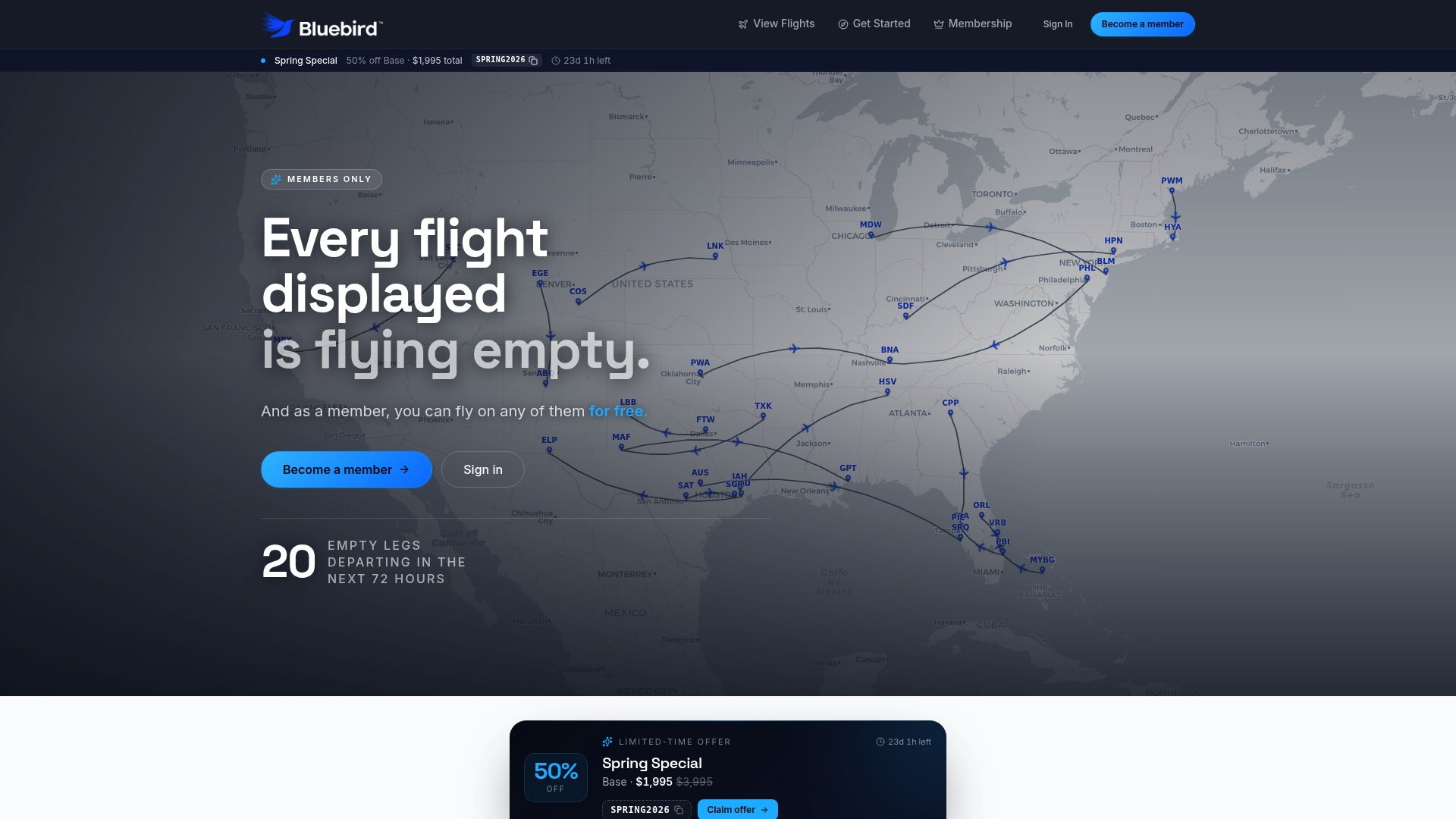
Bluebirdjets offers a membership with unlimited access to empty leg flights on its platform. Empty legs are private jet flights that need to reposition after dropping off a previous passenger. Because the aircraft is flying anyway, the cost drops significantly. For travelers with flexible schedules, this is one of the most direct ways to access genuine last-minute savings without competing for the handful of discounted commercial seats that flash sales produce. Browse available flights on Bluebirdjets to see current empty leg options and routes.
FAQ
Why are last-minute flights usually more expensive?
Airlines use yield management to raise prices as seats fill and departure approaches. The 21-day, 14-day, and 7-day marks before a flight typically trigger automatic price increases.
Do flights ever get cheaper right before departure?
Genuine price drops do occur but are rare. They happen through flash sales with very limited seat availability or on low-demand routes where the airline needs to fill empty seats close to departure.
What days are cheapest for last-minute flights?
Tuesday and Wednesday departures consistently show the lowest last-minute fares. Flying on Thursday instead of Sunday can save up to 17% on airfare.
What is virtual interlining and does it help with last-minute deals?
Virtual interlining combines separate tickets from multiple airlines into one itinerary, often surfacing cheaper routes that standard booking platforms miss. It requires managing each ticket independently but can produce real savings on last-minute travel.
When does it actually make sense to book last minute?
Last-minute booking makes sense when you have genuine flexibility on dates, airports, and destination, or when you catch a verified flash sale. For fixed plans on specific dates, booking at least 21 days in advance almost always produces a lower fare.