Six Step Copy Ready Charter Quote Checklist for Affluent Flyers

Six Step Copy Ready Charter Quote Checklist for Affluent Flyers
The charter quote process is a short, structured workflow: define your trip, request identical quotes from multiple sources, verify operator credentials, then confirm the flight in writing. Operators must hold FAA Part 135 certification, and groups like NBAA publish standard request forms to keep quotes comparable. Membership platforms such as Bluebirdjets offer a different route entirely: unlimited access to published empty-leg flights instead of quote-by-quote shopping.
TL;DR:
- Verifying FAA Part 135 certification and insurance is crucial, as quotes from unlicensed operators pose safety and legal risks.
- Positioning fees can significantly increase costs, especially if the aircraft is based far from your departure airport, sometimes adding thousands of dollars.
- Providing identical trip details across multiple quotes helps identify truthful offers and avoid hidden costs or misleading inclusions.
- Bookings under 48 hours reduce available aircraft options and typically lead to higher prices due to urgent scheduling.
- Membership models offering unlimited access to published empty-leg flights are advantageous for frequent travelers seeking faster, more transparent options.
Table of Contents
- How does the charter quote process actually work?
- What to include when you request a charter quote
- What actually makes up a charter price
- How to compare quotes without getting burned
- How fast can you expect a quote and a confirmed booking?
- The safety checks that matter more than the price
- Where a membership model changes the equation
- What I’d prioritize if I were booking this week
- A membership alternative to the quote cycle
- FAQ
- Sources
How does the charter quote process actually work?
The sequence is the same whether you call a broker, contact an operator directly, or check a membership platform’s live inventory.
- Define your mission. Lock down your dates, departure and arrival airports, passenger count, baggage, and how much schedule flexibility you can tolerate.
- Decide who to contact. An operator owns and flies the aircraft; a broker arranges charters across multiple operators; a membership platform publishes pre-set routes you simply claim. Each has a different speed and price tradeoff.
- Send identical requests. Use the same trip details, word for word, in every quote request so you’re comparing real differences in price and service, not differences in what you asked for.
- Collect and review the quotes. Look past the headline number to what’s actually included: aircraft type, crew, fees, and taxes.
- Verify the operator before you pay. Confirm Part 135 certification, insurance, and the specific aircraft before any money changes hands.
- Confirm in writing. Get a contract that names the tail number, crew, payment terms, and cancellation policy before you consider the flight booked.
Skipping step 5 is the most common costly mistake. A quote that looks clean can still come from an operator who can’t legally fly the trip the way it’s described, or who subcontracts it to someone you never vetted.
What to include when you request a charter quote
A quote is only as accurate as the information behind it. Give every operator, broker, or platform the same details so the numbers you get back actually mean something.
- Departure and arrival airports, ideally by ICAO or IATA code.
- Exact dates and times, including return legs if it’s a round trip.
- Passenger count, baggage volume, and any pets traveling.
- Special service needs: catering, ground transportation, accessibility requirements.
- Runway length constraints at smaller airports, and any international permits or customs needs.
Operators may also ask for passport details or a signed credit authorization once you move past the quote stage. State clearly whether your dates are firm or flexible: flexibility on timing often unlocks a materially lower rate, especially for positioning flights.
Pro Tip: Send the same request template to three operators or brokers at once. Identical inputs make it obvious when one quote is hiding something the others aren’t.
What actually makes up a charter price
A charter quote is rarely just an hourly rate. Understanding the components helps you spot a fair number and question an unfair one.
- Hourly or trip rate, often with a contracted minimum number of hours.
- Positioning or ferry fees for moving the aircraft to your departure airport empty.
- Landing and handling fees, which vary widely by airport.
- Fuel surcharges, catering, crew overnight costs, and deicing where seasonal.
- International fees and taxes, including customs and permit costs on cross-border trips.
Aircraft category, how far out you’re booking, and the season all move the price independently of the route itself. A cost breakdown guide can help you see how these line items stack up on a real trip.
Positioning fees alone can add thousands of dollars to a quote when the aircraft isn’t already based near your departure airport, which is one reason reducing positioning costs matters as much as the base hourly rate.
Empty-leg flights skip most of this because the aircraft is already flying that route. A custom charter builds the full cost from scratch, which is why custom quotes often run higher than expected without a clear breakdown up front.
How to compare quotes without getting burned
Line up every quote against the same checklist before you decide anything on price alone.
- Confirm the exact aircraft category and, where possible, the tail number.
- Separate firm quotes from estimates, and ask what could still change.
- Check what’s included: fuel, catering, and crew costs, versus what’s billed separately.
- Review cancellation and refund terms in writing, not just verbally.
- Ask for an itemized invoice, not a single lump total.
Red flags include an operator who won’t share a Part 135 certificate number, vague wording around what’s “included,” a price far below the others with no explanation, or pressure toward an informal or cash arrangement. NBAA’s consumer guide recommends treating price as one input among several, not the deciding factor.
Pro Tip: Ask directly what happens if your operator can’t source the contracted aircraft. A solid quote includes a backup plan, not just a backup excuse.
How fast can you expect a quote and a confirmed booking?
Timelines vary more than most first-time charter buyers expect.
- Instant-tool quotes from booking platforms can arrive in minutes, but they’re often estimates pending availability confirmation.
- Broker and operator quotes typically take a few hours to a full business day, since someone is checking real aircraft availability.
- Short-notice trips (under 48 hours) usually narrow your aircraft options and can raise the price.
- Confirmation should always include a written contract, tail number, payment terms, and a contingency plan before you treat the flight as booked.
The safety checks that matter more than the price
Before accepting any quote, confirm the operator holds an active FAA Part 135 certificate and ask for the certificate number along with the issuing FSDO or principal operations inspector. Request a certificate of insurance naming you as an additional insured, and ask about crew qualifications for the specific aircraft.
- Ask directly: “What’s your Part 135 certificate number, and which FSDO issued it?”
- Request proof of insurance naming you as an additional insured.
- Confirm who exercises operational control of the flight, the certificate holder, not a third party.
- Avoid any arrangement that skips a written contract or asks for informal payment.
Informal “friends-and-favors” flights or arrangements that sidestep certification can violate federal regulations and put passengers at real safety and legal risk, according to NTSB legal precedent.
A quick safety briefing review, similar to the practice outlined in this passenger safety guide, is a reasonable habit to carry into any charter, not just aviation.
Where a membership model changes the equation
A membership built around published empty-leg inventory removes much of the quote-comparison work described above. A membership model can give members unlimited access to live, daily-updated empty-leg routes on operator-owned Learjet 60 aircraft, with priority queue booking instead of a new quote cycle every time. For specific trips outside that inventory, booking best practices still apply, and the same Part 135 and insurance checks matter regardless of how you book.

What I’d prioritize if I were booking this week
Speed matters less than verification: confirm Part 135 status first, then get everything in writing. Call a broker for a specific one-off trip; lean on a membership platform when your travel is frequent or spontaneous enough that published inventory beats custom quotes.
— Nick
A membership alternative to the quote cycle
If you fly often enough that requesting fresh quotes every time feels like a chore, Bluebirdjets’ membership replaces that cycle with published inventory you simply claim. The Base and Plus membership tiers give unlimited access to empty-leg flights on operator-owned Learjet 60 jets, with up to six guests per flight and no broker markup on the listed routes. Members who want to jump the priority queue on a specific flight can add Skip-The-Line for a one-off fee.
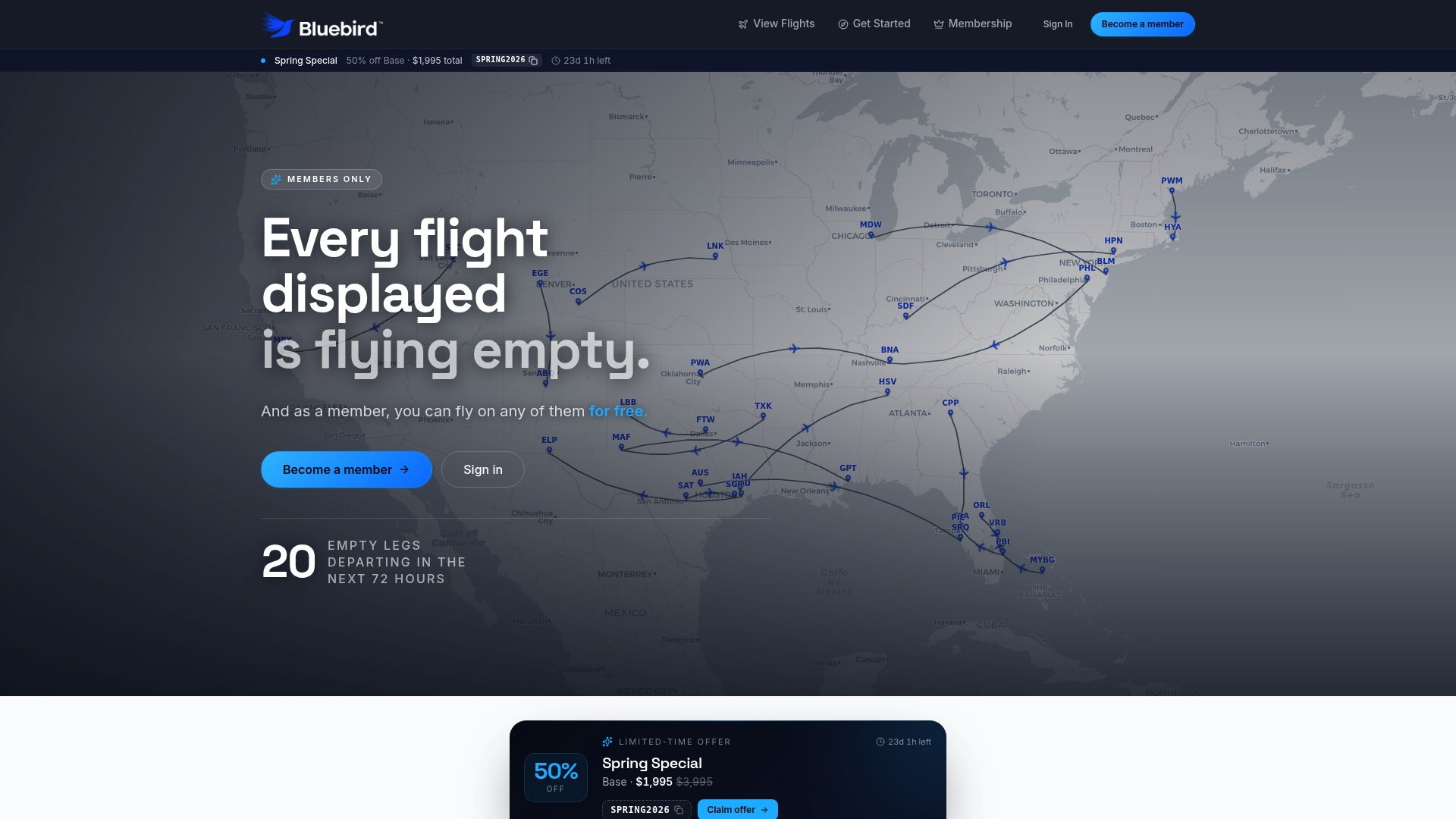
This fits best for travelers who fly on short notice several times a year rather than once. Check current live inventory or get started to see how it compares to your next custom quote.
FAQ
Do you tip a private jet pilot?
Tipping isn’t standard or expected for charter pilots, unlike cabin crew in some other travel contexts. If a crew went well beyond the standard service, a direct gratuity is a personal choice rather than an industry norm.
What are the steps to charter a private jet?
Define your trip details, request identical quotes from multiple operators or brokers, verify the operator’s Part 135 certification and insurance, then confirm the aircraft and crew in a written contract before payment. NBAA’s charter guide recommends using an identical request form across every quote you solicit.
Can you go to the bathroom on a private jet?
Most midsize and larger private jets have an onboard lavatory, though very light jets may have a minimal or enclosed option only. Ask the operator about the specific aircraft’s lavatory setup when you request your quote.
Is it cheaper to charter a jet or own one?
Chartering is typically far less expensive than ownership for occasional flyers, since ownership carries fixed costs like hangar fees, maintenance, and crew salaries regardless of how often you fly. Frequent flyers sometimes find a membership model, which trades per-trip quoting for a flat annual fee and published empty-leg access, cheaper than either full ownership or constant one-off chartering.
Sources
- Charter-Type Services (Part 135) | Federal Aviation Administration
- NBAA aircraft charter consumer guide