Private Flyers: Stop $7,500–$10,000/hr Surprises in Custom Charter Quotes

Private Flyers: Stop $7,500–$10,000/hr Surprises in Custom Charter Quotes
A custom charter quote is a mission-specific, all-in price for a private flight built around your exact departure point, dates, passenger count, and aircraft preference, rather than a generic published fare. The fastest way to get one is through an instant-quote engine for a rough number in minutes, or a broker/operator request for a firm, flyable price within a day. Expect ballpark figures with light jets costing several thousand dollars an hour and heavy jets costing significantly more, before taxes and fees.
TL;DR:
- Instant-quote engines provide quick estimates but often omit mission-specific costs like de-icing or repositioning fees, making manual quotes more reliable for complex trips.
- Repositioning time and costs, especially for aircraft not already at the departure airport, can significantly increase the total price, sometimes exceeding the actual flight cost.
- Requesting detailed line-item quotes, verifying FAA Part 135 certification, and comparing multiple operators help avoid hidden fees and ensure price transparency.
- Flexible scheduling, accepting nearby airports, and leveraging empty-leg inventory can drastically reduce costs by utilizing already planned flights.
- Membership platforms offering unlimited access to empty-leg flights eliminate repositioning and minimum-hour charges, providing clearer pricing and better control over expenses.
Table of Contents
- How custom charter quotes actually get built
- What actually drives the price on a custom charter quote
- What to include when you request a custom charter quote
- How to read a quote and catch hidden costs before you sign
- How long does a custom charter quote actually take?
- Sample quoted missions illustrate how costs may add up, with a short domestic hop including an hourly rate, minimum flight time charges, positioning, fuel surcharges, taxes, catering, and ground handling. Longer transcontinental trips add additional fees like overnight crew stays, heavier fuel surcharges, and possibly multiple positioning legs, significantly increasing the total before taxes.
- How to get a better price without cutting corners
- Why transparent line items matter more than the headline number
- Get a transparent quote through Bluebirdjets membership
- Sources
How custom charter quotes actually get built
Two very different processes hide behind the phrase “get a quote,” and knowing which one you’re dealing with changes how much you should trust the number on your screen.
The first is the instant-quote engine. These tools pull historical charter data, aircraft positioning, and route distance to spit out an estimate almost immediately. Providers like Paramount Business Jets build entire booking flows around this speed, and for a straightforward point-to-point trip with common aircraft availability, the number is often close to what you’ll actually pay. The catch: instant estimates frequently skip mission-conditional costs like de-icing, overnight crew fees, or last-minute repositioning, so treat the first figure as a strong starting point, not a locked contract.
The second is manual sourcing, which is slower but more accurate for anything unusual. A charter broker or an operator’s dispatch team reviews your itinerary, checks live aircraft availability, confirms crew duty-time limits, and prices in the specific quirks of your trip. Multi-leg itineraries, international segments, oversized cargo, or tight turnaround windows almost always need this layer of human review. It typically takes hours instead of minutes, but it produces a price you can actually book against.
Marketplaces sit somewhere in between. Platforms such as Aviapages let you submit one request and receive competing responses from multiple operators in a single dashboard, which speeds up comparison shopping without sacrificing the accuracy of a human-reviewed quote. Membership platforms change the equation again: instead of quoting a one-off charter from scratch, they surface pre-priced empty-leg inventory, which can eliminate several cost lines entirely for flyers with flexible schedules.
Whichever path you use, verify the operator before you commit. Legitimate charter operators in the U.S. hold FAA Part 135 certification, which governs pilot training, aircraft maintenance standards, and operational safety oversight. Any operator or broker unwilling to name the certificate holder actually operating the flight is a signal to walk away.
A few things worth checking before you request anything:
- Whether the quote comes from an instant engine, a broker, or the operator directly, since that affects how firm the number is.
- The FAA Part 135 certificate holder’s name, not just the broker’s brand name.
- Whether the platform aggregates multiple operator responses or shows you a single source.
- How the platform handles empty-leg or repositioning inventory, since that’s often where the real savings hide.
What actually drives the price on a custom charter quote
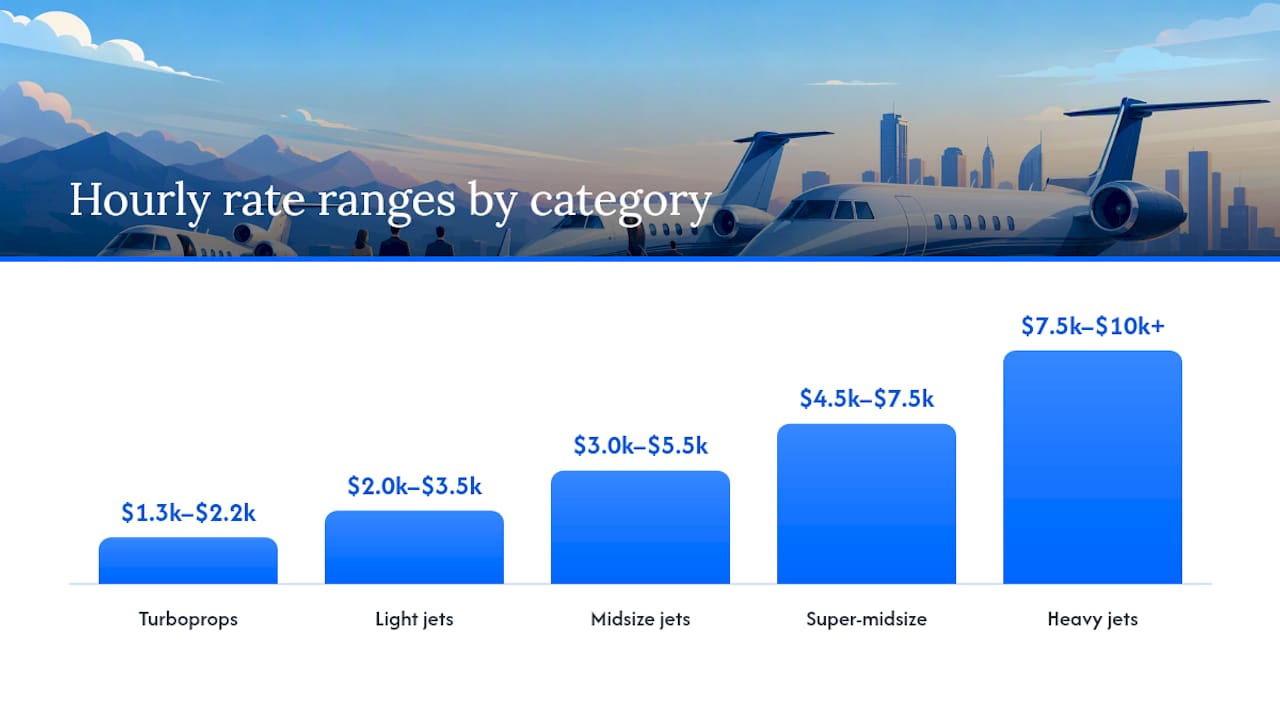
Aircraft category sets the baseline, but five or six other variables decide where you land inside that range. Ballpark hourly rates before fees typically run something like this, and your aircraft category choice alone can swing the total by thousands per hour:
- Turboprops: roughly $1,300 to $2,200 per flight hour, suited to shorter regional hops.
- Light jets: roughly $2,000 to $3,500 per hour, common for trips under three hours with four to seven passengers.
- Midsize jets: roughly $3,000 to $5,500 per hour, with more cabin room and longer range.
- Super-midsize jets: roughly $4,500 to $7,500 per hour, often chosen for transcontinental trips.
- Heavy jets: roughly $7,500 to $10,000-plus per hour, built for long international legs and larger groups.
Pro Tip: Ask whether the quoted hourly rate applies for the whole trip or only the “productive” flight time. Some operators bill positioning legs at the same hourly rate, others discount them, and that difference alone can move a quote by hundreds or thousands of dollars.
Flight time is the obvious driver, but repositioning, often called a deadhead leg, quietly does more damage to a budget than most first-time charter buyers expect. If the nearest available aircraft isn’t already sitting at your departure airport, you’re paying for it to fly there empty first, and that repositioning time frequently gets billed at the same hourly rate as your actual trip. A one-way charter that leaves an aircraft stranded far from its base is often priced higher than a round-trip covering similar total mileage, precisely because of this repositioning math.
Most operators also enforce daily minimums, commonly two to two and a half hours, so a short 45-minute hop can still get billed as if it were a two-hour flight. Fuel volatility adds another layer: operators build in surcharges tied to current jet fuel pricing, and those surcharges tend to spike during peak travel weeks like major holidays or big sporting events, when demand for aircraft outpaces supply in a given region.
Then come the statutory costs. The federal excise tax applies to most domestic private air charter transactions, and the IRS’s air transportation guidance lays out how that tax interacts with segment fees and international travel facilities tax where applicable. These aren’t negotiable and should appear as a clearly separated line item, not folded invisibly into the hourly rate.
What to include when you request a custom charter quote
Operators and brokers can only price what you tell them, and vague requests are the single biggest reason quotes come back wrong or delayed. Give them the following up front and you’ll usually get a workable number on the first pass.
- Departure and arrival airports, ideally by airport code rather than just city names, since smaller executive airports often price very differently than major hubs.
- Dates and times, or a flexibility window if your schedule isn’t locked, since flexibility can unlock cheaper empty-leg or repositioning options.
- Passenger count, including anyone joining or leaving at intermediate stops.
- Baggage details, especially oversized items like golf clubs, skis, or medical equipment that affect aircraft selection.
- Trip type, specifying one-way or round-trip, and whether any leg is optional or tentative.
- Special requirements, such as catering preferences, pets on board, ground transportation coordination, or security and privacy handling for high-profile travelers.
Two quick templates make this easier to act on. For a business itinerary: “Round-trip, [City A] to [City B], departing [date/time], returning [date/time], 4 passengers, light jet preferred, no catering required, ground transport needed at arrival.” For a leisure multi-stop trip: “One-way, [City A] to [City B] to [City C], flexible within a 3-day window, 6 passengers plus 2 pets, checked golf bags, catering for a small celebration.” A publisher-hosted booking best practices guide walks through fuller examples if your itinerary has more moving parts.
How to read a quote and catch hidden costs before you sign
A charter quote is really a stack of separate line items, and understanding what each one covers is the difference between comparing apples to apples and getting surprised at invoice time.
The hourly rate covers the aircraft and crew for actual flight time. The minimum guarantees the operator a floor number of hours regardless of how short your trip actually runs. Positioning or deadhead charges cover getting the aircraft to your departure point. A fuel surcharge reflects current market pricing and shifts with volatility. Crew overnight fees apply when the crew has to stay away from base overnight due to duty-time rules. Hangar and de-icing fees show up seasonally and regionally, often as a surprise line for winter trips through northern airports. Catering, ground handling, and taxes (including the federal excise tax) round out the bottom of the invoice. Broker fees, when a broker rather than the operator issues the quote, are sometimes bundled into the total rather than itemized separately.
Some of these are essentially fixed: taxes, and airport landing fees are set by law or by the airport authority and don’t move regardless of who you book with. Others are genuinely negotiable, particularly minimums on off-peak days, positioning costs when an operator has another aircraft nearby, and catering, which you can usually trim or cut entirely.
- Ask for every line item itemized separately, never accept a single “all-in” number with no breakdown.
- Confirm the FAA Part 135 certificate holder actually operating your specific aircraft.
- Check for a written cancellation and amendment policy before you send a deposit.
- Compare at least two quotes for the same mission parameters, since prices for equivalent aircraft can vary by 20% or more between operators.
Vague fee descriptions, an operator who won’t name the certificate holder, or the total absence of cancellation terms are the three biggest red flags in charter quoting. Any one of them is reason enough to request clarification before moving forward, and industry guidance from NBAA reinforces the same operator-verification habits.
How long does a custom charter quote actually take?
Response speed depends almost entirely on which sourcing method you used and how straightforward your itinerary is.
- Instant-quote engines: typically return an estimate within minutes, sometimes instantly on submission.
- Broker or operator manual quotes: usually take 2 to 24 hours, depending on aircraft availability and how many operators the broker checks.
- International or complex itineraries: can extend well beyond 24 hours when customs permits, diplomatic clearance, or multi-country routing enter the picture.
- Membership or priority services: frequently shortcut this entire process by matching you against pre-priced empty-leg inventory instead of building a quote from scratch.
If your dates are firm and your itinerary crosses international borders, start the request early. Permit processing and handling arrangements at unfamiliar airports are the most common causes of quote delays that catch first-time charter buyers off guard.
Sample quoted missions illustrate how costs may add up, with a short domestic hop including an hourly rate, minimum flight time charges, positioning, fuel surcharges, taxes, catering, and ground handling. Longer transcontinental trips add additional fees like overnight crew stays, heavier fuel surcharges, and possibly multiple positioning legs, significantly increasing the total before taxes.
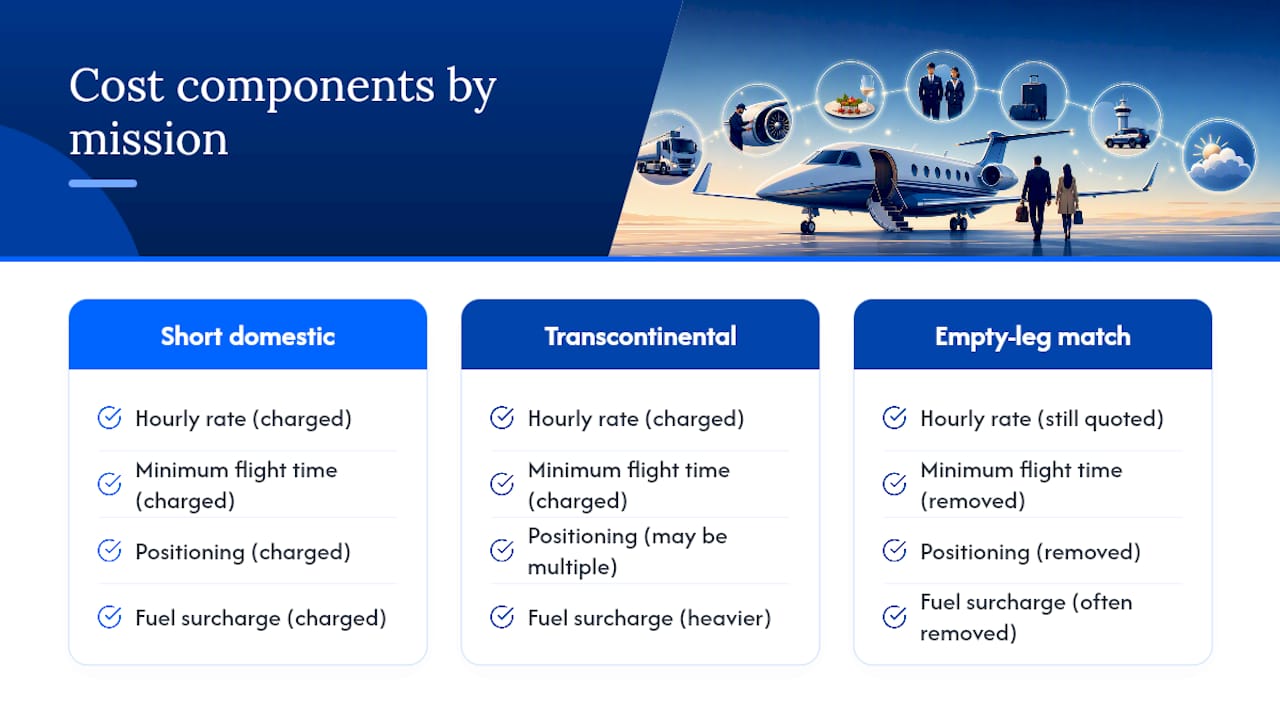
Here’s where the membership math changes things. If either of those missions matched an available empty-leg route, several of these line items, positioning, minimums, and often the fuel surcharge, disappear entirely, because the aircraft was already flying that route regardless of your booking. Readers curious about the mechanics behind operator pricing can see fuller cost breakdown examples with more mission types.
How to get a better price without cutting corners
The single biggest lever most buyers ignore is flexibility. Widening your departure window by even a few hours, or accepting a nearby airport instead of the closest one, often puts you in range of an aircraft that’s already positioned for a different leg, cutting or eliminating positioning charges entirely.
Accepting a repositioning or deadhead leg intentionally, rather than fighting it, can also work in your favor: some operators discount these trips specifically because they’d otherwise fly the route empty anyway. Bundling multiple trips with the same operator across a season sometimes unlocks better per-hour pricing than booking each leg cold.
Pro Tip: Before comparing two quotes side by side, ask both operators for a firm, all-in number that includes every fee and tax. A quote that looks cheaper on the hourly rate can easily come out more expensive once positioning, minimums, and fuel surcharges get added back in.
- Request flexible date ranges instead of a single fixed departure time whenever your schedule allows it.
- Ask directly whether your route matches any existing empty-leg inventory before booking a full charter.
- Confirm cancellation windows and amendment fees in writing before sending a deposit.
- Compare total all-in cost, not just the headline hourly rate, across every quote you receive.
For flyers who fly several times a year rather than once, membership access to empty-leg inventory tends to beat one-off charter pricing by a wide margin, provided you can work with the routes and timing that are actually available. More travel cost tactics are worth reviewing if pricing flexibility matters more to you than fixed departure times.
Why transparent line items matter more than the headline number
Most of the frustration buyers feel with charter pricing comes down to one thing: the first number they see rarely matches the number they end up paying. That’s not usually deception, it’s a structural problem with how instant estimates get built, since they’re pricing a generic version of your trip rather than the specific one you actually need flown.
Bluebirdjets pushes for line-item clarity and senior advisor review on custom charter requests precisely because of this gap. A quote that names positioning, minimums, and taxes separately lets you actually negotiate the parts that move, instead of accepting or rejecting one opaque total. For flyers who book several times a year, the math also shifts toward membership: unlimited access to empty-leg inventory removes the positioning and minimum charges that inflate one-off charters in the first place, provided you can flex around the routes that are live that week.
If your trip needs a fully custom mission rather than an available empty leg, that’s still worth requesting directly, ideally with someone reviewing the aircraft options and pricing before it reaches you.
— Nick
Get a transparent quote through Bluebirdjets membership
Bluebirdjets gives you a cost lever most one-off charter buyers never get: unlimited access to published empty-leg flights on operator-owned Learjet 60 aircraft, which removes the positioning and minimum-hour charges that inflate a typical custom quote. Members fly free on last-minute empty legs, can bring up to six guests, and get first access to a daily-updated inventory with queue and priority booking built in.
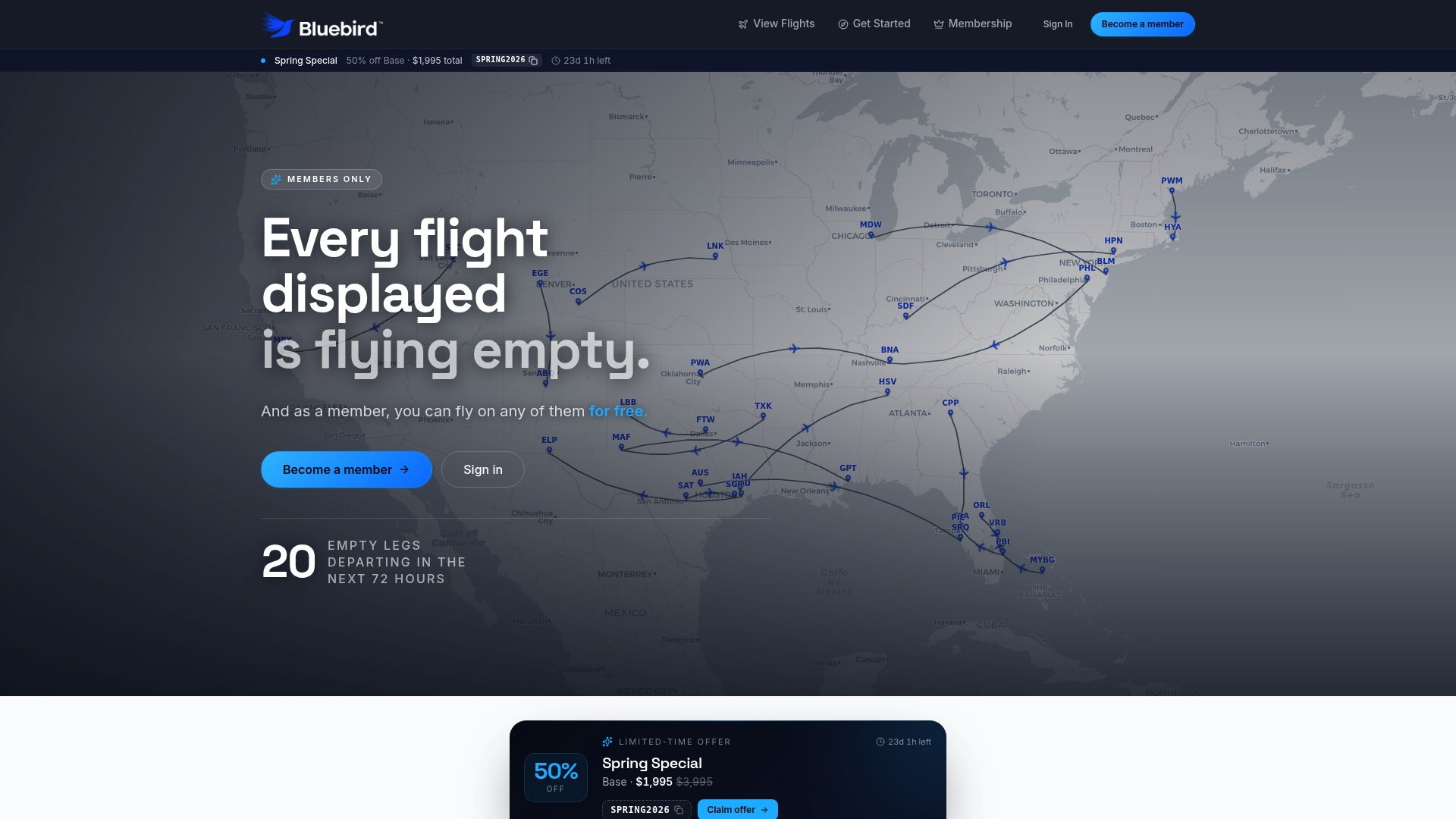
When a trip genuinely needs a bespoke mission rather than an available empty leg, members can still submit a paid custom charter request, and it moves through the queue with the same priority handling as everything else on the platform. That’s the practical difference: instead of shopping a one-off charter cold every time you need to fly, you get standing access to inventory that already exists, plus a fallback option when it doesn’t. Check current live empty-leg routes to see what’s flying this week, or visit the Bluebirdjets membership page to compare tiers and start unlimited access today.
Sources
For primary documentation beyond this guide, consult the FAA’s Part 135 certification page for operator credentialing, the IRS guidance on air transportation for federal excise tax treatment, and NBAA for business aviation best practices. Bluebirdjets also publishes deeper booking best-practice guides for readers planning their next request.
- FAA — Part 135 certification
- IRS — Air transportation (FET) guidance
- Aviapages — Charter Quote Request
- Paramount Business Jets — Instant private jet quotes