First-Time Private Flyer Mistakes You Can Easily Avoid
First-Time Private Flyer Mistakes You Can Easily Avoid
Most common first-time private flyer mistakes come down to three oversights: not verifying your operator’s credentials before booking, navigating to the wrong building at the airport, and showing up with the wrong luggage. Fix those three, and you’ve already avoided what trips up the majority of new private flyers.
Here’s the short version:
- Booking/operator verification: Confirm your operator holds FAA Part 135 authorization and appears on ARG/US or Wyvern safety registries. A broker can help source and vet options if you’re not sure where to start.
- FBO arrival navigation: Save the FBO address from your itinerary into your phone’s navigation app, not the airport’s name. The commercial terminal and the FBO are different buildings, often on opposite sides of the airfield.
- Packing and weight confirmation: Ask your operator for the baggage weight limit and whether soft-sided bags are required. Bring power banks in the cabin, and follow the TSA’s 3.4 oz (100 ml) liquids rule for any carry-on liquids.
Get those right, and the rest of this guide fills in the gaps.
Key Takeaways
First-time private flyer mistakes are almost entirely preventable with a short pre-flight checklist and one operator call before departure.
| Point | Details |
|---|---|
| Verify operator credentials | Confirm FAA Part 135 authorization and ARG/US or Wyvern listings before booking. |
| Save the FBO address | Navigate to the FBO street address, not the airport name, to avoid arriving at the wrong building. |
| Confirm baggage type and weight | Soft-sided bags are preferred on light jets; confirm limits with your operator before packing. |
| Keep valuables in the cabin | Medications, power banks, and key documents belong in your carry-on on every flight. |
| Bluebirdjets membership | Provides live empty-leg inventory, priority booking, and defined guest and baggage rules that remove common first-flight guesswork. |
Table of Contents
- What booking mistakes do first-time private flyers make?
- What should you confirm when you book?
- How do packing and luggage rules differ on private flights?
- Where do you actually go when you arrive at the airport?
- What onboard etiquette do new private flyers get wrong?
- How do cancellations and delays work differently on private flights?
- Are empty-leg flights and memberships right for first-time flyers?
- Your pre-flight prep checklist
- What actually separates smooth first flights from frustrating ones
- Bluebirdjets membership cuts through the rookie friction
- Sources
What booking mistakes do first-time private flyers make?
Don’t assume the aircraft you want is sitting on a ramp waiting for you. Private aviation availability is constrained by crew duty limits, permits, and airport access, which means the aircraft you want may not be available on short notice for your specific route. According to Canary Jet Charter, choosing the wrong aircraft for the mission is one of the most common errors: a light jet may lack the range for a cross-country leg, or its hold may not fit your luggage.
A broker typically adds real value here. They source and vet aircraft options across multiple operators, which reduces the risk of landing on an aircraft that doesn’t fit your route, runway, or baggage needs. For a first-time flyer, that layer of expertise is worth the coordination.
Before you commit to anything, have these details ready: the exact route and date window, the number of passengers, a realistic luggage list, any hard meeting times at the destination, pet requirements, and whether you need Wi-Fi or catering. Operators and brokers use that information to plan fuel, routing, and crew scheduling. Vague requests generate quote revisions and surprises. A specific brief gets you an accurate quote the first time. For a deeper look at private aviation booking best practices, Bluebirdjets has a dedicated guide.
Pro Tip: Treat your booking request like a project brief. Route, passenger count, luggage reality (not aspirational), hard meeting times, and any special needs. Operators who receive a complete brief can often turn around a final quote in hours rather than days.
What should you confirm when you book?
Use this checklist on the call or paste it into your confirmation email. Each item has caused a real problem for a first-time flyer who skipped it.
- Passenger names: Confirm every name exactly as it appears on the government-issued ID or passport. A mismatch can delay departure.
- FBO address: Get the full street address of the FBO, not just the airport code. Save it in navigation before travel day.
- Estimated arrival window: Ask what time you should arrive at the FBO. For domestic flights, 15–30 minutes before departure is standard; international legs typically require 30–45 minutes.
- Baggage allowance and type: Confirm the weight limit and whether soft-sided bags are required. Ask about oversized items separately.
- Pets: If you’re traveling with an animal, confirm the operator’s policy in writing before booking.
- Connectivity and catering: State your Wi-Fi and catering needs upfront. Not all aircraft have both, and catering usually requires advance notice.
- Visa and customs requirements: For international legs, confirm whether customs clearance happens at the FBO or a separate facility, and what documents you need.
- Cancellation and refund policy: Get the terms in writing. Private charter refund rules differ significantly from commercial airline policies.
Per LUKS Aviation’s flight checklist, downloading an offline copy of your itinerary is worth doing before you leave home. Cell coverage at some FBOs and remote airports can be unreliable.
How do packing and luggage rules differ on private flights?
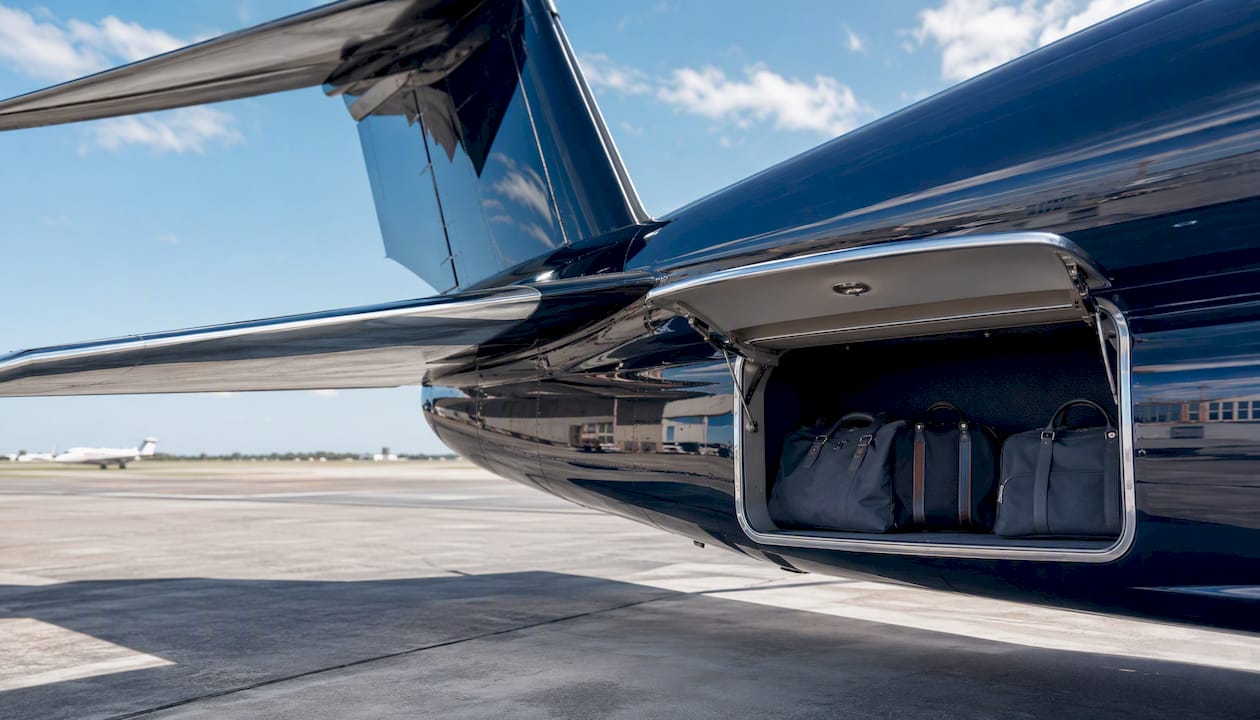
The hold on a light jet is roughly the size of a large car trunk. Soft duffels pack into that space far more efficiently than hard-shell suitcases, and PrivateJetHireUK notes that soft luggage is the standard recommendation for smaller aircraft. If you show up with a rigid roller bag that won’t fit, the operator may have to leave it behind or find alternative stowage.
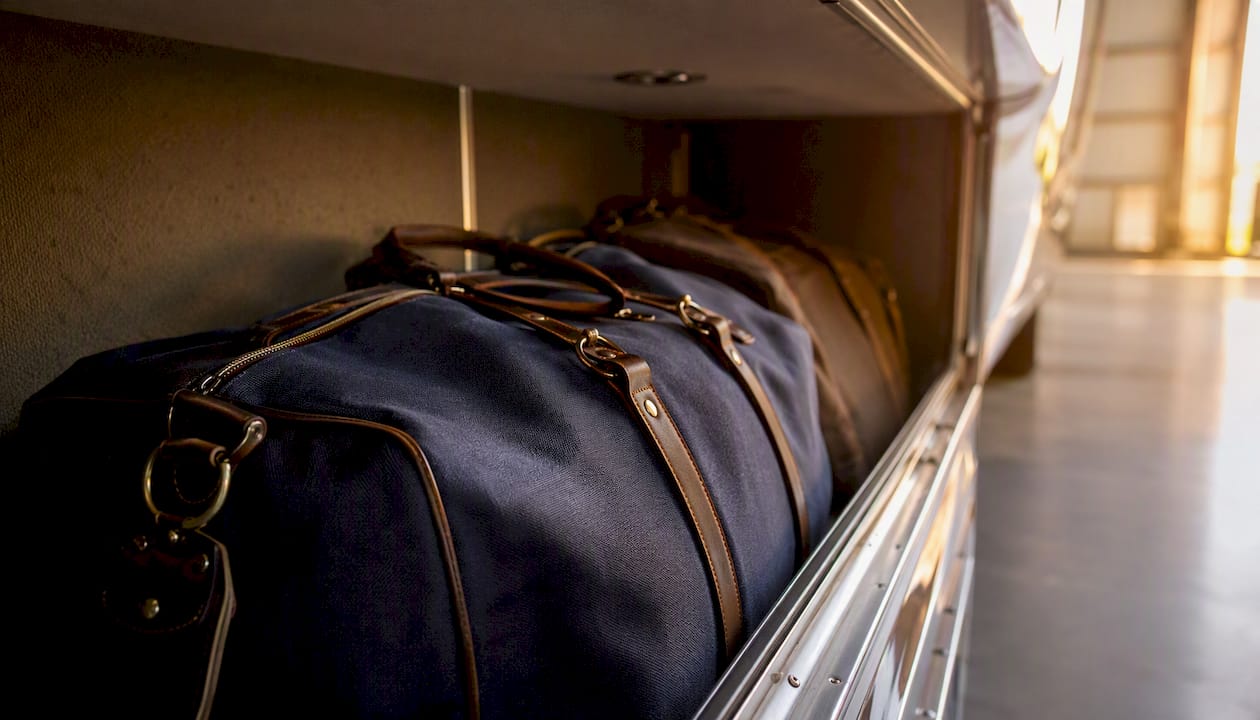
The TSA’s 3.4 oz (100 ml) liquids rule still applies to carry-on bags on private flights. Pack toiletries in travel-sized containers inside a single quart-sized clear bag. Power banks and lithium batteries must travel in the cabin, not in checked luggage, regardless of aircraft type. Valuables, medications, and key documents belong in your carry-on for the same reason they do on commercial flights: mishandled baggage is a real risk, and the cabin is always the safer place for anything irreplaceable.
| Item | Rule | Why It Matters |
|---|---|---|
| Carry-on liquids | 3.4 oz (100 ml) max per container, in a quart bag | TSA rule applies to private flights |
| Luggage type | Soft-sided bags preferred on light jets | Hard cases may not fit the hold |
| Power banks | Cabin only, not in checked luggage | Lithium battery fire risk in hold |
| Medications and valuables | Always in carry-on | Protects against mishandling |
Pro Tip: Pack a day-one kit in your carry-on: medications, chargers, key documents, and a change of clothes. Photograph the contents of any checked bag before handing it over.
Where do you actually go when you arrive at the airport?
The single biggest operational mistake first-time private flyers make is driving to the commercial terminal. The FBO is a separate facility, often on the opposite side of the airfield, and your navigation app will default to the main terminal if you search by airport name. Save the FBO’s street address in your phone before you leave home.
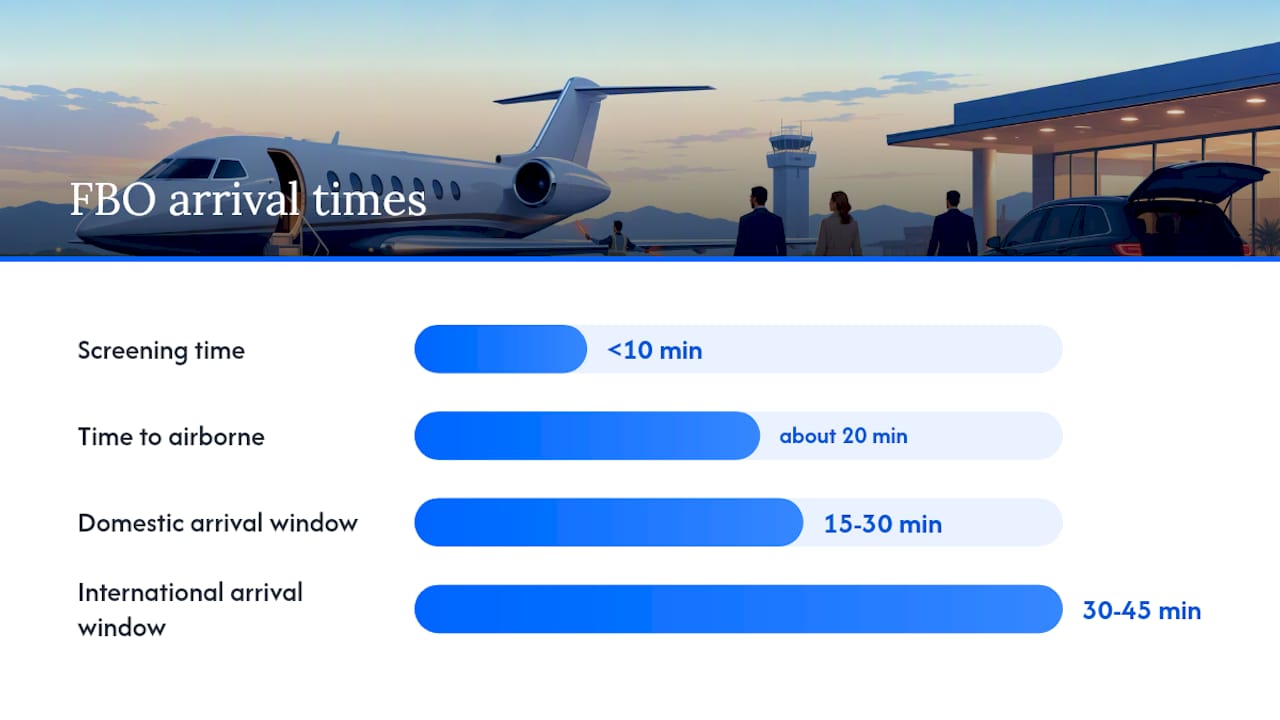
Once you’re at the right building, the experience is nothing like a commercial terminal. FBO screening is discreet and fast: most passengers complete identity checks and bag screening in under 10 minutes and are airborne within about 20 minutes of arrival when the flight is on schedule. You walk directly to the aircraft from the FBO lounge, no gate, no jetbridge, no crowd.
A few things to sort out in advance:
- Share the FBO’s gate entrance instructions with your driver or rideshare. Standard rideshare apps often can’t access the ramp, and some FBOs have a separate entrance for vehicles.
- Bring a valid government-issued photo ID for domestic flights. International legs require a passport, and some destinations require visas confirmed before departure.
- Arrive 15–30 minutes before departure for domestic, 30–45 minutes for international. Arriving much earlier than that is unnecessary at most FBOs, though it’s worth confirming the specific window with your operator.
What onboard etiquette do new private flyers get wrong?
Private aircraft follow the same FAA safety regulations as commercial flights. The crew’s safety briefing is not optional, and seatbelts stay on during taxi, takeoff, and landing. The difference is tone: the crew is smaller, the interaction is more personal, and the expectations are less scripted.
Ask before photographing crew members or other passengers. If you’re traveling with a group and want quiet time to work, say so before boarding. Small personal items go in the overhead or under the seat, same as commercial, but the overhead on a light jet is genuinely small. Turbulence is more noticeable on smaller aircraft because of lower altitude and lighter weight. If motion sensitivity is a concern, request a midsize or super-midsize jet when booking.
Tipping is not required but is common for exceptional service. A standard range is $50–$100 per crew member for a domestic leg, though this varies.
How do cancellations and delays work differently on private flights?
Private aviation reduces many common delays, but weather, crew duty limits, and permit issues can still disrupt a trip. What changes is the refund and rebooking process. Unlike commercial airlines, private charter contracts typically follow their own cancellation terms, which vary by operator and booking type. Get those terms in writing before you pay.
Watch for costs that first-timers often miss:
- Repositioning fees: If the aircraft needs to fly empty to reach your departure airport, that cost may be passed on.
- De-icing: Charged separately at many FBOs during winter operations.
- Custom clearance fees: International legs can carry additional ground handling and customs charges.
- Last-minute routing changes: Rerouting due to weather or slot availability may affect pricing.
When a disruption happens, contact your broker or operator immediately. Ask specifically about alternative aircraft, repositioning options, and whether the delay affects crew duty limits. Trip cancellation insurance and charter-specific travel insurance are worth considering before any trip, particularly for international travel or time-sensitive meetings. Understanding how route flexibility works on private jets can help you anticipate these scenarios before they arise.
Are empty-leg flights and memberships right for first-time flyers?
Empty legs are flights an aircraft must make anyway to reposition between charters. They’re offered at reduced rates, but the route and timing are fixed by the operator’s schedule, not yours. If your dates and destination happen to align, the savings are real. If they don’t, you’re out of luck.
A membership with live inventory and priority booking changes that equation. Instead of hunting for a matching empty leg, you get access to a regularly updated pool of routes with the ability to queue and book ahead of general availability.
| Option | Price | Flexibility | Booking Lead Time | Guests Allowed |
|---|---|---|---|---|
| Ad hoc empty leg | Lower | Fixed route and time | Short, often last-minute | Varies by aircraft |
| Membership with priority access | Annual fee, flights included | Higher, live inventory | Priority queue, daily updates | Up to 6 per flight |
Pro Tip: If spontaneity matters to you, a membership with live inventory and priority booking removes the top rookie friction points: wrong airport, last-minute luggage surprises, and aircraft mismatch. You know the rules before you book because the membership defines them.
Your pre-flight prep checklist
Save this list to your phone the day before departure. It covers the checks that prevent the most expensive and frustrating first-time mistakes, adapted from Frommer’s airport checklist for private flight norms.
24 hours before:
- Confirm your booking reference and passenger names with the operator or broker.
- Save the FBO street address in your navigation app.
- Check passport or ID expiration date.
- Confirm ground transport has the FBO entrance address, not the airport name.
- Call or message your operator with any last-minute changes to passenger count or luggage.
Day of travel:
- Leave with enough time to arrive 15–30 minutes before departure (domestic) or 30–45 minutes (international).
- Pack power banks and medications in your carry-on.
- Carry liquids in 3.4 oz containers inside a quart-sized bag.
- Have your government-issued ID or passport accessible, not buried in a bag.
- Confirm your driver or rideshare has the correct FBO gate entrance.
What actually separates smooth first flights from frustrating ones
The advice in most private aviation guides focuses on the glamour and skips the friction. After enough trips, the pattern becomes clear: the flyers who have a bad first experience almost always made the same two or three mistakes. They navigated to the wrong building. They packed the wrong bags. They didn’t ask about the cancellation terms until they needed them.
None of those are hard to fix. The checklist above takes about five minutes to run through. The operator call takes ten. What makes the difference isn’t access to insider knowledge — it’s the habit of treating the booking like a brief and the departure like a logistics problem with a known solution.
The one thing most guides understate is how much the aircraft class matters for comfort. A light jet on a three-hour leg in moderate turbulence is a meaningfully different experience from a midsize on the same route. If you’re sensitive to motion or planning a long leg, that conversation with your broker is worth having before you commit to a specific aircraft.
Bluebirdjets membership cuts through the rookie friction
The biggest first-time mistakes — wrong airport, baggage surprises, aircraft mismatch — share a common cause: incomplete information at the booking stage. Bluebirdjets membership addresses that directly. Members get access to live empty-leg inventory on Learjet 60 jets, updated daily, with a priority queue that puts you ahead of general availability. You can bring up to six guests per flight, and the membership terms define baggage and guest rules upfront, so there’s no guessing on the day.
For flyers who want the private experience without building a relationship with a charter broker from scratch, the membership model removes the friction that makes first flights stressful. Optional custom charter requests are available for routes outside the live inventory. Browse current empty-leg availability or review membership tiers and benefits to see whether the routes and timing fit your travel pattern.
Sources
- First-Time Flying Mistakes — Travel + Leisure
- What to Expect on Your First Private Jet Flight | Uncompromised Travel
- First Time Private Jet Flight Checklist (2026) | What to Expect
- Your First Private Jet Flight: What Nobody Tells You
- First-time flying: an easy step-by-step checklist for airport newbies — Frommer’s
- First-time flyer tips — Citi travel guide