How Route Flexibility Works on Private Jets

How Route Flexibility Works on Private Jets
Route flexibility in private jet travel is the ability to adjust flight paths, departure times, and itineraries dynamically within regulatory and operational limits. Private jets access over 5,000 airports across the United States, compared to roughly 500 served by commercial airlines. That difference alone transforms how travelers plan trips. Domestic bookings require as little as 2–6 hours of lead time, while international flights need 24–48 hours for permits and customs clearance. FAA and EASA regulations govern crew duty limits and airspace coordination, setting the practical boundaries within which all this flexibility operates. Understanding how route flexibility works on private jets means knowing both what it enables and what constrains it.
How do private jets customize flight routes and schedules?
Private jets choose routes and airports that commercial carriers simply cannot use. Smaller regional airports sit closer to most business districts, resort towns, and rural destinations. Flying into a reliever airport instead of a major hub can cut ground travel time by an hour or more each way.

Air traffic control still shapes every flight path. ATC routing adds 3–8% to the theoretical great-circle distance on most routes. That means a 500-mile straight-line trip may cover 515–540 miles in practice. Pilots coordinate with ATC to avoid congested airspace and maintain safe separation, but private jets retain far more routing freedom than commercial flights locked into fixed corridors.
Departure time adjustments work differently on private jets than on commercial flights. Operators can shift wheels-up times by 30 minutes or more per segment when brokers communicate preferences early. Weather, traffic, and last-minute passenger changes all trigger real-time route recalculations. Pilots and dispatchers handle these adjustments without the cascading delays that affect hub-and-spoke airline networks.
Multi-leg itineraries add another layer of customization. A traveler can fly New York to Chicago in the morning, Chicago to Denver in the afternoon, and Denver to Los Angeles the next day, all on a single coordinated booking. Experienced brokers managing these complex itineraries are the difference between a smooth trip and a logistical failure.
- Smaller airports reduce ground transit time significantly
- ATC coordination happens in real time, not through fixed schedules
- Departure windows adjust around passenger needs, not airline timetables
- Multi-leg trips consolidate into one managed itinerary
Pro Tip: Tell your broker your preferred departure window and backup timing before the aircraft is confirmed. That 30-minute buffer gives operators room to position the crew without rushing.
What operational limits impact private jet route flexibility?
Route flexibility has real boundaries. Regulatory, mechanical, and logistical constraints define what is actually possible on any given trip.
-
Crew duty limits. FAA and EASA rules cap a crew’s duty day at 14 hours with a mandatory 10-hour rest period before the next flight. A trip that pushes past that limit requires an overnight stop or a crew swap. Both options add time and cost to the itinerary.
-
Aircraft range and fuel stops. When a route exceeds 85% of an aircraft’s maximum range, a fuel stop becomes mandatory. Fuel stops add 45–60 minutes of ground time per stop. A midsize jet flying coast to coast may need one stop, while a large-cabin or ultra-long-range aircraft can complete the same route nonstop.
-
Mandatory maintenance schedules. Aircraft follow strict inspection intervals set by the manufacturer and the FAA. An unexpected maintenance requirement can ground a specific tail number, forcing operators to source a replacement aircraft. That substitution is not always immediate.
-
Repositioning flights. When an aircraft needs to move from its current location to the departure airport, that repositioning flight costs time and money. Operators factor this into pricing and availability. Repositioning is an operational necessity, not an optional service.
-
Multi-leg verification requirements. Every stop on a multi-leg trip requires confirmation that the runway length, fuel supply, and ground services match the aircraft’s specifications. Each segment demands independent verification. A stop at a small mountain airport may be incompatible with a heavy jet even if the destination is ideal.
Knowing these limits before booking prevents surprises mid-trip. A traveler who understands crew rest rules, for example, will plan overnight stops proactively rather than discovering the constraint after departure.
How do booking models affect private jet travel flexibility?
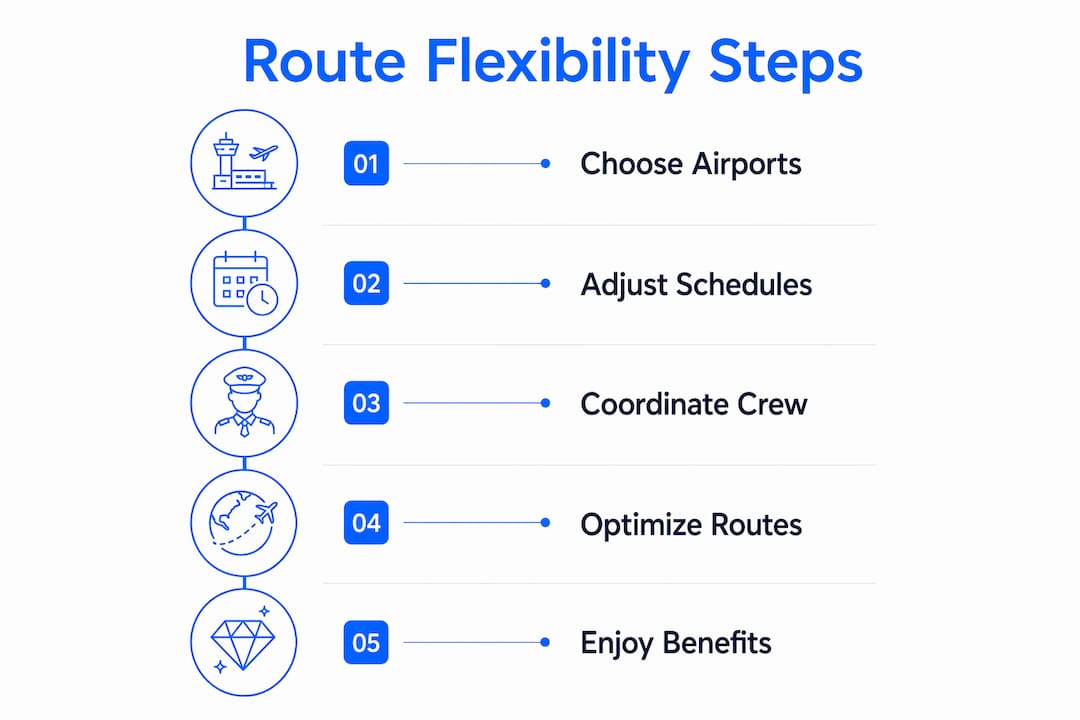
The booking model a traveler chooses shapes how much flexibility they actually get. Three primary models dominate the market, and each trades flexibility against cost and commitment differently.
On-demand charter offers the most flexibility. There is no upfront capital, no annual commitment, and no fixed fleet. Travelers pay per trip at market rates. This model works best for those flying fewer than 50 hours per year. Availability varies, and pricing fluctuates with demand, but the routing freedom is unmatched. Cancel-anytime charter options allow itinerary changes or cancellations without fees within set notice windows, making them ideal for travelers whose schedules shift frequently.
Jet cards provide guaranteed availability and fixed hourly rates. A 25-hour midsize jet card typically costs $150,000–$250,000. Jet cards suit travelers flying 50–200 hours per year who want predictable pricing without the complexity of aircraft ownership. Routing flexibility is high, but the card’s terms may restrict aircraft category, geographic region, or peak-day availability.
Fractional ownership involves purchasing a share of a specific aircraft. Owners commit upfront capital and accept fixed usage schedules. This model delivers consistency but the least spontaneous flexibility. Changing routes or departure times requires working within the management company’s scheduling system.
For travelers who want to understand the full range of private aviation access options before committing, comparing these models against actual flight frequency and schedule variability is the right starting point.
Pro Tip: If your schedule changes more than twice a month, on-demand charter or a cancel-anytime option will save you more money in avoided fees than a jet card’s fixed rate saves you in hourly costs.
What practical benefits does route flexibility deliver?
Route flexibility translates directly into time saved, stress reduced, and trips that actually fit a traveler’s life.
The most immediate benefit is eliminating layovers. A direct flight from a regional airport to another regional airport removes connection risk entirely. There is no missed connection, no rebooking, and no lost afternoon in a hub terminal. For business travelers, that recovered time is productive time.
Flexible scheduling also reduces the pressure of tight itineraries. A meeting that runs long does not mean a missed flight. The aircraft waits. That single feature changes how travelers plan their days, particularly for executives managing back-to-back commitments across multiple cities.
Repositioning flights create a cost opportunity that most travelers overlook. When an aircraft needs to move empty to its next charter location, operators offer that leg at a discount. These empty legs give flexible travelers access to premium aircraft at a fraction of the standard rate. The catch is that the route and timing are fixed by the operator’s schedule, not the passenger’s preference.
- Direct routes eliminate connection risk and hub delays
- Aircraft wait for passengers, not the other way around
- Multi-leg itineraries combine business and leisure stops in one trip
- Empty legs reduce cost for travelers with flexible timing
For business travelers specifically, the ability to fly into a smaller airport near a client’s office and return the same evening is a genuine productivity multiplier. For leisure travelers, it means arriving at a ski resort or island destination without a rental car odyssey from the nearest major airport.
Key Takeaways
Private jet route flexibility works because operators can access thousands of airports, adjust schedules in real time, and customize multi-leg itineraries within FAA and EASA regulatory boundaries.
| Point | Details |
|---|---|
| Airport access advantage | Private jets reach over 5,000 airports vs. roughly 500 for commercial airlines, enabling direct routes. |
| Booking lead time | Domestic trips book in 2–6 hours; international routes need 24–48 hours for permits and approvals. |
| Crew duty limits | FAA rules cap duty days at 14 hours, requiring rest or crew swaps that affect scheduling. |
| Booking model matters | On-demand charter offers maximum flexibility; jet cards balance fixed rates with guaranteed availability. |
| Empty legs cut costs | Repositioning flights offered as discounted empty legs reward travelers with flexible timing. |
What I’ve learned about flexibility that most travelers miss
The word “flexibility” gets used loosely in private aviation. Travelers hear it and assume they can change anything at any time with no consequence. That is not how it works, and understanding the gap between expectation and reality is what separates a smooth trip from a frustrating one.
The brokers who consistently deliver flexible itineraries are not the ones with the largest fleets on paper. They are the ones with deep relationships with specific operators and crews. A broker who has worked with the same operator for five years can get a 30-minute departure shift approved in a phone call. A broker making a cold booking cannot. That relationship is the actual source of flexibility, not the contract language.
I have also noticed that travelers who communicate their priorities clearly get better outcomes. If you tell your broker that the departure time is fixed but the aircraft category is negotiable, they have room to work. If you treat every variable as non-negotiable, you force the operator into a corner and pay for it in availability or cost.
The empty leg angle deserves more attention than it gets. Most travelers think of empty legs as a lottery, something you hope lines up with your plans. The smarter approach is to build a travel calendar with a few flexible windows each quarter and actively look for empty legs that fit. Bluebirdjets makes this practical with a membership that gives unlimited access to empty legs on the platform, so the search cost drops to near zero.
Finally, do not fight the regulatory constraints. Crew duty limits and fuel stop requirements exist for safety reasons. Build them into your planning rather than treating them as obstacles. A trip that accounts for a fuel stop and a crew rest period will run smoothly. A trip that ignores those realities will not.
— Nick
Bluebirdjets and flexible private jet travel
Bluebirdjets is built for travelers who want real flexibility without the overhead of a jet card or fractional ownership.
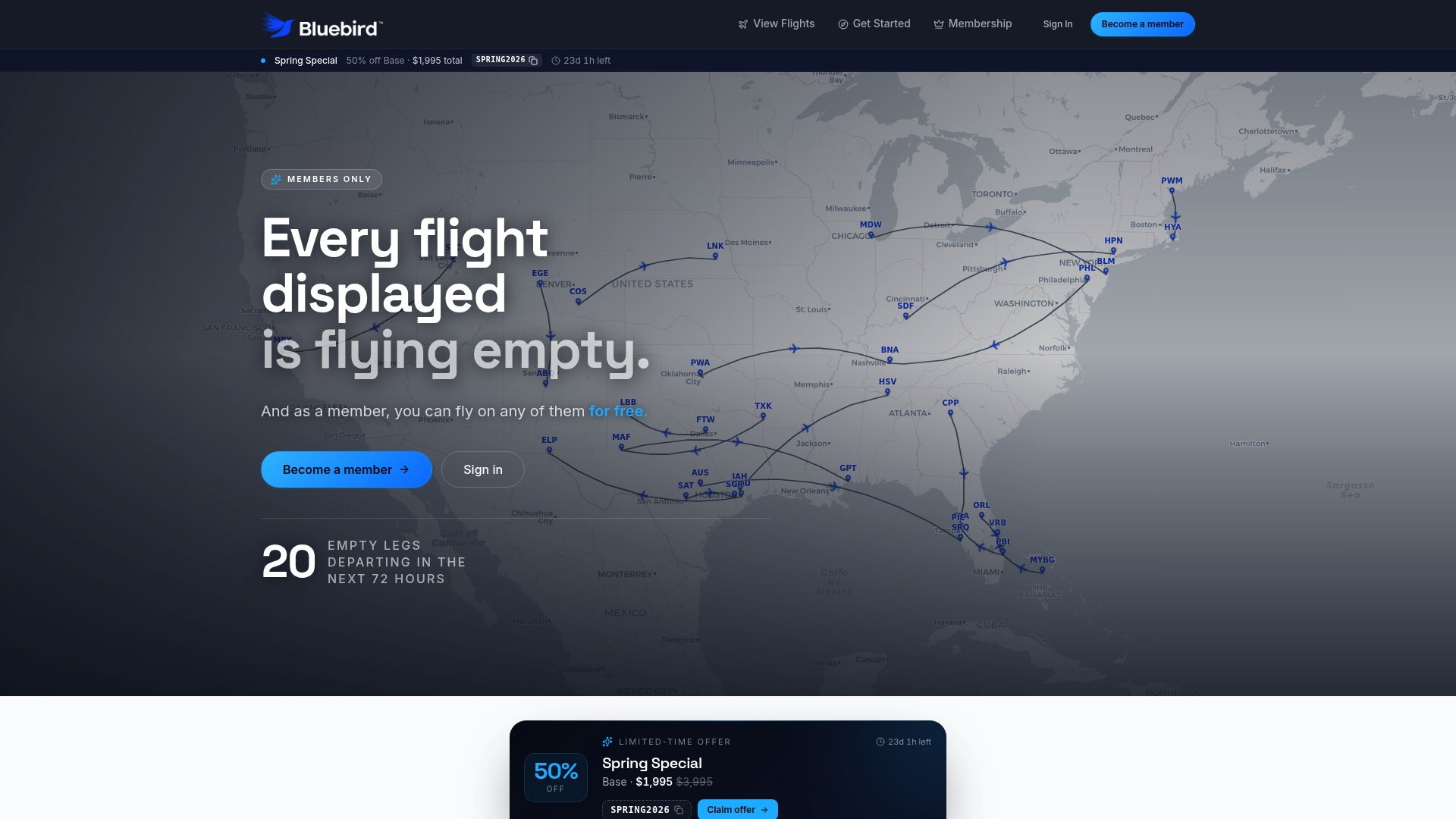
The Bluebirdjets membership gives you unlimited access to empty legs listed on the platform. Empty legs are repositioning flights offered at discounted rates, and they are the most cost-effective way to fly private when your schedule has room to move. Members browse available legs, book directly, and fly on premium aircraft at a fraction of standard charter pricing. For travelers who want to book flexible flights without committing to a $150,000 jet card, this model delivers genuine value. The Bluebirdjets membership is the right fit if you fly opportunistically and want access to a live inventory of discounted legs without per-search fees or booking minimums.
FAQ
How flexible are private jets compared to commercial flights?
Private jets offer significantly more flexibility than commercial flights. They access over 5,000 airports, adjust departure times on short notice, and customize routes without fixed airline schedules.
How much notice do I need to book a private jet?
Domestic private jet bookings require as little as 2–6 hours of lead time. International flights need 24–48 hours to secure permits, customs clearance, and overflight approvals.
What limits route changes on private jets?
FAA and EASA crew duty rules cap duty days at 14 hours, requiring mandatory rest before the next flight. Aircraft range, fuel stop requirements, and maintenance schedules also constrain last-minute route changes.
What is an empty leg flight?
An empty leg is a repositioning flight where an aircraft travels without passengers to reach its next charter location. Operators offer these legs at discounted rates, making them a cost-effective option for flexible travelers.
Which booking model gives the most route flexibility?
On-demand charter offers the highest routing and scheduling flexibility with no upfront commitment. Cancel-anytime charter options extend that flexibility further by allowing itinerary changes without penalty fees within set notice windows.