How Private Aviation Saves Time for Busy Professionals

How Private Aviation Saves Time for Busy Professionals
Private aviation saves time primarily on the ground, not in the air. Arrive 15–20 minutes before departure at a Fixed Base Operator (FBO) instead of the 90–180 minutes commercial airports demand. Access over 5,000 U.S. airports versus roughly 500 commercial hubs, landing closer to your actual destination. Fly direct, skip layovers, and depart on your schedule. The result: most executives recover several hours per trip, door to door.
Here is what drives those savings:
- Arrive shortly before departure versus much longer at commercial terminals
- Access to thousands of airports reduces ground transit time significantly
- Direct routing eliminates layovers and hub connections
- Flexible scheduling means the plane waits for you, not the reverse
- Baggage delivered curbside saves 15–45 minutes on arrival
- Door-to-door time savings of 2–5 hours per flight on typical routes
Table of Contents
- How private aviation saves time at every stage of the trip
- Private aviation protects your cognitive capacity, not just your calendar
- What the time savings actually mean for your travel outcomes
- Ground transportation works differently when you fly private
- Bluebirdjets puts private aviation within reach for frequent flyers
- Key Takeaways
How private aviation saves time at every stage of the trip
The efficiency compounds across multiple touchpoints, each one cutting minutes that add up fast.
Pre-flight and check-in. At an FBO, check-in and security takes roughly 15–30 minutes versus 2–3 hours at a commercial terminal. No kiosks, no TSA queues, no boarding zones. You confirm your identity, walk to the aircraft, and sit down.
Airport access. Private jets reach thousands of public U.S. airports compared to hundreds serviced by commercial airlines, per FAA data. That reach matters most on secondary-market trips: manufacturing facilities, regional offices, and acquisition targets often sit near smaller airports that commercial carriers don’t serve. Landing closer to a meeting location can save considerable ground travel time.
Routing. Private aircraft fly direct, avoiding the hub-and-spoke model that forces commercial passengers through Atlanta or Chicago to reach a mid-size city. Skipping layovers can cut 30–50% off total transit time on regional routes.
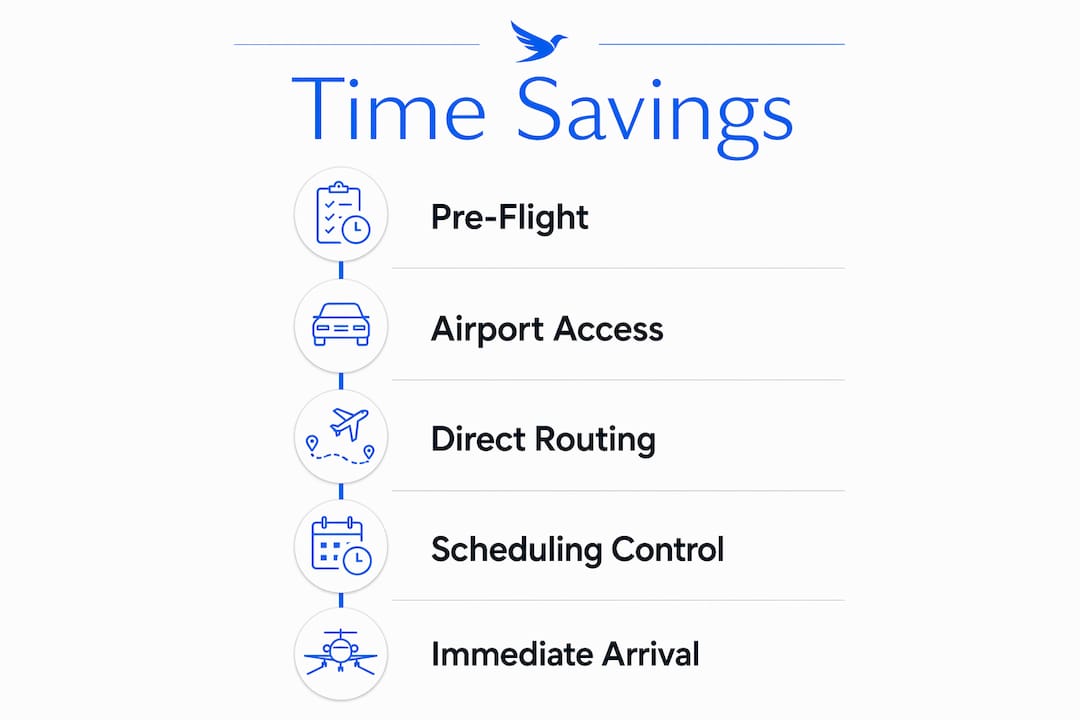
Scheduling control. The aircraft departs when you’re ready. That single fact prevents the cascade of missed connections, rebooking delays, and lost afternoons that commercial schedules routinely produce. Multi-city itineraries that would take 3–4 commercial travel days often collapse into a single day privately.
Arrival. Private passengers disembark immediately, luggage arrives curbside within minutes, and ground transport is steps away. Commercial passengers routinely wait 30–60 minutes between landing and leaving the terminal.
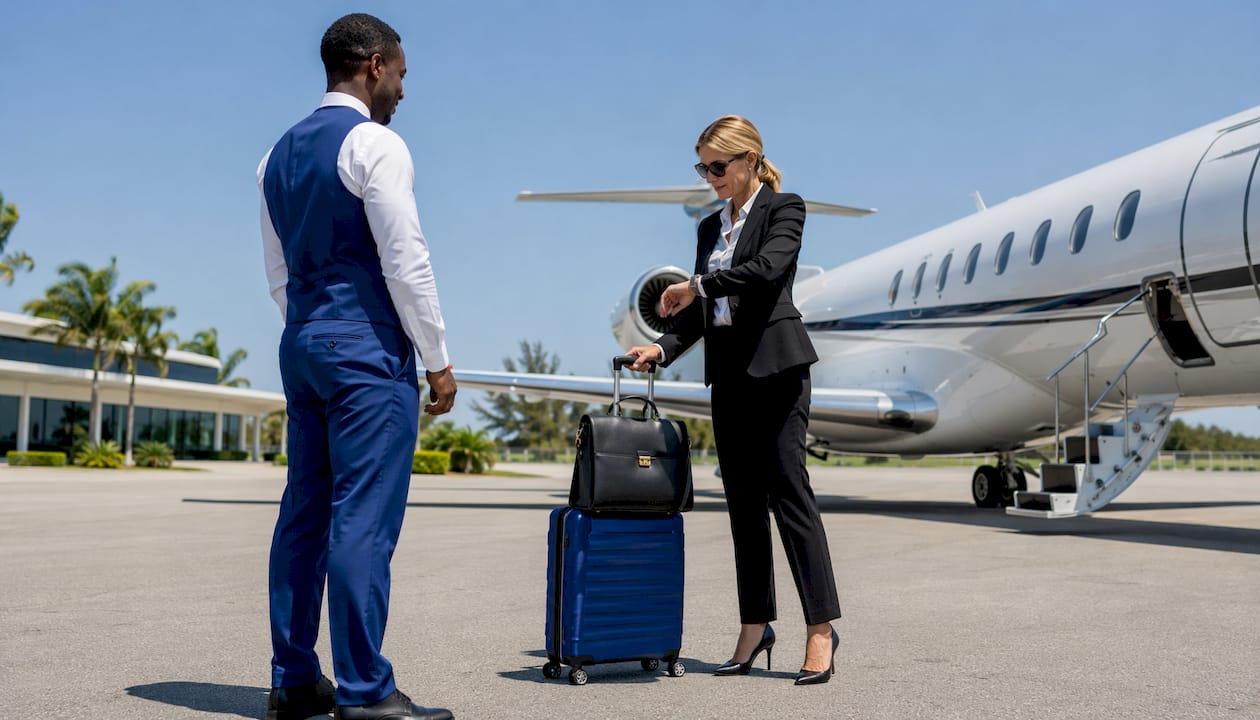
Pro Tip: When evaluating time savings, calculate door-to-door time, not just block flight time. The full trip picture almost always favors private aviation by a wider margin than the airborne comparison suggests.
Private aviation protects your cognitive capacity, not just your calendar
Time savings are measurable. What they protect is harder to quantify but arguably more valuable: the mental bandwidth executives need to perform at their best.
Research applying the Job Demands-Resources Model shows that private aviation restores executive cognitive capacity by reducing travel fatigue and stress, producing structural improvement in meeting performance, not just marginal comfort. Leaders arrive more focused and less depleted, which changes the quality of decisions made immediately after landing.
Commercial travel stacks friction: crowded terminals, unpredictable delays, middle seats, and the low-grade anxiety of connection timing. That friction consumes working memory before the first meeting begins. A private cabin, by contrast, offers a controlled environment where real work happens. Calls, documents, strategy conversations — none of it requires headphones and a prayer.
Schedule control adds another layer. When your departure time is fixed by an airline, a delayed flight doesn’t just cost hours; it costs momentum. A deal that needed a same-day decision gets pushed. A client who expected you at 2 PM reschedules. Private aviation removes that variable entirely.
Pro Tip: For executives whose time is valued at $1,000 per hour, the math on private jet time savings becomes straightforward quickly. Saving large amounts of time annually represents substantial recovered value.
What the time savings actually mean for your travel outcomes
Private aviation compresses the door-to-door experience by removing friction at every stage, and the cumulative effect reshapes what travel-intensive work looks like.
- Check-in and security savings alone recover substantial time per departure
- Greater airport access reduces ground transit time substantially on many routes
- Direct routing eliminates layover time entirely on applicable legs
- Schedule flexibility prevents costly delays and keeps complex itineraries intact
- Baggage handling at arrival saves significant time
- Frequent private fliers can reclaim 800–2,000 hours annually, equivalent to up to 2.5 months of working time
The value scales with itinerary complexity. A straightforward point-to-point trip between major cities might yield a few hours advantage. A multi-stop trip through secondary markets, where commercial options require overnight stays and connection delays, can save several hours per leg. For executives running those itineraries regularly, private jet travel frequency compounds the benefit across the year.
The honest calculation also accounts for preserved energy. An executive who arrives rested and focused generates different outcomes than one who spent six hours navigating O’Hare. That difference rarely appears in a spreadsheet, but it shows up in the room.
Ground transportation works differently when you fly private
Private terminals sit apart from commercial congestion, and that separation changes the entire ground experience. Your car, driver, or rideshare meets you steps from the aircraft, not at a terminal curb shared with hundreds of other passengers.
On departure, you drive directly to the FBO, often bypassing the traffic patterns that funnel commercial travelers through airport access roads during peak hours. On arrival, your bags come off the plane and go directly into your vehicle. No carousel, no claim ticket, no waiting. The baggage handling difference alone routinely saves 20–45 minutes per trip, and it eliminates the risk of lost luggage entirely.
For international trips, private terminals often offer expedited customs and immigration processing. Passengers clear in a fraction of the time a commercial international terminal requires, sometimes in under 10 minutes.
Bluebirdjets puts private aviation within reach for frequent flyers
Most of the time savings described above are available on every private flight. The barrier has always been cost and access. Bluebirdjets removes both with a membership that gives you unlimited access to empty leg flights on the platform.
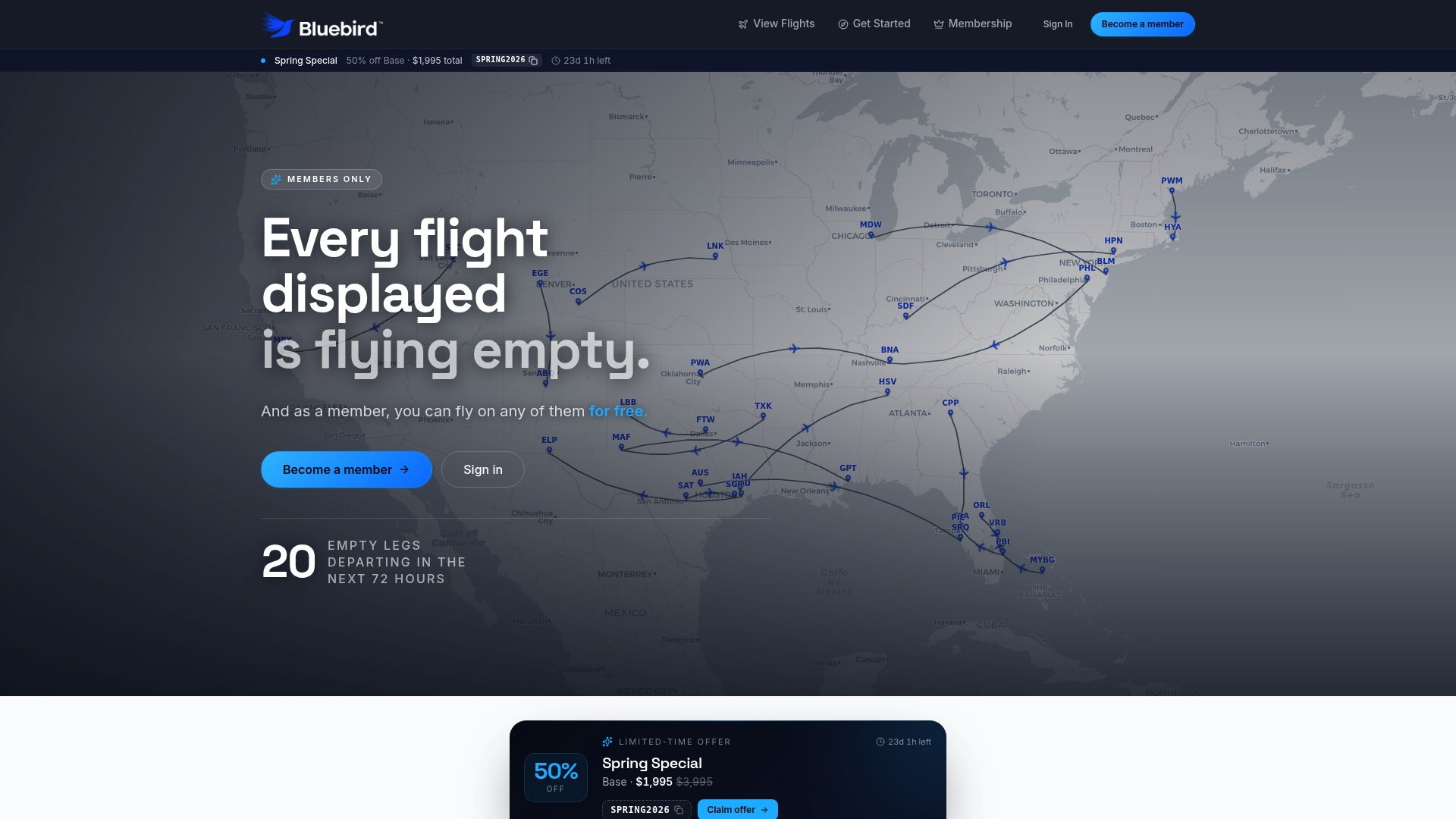
Empty legs are repositioning flights that would otherwise fly without passengers. They offer the same aircraft, the same FBOs, the same direct routing and flexible scheduling at a fraction of standard charter rates. For professionals who fly frequently enough to benefit from private aviation’s time advantages, the Bluebirdjets membership converts that benefit into something financially practical. Browse available private flights and see what routes are open on your schedule.
Key Takeaways
Private aviation saves 2–5 hours per trip door-to-door by cutting airport wait times, eliminating layovers, and aligning departures with your schedule rather than an airline’s.
| Point | Details |
|---|---|
| Pre-flight time savings | Arriving 15–20 minutes before departure vs. 90–180 minutes recovers 1.5 to 2.5 hours per flight. |
| Airport access advantage | 5,000+ private airports vs. ~500 commercial hubs reduces ground transit by 1–2 hours on many routes. |
| Cognitive performance | Research shows private travel restores executive focus, producing better meeting outcomes after landing. |
| Annual time recovery | Frequent private fliers reclaim 800–2,000 hours annually, equivalent to up to 2.5 months of working time. |
| Bluebirdjets membership | Unlimited access to empty leg flights makes private aviation’s time savings financially practical for regular travelers. |