Private Jet Buyers: Avoid Losing an Empty Leg to Routing Changes

Private Jet Buyers: Avoid Losing an Empty Leg to Routing Changes
Yes, routing and schedule changes can move or erase an empty leg flight, and when that happens, your advertised savings can vanish with it. The empty leg you booked exists only because another client’s charter created it; any change to that original trip, from a weather delay to a canceled meeting, can cancel yours too. Keep a commercial backup ticket active and confirm notification and refund terms in writing before you drop other plans.
TL;DR:
- Fixed empty legs, booked after the main charter is completed, are significantly more reliable than dynamic legs that depend on ongoing client bookings, which carry higher cancellation risks.
- Routing changes often stem from the original charter’s schedule shifts, weather disruptions, aircraft maintenance issues, or operator decisions, which can occur with hours’ notice or less.
- Pricing discounts for empty legs increase closer to departure, especially within five days, but added stops, landings, or route deviations can erode savings.
- Verifying whether an empty leg is fixed or dynamic, understanding operator authority, and securing written refund and notification terms are crucial before booking.
- Membership platforms with live inventory and priority booking can mitigate some routing-change risks by providing faster updates and quicker access to replacement options.
Table of Contents
- What Causes Empty Leg Routing Changes in the First Place
- Fixed vs. Dynamic Empty Legs: Which One Are You Actually Booking?
- What Routing and Schedule Changes Actually Remove an Empty Leg
- How Routing Changes Affect Pricing and Whether the Savings Are Real
- A Practical Checklist Before You Book an Empty Leg
- Timing Tactics That Reduce Routing-Change Risk
- What Happens If Your Empty Leg Gets Canceled
- How Bluebirdjets Approaches Routing Changes and Member Protection
- When an Empty Leg Is the Right Call, and When It Isn’t
- Why Bluebirdjets Membership Changes the Routing-Change Math
- Sources
- FAQ
What Causes Empty Leg Routing Changes in the First Place
An empty leg is not its own flight. It is a repositioning leg, the byproduct of a paying client’s one-way charter that leaves an aircraft needing to fly back to base or on to its next assignment empty. Bluebirdjets and every other empty-leg source depend on this same supply chain: someone else books a jet from Point A to Point B, and the return or continuation flight becomes available at a steep discount because the operator would rather recover some revenue than fly empty.
That dependency is exactly why routing changes happen. You are not the customer who controls the schedule. The original charter client is, and their itinerary, not yours, dictates the departure time, the airport, and whether the flight happens at all.
Operational control adds another layer most travelers never think about. Under Federal Aviation Regulations Part 135, the certificated operator holds final authority over go/no-go decisions, routing, and flight termination — not the broker, not the buyer, not even the pilot in isolation. That means an operator can legally pull, delay, or reroute a flight for operational control reasons under Part 135 even after you have booked, and there is no negotiating with that authority once safety or compliance is in question.
A few mechanics worth understanding before you shop for a deal:
- The empty leg’s route is fixed by the original charter’s needs, not by demand for your preferred city pair.
- Timing is set by when the paying client finishes their trip, which can shift by hours or days.
- The operator can reassign the aircraft to a different, more profitable charter if one materializes.
- Weather, maintenance, and airport slot restrictions all apply to the empty leg exactly as they would to any other flight.
Understanding why private jets have spare seats in the first place makes the rest of this article click into place. You are buying access to someone else’s leftover capacity, and that access comes with someone else’s schedule attached.
Fixed vs. Dynamic Empty Legs: Which One Are You Actually Booking?
Not all empty legs carry the same risk, and the difference comes down to timing relative to the primary charter. Fixed empty legs happen after the paying client has already flown; the aircraft is sitting at the departure airport with a known return schedule. Dynamic empty legs get posted before the primary client has even taken off, which means the entire flight still depends on a trip that has not happened yet.
Fixed legs are dramatically more reliable. The plane exists at the airport it says it does, the crew is assigned, and the main variable left is weather or last-minute maintenance. Dynamic legs, by contrast, carry the highest cancellation risk in the empty-leg market because the client whose trip creates the leg could change plans, extend their stay, or cancel outright.
Here is how to tell which type you are looking at:
- Check the listing date against the departure date. A leg posted 10 to 14 days out is almost always dynamic; one posted 24 to 48 hours out is more likely fixed.
- Ask the operator directly whether the primary flight has already occurred. Many listings simply do not disclose this, and operators vary widely in how much detail they publish unless you push for it.
- Look at the language in the listing. Phrases like “expected” or “anticipated” routing signal a dynamic leg; a listing that names a specific tail number already positioned at the departure airport signals fixed.
Pro Tip: Never assume silence means the leg is fixed. If a listing doesn’t specify, treat it as dynamic and plan your backup accordingly. The burden is on you to ask, not on the operator to volunteer it.
What Routing and Schedule Changes Actually Remove an Empty Leg
Four categories of events account for almost every empty leg that moves or disappears after booking, and understanding them helps you gauge risk before you commit rather than after you’ve canceled your commercial ticket.
Original charter changes. The paying client who created the leg cancels their trip, extends their stay at the destination, or shifts their return time. Because the empty leg only exists as a byproduct of that booking, any change to it ripples directly into your flight, often with notice ranging from several days down to just a few hours.
Aircraft becomes unserviceable. Mechanical issues discovered during a preflight inspection, commonly called AOG (aircraft on ground), can ground a jet with essentially no warning. This applies to fixed and dynamic legs alike, though fixed legs at least confirm the aircraft was airworthy for its prior flight.

Weather and airport access. Storms, low visibility, runway closures, or a destination airport tightening slot availability can force a reroute or outright cancellation. Private aviation isn’t exempt from the same weather systems that ground commercial flights.
Operator decisions under OpSpecs and crew limits. Every certificated operator flies under Operations Specifications that govern which airports, weather minimums, and crew duty limits apply. A crew member timing out on duty hours, or an airport falling outside the operator’s approved OpSpecs, can force a last-minute substitution or cancellation entirely outside anyone’s control.
A few other triggers worth knowing:
- A more lucrative full charter request comes in, and the operator reassigns the aircraft.
- The original client’s connecting commercial flight is delayed, pushing the whole rotation later.
- Regulatory or customs changes affect international routing on cross-border empty legs.
Notice windows on these cancellations vary enormously. Some travelers get days of warning; others find out with only hours to spare, which is exactly why a standing commercial backup matters more than the discount itself.
How Routing Changes Affect Pricing and Whether the Savings Are Real
Operators price empty legs based on how badly they want to sell them versus how likely they are to book a full charter on that route instead. A leg listed two weeks out often carries a modest discount because the operator still hopes a paying client will fill that slot. The real value shows up as departure approaches.
This is the industry’s so-called 5-Day Rule: pricing and booking certainty both shift meaningfully inside the final five days before departure. Operators know the aircraft is flying regardless, so they drop prices to fill seats rather than fly empty, and the routing is far less likely to change again since the primary charter has typically already been confirmed or completed.
But timing cuts both ways. The closer you book to departure, the more certain the deal, yet the less time you have to arrange logistics if something still goes wrong.
Routing changes also erode savings in less obvious ways:
- Adding a pickup stop. If the operator agrees to add a passenger pickup along the route, expect added flight time and potentially a fuel surcharge that eats into your discount.
- Extra landings for fuel or customs. International empty legs sometimes require a technical stop that wasn’t in the original pricing.
- Route deviations around weather. A reroute around a storm system adds flight hours, and some operators pass that cost to the empty-leg passenger.
- Airport changes. Being asked to depart from a different, less convenient airport than advertised is common and rarely comes with compensation.
None of this means empty legs are a bad deal. It means the advertised price is a snapshot, not a guarantee, and the 5-Day Rule exists precisely because certainty and discount move together as departure nears.
A Practical Checklist Before You Book an Empty Leg
Every empty-leg listing deserves the same short interrogation before money changes hands. Skipping this step is how travelers end up stranded with a canceled commercial ticket and no aircraft.
- Confirm fixed vs. dynamic status. Ask whether the primary charter that created this leg has already flown. This single question tells you more about cancellation risk than anything else in the listing.
- Get the operator’s name and Part 135 certificate status. Knowing exactly who controls the aircraft tells you who has authority to cancel or reroute, and it lets you verify the operator independently.
- Ask how you’ll be notified of changes. Text, email, phone call? Get a specific answer, not a vague “we’ll let you know.”
- Get the exact refund and credit terms in writing. Full refund, partial credit, or no refund at all should be spelled out before you pay, not discovered after a cancellation.
- Ask whether a replacement aircraft would be sought. Some brokers with wide operator networks can source a replacement fast, while others will simply refund and leave you to rebook.
- Clarify the departure window. Empty legs often have flexible, sometimes multi-hour departure windows rather than a fixed time. Know this before you plan ground transportation.
Pro Tip: Write down the operator name, listing time relative to departure, and exact refund clause for every empty leg you book. That single record is what you’ll need if the leg disappears and you’re negotiating a refund or credit after the fact.
Watch for these red flags: vague or nonexistent refund language, no named operator anywhere in the listing, and “as-is” listings that make no promise of notice at all. Any of these should push you toward a different listing or at minimum a direct call to confirm terms before you pay.
Timing Tactics That Reduce Routing-Change Risk
The travelers who consistently land good empty-leg deals with fewer surprises tend to use a few specific tactics rather than just browsing whatever pops up.
Corridor alerts are the biggest lever. Instead of searching for an exact city pair, set alerts for a radius of roughly 100 miles around your origin and destination. This dramatically widens your pool of available legs, since operators frequently reposition through nearby regional airports rather than the exact major hub you had in mind.
- Watch a corridor, not a single airport, to catch legs that would otherwise never show up in your search.
- Accept that last-minute booking, inside the 5-Day window, usually yields the steepest discounts but leaves you almost no runway to react to a cancellation.
- Booking further out gives you more planning time but exposes you to more of the schedule volatility described earlier in this article.
- A broker or membership platform with a wide operator network can sometimes find a replacement aircraft faster than you could on your own, simply because they have more relationships to call on.
There is a real trade-off here, and no single answer is right for every trip. If your schedule can absorb a same-day change, lean toward last-minute bookings for the best price. If you have a hard commitment on the other end, weigh whether the discount is worth the added uncertainty, or whether a flight with a fixed, already-positioned aircraft is worth paying slightly more to secure.
What Happens If Your Empty Leg Gets Canceled
When a routing change kills your empty leg, the outcome depends almost entirely on what you agreed to before booking, which is exactly why the checklist above matters so much.
Three outcomes are common. Some operators offer a full refund, particularly when the cancellation originates entirely on their end, such as an AOG event. Others offer partial refunds or credit toward a future flight, especially if some costs were already incurred. And some listings are explicitly sold as no-refund, priced lower specifically because the buyer accepts that risk upfront.
If your leg disappears, ask immediately whether a same-day replacement aircraft is available. Success depends on route popularity, time of day, and how many other aircraft the operator or broker has access to in that region. A replacement is realistic on high-traffic corridors like Northeast to Florida; it is far less likely on a thin regional route with limited aircraft in the area.
Travel insurance can help with certain costs, hotel stays, missed connections, nonrefundable event tickets, but it rarely reimburses the empty leg’s cost itself if the listing was explicitly no-refund. Read your policy’s language on “chartered aircraft” or “non-scheduled carrier” exclusions before assuming you’re covered.
| Cancellation outcome | What triggers it | What you should ask for |
|---|---|---|
| Full refund | Operator-caused cancellation (AOG, crew, weather) | Refund timeline in writing |
| Partial refund or credit | Shared responsibility or late-stage change | Credit expiration terms |
| No refund | “As-is” listing disclosed at booking | Confirmation you understood the risk |
The gap between an ideal empty-leg experience and an actual one usually comes down to whether the traveler asked these questions before paying, not after the cancellation email arrived.
How Bluebirdjets Approaches Routing Changes and Member Protection
Bluebirdjets built its model around the exact friction points described above: discovery speed and priority access when routing shifts. Members get unlimited access to live empty-leg inventory on Bluebirdjets’s own Learjet 60 fleet, updated daily, rather than static listings that go stale the moment the original charter’s plans shift.
A live example: Bluebirdjets has advertised specific legs such as a routing from ECP to CJR, giving members a concrete sense of what shows up on the platform day to day rather than an abstract promise of “deals.”
A few structural features matter here:
- Operator-owned fleet. Some companies operate their own aircraft rather than aggregating third-party listings, which can reduce uncertainty about who controls the go/no-go decision.
- Queue and priority booking. Some membership programs offer priority booking that lets members position themselves ahead of the general public when a leg posts, which matters most on high-demand corridors where legs are claimed quickly.
- Live, daily-updated inventory reduces the lag between a routing change and users seeing the updated availability.
None of this eliminates operator-level cancellation events. Weather grounds flights regardless of membership tier, and an unexpected maintenance finding takes an aircraft out of service no matter who’s watching the queue. What membership changes is how fast you find out about it and how quickly you can find an alternative.
When an Empty Leg Is the Right Call, and When It Isn’t
Empty legs make the most sense for travelers whose schedules can flex, a long weekend, a flexible business trip, a destination with multiple ways to get there. They make far less sense for a wedding, a closing, or any arrival where being late isn’t an option.
Membership access or a strong broker relationship shifts that calculus somewhat, because faster discovery and replacement odds reduce the downside of a routing change. Still, discipline matters more than access. Don’t cancel a commercial backup ticket until your private flight has actually departed. That one habit protects you from nearly every scenario this article covers.
— Nick
Why Bluebirdjets Membership Changes the Routing-Change Math
Instead of hunting broker listings one at a time or chasing scattered empty-leg posts across multiple sites, some membership platforms offer unlimited access to a single live inventory feed with priority queue placement built in.
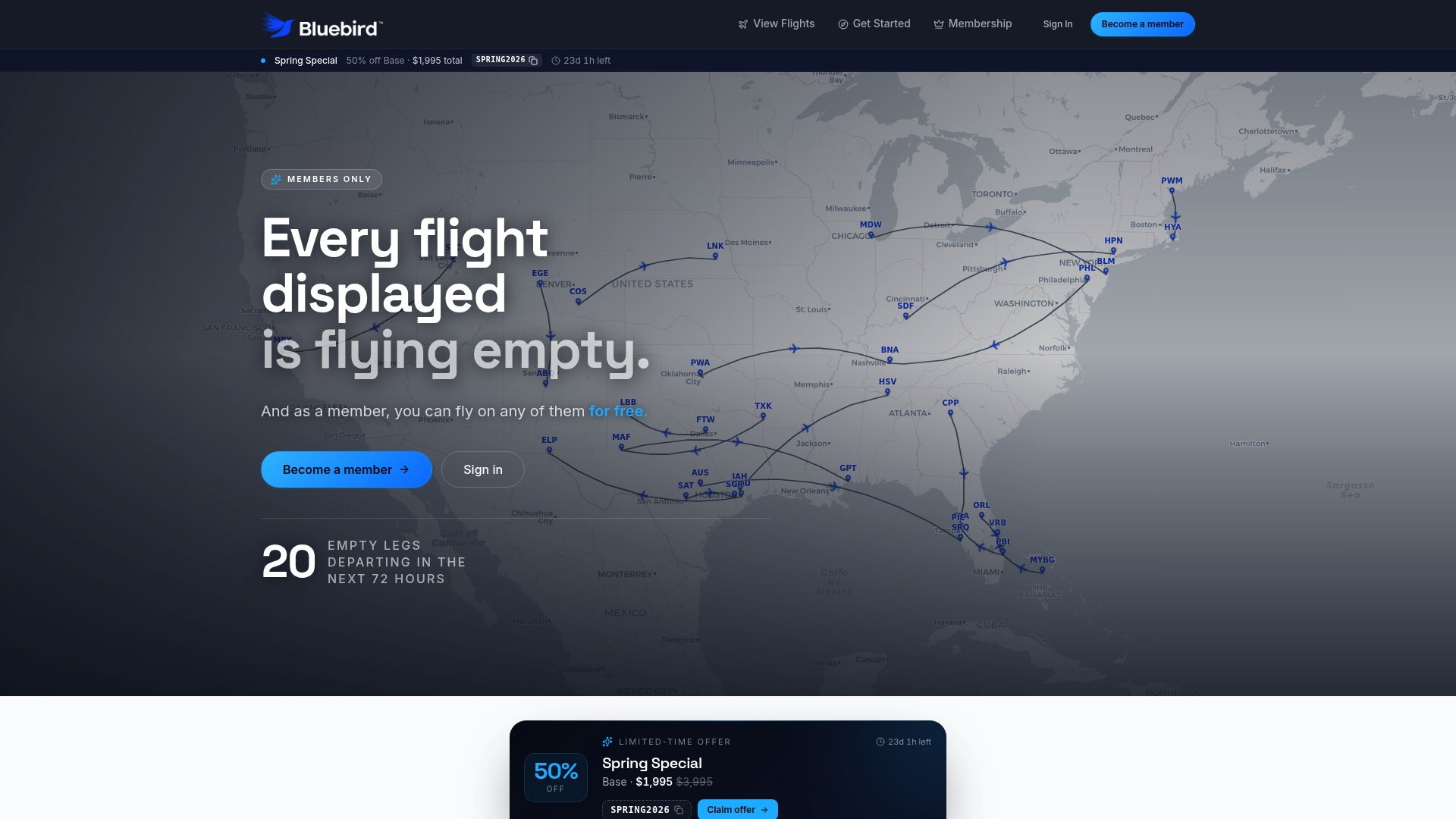
That priority matters most in exactly the scenario this article describes: a routing change pulls a leg you wanted, and now you’re racing other travelers to claim whatever replacement posts next. Members also get the option to bring up to six guests per flight and can pay the one-time Skip-The-Line fee of $2,000 when they want to jump the queue on a specific listing rather than wait their turn.
To be direct about the limits: membership improves discovery speed and booking priority, it does not override an operator’s AOG finding or a weather system. What it does is put you closer to the front of the line when a new leg opens up to replace one that just changed.
Membership runs $3,995 per year for the Base plan or $9,995 per year for Plus, with Plus carrying higher queue priority. If routing-change risk has been the thing keeping you from booking empty legs regularly, browse current listings on the live flights page and see what’s posted for your corridor this week.
Sources
- Operational control and go/no-go decisions (Part 135) — CTSys
- What happens if your empty leg flight gets cancelled? — AeroCorner
- What Is an Empty Leg Flight? A Broker Explains — FlyPeak
- The truth about empty legs — Aircraft Broker Program
FAQ
What are the current deals for empty leg flights?
Current empty-leg pricing changes daily based on which charters are flying and how close departure is, with the steepest discounts typically appearing inside the 5-Day Rule window before takeoff. Bluebirdjets members can check live, daily-updated inventory directly rather than relying on static listings that may already be outdated.
What are the major changes to air travel in the US in 2026?
Private aviation continues to see growing demand for flexible, on-demand travel, which has pushed more operators toward publishing empty-leg inventory to fill repositioning flights that would otherwise fly empty. On the commercial side, capacity and scheduling pressures have made travelers increasingly interested in private alternatives that don’t depend on hub-and-spoke routing.
What flight lasts 57 seconds?
This refers to a widely cited historical curiosity involving an extremely short scheduled commercial flight between two closely spaced islands, not a private jet or empty-leg route. It has no bearing on empty-leg routing or scheduling practices covered here.
Is Jet Airways going to start again?
Jet Airways is a commercial airline undergoing separate corporate and regulatory proceedings unrelated to the private charter and empty-leg market. Its status has no effect on empty-leg availability, pricing, or the operational-control rules that govern Part 135 charter flights.
How much notice will I get if my empty leg’s routing changes?
Notice varies widely, from several days down to just a few hours, depending on why the change happened. A maintenance issue or the original charter client canceling can surface with very little warning, which is why confirming refund and notification terms before booking matters more than the advertised discount.
Can I get a refund if my empty leg flight is canceled?
It depends entirely on the terms you agreed to at booking. Some operators offer a full refund for operator-caused cancellations, others provide credit toward a future flight, and some listings are sold explicitly as no-refund in exchange for a lower price.