Empty Leg Waitlists: U.S. Flyers Can Move Up With Membership

Empty Leg Waitlists: U.S. Flyers Can Move Up With Membership
Yes, many operators and platforms let you join an empty-leg waitlist or queue, and turning that spot into a confirmed seat happens often though it is never guaranteed. Converting an opportunity takes flexibility, a fast response when a seat opens, and accurate passenger details ready to go. Membership programs add live inventory and priority features that make waitlisting more workable for frequent travelers.
TL;DR:
- Dynamic legs can shift or disappear if the primary charter changes, while fixed legs are more dependable because the charter is already complete.
- When a seat opens, operators may require passenger details and payment within minutes, so keep identification and payment information ready and monitor your phone.
- A listing’s seat count reflects the aircraft’s actual capacity, so confirm your group fits before joining; parties cannot exceed that limit.
- Base costs $3,995 annually and Plus costs $9,995, while the $2,000 Skip The Line fee buys priority for a single flight.
- Waitlisting suits spontaneous trips with flexible dates and airports, but it is a poor fit for weddings, conferences, or connections that cannot be missed.
Table of Contents
- How empty-leg waitlists and priority queues actually work
- Where to find empty-leg listings and waitlists
- How to increase your chances on a waitlist
- What to expect after you join a waitlist
- Step-by-step: join a waitlist and convert a listing into a booked seat
- Benefits of a membership for empty leg access versus one-time bookings
- Differences between Base and Plus membership levels relevant to empty legs
- How unlimited access membership changes waitlist priorities or benefits
- Typical costs or pricing structure for memberships related to empty leg usage
- When waitlisting is the right approach: author perspective
- Bluebird Jets membership: an option to reduce waitlist friction
- FAQ
- Sources
How empty-leg waitlists and priority queues actually work
An empty leg exists because an aircraft needs to reposition after dropping off a primary charter client. Some of these legs are dynamic: they depend on that primary trip actually happening, so the route or timing can shift or disappear. Others are fixed, meaning the primary charter is complete and the repositioning flight is locked in, which makes them far more stable to plan around.
Every listing carries a seat count tied to the aircraft’s actual capacity. That number is not negotiable: if the jet seats six, a party of eight cannot squeeze in regardless of how badly they want the flight.
Queues typically run on a few models: first-come-first-served, membership-based priority, or a paid skip-the-line option that moves a request ahead of the general queue. Operators confirm seats once documentation and payment clear, and they reserve the right to cancel or reroute a leg if the primary charter’s plans change. Understanding what determines empty leg availability helps explain why some queues move fast and others stall for days.
Where to find empty-leg listings and waitlists
Catching a good empty leg before someone else does comes down to watching the right channels and setting them up so nothing slips past you.
- Check platform live-inventory pages and dedicated flight listing pages daily, since routes update as operators finalize repositioning schedules.
- Visit operator and charter websites directly, including their help-center pages, which usually spell out seat counts and booking rules for each leg.
- Set up email alerts, saved searches, and mobile push notifications, or build your own automation with RSS feeds or IFTTT to flag new listings the moment they post.
- Work with a travel concierge or join a membership platform for a higher-touch option, since these luxury travel planning services including concierge-level itinerary design often surface opportunities before they reach public listings.
Our own empty leg alerts guide walks through configuring notifications so you are not refreshing a page every hour. A broader off-season travel calendar is also worth checking, since slower travel periods tend to produce more repositioning flights and more chances to catch one.
How to increase your chances on a waitlist
A handful of habits separate travelers who convert waitlist spots from those who watch opportunities pass them by.
- Stay flexible on dates, departure airports, and times of day since narrowing your options too early shrinks your odds dramatically.
- Join a membership or priority queue if you travel often enough that unlimited access pays for itself over one-off bookings.
- Confirm your group size against the listed seat count before requesting a spot, since a mismatch wastes everyone’s time.
- Stay reachable at all times once you join a queue, because confirmations often require an answer and payment within minutes.
- Keep payment details and passport or ID information formatted and ready so nothing holds up a confirmation once a seat opens.
Reading about why flexible schedules suit empty legs is a good next step if you are weighing how much flexibility you actually need to build in.
Pro Tip: Save your passenger names exactly as they appear on government ID in a note on your phone, so you can paste them into a confirmation request the instant a seat opens.
What to expect after you join a waitlist
Timing on empty legs ranges from a few hours to a few days, and the window can compress fast when a leg is dynamic rather than fixed. Our guide to the 24 to 72 hour booking window covers the pattern in more detail, but the short version is that last-minute means last-minute: plan to move quickly once you hear back.
When a seat opens, expect a message asking for passenger names, payment confirmation, and your planned arrival time at the airport. Respond quickly, since slow replies often mean the seat goes to the next person in line.
Operators can cancel or alter a leg if the primary charter client changes plans, which is one of the tradeoffs of chasing a repositioning flight instead of a scheduled one. If you do get confirmed, bring valid government ID, arrive at the recommended time, and keep your phone on in case departure timing shifts slightly.
Step-by-step: join a waitlist and convert a listing into a booked seat
Here is the sequence that works whether you are using a free listing site or a membership platform.
- Find a listing that fits your dates and airports, and save it or bookmark the page.
- Review the aircraft type and seat count to confirm your group fits.
- Join the waitlist or queue, and double-check that your contact information and payment method are current.
- Watch your notifications closely and respond immediately, completing payment the moment a seat is offered.
- Once confirmed, follow the operator’s instructions for passenger details and arrival timing exactly as given.
An example listing, like the JWY to PQL empty leg departing July 18, shows how a flight page typically displays seat count, route, and date together so you can evaluate it at a glance.
Benefits of a membership for empty leg access versus one-time bookings
One-time bookings mean starting from zero every time: searching multiple sites, comparing operators, and hoping a seat count and route line up with your plans before someone else claims it. A membership flips that process by giving you standing access to live inventory you can check whenever you want, rather than waiting on a single alert to land in your inbox.
Memberships often include priority queue placement, which matters most when a desirable leg attracts more than one request at once. Members may also bring up to six guests per flight, which changes the math for families or small groups who would otherwise need to track down a jet big enough for everyone on a one-off booking.
The bigger shift is frequency. A traveler booking once or twice a year may do fine watching free listings and reacting when something fits. Someone who wants to fly opportunistically several times a year benefits from paying once annually and then treating every matching leg as available, rather than negotiating access each time. That shift from per-flight shopping to standing access is the core value a membership adds over repeatedly booking one-off charters.
Differences between Base and Plus membership levels relevant to empty legs
Our Base and Plus membership tiers both unlock unlimited access to published empty-leg flights, so the starting benefit is the same regardless of which plan you choose. Base membership costs $3,995 per year and gives you live inventory access, the ability to bring up to six guests, and standard queue placement when requesting a seat.
Plus membership runs $9,995 per year and layers in higher queue priority on top of everything Base includes. For a traveler who flies often enough that competing for popular routes becomes a recurring issue, that priority placement can be the difference between getting the confirmation message first and waiting to see if a seat is still open.
Choosing between the two comes down to how often you expect to fly and how much you value moving to the front of the queue when multiple members want the same leg. Someone flying occasionally may find Base covers their needs, while a frequent flyer chasing specific routes or tighter windows gets more practical value from the Plus tier’s priority access.

How unlimited access membership changes waitlist priorities or benefits
Unlimited access changes the waitlist dynamic because holders of such memberships often do not hesitate over single flights, which can speed response times. Operators and platforms that reward quick responses usually favor users who can commit the moment a seat appears.
Priority placement within the queue can mean some requests get reviewed ahead of the general public’s interest in the same leg. For a dynamic empty leg that may only be confirmed hours before departure, that head start can be the entire difference between flying and missing out. Pairing priority access with fast, prepared response habits gives a traveler the best realistic shot at converting a waitlist spot into a seat.
Typical costs or pricing structure for memberships related to empty leg usage
Our membership pricing runs on an annual structure rather than a per-flight fee. Base membership is $3,995 per year, and Plus membership is $9,995 per year, with both granting unlimited access to published empty-leg flights rather than charging per seat.
For travelers who want to move ahead of the standard queue on a specific flight without committing to a membership, a Skip-The-Line fee of $2,000 one-off is available as a per-flight option. Comparing that single-flight cost against the annual membership price is a useful way to decide which structure fits your travel frequency: someone flying several times a year typically gets more value from unlimited annual access than from paying the skip-the-line fee flight by flight.

When waitlisting is the right approach: author perspective
Waitlisting makes sense for spontaneous leisure trips where your dates and destination have real give in them. It falls apart fast for anything tied to a fixed schedule: a wedding, a conference, a connecting flight you cannot miss. Under U.S. Department of Transportation rules, passengers on a single-entity charter do not occupy individually sold seats, which is part of why operators cannot simply sell leftover spots on demand the way a scheduled airline would. A membership with live inventory and priority queueing does not remove that uncertainty, but it shifts more of the waiting and monitoring off your plate.
— Nick
Bluebird Jets membership: an option to reduce waitlist friction
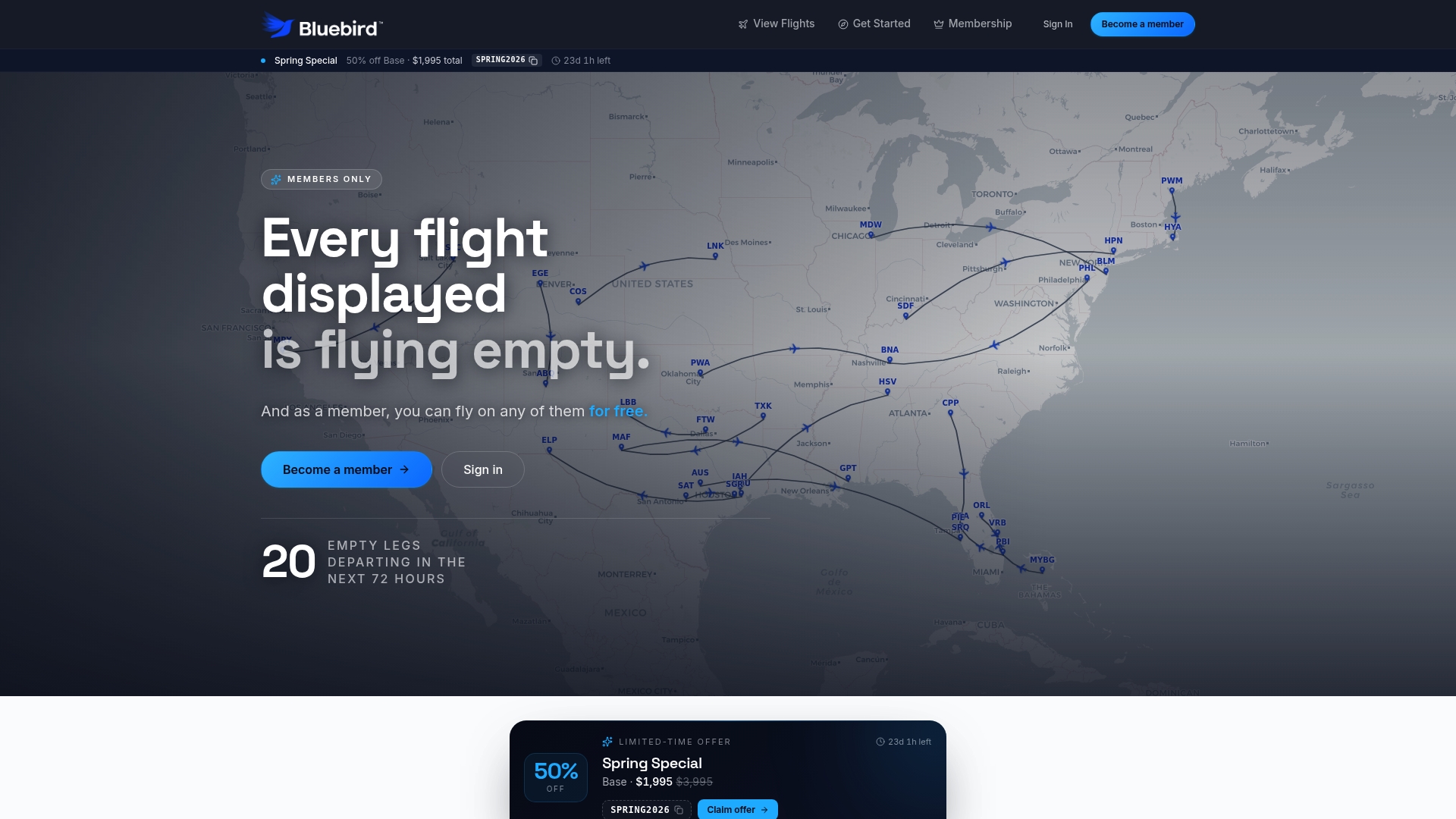
If chasing free listings across multiple sites sounds like more work than it is worth, our membership is built to cut that friction. We publish live, daily-updated inventory on our own operator-owned Learjet 60 aircraft, so you are checking one place instead of ten.
- Members get unlimited access to published empty-leg flights at a flat annual fee, with no per-flight markup.
- Plus members receive higher queue priority for competitive routes.
- Every flight allows up to six guests, which covers most families and small groups without extra booking steps.
- A Skip-The-Line option is available for a one-time fee when you want to move ahead on a specific flight without a full membership.
Because our inventory updates daily and queue status is visible, the gap between spotting a listing and locking in a seat tends to be shorter than piecing together alerts from scattered sources. Visit our membership page to compare Base and Plus, or browse current flights to see what is available right now.
FAQ
What does it mean if your flight is waitlisted?
Being waitlisted means your request for a seat has been logged but not yet confirmed, usually because the operator is waiting on the primary charter’s plans to finalize or because other requests are ahead of yours in the queue. A confirmed seat typically comes with a direct message asking for passenger details and payment.
Can I book a private jet last minute?
Yes, last-minute private jet bookings are common, especially for empty legs, which often confirm within a 24 to 72 hour window before departure. Availability depends heavily on flexibility around dates, airports, and group size relative to the aircraft’s seat count.
How do membership programs differ from one-time empty leg bookings?
A membership grants ongoing access to live inventory and queue priority for a flat annual fee, while one-time bookings mean searching and competing for each flight individually. For travelers who fly several times a year, a membership often simplifies access compared to repeatedly bidding for one-off seats.
What should I have ready before joining a waitlist?
Have your payment method and passport or government ID details formatted and accessible, since operators request this information immediately once a seat opens. Being reachable by phone or email at all times after joining a queue also improves your odds of confirming before the opportunity passes.