Bluebird Unlimited Empty Leg Membership Pays After Four Flights

Bluebird Unlimited Empty Leg Membership Pays After Four Flights
Yes, for flexible, frequent flyers, a flat-fee unlimited empty-leg membership like Bluebird can cut private travel costs dramatically, since roughly 30% of private jet movements are repositioning flights operators need to fill anyway. The trade-off: you’re booking on standby, not a guaranteed schedule.
TL;DR:
- Membership costs range from about $1,000 to over $15,000 annually, with tiers offering different levels of priority and guaranteed access.
- If you fly four or more flexible one-way private trips per year, an unlimited empty-leg membership can save you significant money compared to booking individual charters.
- Availability of empty-leg flights depends heavily on operator routes and repositioning schedules, which can mean waiting one to four weeks for a good match.
- Flexible travelers on common routes and with loose travel dates benefit most, while those with fixed schedules or specific international routes may find fewer options.
- Key risks include vague cancellation policies, aircraft substitution clauses, blackout dates, and lack of transparency about operator credentials.
Table of Contents
- How Do Unlimited Empty-Leg Memberships Actually Work?
- Who Actually Benefits From an Unlimited Empty-Leg Membership?
- What Do Unlimited Empty-Leg Memberships Cost?
- How Do You Actually Land an Empty-Leg Flight?
- What Membership Red Flags Should You Watch For?
- What Does Bluebird’s Membership Include?
- How Do You Actually Sign Up?
- What Will a Year of Membership Actually Cost You?
- How Long Until You Take Your First Flight?
- When Would I Actually Buy an Unlimited Empty-Leg Membership?
- Ready to Book Your First Empty Leg?
- Sources
How Do Unlimited Empty-Leg Memberships Actually Work?
Empty legs exist because private jets rarely fly round trip with the same passengers both ways. An operator flies a client from New York to Miami, then needs to reposition that jet back north (or to its next job) with nobody aboard. That flight has to happen regardless. Membership platforms exist to fill that seat instead of letting it fly empty, and operators recover part of their repositioning cost by selling access to members.
“Unlimited” refers to the number of empty-leg flights you can book, not to schedule certainty. You’re on a standby model: routes and departure windows get published against live inventory, and members claim seats first-come or through a priority queue.
- Routes and times are set by the operator’s existing repositioning needs, not by member requests.
- Aircraft type is usually fixed to whatever fleet the membership draws from.
- “Unlimited” typically excludes custom charter requests, which get quoted and paid separately.
- Guest allowances vary by membership tier and aircraft cabin size.
Who Actually Benefits From an Unlimited Empty-Leg Membership?
Frequency and flexibility decide whether this membership model pays off, not income alone.
- Frequent regional flyers who travel the same handful of corridors (say, Northeast to Florida, or coast to coast) see the most value, since repositioning traffic clusters around popular routes.
- Flexible executives who can shift a meeting by a day or fly out on four hours’ notice get first crack at fresh inventory.
- Spontaneous weekend travelers without fixed return times can treat empty legs as found money rather than a planned itinerary.
- Travelers needing fixed departure times for weddings, board meetings, or connecting international flights should look elsewhere. Standby means no guarantee.
- Frequent long-haul flyers will find empty-leg inventory thin on transcontinental or international routes compared to regional hops.
As a rough threshold: if you’d otherwise book four or more one-way private charters a year on flexible dates, the math tends to favor membership over paying full charter rates each time.
What Do Unlimited Empty-Leg Memberships Cost?
Annual fees for unlimited empty-leg access span a wide range depending on priority level and fleet access. Market examples run from around $1,000 a year on the low end, as seen when one app-based membership launched with a sub-$1,000 annual fee, up to $15,000 or more for tiers bundling guaranteed seats or larger cabins.
Statistic to know: industry pricing pages show unlimited empty-leg tiers clustering into three brackets: entry-level standby access, mid-tier plans adding priority queueing, and premium tiers with skip-the-line or near-guaranteed booking.
- Entry tier: lowest annual fee, pure standby, no priority queue.
- Mid tier: moderate fee, priority booking window before general members.
- Premium tier: highest fee, skip-the-line access or refundable options.
The math is simple. One empty-leg seat that would have cost $2,500 to $4,000 on a one-way charter covers a meaningful chunk of a mid-tier annual fee in a single flight. Book three or four of those a year and the membership has likely paid for itself, with everything after that running close to free.
How Do You Actually Land an Empty-Leg Flight?
Live inventory is the whole game. Routes get added and removed daily as operators finalize their repositioning schedules, so checking inventory frequently and setting alerts for your regular corridors beats checking once a week.
Pro Tip: Build a short list of two or three “backup” airports within driving distance of your primary one. Empty legs cluster around busy operator hubs, and a route landing 40 minutes from your usual airport still beats a commercial connection.
- Set inventory alerts for your top two or three routes rather than browsing randomly.
- Keep a go-bag mentality. The best seats often post 24 to 72 hours out.
- Plan around regional hub traffic (South Florida, the Northeast corridor, Southern California) where empty legs are densest.
- Pay for a skip-the-line or priority upgrade only when a specific date genuinely can’t slip. Standby works fine when you’re flexible.
What Membership Red Flags Should You Watch For?
Not every membership contract treats members the same way, and the fine print is where problems hide.
- Vague refund language. If cancellation terms don’t specify a dollar amount or timeframe, assume the worst case applies.
- Aircraft substitution clauses. Some contracts allow operators to swap a promised jet type for something smaller without notice.
- Blackout dates around holidays. Peak travel windows often get carved out of “unlimited” access entirely.
- Missing operator credentials. Legitimate programs should be transparent about which FAA-certificated operators fly the empty legs, not just the platform’s own branding.
- No verified member feedback. A membership with zero traceable reviews after a year in market is a program still finding its footing.
Cross-check any of these against the operators actually flying the routes before signing.
What Does Bluebird’s Membership Include?
Bluebird built its membership around the exact profile this guide describes: flexible, frequent flyers who want unlimited empty-leg access without negotiating a new charter every time.
- Unlimited access to empty-leg flights on operator-owned Learjet 60 aircraft.
- Live inventory updated daily, so routes reflect real repositioning schedules rather than stale listings.
- Queue and priority booking features that give members a fair shot at high-demand routes.
- Bring up to six guests per flight at no added membership cost.
- Optional paid custom charter requests for trips outside published inventory.
| What you get | Detail |
|---|---|
| Access model | Unlimited empty-leg bookings, standby-based |
| Fleet | Operator-owned Learjet 60 |
| Guests | Up to six per flight |
| Inventory | Updated daily, live |
| Extras | Paid custom charter option |
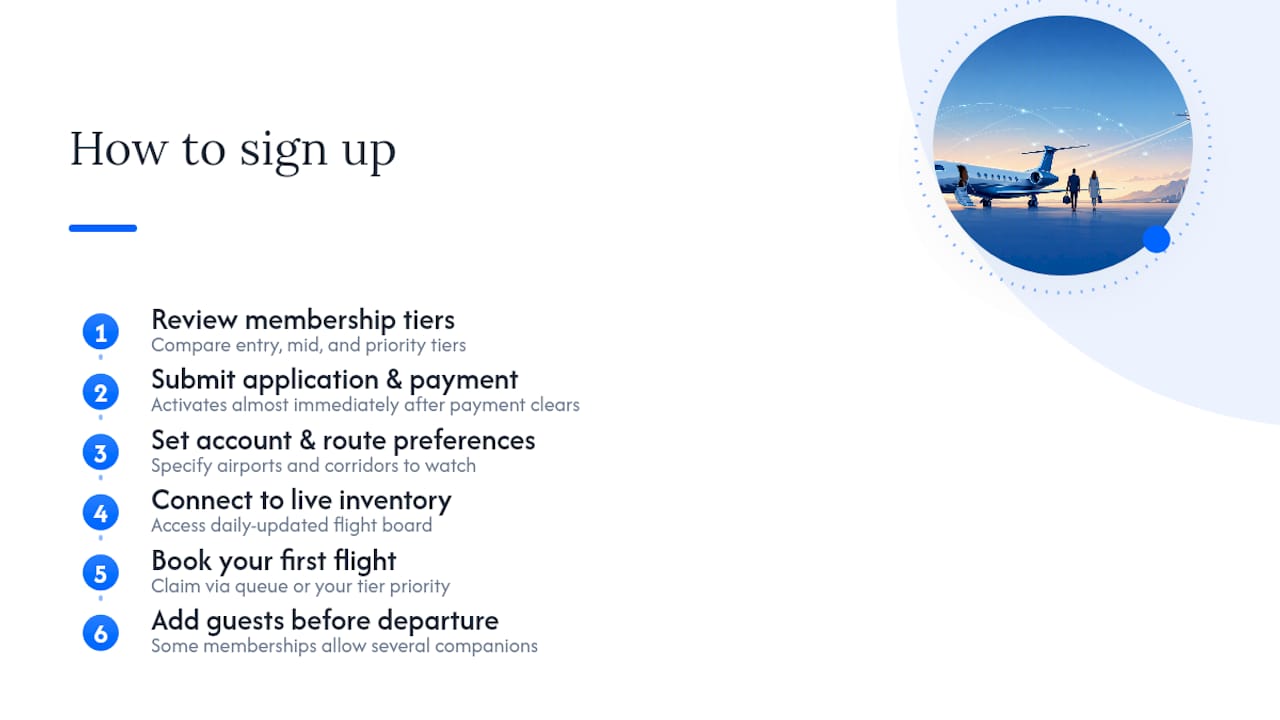
How Do You Actually Sign Up?
Joining an unlimited empty-leg membership follows a predictable sequence, and knowing the steps ahead of time keeps the first few weeks from feeling like guesswork.
Step one: review the membership tiers. Compare entry, mid, and priority tiers against how often you actually fly and how firm your schedule tends to be.
Step two: submit your application and payment. Most platforms process the annual fee upfront through the website, and membership activates almost immediately after payment clears.
Step three: set up your account and route preferences. This is where you tell the platform which airports and corridors matter to you, so alerts surface the routes worth watching.
Step four: connect to live inventory. Once your account is active, you get access to the daily-updated flight board and can start watching for matches.
Step five: book your first flight. When a route fits, you claim it through the queue or priority system your tier allows. Confirmation typically comes fast since operators need firm headcounts to finalize repositioning logistics.
Step six: bring your guests. Depending on the membership, you can add up to several travel companions at no extra charge, so loop them in before departure day.
The entire process, from application to your account going live, usually takes a day or two. The real variable isn’t onboarding speed. It’s how quickly a route matching your travel pattern shows up in inventory.
What Will a Year of Membership Actually Cost You?
Budgeting for an unlimited empty-leg membership means accounting for more than the sticker price on the annual fee.
Start with the membership fee itself, which sits anywhere from roughly $1,000 on entry-level, standby-only programs to well over $10,000 for premium tiers with priority or near-guaranteed access. That’s the fixed, known cost.
Beyond the base fee, expect a few variables. Custom charter requests, used when no empty leg matches your dates, are quoted and billed separately per flight and can run into the thousands depending on route and aircraft. Skip-the-line or priority upgrades, where offered, sometimes carry a per-flight fee on top of the annual membership rather than being bundled into a higher tier. Ground transportation, catering upgrades, and any add-on guest fees beyond your included allowance are typically extra as well.
There’s no federal excise tax on the member side of most empty-leg bookings the way there is on standard charter contracts, since you’re accessing pre-scheduled repositioning flights rather than chartering a dedicated trip, though this varies by program structure and is worth confirming before you fly.
Realistically, a member who flies four to six empty legs a year and skips custom charters entirely can expect their total annual cost to land close to the membership fee alone. Add one or two custom charters, and total yearly spend can climb by several thousand dollars, still well below chartering every trip independently.
How Long Until You Take Your First Flight?
The gap between signing up and boarding your first empty leg depends almost entirely on how flexible your travel dates are, not on the platform.
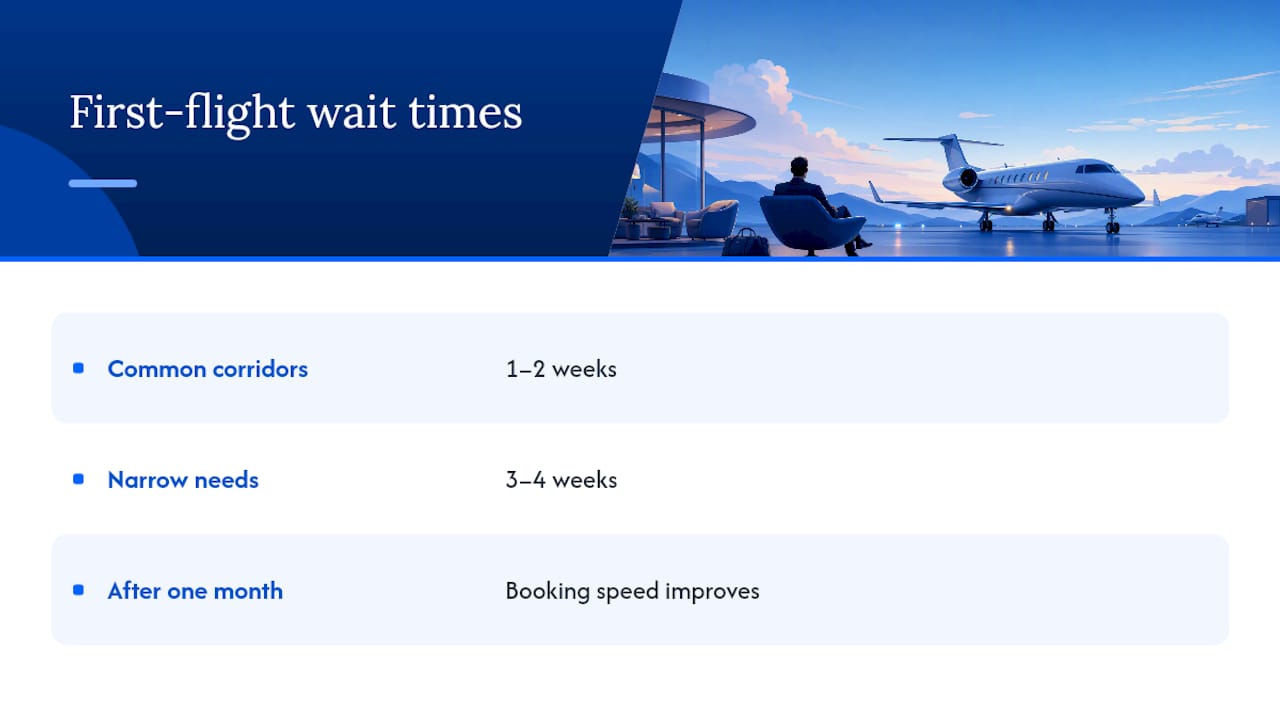
Members who fly common corridors, Northeast to Florida, California coastal routes, major business hubs, often see a matching flight within the first one to two weeks of membership. Regional concentration near busy operator hubs is the single biggest factor in how fast that first match appears.
Members with narrower needs, a specific less-traveled route, tight date windows, larger group sizes, may wait three to four weeks for the right inventory to surface. That’s not a flaw in the system. It reflects the actual repositioning patterns of the fleet you have access to.
The practical takeaway: set your route alerts the day your membership activates, stay ready to commit on short notice, and treat the first month as a calibration period. After that, most members develop a feel for which days and routes tend to post inventory, and booking speed improves noticeably from there.
When Would I Actually Buy an Unlimited Empty-Leg Membership?
I’d buy one the moment my travel pattern looked more like “I go to the same three places often” than “I need to be somewhere specific on a specific date.” That’s the real test, more than income or how much you fly commercially today.
Two heuristics settle it fast. First, count how many one-way private trips you took last year that could have shifted by a day or two without real cost. If that number is four or higher, membership math works in your favor. Second, ask whether missing one weekend’s flight because inventory didn’t materialize would genuinely ruin your plans. If yes, this isn’t your model yet.
If you’re unsure, watch for a seasonal promotional rate or a shorter initial commitment before locking into a full year.
— Nick
Ready to Book Your First Empty Leg?
Bluebird’s membership was built for exactly the traveler this guide describes: someone who flies often, holds their dates loosely, and would rather pay one flat annual fee than negotiate a new charter every time. Compared to shopping charters one trip at a time, you get unlimited access to daily-updated empty-leg inventory, priority queue tools, and room to bring up to six guests along for the ride.

If your travel pattern fits, the next move is straightforward. Check current empty-leg availability on the live board to see what’s flying near your usual routes this month, then review membership tiers to find the priority level that matches how often you fly.