How Airport Slots Work in Private Aviation: 2026 Guide

How Airport Slots Work in Private Aviation: 2026 Guide
Airport slots are designated time windows that grant an aircraft permission to land or take off at a specific airport during a set period. Understanding how airport slots work in private aviation is not optional for operators and pilots. Slot access determines whether a flight operates on schedule, gets delayed, or gets denied entirely. At coordinated airports worldwide, the International Air Transport Association (IATA) Worldwide Slot Guidelines govern the process, but private aviation faces its own layer of complexity that commercial airlines rarely encounter.
How airport slot allocation works for private jets worldwide
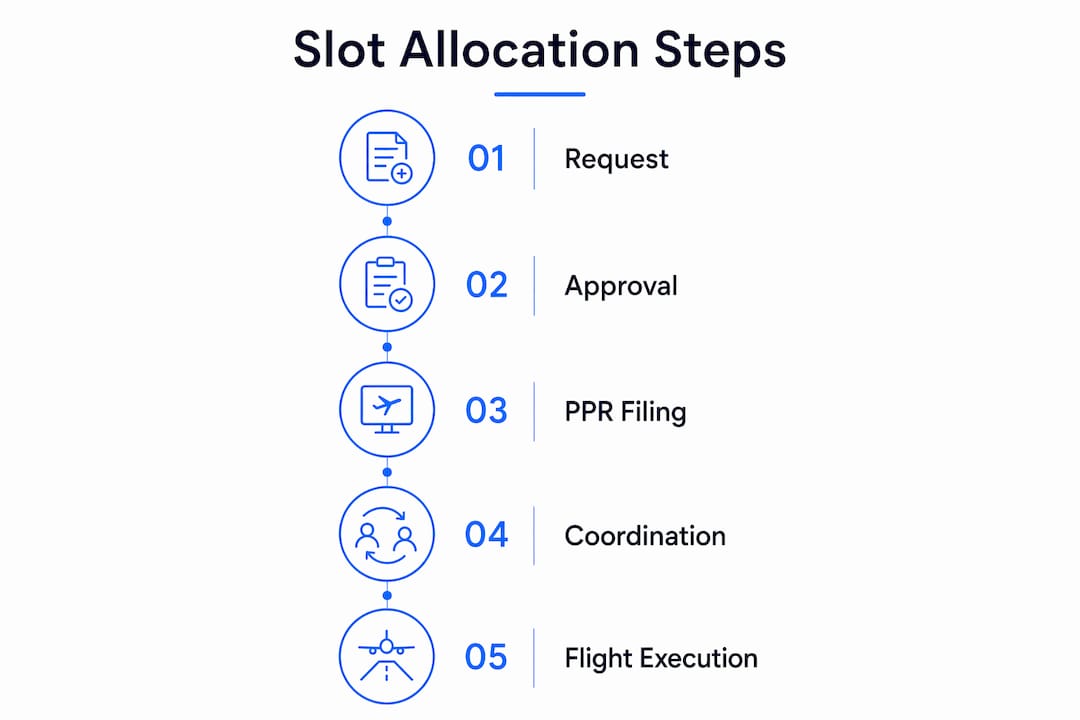
Slot allocation in private aviation runs through a formal request and approval chain. Operators submit a slot request, a Prior Permission Required (PPR) application, and a parking coordination request to the airport authority or its designated slot coordinator. These three elements must align exactly in timing. A mismatch between the PPR time and the slot window causes rejection or compliance failure.

Lead times vary significantly by region. In India, operators submit requests 3–4 days before operations at busy airports, with approvals arriving 1–2 days before arrival. That timeline is tight by global standards. Greek island airports operate under a stricter framework, with a 14-day regulatory lead time and a 48-hour minimum enforcement window. Capacity at some Greek island airports is capped at 4 slots per hour across all traffic, airline and general aviation combined.
The approval process typically works like this:
- The operator or handling agent submits the slot request to the airport coordinator or civil aviation authority.
- A PPR application is filed simultaneously, specifying exact arrival and departure times.
- Parking availability is confirmed separately, often through the ground handler.
- The coordinator reviews capacity, existing traffic, and operator history before issuing approval.
- Confirmation arrives within the airport’s stated lead time window, with conditions attached.
Pro Tip: Always file your PPR and slot request at the same time, using identical timestamps. Even a 10-minute discrepancy between the two documents can trigger a rejection at strict airports like those in the Greek Islands.
Regulatory bodies involved include national civil aviation authorities (such as India’s DGCA), IATA’s Slot Coordination body, and local airport management companies. Each layer adds procedural requirements that private operators must satisfy before a single wheel touches the runway.
What challenges affect private aviation slots at congested airports?
Slot scarcity is the defining constraint at major hubs. At airports like LaGuardia (LGA) and Newark (EWR), private slots require advance reservation and operational delays are common due to airline sequencing. Commercial traffic takes scheduling priority, and private jets sit lower in the queue. This is not a policy preference. It reflects the physical reality of runway capacity.
Peak events make scarcity extreme. During the World Economic Forum in Davos, slot pools are oversubscribed 3–5 times normal capacity. That means five aircraft competing for every one available window. Operators without established relationships at the coordinating authority face near-certain rejection for prime slots.
“Access to congested airports is a limited resource where private jets compete with commercial traffic. Success requires early, synchronized coordination of PPRs, slots, and ground handling with experienced agents. When preferred slots become unavailable, operators must shift schedules or reposition to alternate airports entirely.”
Several airport-specific factors compound the challenge:
- Runway length: Shorter runways at regional airports limit which aircraft types can operate, reducing alternatives.
- Customs availability: Many smaller airports offer customs only during set hours, which constrains arrival windows regardless of slot availability.
- Parking capacity: Limited ramp space means a confirmed slot does not guarantee a parking stand, especially during peak periods.
- Slot deviation tolerance: Greek island airports enforce a ±15-minute deviation window. Arriving outside that window risks penalties ranging from €1,000 to €30,000, plus a multi-month administrative review.
Non-compliance carries real financial and reputational costs. Operators who violate slot conditions face penalties, future slot denials, and damaged relationships with coordinators. For private aviation, where client expectations are high and schedules are tight, a single slot violation can collapse an entire trip.
Strategies for securing and managing private aviation slots
Early planning is the single most effective tool for slot success. For major events, the timeline is non-negotiable:
- Start 6–9 months out. For events like the 2026 World Economic Forum, slot bookings must begin 6–9 months in advance. Confirmations typically arrive 5–6 months before the event.
- Confirm by month five. Operators who wait until 3 months before the event consistently miss preferred windows. The best slots are gone by then.
- Align all three requests simultaneously. Submit the slot, PPR, and parking request in one coordinated package. Staggered submissions create timing gaps that coordinators flag.
- Assign a local ground handler early. Ground handlers with established airport relationships accelerate approvals and catch documentation errors before submission.
- Build in alternate airport options. Identify a reliever airport before you need one. Teterboro (TEB) near New York, for example, handles overflow from LGA and EWR with far less slot congestion and shorter taxi times.
- Monitor slot trading opportunities. Operators with strong slot portfolios sometimes release slots near event dates. This backup exists but is unreliable. Never plan a critical mission around it.
Pro Tip: Operator history is a competitive advantage. Coordinators at high-demand airports track which operators consistently comply with slot conditions. A clean compliance record from previous seasons directly improves your approval odds for future peak periods.
Relationships with local agents matter as much as the paperwork. An experienced agent at a Greek island airport knows which coordinator handles exceptions, what documentation format is preferred, and when to follow up. That local knowledge is not replaceable by a generic slot request template. For guidance on advance planning tactics, the structure of your access method matters as much as the timing.
How slot coordination shapes day-of flight operations
Slot windows dictate everything that happens on the ground. The moment a slot is confirmed, the entire operational timeline locks around it. Crew duty times, fuel uplift scheduling, catering delivery, and passenger transport to the aircraft all trace back to the slot window. A 30-minute slot delay cascades through every one of those elements.
The table below shows how slot timing affects key operational decisions:
| Operational element | Impact of slot delay | Mitigation |
|---|---|---|
| Crew duty time | Pushes into rest period limits | Build buffer into crew scheduling |
| Fuel planning | Recalculates burn for revised departure | Pre-position fuel with flexibility |
| Passenger logistics | Ground transport timing shifts | Confirm flexible transfer arrangements |
| Parking stand | Stand may be reassigned | Confirm stand hold with handler |
| Customs clearance | Window may close at smaller airports | Pre-clear where available |
Reliever airports solve many of these problems before they start. Private jets near New York regularly divert to Teterboro to avoid LGA’s airline sequencing queues. The trade-off is a longer ground transfer for passengers, but the operational reliability gain is significant.
During the Greek Islands summer season, slot misalignment between PPR and actual arrival time is the most common cause of operational failure. Pilots who arrive even 16 minutes outside their approved window face immediate compliance review. Real-time slot monitoring through the ground handler is the standard practice for experienced operators in that region. When preferred slots run out, repositioning to an alternate airport and arranging surface transport is often the only viable path forward. Understanding how to manage schedule disruptions before they happen separates professional operators from reactive ones.
Key takeaways
Airport slot coordination in private aviation requires synchronized submission of slots, PPRs, and parking requests, with lead times ranging from 3 days to 9 months depending on the airport and event.
| Point | Details |
|---|---|
| Slots and PPRs must align | Submit both with identical timestamps to avoid rejection at strict airports. |
| Lead times vary by region | India requires 3–4 days; Greek island airports enforce a 14-day regulatory minimum. |
| Peak events demand early action | Major events like WEF require bookings 6–9 months out; 3 months is too late. |
| Penalties for non-compliance are steep | Greek island violations carry fines from €1,000 to €30,000 plus administrative review. |
| Reliever airports reduce risk | Airports like Teterboro offer slot flexibility when major hubs are congested. |
What I’ve learned about slots that most briefings skip
The standard advice on airport slots focuses on lead times and paperwork. That advice is correct but incomplete. What actually determines success at a congested airport during a peak event is operator reputation, and that reputation is built over years of clean compliance, not over one well-timed application.
I’ve seen operators with perfect documentation get bumped from preferred Davos slots because a newer entrant with a stronger local relationship got there first. The coordinator knew that operator’s ground handler, trusted their compliance history, and allocated accordingly. The paperwork was secondary.
The other thing most briefings understate is the parking problem. A confirmed slot does not mean a confirmed stand. At Greek island airports in July and August, ramp space fills before the slot list does. Operators who treat parking as an afterthought discover this at the worst possible moment, usually when a client is already in the car heading to the airport.
My honest view on 2026: slot pressure at high-demand airports is increasing, not easing. New capacity is not coming fast enough to match demand growth in private aviation. The operators who will consistently secure quality slots are those who treat slot coordination as a year-round discipline, not a pre-trip checklist item.
— Nick
Bluebirdjets and the slot complexity behind every flight
Slot coordination is one of the most time-intensive parts of planning a private flight. Most passengers never see it. Bluebirdjets builds that coordination into its platform so operators and travelers don’t have to manage it alone.
The Bluebirdjets membership gives you unlimited access to empty leg flights on the platform, with scheduling built around real slot availability. The team handles PPR alignment, ground handler coordination, and alternate airport options when primary slots are unavailable. For flights where timing is fixed and slot access is critical, browse available flights with integrated scheduling support. Bluebirdjets removes the coordination burden so you can focus on the trip itself.
FAQ
What is an airport slot in private aviation?
An airport slot is a designated time window that grants an aircraft permission to land or take off at a specific airport. In private aviation, slots are required at coordinated airports where demand exceeds runway capacity.
How far in advance should I book a private jet slot?
Lead times range from 3–4 days at busy Indian airports to 6–9 months for major events like the World Economic Forum in Davos. Earlier is always better at high-demand destinations.
What happens if a private jet misses its slot window?
At Greek island airports, arriving outside the approved ±15-minute window can trigger penalties from €1,000 to €30,000 and a multi-month administrative review. At other airports, the slot is forfeited and the aircraft may face significant delays.
What is PPR and how does it relate to slots?
Prior Permission Required (PPR) is a formal authorization to land at an airport, separate from but linked to the slot. The PPR and slot request must match exactly in timing. A mismatch causes rejection or compliance failure.
Why do private jets use reliever airports instead of major hubs?
Reliever airports like Teterboro near New York offer more slot availability, shorter taxi times, and less airline sequencing pressure than congested hubs like LGA or EWR. Operators choose them to protect schedule reliability when hub slots are scarce.