Private Jet Categories Explained: Your 2026 Guide

Private Jet Categories Explained: Your 2026 Guide
Private jet categories are defined by range, cabin size, and passenger capacity, and the industry recognizes six primary types: turboprops, very light jets, light jets, midsize jets, super-midsize jets, and heavy or ultra-long-range jets. Each category carries a distinct cost profile, comfort level, and mission fit. Getting the private jet categories explained correctly before you book or invest saves real money and avoids real discomfort. The right aircraft for a 600-mile regional hop is completely wrong for a transatlantic crossing.
What are the six private jet categories?
The six primary categories span from turboprops at the entry level to ultra-long-range jets at the top. Turboprops use propeller-driven engines and serve short regional routes, typically under 1,000 nautical miles, with operating costs well below any jet category. They are the practical choice for accessing small airports with short runways, not for cross-country comfort. The five jet categories above them scale upward in range, cabin volume, and hourly cost.
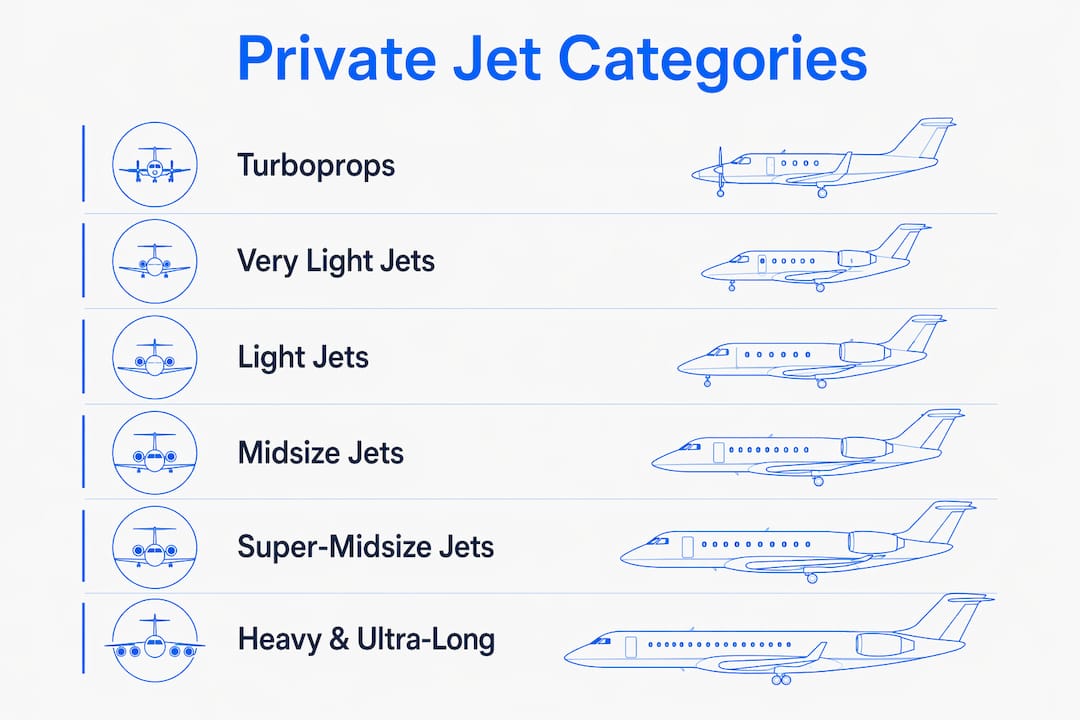
Very light jets sit at the base of the pure jet tier. Above them, light jets handle longer domestic routes. Midsize and super-midsize jets cover coast-to-coast and some transatlantic missions. Heavy and ultra-long-range jets handle intercontinental travel with full cabin amenities. Understanding where each category starts and stops is the foundation for every travel planning or investment decision.

What are the capabilities of very light and light jets?
Very light jets, often called VLJs, carry 2–4 passengers with a range around 1,200 nautical miles and hourly rates of $1,400–$2,000. The Embraer Phenom 100, Citation Mustang, and HondaJet are the most recognized examples. Cabin widths run roughly 4.8–5.1 feet, which means taller passengers will feel the ceiling on longer flights. Baggage space is limited, typically one or two carry-on-sized bags per passenger.
Light jets step up meaningfully. They seat 6–8 passengers, reach ranges of 1,500–2,100 nautical miles, and work well for domestic routes under three hours. Cabins are slightly wider and taller than VLJs, and most light jets include a small enclosed lavatory. Hourly costs climb above VLJ rates but remain well below midsize pricing.
Both categories share one practical limitation: they are not built for standing up or moving around the cabin. Passengers over six feet tall will notice this on flights longer than 90 minutes.
- VLJ best uses: Regional hops of 500–1,000 nm, groups of 2–4, minimal baggage
- Light jet best uses: Domestic routes up to 2,100 nm, groups of 5–7, moderate baggage
- Shared limitation: No stand-up cabin, limited galley, restricted cargo volume
- Cost advantage: Lowest hourly rates in the jet tier, strong availability on empty leg flights
Pro Tip: Choose a VLJ or light jet only when your entire group fits with luggage and the trip is under two hours. A cramped three-hour flight in a VLJ costs less per hour but more in discomfort.
What makes midsize and super-midsize jets different?
Midsize jets are the first category with a true stand-up cabin. Cabin heights run 5.7–5.9 feet, widths 5.7–6.0 feet, and hourly rates land at $3,000–$4,000. The Citation XLS, Hawker 800XP, and Learjet 60 are the standard references. Range extends to 2,000–2,800 nautical miles, which covers most coast-to-coast US routes without a fuel stop. Groups of 6–9 passengers fit comfortably, and enclosed lavatories are standard.
Super-midsize jets push the envelope further. They seat 8–10 passengers, reach 3,000–3,600 nautical miles, and offer wider cabins with more headroom than standard midsize models. Speed is also higher, which matters on longer routes where an extra 50 knots saves meaningful time. Hourly rates rise accordingly, typically landing above midsize pricing but below heavy jet costs.
- Midsize strengths: Stand-up cabin, coast-to-coast range, enclosed lavatory, strong value per seat
- Super-midsize strengths: Wider cabin, higher cruise speed, transatlantic-adjacent range
- Midsize limitations: Cabin width can feel tight for groups over 7 on long flights
- Super-midsize limitations: Higher hourly cost makes short trips economically inefficient
Pro Tip: If your group is 6–8 people flying coast-to-coast, a midsize jet almost always delivers the best balance of comfort and cost. Upgrade to super-midsize only when range or cabin width is genuinely needed.
The midsize category is where private jet travel frequency starts to make strong economic sense for business travelers. The per-seat cost becomes competitive with first-class commercial fares once you factor in time savings and airport flexibility.
What do heavy and ultra-long-range jets offer?
Heavy jets are built for international routes. Cabin lengths run 40–45 feet, passenger capacity reaches 10–16, and hourly rates fall between $5,500–$8,000. The Gulfstream G550 and Challenger 604 are the benchmark aircraft in this tier. Range exceeds 3,400 nautical miles, which covers transatlantic crossings with 12 passengers. Multi-zone cabin configurations allow separate sleeping, dining, and working areas on long flights.
Ultra-long-range jets extend that capability to 6,500–7,500 nautical miles nonstop. They carry 12–18 passengers and represent the top of the civilian jet market. Cabin amenities in this tier include full beds, showers on some models, dedicated crew rest areas, and advanced entertainment systems. These aircraft are designed to replace commercial first class entirely for intercontinental travel.
| Category | Passengers | Range (nm) | Hourly Rate |
|---|---|---|---|
| Heavy jet | 10–16 | 3,400+ | $5,500–$8,000 |
| Ultra-long-range | 12–18 | 6,500–7,500 | $8,000+ |
One trade-off is often overlooked: heavy jets burn significantly more fuel per hour than midsize aircraft. Using a heavy jet for a 90-minute domestic flight wastes operating budget and rarely improves the passenger experience over a super-midsize. These aircraft earn their cost on routes over 3,000 nautical miles where their range and cabin volume are genuinely necessary.
How do you choose the right private jet category?
The right jet category depends on four factors: passenger count, trip distance, baggage volume, and budget. Passenger count filters the field fastest. Groups above 5 typically require midsize or larger. Groups of 9 or more almost always need a super-midsize or heavy jet. Trying to fit 8 passengers into a light jet creates a miserable experience and may not be operationally feasible.
Trip distance is the second filter. A 1,000-nm domestic route does not require a heavy jet. A 4,500-nm transatlantic route cannot be served by a midsize. Matching range to mission eliminates most of the wrong options quickly.
- Count your passengers and add one for realistic comfort, not just maximum capacity
- Measure your route in nautical miles and add 10% for weather and routing variations
- Estimate your baggage in cubic feet, not just bag count, since golf clubs and ski equipment change the math
- Set a hard budget per flight, not per hour, to account for fuel surcharges and repositioning fees
- Default to the smallest category that meets all four criteria to control cost and maximize availability
A common mistake is selecting a jet based on passenger count while ignoring runway and airport compatibility. Heavy jets require longer runways and are restricted from many regional airports. Choosing the right category on paper but flying into the wrong airport adds ground transportation time that erases the speed advantage of private aviation entirely.
Pro Tip: Total trip costs often exceed advertised hourly rates. Fuel surcharges, minimum flight hour requirements, and repositioning fees can effectively double the cost of a short trip. Always request an all-in quote before committing to a category or program.
Key Takeaways
Choosing the right private jet category requires matching passenger count, trip distance, baggage volume, and budget to the smallest aircraft that meets all four criteria.
| Point | Details |
|---|---|
| Six categories exist | Turboprops through ultra-long-range jets differ in range, cabin size, and cost. |
| VLJs and light jets suit short trips | Best for 2–8 passengers on routes under 2,100 nm with minimal baggage. |
| Midsize jets offer the best value | Stand-up cabins and coast-to-coast range at $3,000–$4,000 per hour. |
| Heavy jets belong on long routes | Use them for 3,400+ nm international flights, not short domestic hops. |
| Default to the smallest fit | The smallest category meeting all mission needs controls cost and availability. |
Why category knowledge changes how you buy, not just how you fly
Most travelers I speak with approach private aviation backward. They start with a jet they have seen in a photo or heard mentioned at a dinner, then try to justify the cost. The aircraft becomes the goal rather than the tool. That approach consistently leads to overspending on prestige and underspending on the things that actually matter, like range accuracy, baggage capacity, and airport access.
The more useful frame is mission-first selection. When you know your route, your group size, and your real budget per trip, the right category becomes obvious. The emotional pull of a heavy jet fades quickly when you realize a midsize covers 90% of your actual flights at roughly half the hourly cost.
The same logic applies to types of private aviation access. Fractional ownership suits travelers flying 75–100 hours annually with consistent mission profiles. Travelers flying fewer than 25–30 hours annually often find on-demand charter or membership programs more efficient than structured ownership due to lower upfront costs and greater flexibility. Jet cards require deposits of $50,000–$150,000, while fractional shares start at $200,000–$500,000 plus ongoing fees. Neither makes sense if your actual flying pattern does not justify the capital commitment.
The best private jet membership structure depends heavily on travel geography and usage frequency. Jet cards favor frequent US domestic travel. No-repositioning models favor international routes. Understanding jet categories first gives you the vocabulary to evaluate those structures honestly, rather than accepting whatever a sales program presents as the default.
— Nick
How Bluebirdjets membership fits across jet categories
Bluebirdjets offers a membership that gives you unlimited access to empty leg flights across the platform, covering multiple aircraft categories from light jets to heavy jets.

Empty legs are repositioning flights that would otherwise fly without passengers. They represent the most cost-efficient way to access private aviation across every category, from light jets on domestic routes to heavy jets on longer segments. Bluebirdjets members get access to the full inventory without paying charter rates. The Bluebirdjets membership is built for travelers who want category flexibility without the capital commitment of fractional ownership or jet cards. You can browse available flights directly on the Bluebirdjets flights platform and book the category that fits your next trip.
FAQ
What are the six private jet categories?
The six categories are turboprops, very light jets, light jets, midsize jets, super-midsize jets, and heavy or ultra-long-range jets. Each is classified by range, cabin size, and passenger capacity.
How much does a private jet membership cost?
Jet card deposits run $50,000–$150,000, fractional ownership shares start at $200,000–$500,000, and subscription-based memberships begin near $2,995 annually. Hourly rates range from $2,500 to $12,000 depending on jet category.
What is the best private jet category for coast-to-coast flights?
Midsize jets are the standard choice for coast-to-coast US routes, offering stand-up cabins, 2,000–2,800 nm range, and hourly rates of $3,000–$4,000 for groups of 6–9 passengers.
Is private jet membership better than ownership?
Membership or jet card programs suit travelers flying under 75 hours annually, while fractional ownership makes sense at 75–100 hours with consistent mission profiles. Full ownership requires even higher utilization to justify the capital and operating costs.
What is an empty leg flight?
An empty leg is a repositioning flight where the aircraft travels without paying passengers. These flights are available at significantly reduced rates and cover every jet category, making them the most cost-efficient entry point into private aviation.