How Private Aviation Platforms Work: A Practical Guide

How Private Aviation Platforms Work: A Practical Guide
Private aviation platforms connect travelers to vetted aircraft and operators, automate quotes and availability, and handle contracts and trip logistics so you can book private travel online. Here is the short version of how they function:
- Search and availability: You enter route, dates, and passenger count; the platform queries operator schedules or its own fleet.
- Pricing and quoting: Quotes are generated manually by a broker or automatically by a pricing algorithm, then returned with line-item detail.
- Vetting: Platforms screen operators against safety audits, FAA credentials, and insurance requirements before listing them.
- Contracting: A charter agreement naming the operator, aircraft, schedule, and cancellation terms is issued before payment.
- Trip operations: The platform or operator manages FBO coordination, permits, catering, and day-of logistics.
The single most useful frame for deciding which type of platform to use: buy the mission, not the jet. Match the access model to how often and how predictably you fly, and the rest follows naturally.
Table of Contents
- How do private aviation platforms actually work?
- What are the main access models in private aviation?
- What does the private jet booking process look like?
- Where do platforms source aircraft, and who actually flies you?
- What drives the cost of a private flight?
- How do empty legs and seat-share flights work?
- What safety credentials should you verify before booking?
- Which access model is right for your travel pattern?
- Should you buy a membership or book on demand?
- Key Takeaways
- Why mission-fit matters more than platform features
- Bluebirdjets membership: access to empty-leg inventory
- Useful sources
How do private aviation platforms actually work?
Private aviation platforms sit between travelers and the operators who hold the legal authority to fly them. Understanding the private aviation services market starts with recognizing three distinct layers: operators, brokers, and marketplaces.

Operators hold FAA Part 135 certificates and run the actual flights. They own or manage aircraft, employ crews, maintain airworthiness, and carry the legal and operational responsibility for every departure. A broker owns nothing but shops your trip across many operators, using market knowledge and relationships to find the right aircraft at the right price. A marketplace or app aggregates supply from multiple operators, often enabling instant booking for straightforward trips.
Each layer changes what you get. Going direct to an operator is efficient when their aircraft happens to be based near you and available on your dates. A broker’s advantage is the whole-of-market view: for any given trip, the best-value aircraft might belong to any of dozens of operators, and you have no way of knowing which without someone who tracks them all. Marketplaces trade some of that human judgment for speed, surfacing bookable prices in seconds rather than hours.
The platform model that makes sense for you depends almost entirely on how you fly. Occasional travelers benefit most from on-demand access with no commitment. Frequent flyers who want guaranteed availability and predictable pricing tend to gravitate toward jet cards, memberships, or fractional programs. The sections below break down each model in detail.
What are the main access models in private aviation?
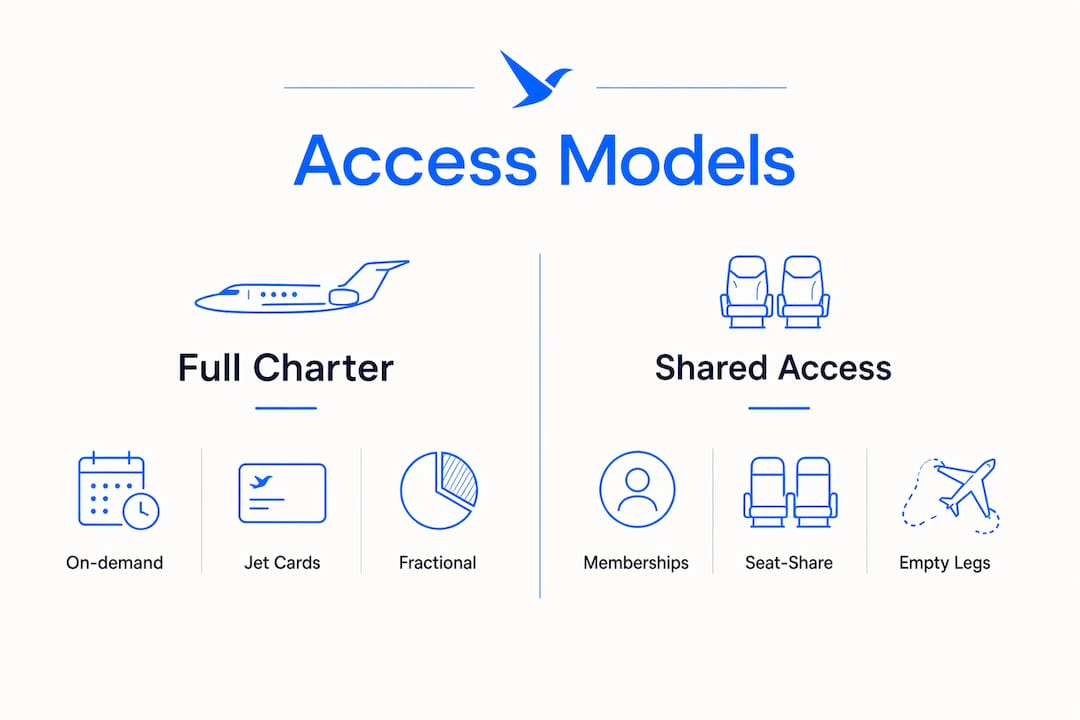
Private aviation is not one product. It is six or seven distinct commercial arrangements, each with different economics, flexibility, and commitment levels. Knowing the difference before you start comparing quotes saves real money.

On-demand charter is the simplest entry point. You pay for one trip at a time, with no upfront commitment. The platform or broker sources an aircraft from a Part 135 operator, you sign a charter agreement, pay in advance, and fly. It suits travelers who fly fewer than 25 hours a year or whose routes and dates vary too much to predict.
Broker and marketplace models are distribution channels rather than access products. A broker handles the sourcing and negotiation on your behalf, which is valuable for complex itineraries or unusual routes. Brokers provide whole-of-market search with human negotiation, while marketplaces offer faster, self-serve instant booking for straightforward trips. The tradeoff is speed versus coverage.
Jet cards are prepaid hour blocks, typically sold in 25-hour increments, at a fixed hourly rate for a specific aircraft category. They lock in pricing and guarantee availability within a defined notice window, usually 24–72 hours. The commitment is financial rather than contractual, and unused hours often carry expiration dates.
Memberships and subscriptions vary widely. Some programs charge a monthly or annual fee for access to a fleet or network, with flights priced separately. Others, like Bluebirdjets, sell membership as the gateway to a specific inventory type, such as empty-leg flights, at a flat access fee rather than per-trip pricing.
Fractional ownership means buying a share of a specific aircraft, typically expressed as a fraction of annual flight hours (one-sixteenth of a share equals roughly 50 hours per year). Programs like NetJets pioneered this model. You get guaranteed availability, a consistent aircraft type, and crew continuity, but the capital commitment is substantial and management fees add up.
Seat-share and per-seat models let you buy individual seats on a private aircraft alongside other passengers, reducing cost significantly. Wheels Up and XO have both experimented with semi-private scheduled routes. The tradeoff is that your schedule aligns with the aircraft’s, not the other way around.
Empty legs are repositioning flights that operators must fly anyway to return aircraft to base or position them for the next booking. Platforms list these at steep discounts because the operator is already committed to the flight. The catch is fixed routing, fixed timing, and real cancellation risk if the originating trip changes.
| Access model | Best for | Pricing model | Commitment level | Typical lead time | Included services |
|---|---|---|---|---|---|
| On-demand charter | Occasional flyers, variable routes | Per-trip hourly rate | None | 24–48 hrs domestic | Trip support, catering optional |
| Broker/marketplace | First-timers, complex itineraries | Per-trip (markup or fee) | None | 4–48 hrs | Sourcing, negotiation, trip docs |
| Jet card | 25 hrs/year, predictable routes | Prepaid hourly block | Financial (prepaid) | 24–72 hrs guaranteed | Fixed rate, guaranteed availability |
| Membership/subscription | Regular flyers, empty-leg access | Monthly or annual fee | Ongoing subscription | Varies by inventory | Platform access, trip support |
| Fractional ownership | 50+ hrs/year, consistent aircraft | Share purchase + management fee | Long-term capital | 4 hrs guaranteed | Dedicated crew, guaranteed lift |
| Seat-share / semi-private | Budget-conscious, flexible schedule | Per-seat | None | Hours to days | Shared cabin, fixed schedule |
| Empty leg | Flexible travelers, cost-focused | Discounted per-trip | None | Hours to days | Flight only, fixed route |
What does the private jet booking process look like?
The private jet booking process has five distinct stages, and knowing where decisions happen prevents surprises.
-
Define the mission. Start with route, dates, passenger count, and any special requirements: pets, oversized luggage, a passenger with mobility needs, an early departure. The more specific you are here, the faster and more accurate the quote. This is also where the aircraft category gets determined. Distance and passenger count together narrow the field to very light, light, midsize, super-midsize, or large-cabin jets.
-
Request a quote. Submit your details through a platform form, broker contact, or marketplace search. A broker will survey the market and return two to four options at different price points, typically within a few hours. Automated marketplaces can return instant bookable prices by querying operator scheduling systems directly. A complete quote should disclose the operator name, aircraft type (or tail number), a full pricing breakdown covering hourly rate, fuel, fees, and taxes, plus cancellation terms.
-
Hold the aircraft. Most platforms and brokers offer a free, non-binding option hold, typically for 24–48 hours, while you finalize approvals. The operator will not sell the aircraft out from under you during that window. This mechanism is standard practice in the industry and costs nothing to use.
-
Sign the charter agreement and pay. Once you commit, you receive a charter agreement naming the operator, aircraft, schedule, and what is included. Read the cancellation terms carefully: standard structures typically step from a partial penalty for cancellations more than a week out to most or all of the fee within 24 hours. Payment is almost always a bank transfer in full before departure. Cards are sometimes accepted with a surcharge. If anyone asks you to pay a private individual’s account rather than a company account, that is the single biggest red flag in this industry.
-
Receive the trip sheet and fly. One to two days before departure, you get a trip sheet with the FBO address (often not the main terminal), crew names, tail number, and timings. Catering gets finalized, and passport details go in for customs on international trips. On the day, arrive 15–20 minutes before departure at the private terminal and hand over your bags.
Pro Tip: Always ask for the option hold before committing. It is free, standard practice, and gives you 24–48 hours to get sign-off from a travel partner, employer, or group without losing the aircraft or the price.
For domestic trips, 24–48 hours is comfortable lead time, and same-day booking is achievable when supply exists and you are flexible on aircraft type. International itineraries typically need 48–72 hours minimum for overflight permits and customs submissions. Peak-season travel around major events, ski weekends, or summer resort destinations can require weeks of advance planning regardless of the model you use.
Where do platforms source aircraft, and who actually flies you?
The supply side of private aviation is more layered than most travelers realize, and understanding it clarifies who is responsible for what.
- Fleet-controlled platforms own or directly manage the aircraft they sell. The platform is the operator, which means tighter quality control and a single point of accountability. NetJets operates this way for its fractional fleet.
- Marketplace aggregators connect to multiple independent Part 135 operators through scheduling integrations or manual availability checks. XO, for example, uses algorithmic pricing and schedule integrations to move many trips from manual quotes to instant bookable prices.
- Broker-mediated sourcing relies on human relationships and market knowledge rather than technology integrations. A broker contacts operators directly, negotiates pricing, and presents options to the client. This approach handles complex or unusual itineraries better than automated systems.
- Local charter operators sell directly to clients without a broker or marketplace layer. They are efficient for repeat customers whose routes align with the operator’s base, but offer no market-wide price comparison.
The legal operator on every U.S. private charter flight must hold an FAA Part 135 operating certificate. That certificate is the regulatory foundation: it authorizes the operator to conduct commercial air transportation, sets crew training and rest requirements, and establishes maintenance standards. The platform or broker arranging the trip is not the legal operator unless they hold their own Part 135 certificate. This distinction matters for liability and insurance: the Part 135 operator carries the operational responsibility and the required insurance coverage.
After booking, operational handoffs follow a clear pattern. The operator manages crew scheduling, aircraft maintenance, and flight planning. The platform or broker handles client communication, trip documentation, and often catering coordination. FBO coordination, slot requests, and overflight permits are managed by the operator’s dispatch team, sometimes with broker support for international routing.
Advanced platforms integrate directly with operator scheduling systems, which means the availability and pricing you see reflects real-time data rather than a manual check. Not every platform labeled as using automation provides the same depth of integration, so it is worth asking how availability is verified before you book.
What drives the cost of a private flight?
Private jet pricing has more moving parts than a commercial ticket, and a quote that omits line items is not a low price. It is an incomplete one.
The core components of any charter quote:
- Aircraft hourly rate: The base cost of the aircraft and crew for time in the air. Light jets commonly start around $2,500–$4,000 per flight hour; heavy jets range considerably higher depending on aircraft type and market conditions.
- Fuel surcharges: Often billed separately from the base rate and subject to market fluctuation.
- Landing and handling fees: Charged by the destination and departure airports and FBOs. These vary significantly by airport.
- Repositioning legs: If the aircraft is not based at your departure airport, the operator charges for the ferry flight to reach you. This can add a meaningful amount to short-haul trips.
- Crew overnight costs: On trips requiring an overnight stay, hotel and per diem for the crew are typically passed through.
- Taxes and regulatory fees: Federal excise tax applies to domestic U.S. charter flights. Segment fees and international departure taxes add to international itineraries.
- Catering and ancillaries: Usually optional and priced separately unless the platform includes them in a flat rate.
Pricing models differ across platform types. Brokers typically earn a margin on the operator’s wholesale rate, which may or may not be disclosed. Marketplaces often use dynamic algorithmic pricing that adjusts with supply and demand. Jet card programs lock in a fixed hourly rate for a specific aircraft category, eliminating fuel and fee variability. Membership programs may bundle platform access with discounted or fixed-rate flight pricing.
| Quote line item | What it covers | Watch for |
|---|---|---|
| Base hourly rate | Aircraft + crew for flight time | Confirm whether rate is all-in or base-only |
| Fuel surcharge | Fuel cost above base rate | Ask if it is fixed or market-indexed |
| Landing / handling fees | Airport and FBO ground charges | Varies per stop |
| Repositioning leg | Ferry flight to your departure point | Often omitted from headline quotes |
| Crew overnight | Hotel and per diem if crew stays overnight | Applies on multi-day trips |
| Federal excise tax | U.S. domestic charter tax | Mandatory; confirm it is included |
| Catering | Onboard food and beverage | Usually optional; confirm what is included |
A quote missing repositioning costs or taxes is not competitive. It is incomplete. Always ask for a fully loaded price before comparing options.
How do empty legs and seat-share flights work?
Empty-leg flights are one of the most misunderstood products in private aviation, and also one of the most interesting for cost-conscious travelers.
When an operator positions an aircraft to pick up a charter client, or returns it to base after a one-way trip, that repositioning flight has to happen regardless. Rather than fly empty, operators list these legs at discounted prices. The discount can be steep because any revenue is better than none on a flight the operator is already committed to.
The constraints are real, though. The route is fixed. The timing is fixed. And if the originating charter trip cancels or changes, the empty leg disappears with it. That cancellation risk is the central tradeoff: you get a significant price reduction in exchange for schedule uncertainty.
Per-seat or semi-private models work differently. Platforms like Wheels Up and XO have offered scheduled semi-private routes where individual seats are sold on a shared aircraft. You get a private aircraft experience at a fraction of the full-charter cost, but your schedule aligns with the aircraft’s fixed routing rather than your own preferences.
Pros and cons of empty legs vs. full charter:
- Empty leg pros: Steep discounts on repositioning flights; access to aircraft categories you might not charter outright.
- Empty leg cons: Fixed route and timing; cancellation risk if the originating trip changes; limited refund options if the leg is pulled.
- Seat-share pros: Lower per-person cost than full charter; private aircraft environment.
- Seat-share cons: Schedule is set by the operator; limited route availability; less flexibility than a full charter.
| Feature | Empty leg | Seat-share / semi-private | Full charter |
|---|---|---|---|
| Cost vs. full charter | Significant discount | Moderate discount | Full price |
| Route flexibility | None (fixed) | None (fixed schedule) | Full flexibility |
| Cancellation risk | High (depends on originating trip) | Low to moderate | Low |
| Lead time | Hours to days | Days to weeks | 24 hrs+ domestic |
| Best for | Flexible travelers, aligned routes | Budget-conscious, fixed routes | Full control, custom itinerary |
Membership programs that provide ongoing access to empty-leg inventory change the math for regular travelers. Instead of monitoring listings reactively, members get first access to available legs as they are posted, which increases the practical value of the discount.
What safety credentials should you verify before booking?
Safety in private aviation is not self-reported. It is audited, certified, and documented, and you have every right to ask for proof before you pay.
Regulatory baseline:
- FAA Part 135 certificate: Any U.S. commercial charter operator must hold this. It is the legal authorization to conduct for-hire air transportation and sets minimum standards for crew training, aircraft maintenance, and operational procedures. Ask for the operator’s certificate number and verify it through the FAA’s registry if you want to confirm it independently.
- Insurance: Commercial charter operators carry liability insurance. Ask for the coverage limits in writing. Minimum industry standards exist, but limits vary; higher-value programs typically carry more coverage.
Third-party safety audits:
- ARG/US (Aviation Research Group/US): Rates operators on a Platinum, Gold, or Silver scale based on safety records, crew qualifications, and operational procedures. Platinum is the highest rating and requires the most rigorous documentation.
- Wyvern: Issues PASS (Wingman) ratings based on operator and pilot safety records, aircraft maintenance history, and operational standards. Many corporate travel programs require Wyvern certification as a minimum.
- IS-BAO (International Standard for Business Aircraft Operations): A process-based safety management standard developed by the International Business Aviation Council. Operators register and are audited against a defined safety management system framework.
Operational indicators to confirm in writing:
- Named operator on the charter contract (not just a platform or broker name)
- Specific tail number or aircraft type confirmed before departure
- Pilot minimum hours and type ratings for the aircraft category
- Maintenance records availability and last inspection date
- Clear cancellation and aircraft substitution policy
What to ask before you sign:
- What is the operator’s ARG/US or Wyvern rating?
- Who is the named operator on the contract?
- What are the cancellation terms and refund mechanics?
- What happens if the aircraft goes unserviceable before departure?
- What insurance coverage does the operator carry?
Reputable platforms vet operators before listing them and can provide audit documentation on request. If a platform cannot tell you the operator’s safety rating or declines to name the operator before you sign, that is a meaningful signal about how the platform manages its supply chain.
Which access model is right for your travel pattern?
The right private aviation model is a function of how often you fly, how predictable your routes are, and how much capital you want to commit. Matching access to actual travel volume limits risk and avoids paying for capacity you will never use.
Traveler profiles and model fit:
- Occasional flyer (fewer than 25 hours/year): On-demand charter or marketplace booking. No commitment, full flexibility, pay per trip. A broker adds value for complex or international itineraries.
- Seasonal user (25–50 hours/year, predictable peaks): A jet card makes sense here. Fixed hourly rates and guaranteed availability within a notice window eliminate the pricing uncertainty of on-demand booking during peak periods.
- Frequent business flyer (50–150 hours/year): Fractional ownership or a high-tier membership program. The capital commitment is justified by the consistency of access, crew familiarity, and guaranteed lift.
- Group or event planner: Full charter on-demand, often through a broker for complex multi-leg itineraries. Seat-share or empty legs can work for single-destination events where timing aligns.
Decision criteria checklist:
- How many hours per year do you realistically fly private?
- Are your routes and dates predictable, or do they vary significantly?
- Do you need guaranteed availability within a short notice window?
- How much capital are you willing to commit upfront?
- Do you need detailed trip reporting or administrative documentation?
- Is schedule flexibility more important than cost savings?
| Traveler profile | Recommended model | Rationale |
|---|---|---|
| Fewer than 25 hrs/year, variable routes | On-demand charter or marketplace | No commitment; full flexibility; pay per trip |
| 25–50 hrs/year, predictable peaks | Jet card | Fixed rate; guaranteed availability; no long-term capital lock |
| 50–150 hrs/year, consistent routes | Fractional or high-tier membership | Guaranteed lift; crew continuity; justifies capital commitment |
| Flexible, cost-focused, aligned routes | Empty-leg membership | Access to discounted inventory; no per-trip commitment |
| Group or event travel | Full charter via broker | Handles complexity; whole-of-market sourcing |
For private aviation booking best practices that apply across all models, the consistent advice is to confirm operator identity, get all fees in writing, and book with enough lead time to have aircraft options rather than one take-it-or-leave-it quote.
Should you buy a membership or book on demand?
The clearest framework for this decision comes from Brown Advisory’s analysis of private aviation access: match the model to the mission, not to an aspiration about how often you might fly. Overcommitting capital to a fractional share or jet card program for travel volume that never materializes is a common and expensive mistake.
For a traveler flying 15–20 hours a year on variable routes, on-demand charter is almost always the right answer. The per-hour cost is higher than a jet card, but the total annual spend is lower because there is no prepaid block sitting unused.
The calculus shifts when empty-leg access enters the picture. Empty-leg inventory is priced well below full-charter rates because the operator is already committed to the flight. A membership program that provides ongoing, prioritized access to that inventory changes the effective cost per flight hour for a traveler whose schedule has any flexibility. The membership fee is a fixed cost; the per-flight savings on empty legs can offset it quickly for someone flying even a handful of times a year on routes that align with available inventory.
Here is a simple scenario: a traveler flying four to six times a year on domestic routes, with two to three days of schedule flexibility on each trip, could access empty-leg flights at a fraction of on-demand charter rates through a membership program. The membership fee is predictable and fixed. The flights are discounted. The tradeoff is that not every trip will align with available inventory, so on-demand charter remains the backup for time-sensitive travel.
Pro Tip: Before committing to any prepaid program, map your last 12 months of travel. If fewer than half your trips had fixed, non-negotiable dates, empty-leg access through a membership is worth evaluating seriously.
Key Takeaways
Private aviation platforms work by connecting travelers to vetted Part 135 operators, automating or brokering quotes, and managing contracts and trip logistics so you can book private flights online without owning or leasing an aircraft.
| Point | Details |
|---|---|
| Match model to mission | Choose on-demand, jet card, fractional, or membership based on annual flight hours and schedule flexibility. |
| Verify the operator | The named Part 135 operator on the contract is the legally responsible party; confirm their FAA certificate and safety audit rating. |
| Get all fees in writing | A complete quote includes hourly rate, fuel, landing fees, repositioning legs, crew overnights, and taxes. |
| Lead times vary | Domestic trips are bookable in 24–48 hours; international itineraries typically need 48–72 hours minimum for permits. |
| Bluebirdjets membership | Provides unlimited access to empty-leg inventory, suited to flexible travelers who want discounted private flights without per-trip commitment. |
Why mission-fit matters more than platform features
Most articles about private aviation spend their energy comparing platform interfaces and membership perks. The more useful question is whether the access model matches how you actually travel, not how you imagine you might travel.
The private aviation industry has a long history of selling aspiration. Fractional programs market the consistency of a dedicated aircraft. Jet cards sell the comfort of a locked-in rate. Memberships sell the feeling of belonging to something. None of that is inherently wrong, but it can lead travelers to commit capital to a model that does not fit their real travel patterns.
What the evidence actually supports is simpler: the travelers who get the most value from private aviation are the ones who chose the access model that matched their flight frequency and schedule flexibility, not the one with the most impressive branding. A flexible traveler flying four times a year on routes with some schedule give gets more practical value from empty-leg access than from a jet card with a 25-hour minimum that expires in 12 months.
Bluebirdjets’s focus on membership access to empty-leg inventory reflects that logic. The model is not for everyone. It suits travelers who have flexibility and want to use it to access private aviation at a lower cost per flight. That is a specific value proposition, and it is worth being honest about who it fits.
Bluebirdjets membership: access to empty-leg inventory
Most private aviation platforms require you to commit capital upfront, whether through a prepaid jet card block, a fractional share, or a per-trip charter fee. Bluebirdjets takes a different approach: a membership that gives you unlimited access to empty-leg flights listed on the platform, with no per-trip commitment beyond the flight itself.
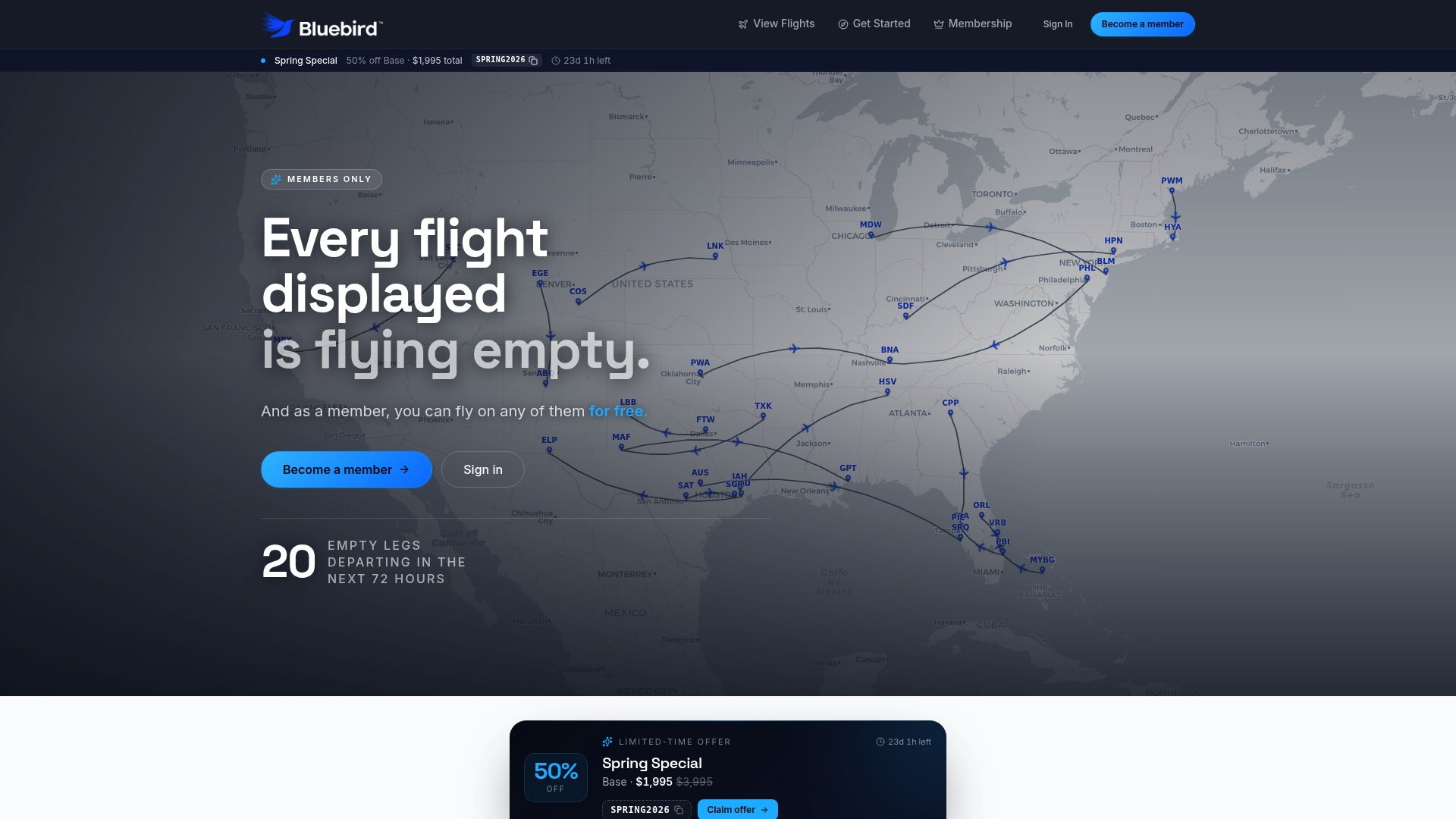
For travelers with schedule flexibility, that structure changes the economics of private aviation. Empty legs are already discounted because operators are repositioning aircraft they have committed to fly. Membership access means you see that inventory as it becomes available, rather than monitoring listings reactively. The membership fee is fixed and predictable; the savings on individual flights can be significant for anyone flying multiple times a year on domestic routes.
If you are evaluating whether private aviation fits your travel pattern, explore Bluebirdjets membership or browse available flights to see current empty-leg listings. This is a commercial offering from Bluebirdjets, disclosed clearly: the platform earns revenue through membership fees and flight bookings.
Useful sources
The following sources informed this article and are worth reading for additional depth:
- How To Book A Private Jet: First-Timer’s Complete Guide — Detailed walkthrough of the booking lifecycle, quote anatomy, and payment norms. Useful for first-time charter travelers.
- Private Jet Charter: Costs, How It Works & When It Makes Sense — Covers market layers, lead time norms, and empty-leg mechanics with practical cost context.
- How Booking a Private Jet Actually Works, Step by Step — Broker vs. operator comparison, the option hold mechanism, and contract and payment norms explained clearly.
- How Vista’s XO Uses AI to Digitize Private Jet Bookings — Industry case study on schedule integrations and algorithmic pricing in marketplace platforms.
- Buy the Mission, Not the Jet: A Strategic Guide to Private Aviation — Brown Advisory’s framework for matching access model to travel volume and risk tolerance. The clearest strategic guide available on this topic.
- Private Aviation Business Models: An In-Depth Look — StratosJets overview of the main commercial structures in private aviation, from charter to fractional ownership.
- NBAA Business Aviation: Just the Facts — National Business Aviation Association industry data and regulatory context for U.S. business aviation.