5–20 Minutes to Wheels Up: Skip the Line on Private Jets in the U.S.

5–20 Minutes to Wheels Up: Skip the Line on Private Jets in the U.S.
Skipping the line on a private jet means avoiding commercial security queues by departing from a private terminal, not skipping security itself. Passengers still get vetted, and international flights still clear customs, but it happens privately at a fixed-base operator (FBO) instead of a public checkpoint. The fastest routes to a seat are empty-leg membership access, instant-charter platforms with live pricing, and paid priority upgrades. If you need to fly today, checking live empty-leg inventory or requesting an instant quote is the first move.
TL;DR:
- Private jet speed relies on arriving at a private FBO, where passengers are vetted in advance, rather than skipping security checks entirely.
- Booking methods like empty-leg memberships and instant platforms help achieve faster departure, but actual readiness depends on aircraft position and crew availability.
- On-site aircraft can often be airborne within 5 to 20 minutes if pre-cleared, but repositioning, crew rules, and customs can extend that to hours or days.
- Hidden costs such as repositioning, handling, and international fees can significantly raise the overall price beyond initial quotes.
- Using membership access and pre-arranged flight plans transforms “skip the line” from a one-time perk into a reliable infrastructure for rapid private travel.
Table of Contents
- What Actually Lets You Skip the Line at the Airport?
- Which Booking Method Gets You Airborne Fastest?
- How Fast Can You Really Get Wheels Up?
- When Does Speed Cost More, and When Does It Save You Money?
- A Rapid-Booking Checklist Before You Call the Operator
- How Bluebird Jets Maps to Skip-the-Line Travel
- What’s the Full Cost of Flying Private, Fees Included?
- How Do Providers Compare on Speed and Reliability?
- What Happens if You Need to Cancel or Change Plans?
- The Gap Between “Skip the Line” Marketing and What Actually Happens
- Ready for Faster Boarding? Here’s How Membership Works
- Sources
- FAQ
What Actually Lets You Skip the Line at the Airport?
The speed comes from where you show up, not from a loophole in federal law. An FBO is a private terminal on airport property, separate from the commercial concourse, where you park, check in, and walk straight to your aircraft. Compare that to a commercial terminal, where you queue for check-in, security, and boarding across three separate lines that can eat 90 minutes even on a good day.
Most private flights never pass through a public TSA checkpoint. Instead, operators vet passengers in advance and file manifests before departure, which is the real mechanism behind “skip the line,” according to Flyius. That is not the same as skipping the legal requirements. The TSA’s Private Charter Standard Security Program (PCSSP) still mandates passenger and baggage screening for larger aircraft, generally those over roughly 100,309 pounds or with 61 or more seats, per the TSA’s own aviation program rules. Fly out of Washington Reagan National, and you may hit checkpoint requirements that smaller jets elsewhere avoid entirely.
International trips add another layer. Customs and immigration are still mandatory. What changes is the setting: officers process you privately at the FBO rather than funneling you through a public customs hall.
Here’s what to actually expect on arrival at an FBO:
- Show a government-issued ID or passport to ground staff, not a TSA officer.
- Your name goes on a manifest submitted before you ever reach the airport.
- Baggage gets loaded directly to the aircraft, no belt, no scanner line.
- A car can often drive you to the aircraft steps.
Pro Tip: Call the FBO the morning of your flight to confirm your exact parking or curbside drop point. Airports with multiple FBOs (Teterboro and Van Nuys are notorious for this) can send you to the wrong ramp if you just plug the airport code into your GPS.
Which Booking Method Gets You Airborne Fastest?
Four booking paths dominate private aviation, and each solves a different urgency problem.
- Empty-leg membership access. Operators reposition aircraft empty between jobs constantly. A membership that unlocks unlimited access to that published inventory turns those repositioning flights into free or steeply discounted last-minute seats, often bookable within hours of departure.
- Instant-charter platforms. These show live pricing and all-in quotes the moment you search a route. Instant pricing does not mean instant departure. Actual fulfillment still depends on aircraft position and crew availability, so treat the quote speed and the wheels-up speed as two different numbers.
- Membership priority and paid upgrades. Some memberships include a priority queue for booking requests, and a few offer a one-off paid upgrade (Bluebirdjets calls this Skip-The-Line, a paid upgrade that jumps you ahead of standard requests during high-demand windows).
- Jet cards. You prepay for a block of flight hours at a locked rate, which removes the pricing negotiation from the booking process entirely. That is valuable for frequent flyers who want to book with a phone call, though it usually costs more per hour than an empty-leg seat.
The right choice depends on whether you’re optimizing for lowest cost, highest reliability, or fastest possible confirmation. Rarely can one option win all three at once.
How Fast Can You Really Get Wheels Up?
The honest answer is “it depends on what’s already sitting on the ramp.” A jet that is fueled, crewed, and parked at your departure airport can have you airborne in 5 to 20 minutes from arrival at the FBO, since there’s no checkpoint queue to absorb, according to Simple Flying’s breakdown of private jet security procedures. Same-day bookings through empty-leg or instant-charter channels are common, though “same-day” can mean two hours from now or eight, depending on aircraft position.
Several factors push that timeline out from minutes to hours, or occasionally days:
- Repositioning. If the nearest available aircraft is two states away, you’re paying for and waiting on that flight leg.
- Crew duty and rest rules. Federal rest requirements can sideline a crew that flew a long day yesterday, even if the aircraft is available.
- Airport curfews. Some fields restrict late-night or early-morning departures and arrivals entirely.
- Customs officer scheduling. International arrivals at smaller airports may need advance notice to get a customs officer on-site.
| Scenario | Typical timeframe |
|---|---|
| Pre-cleared manifest, aircraft on-site | 5 to 20 minutes |
| Same-day empty-leg or instant charter | Within hours |
| Repositioning or crew rest required | Hours to a full day |
| International arrival, small airport | Add time for customs coordination |
Before booking anything short-notice, ask the operator directly about crew availability, the airport of entry for international legs, and whether customs has been scheduled.
When Does Speed Cost More, and When Does It Save You Money?
Pricing in private aviation isn’t one model, it’s four different shapes stacked on top of each other. Empty legs are the cheapest way to fly privately because you’re buying an already-scheduled repositioning flight, not commissioning a new one. On-demand charter gives you an all-inclusive quote for a specific route on your schedule, at a real premium over an empty leg. Membership is a flat recurring fee that buys ongoing access rather than a single flight. Jet cards are prepaid hours at a locked rate, which trades flexibility for price certainty.
None of those headline numbers are the full cost. Watch for these additive charges:
- Repositioning fees when no aircraft is near your departure point.
- Landing and airport handling fees, which vary sharply by airport.
- International segments carry customs and handling fees on top of the flight cost.
- Crew overnight and catering charges on multi-day trips.
- Cancellation penalties, which scale with how close to departure you cancel.
Frequency should drive the decision more than urgency does. Fly privately once or twice a year and an on-demand charter or empty-leg booking beats locking into an annual fee. Fly monthly or more, and a membership’s flat cost usually undercuts what you’d pay booking each trip individually, especially once you count the empty legs you’d otherwise pay full charter price for.
Fractional ownership sits at the far end of that spectrum. Analysis of jet card and fractional program economics shows that under roughly 50 flight hours a year, a prepaid jet card or membership model typically beats a fractional share on cost, since fractional programs carry fixed monthly management fees regardless of how much you fly.
A Rapid-Booking Checklist Before You Call the Operator
Run through these steps in order, and you’ll cut the back-and-forth that eats the time you’re trying to save.
- Have your ID or passport ready and confirm every passenger’s legal name matches their travel document exactly. Manifests get rejected over typos more often than you’d think.
- Confirm the departure FBO by name, not just the airport code. Large airports often host three or four separate FBOs.
- For international trips, confirm CIQ (customs, immigration, quarantine) scheduling at your arrival airport before you finalize the booking.
- Ask for the exact wheels-up ETA, not a vague “within a few hours.”
- Get the all-in cost in writing, including repositioning, landing fees, and any overnight crew charges.
- Ask who files the manifest and handles watchlist vetting, the operator or a third party, and confirm the timeline for that filing.
- Ask about backup aircraft and the cancellation policy before you commit, especially on short-notice bookings.
Pro Tip: Treat vague answers as your biggest red flag. A trustworthy operator can tell you the tail number, the crew’s duty status, and your confirmed arrival window without hesitation. If they can’t confirm the manifest has been filed or dodge questions about total fees, walk away and call someone else.
Watch for opaque pricing that only firms up after you’ve committed, an inability to confirm customs arrangements for international legs, and any operator who can’t answer the manifest question directly.
How Bluebird Jets Maps to Skip-the-Line Travel
Bluebirdjets built its membership around exactly the problem this guide describes: getting you off a waitlist and onto an aircraft with minimal friction. Members get unlimited access to published empty-leg flights on operator-owned Learjet 60 aircraft, live inventory that updates daily, and the ability to bring up to six guests on a single flight. A queue and priority booking system handles requests in order, and members who need to jump that queue on a specific date can use the paid Skip-The-Line upgrade.
That structure exists because the two things that actually create airport speed, private-terminal access and pre-departure vetting, work best when you’re not negotiating them fresh for every trip. A membership turns “skip the line” from a one-off purchase into a standing arrangement.
For the operational details behind these features, Bluebirdjets covers the boarding process itself in a first-timer’s guide to private jet boarding, the TSA program exceptions in a breakdown of when TSA screens private jets, and FBO basics in a traveler’s guide to what FBO means. Author Nick has written extensively on the operational side of private aviation for the Bluebirdjets blog, and the brand’s rating signals and member testimonials are published on its site.
- Unlimited empty-leg access on operator-owned Learjet 60 aircraft
- Live inventory updated daily across available routes
- Queue and priority booking, with a paid Skip-The-Line option for urgent dates
- Bring up to six guests per flight at no added membership cost
What’s the Full Cost of Flying Private, Fees Included?
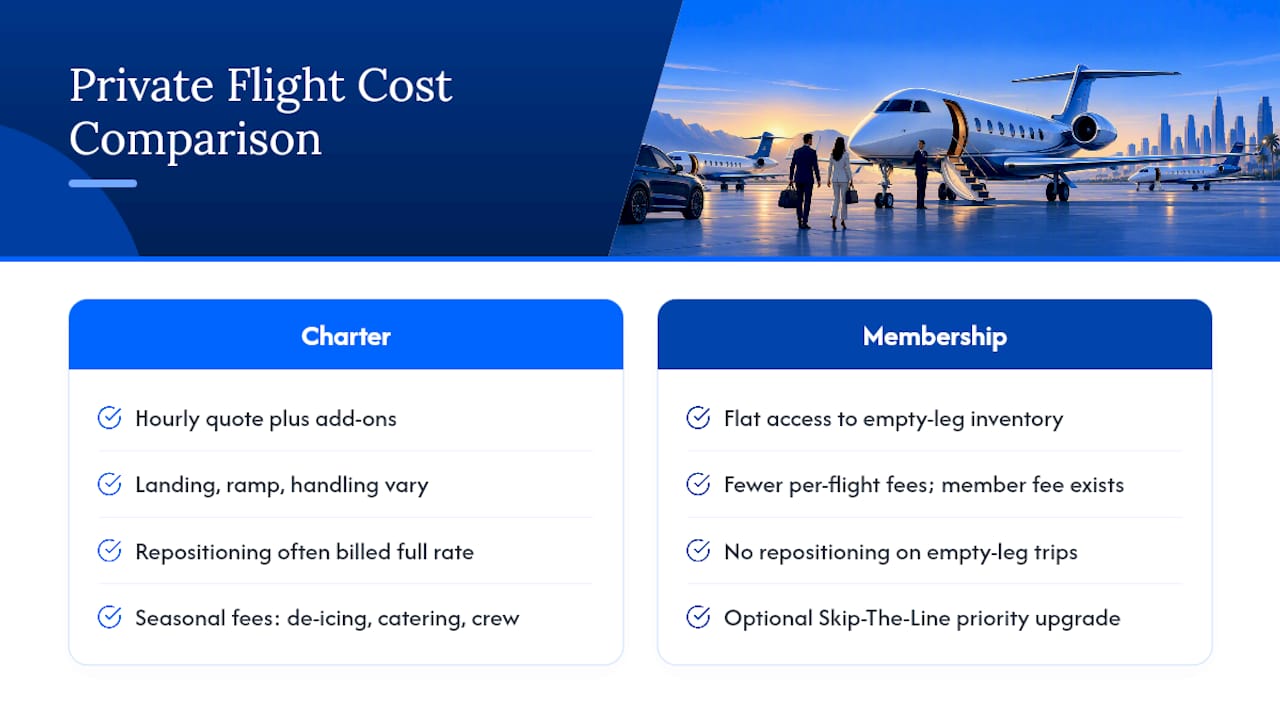
The quoted flight price is rarely the number you actually pay. Landing fees vary by airport and time of day, with busier fields charging significantly more during peak hours. Ramp and handling fees at the FBO cover parking, ground power, and lavatory service, and they differ from one FBO to the next even at the same airport.
International trips add customs and immigration processing fees, plus occasional overflight fees charged by countries you cross without landing. Domestic segregated fees to watch for include de-icing in cold months, catering (which can range from a simple charge for coffee and snacks to a substantial bill for a multi-course meal), and crew overnight costs if your trip requires the crew to stay somewhere other than home base.
Repositioning is the line item that catches first-time charter buyers off guard. If the nearest suitable aircraft is sitting 300 miles from your departure point, you pay for that empty flight to reach you, often at the same hourly rate as your actual trip. This is precisely why empty-leg flights are priced so far below on-demand charter: someone else’s repositioning cost has already been absorbed into the operator’s schedule, and you’re simply filling a seat that was flying anyway.
Membership fees work differently. Bluebirdjets offers memberships covering unlimited access to published empty-leg inventory rather than per-flight fees. The optional Skip-The-Line upgrade is a paid option for members who want priority ahead of standard queue requests. Compare that flat structure against paying full charter rates for even a handful of last-minute trips a year, and the math tends to favor membership for anyone flying privately more than occasionally.
How Do Providers Compare on Speed and Reliability?
Not every private aviation option is built to answer “how fast can I fly” equally well. On-demand charter brokers can source almost any aircraft type for almost any route, but that flexibility means checking availability fresh each time, which adds negotiation time you don’t have when you need to leave today.
Instant-charter platforms solve the pricing-speed problem by showing live quotes immediately, but the quote appearing instantly doesn’t mean the aircraft is instantly available. You’re still at the mercy of positioning and crew scheduling behind that number.
Membership models built around a fixed or owner-operated fleet, which is how Bluebirdjets structures its Learjet 60 access, tend to offer more predictable reliability because the inventory pool is smaller and more visible. You’re choosing from published routes on aircraft the company actually controls, not hoping a broker finds something on short notice. The trade-off is route flexibility: an owned-fleet membership serves the routes those aircraft actually fly, while a broker can theoretically reach anywhere.
Reliability signals worth checking before committing to any provider include how consistently their published response times hold up, whether they publish live inventory you can verify yourself, and how transparent their fee structure is before you book. An operator that hides the total cost until after you’ve committed is a reliability problem wearing a pricing disguise.
What Happens if You Need to Cancel or Change Plans?
Cancellation costs in private aviation scale with how close to departure you cancel, and the penalty structure differs sharply by booking type. On-demand charter contracts typically allow a full or near-full refund if you cancel well in advance, say a week or more, but that refund shrinks fast inside 48 to 72 hours of departure, and same-day cancellations often forfeit the full quoted price since the operator has already committed the aircraft and crew.
Empty-leg bookings tend to carry looser cancellation terms precisely because the flight was happening regardless of whether you filled the seat. That’s part of why empty legs run cheaper: the operator’s downside risk from your cancellation is lower.
Jet card cancellation policies vary by provider but generally deduct a service fee or a portion of prepaid hours for late changes, since the hours were already allocated against your account. Membership cancellation is different again. Because you’re paying for standing access rather than a single flight, canceling a membership doesn’t carry a per-flight penalty, though canceling a booked empty-leg seat close to departure may still forfeit priority queue standing for that request.
Changes, not just outright cancellations, also cost time. Shifting your departure by even a few hours can require re-filing the passenger manifest and reconfirming customs scheduling on international trips, which is why confirming crew and aircraft availability before you lock a time matters more than it seems at first.
The Gap Between “Skip the Line” Marketing and What Actually Happens
Most private aviation marketing sells “skip the line” as if it means slipping past security entirely. It doesn’t, and treating it that way sets buyers up for a bad surprise the first time a customs officer or a PCSSP checkpoint applies to their flight. The real advantage is structural: a private terminal, a pre-filed manifest, and vetting that happens before you ever leave the house.
Where conventional advice falls short is in treating all “fast” booking paths as interchangeable. An instant quote is not an instant departure, and conflating the two is how travelers end up frustrated when a same-day charter takes six hours to materialize because the nearest aircraft was in another state. Anyone serious about short-notice private travel should prioritize confirming aircraft position and crew status over chasing the lowest quoted price, because a cheap flight that can’t actually depart on time solves nothing.
The travelers who get this right treat membership and empty-leg access as infrastructure they maintain year-round, not a service they shop for in a panic the morning of a trip. That shift in mindset, from reactive charter shopping to standing access, is the actual unlock behind faster boarding.
— Nick
Ready for Faster Boarding? Here’s How Membership Works
Bluebirdjets solves the exact problem this guide walks through: getting from “I need to fly” to wheels up without shopping brokers or waiting on a callback. Base membership opens unlimited access to published empty-leg flights for $3,995 a year, while Plus membership at $9,995 a year adds higher queue priority for members who fly more often and can’t afford to wait behind standard requests.
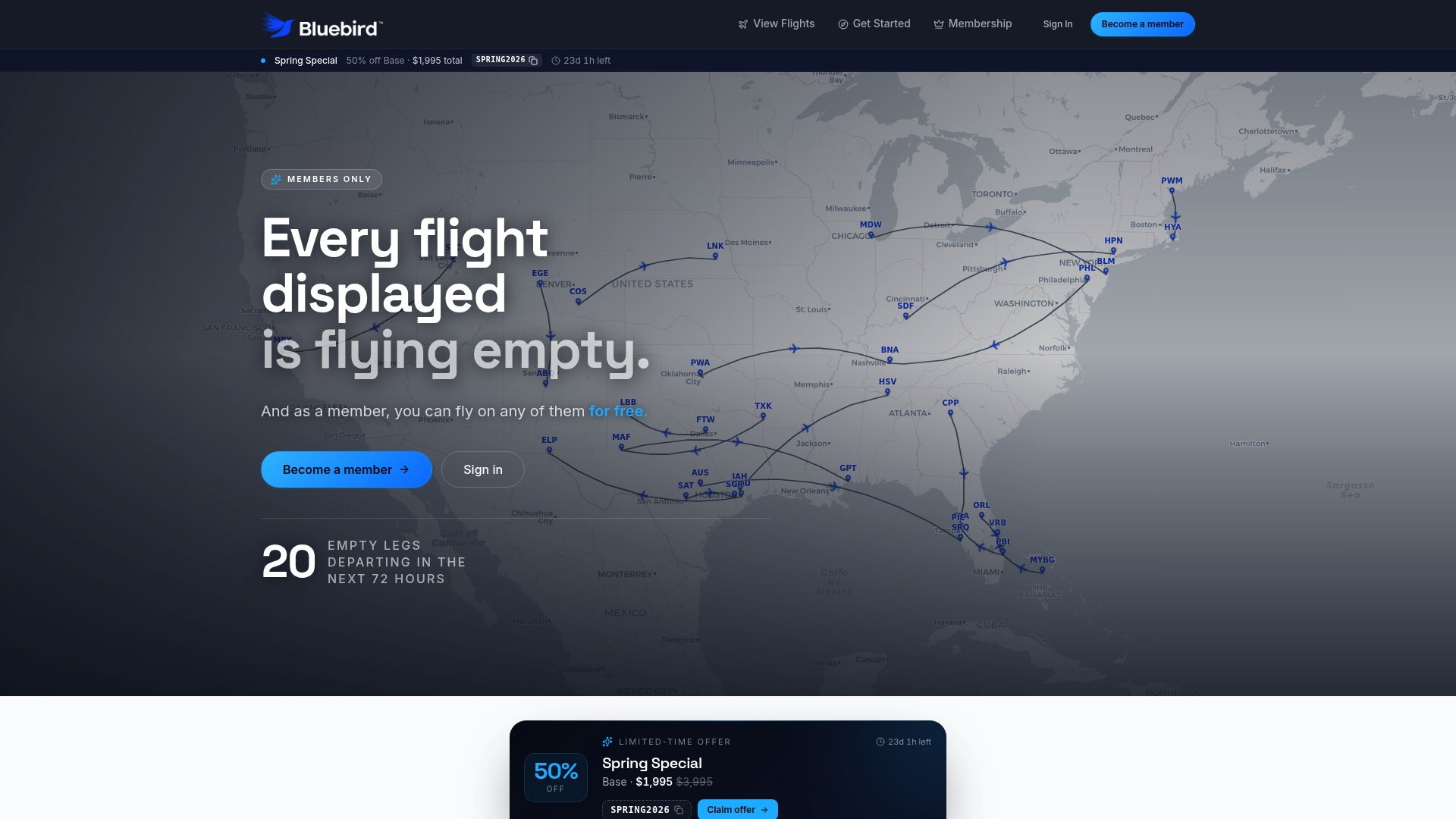
Once you join, you get immediate access to live inventory that updates daily, the queue and priority booking system covered earlier in this guide, and the option to bring up to six guests on any flight you book. If a specific date matters more than the flat membership priority covers, the paid Skip-The-Line upgrade jumps your request ahead of the standard queue.
Check current empty-leg availability and get started with membership today to see what routes are flying this week.
Sources
- Aviation Programs | Transportation Security Administration
- What Do Security Procedures Entail For Private Jet Passengers? | Simple Flying
- NetJets share versus jet card — economics in 2026 — Luxury Travel Standard
FAQ
How Much Does a 2-Hour Private Jet Flight Cost?
Pricing depends heavily on aircraft type and route, but a 2-hour on-demand charter on a light jet often runs several thousand dollars once fuel, crew, and handling fees are included. An empty-leg seat covering the same route can cost far less since you’re filling an already-scheduled flight rather than commissioning a new one.
Does Travis Kelce Have a Private Jet?
Public reporting on individual athletes’ private aircraft ownership varies and isn’t something this guide can verify. What’s well documented is that most high-net-worth frequent flyers lean toward membership, jet card, or charter access rather than outright ownership, since ownership carries fixed costs regardless of usage.
What’s the Cheapest Way to Fly Privately?
Empty-leg flights are consistently the lowest-cost way to fly privately because they fill an aircraft’s already-scheduled repositioning route rather than requiring a dedicated charter. A membership that grants unlimited access to published empty-leg inventory, like Bluebirdjets’s Base plan at $3,995 a year, extends that savings across every trip you take rather than one-off bookings.
How Much Does a 25-Hour NetJets Lease Cost?
Fractional and jet card programs price their hour blocks differently by aircraft category and provider, and current NetJets rates aren’t something this article tracks directly. What the 2026 economics analysis does show is that flyers under roughly 50 hours a year typically come out ahead with a jet card or membership model instead of a fractional share, given the fixed monthly fees fractional programs carry.
Do Private Jets Skip TSA Security Entirely?
No. Most private flights avoid the public TSA checkpoint because operators vet passengers and file manifests privately, but the TSA’s PCSSP rules still require checkpoint-style screening for larger aircraft, generally those over about 100,309 pounds or with 61-plus seats. Smaller jets and most charter flights fall outside that threshold, which is the real source of the time savings.