When TSA Screens Private Jets in the U.S.: DCA, PCSSP, and FBO Steps

When TSA Screens Private Jets in the U.S.: DCA, PCSSP, and FBO Steps
Short answer: for most U.S. private flights, you will not pass through a public TSA checkpoint. Private terminals, called FBOs, handle identity checks and manifest vetting instead of magnetometers and X-ray belts. The main exceptions are very large charter aircraft under the Private Charter Standard Security Program (PCSSP) and any flight into Washington Reagan National. International arrivals still clear customs and immigration, just privately at the FBO.
TL;DR:
- Most private flights in the U.S. avoid TSA checkpoints by relying on FBOs for identity verification, watchlist screening, and access control rather than traditional security lines.
- Large charter aircraft over 61 seats or weighing more than 100,309 pounds, and flights into Washington D.C. Reagan National, must undergo TSA-style screening with passenger and accessible baggage checks.
- International private arrivals must clear customs and immigration at the FBO, with all passengers submitting advance passenger information and carrying valid passports, just like commercial flights.
- At the FBO, passengers typically check in 10 to 30 minutes before departure, provide ID and manifest verification, and proceed directly to the aircraft, often across the tarmac, with limited delays.
- Bringing required documents early, knowing operator-specific procedures, and understanding the applicable security programs help streamline private flight departures and arrivals.
Table of Contents
- How Does TSA Screening Work for Private Jets?
- What TSA Programs Apply to Private Aviation?
- What Happens at the FBO Before You Board?
- Do International Private Flights Skip Customs?
- When Do Private Flights Require Checkpoint-Style Screening?
- What Should You Bring to the FBO, and When?
- How BluebirdJets Members Handle Security and Screening
- An Alternative Way to Book: BluebirdJets Membership
- Sources
- FAQ
How Does TSA Screening Work for Private Jets?
Private jet travelers skip the public security line almost entirely, but that doesn’t mean nobody is checking anything. Fixed base operators, better known as FBOs, function as private terminals. Instead of a Transportation Security Administration officer scanning your bag, the charter operator itself manages who gets on the tarmac and who gets on the aircraft.
That process leans on a few core checks that stand in for the metal detector and X-ray belt you’d see at a commercial gate:
- Photo ID verification against the passenger manifest filed before departure
- Watchlist screening run by the operator, not a TSA officer at a podium
- Visual confirmation that the person boarding matches the name on file
- Access control at the ramp, so only cleared passengers and crew reach the aircraft
The screening intensity also depends on how the flight is operated; learn more from flight training programs that cover federal security requirements to understand operator responsibilities. A Part 91 flight, where an owner or authorized user flies without compensation, typically involves the lightest touch: the operator or pilot handles ID and manifest checks informally. A Part 135 charter, which is a commercial operation for hire, carries more formal obligations, including screener qualifications and procedural requirements written into federal aviation regulations. Either way, most passengers on domestic private flights never see a public TSA checkpoint, according to industry guidance on private jet security.
Pro Tip: Ask your operator ahead of time exactly which documents they’ll want at the FBO desk. Requirements vary slightly by company, and confirming in advance saves you from a last-minute scramble at the ramp.

What TSA Programs Apply to Private Aviation?
TSA doesn’t ignore private aviation. It runs several named programs that determine exactly when and how federal screening applies, and knowing which one governs your flight tells you what to expect before you ever reach the airport.
- Private Charter Standard Security Program (PCSSP): Requires passenger and accessible baggage screening for charter operators flying very large aircraft, generally those exceeding 100,309 pounds or with 61 or more seats.
- Twelve-Five Standard Security Program (TFSSP): Covers certain Part 135 operations flying aircraft with a maximum takeoff weight over 12,500 pounds, layering additional operator security measures on top of standard manifest checks.
- DCA Access Standard Security Program (DASSP): Mandates TSA-style screening for any private flight arriving at or departing from Washington Reagan National, no exceptions for aircraft size.
- Reimbursable Screening Services Program (RSSP): Lets TSA place screening capability at select FBOs when the requesting entity funds it directly.
The RSSP detail is worth sitting with for a second. TSA doesn’t only staff commercial terminals. Under reimbursable agreements, the agency has deployed screening at private terminals in major markets including LAX, ATL, JFK, DFW, BOS, and MIA. That screening exists because an operator or airport authority requested it and paid for it, through a memorandum of understanding, a reimbursable services agreement, or in some cases donated screening equipment.
None of this changes the baseline for most fliers. If you are chartering a midsize jet on a domestic route that doesn’t touch DCA, you’re almost certainly dealing with manifest and ID checks, not a checkpoint line.
What Happens at the FBO Before You Board?
The FBO experience runs on a much tighter clock than a commercial terminal, and it follows a fairly consistent sequence regardless of which operator you fly.
- Arrival at the FBO. Most domestic private flights call for arriving 10 to 30 minutes before departure, a fraction of the two-hour buffer commercial travel demands.
- Check-in and ID verification. Staff confirm your identity against the passenger manifest filed with the operator, matching your photo ID to the name on the flight record.
- Manifest and watchlist confirmation. The operator cross-checks passengers against required watchlists before clearing anyone for boarding, per standard private aviation security guidance.
- Baggage handling. Accessible property gets a visual or physical check by operator staff; X-ray or metal-detector screening only comes into play under PCSSP, DASSP, or an RSSP-equipped FBO.
- Boarding. Passengers walk directly to the aircraft, often across the tarmac from the FBO lounge, with no gate queue.
The full walkthrough of that boarding sequence, including what staff typically ask for at each stage, is worth reviewing before your first flight.
Pro Tip: If you’re flying with pets, firearms, or anything unusual, call the FBO the day before. Operators handle these items case by case, and a heads up avoids delays at the ramp.
Expect variability. Some operators request earlier arrival for international flights or larger groups, and some airports impose their own local rules on top of federal requirements.
Do International Private Flights Skip Customs?
No. Every international private arrival into the U.S. clears customs and immigration, and CBP retains full inspection authority over the aircraft, passengers, and baggage regardless of how private the flight feels. The clearance itself just happens at the FBO instead of a crowded terminal hall.
Here’s what that actually looks like:
- Operators submit advance passenger information to CBP ahead of arrival, tied to your passport details.
- A valid passport is required for international travel, same as any commercial flight.
- CBP officers can meet the aircraft at the FBO to inspect passengers, luggage, or the aircraft itself, and they do this routinely, not as an exception.
- Clearance is genuinely faster than commercial arrivals since there’s no shared customs hall, but “faster” means minutes saved, not the process skipped entirely.
The practical time savings are real. You’re not standing behind two hundred people in a customs line. But the paperwork, the passport check, and CBP’s authority to inspect anything on board apply exactly as they would at a major international terminal.
When Do Private Flights Require Checkpoint-Style Screening?
A handful of scenarios flip the switch from manifest checks to formal TSA-style screening, and knowing them keeps you from being caught off guard.
- PCSSP thresholds: Charter aircraft over 100,309 pounds or with 61-plus seats trigger mandatory passenger and accessible baggage screening.
- DASSP for DCA: Any private flight touching Washington Reagan National requires TSA-style screening, regardless of aircraft size or operator type. This is the exception most fliers overlook, since they assume private aviation is uniformly checkpoint-free.
- RSSP-equipped FBOs: At locations like LAX, ATL, JFK, DFW, BOS, or MIA, an FBO may have on-site TSA screening available through a reimbursable agreement, even for flights that wouldn’t otherwise require it.
- Operator or airport policy: Some operators add screening steps beyond what regulation requires, particularly for high-profile passengers or sensitive routes.
DCA is the one that catches experienced fliers off guard most often, since security guidance on the DASSP program makes clear there’s no size-based exemption the way there is elsewhere.
What Should You Bring to the FBO, and When?
A short checklist covers nearly every domestic and international scenario:
- Government-issued photo ID for domestic flights; a valid passport for anything international.
- Advance passenger information if your operator or destination requests it ahead of time.
- Arrive 10 to 30 minutes early for most domestic flights; build in more time for international departures or PCSSP-covered aircraft.
- Bring pet health paperwork, minors’ birth certificates, or crew ID if the operator flags these as required for your specific trip.
Pro Tip: Membership programs that pre-verify passenger details and streamline manifest submission can shave real time off your FBO check-in, especially if you fly often.
Reviewing basic private jet etiquette before a first flight also helps you know what operators expect from passengers beyond the paperwork.
How BluebirdJets Members Handle Security and Screening
Membership convenience and TSA compliance are two separate things, and it’s worth being direct about that. Members booking empty-leg flights through BluebirdJets still go through the same operator manifest submission and ID verification as any other private passenger. What membership changes is the booking friction, not the security rules. A streamlined manifest process means less back and forth before you show up at the FBO, but CBP, TSA, and operator vetting apply exactly as described above, every time, for every flier.
— Nick
An Alternative Way to Book: BluebirdJets Membership
Chartering a one-off flight or buying a fractional share are the usual routes into private aviation, but both come with real friction: shopping quotes, waiting on availability, committing to costs that don’t flex with your schedule. BluebirdJets takes a different approach. An annual membership gives you unlimited access to published empty-leg flights on operator-owned Learjet 60 aircraft, with room to bring up to six guests and a live inventory that updates daily with new routes.
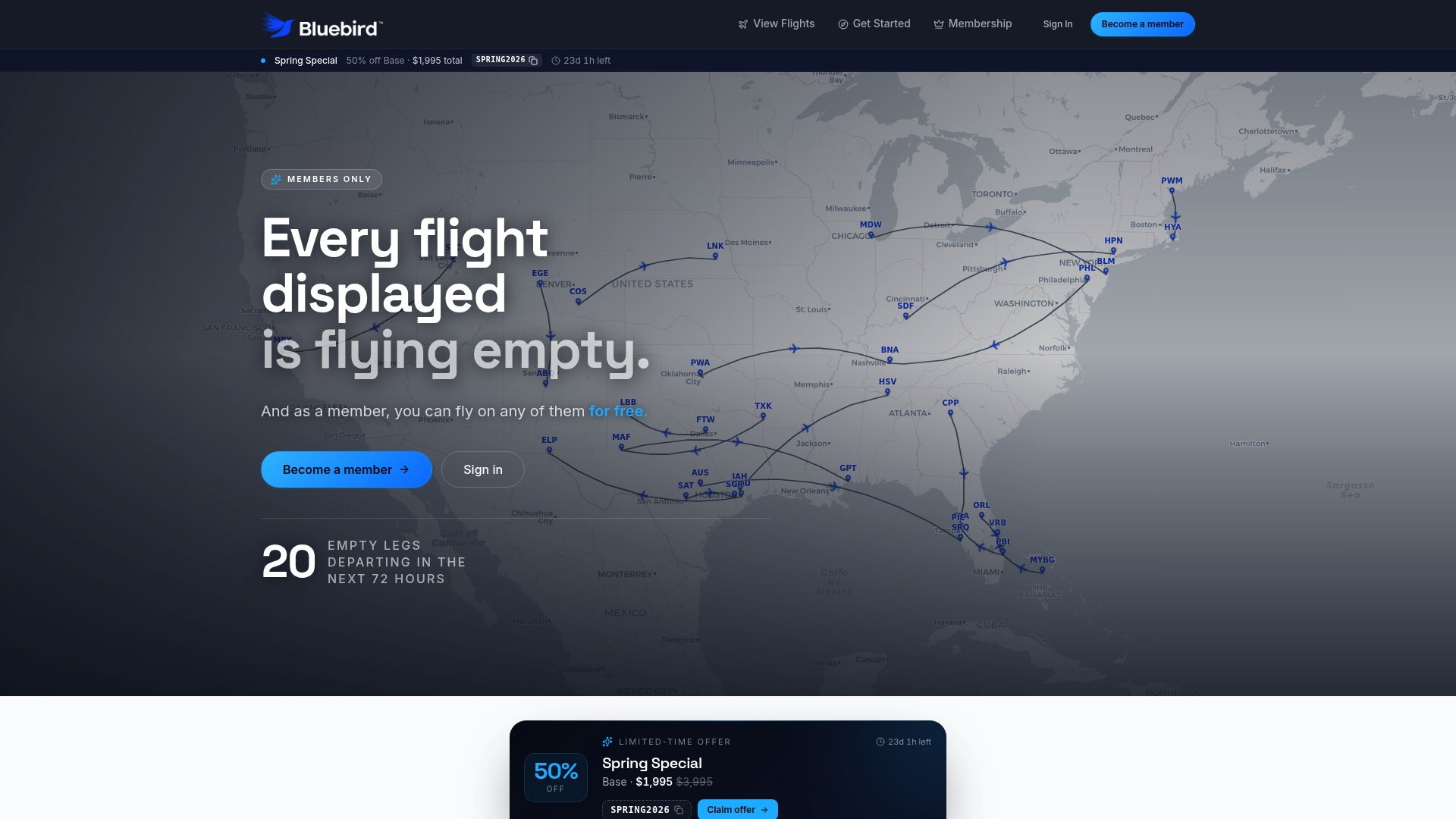
Priority booking and queue features mean less time spent chasing last-minute availability, and a paid Skip-the-Line upsell or custom charter request is there if you need more control over timing. None of that changes what’s covered elsewhere in this guide. Members still work through the same operator manifest checks, ID verification, and CBP procedures on international trips as any other private passenger. What changes is how easily you get to the tarmac in the first place. Browse current empty-leg flights to see what’s flying this week, or check today’s inventory to find a route that fits your schedule.
Sources
- Reimbursable Screening Services Program | Transportation Security Administration
- Private Charter Standard Security Program (PCSSP) | NBAA - National Business Aviation Association
- General aviation processing | U.S. Customs and Border Protection
- Do Private Jets Go Through Customs & Security? | Flyius
FAQ
Do private jets still have to go through TSA?
Most domestic private flights skip the public TSA checkpoint entirely, relying instead on operator manifest and ID checks. Exceptions apply for very large charter aircraft under PCSSP and any flight into Washington Reagan National under DASSP.
What airports have a private TSA?
Under the Reimbursable Screening Services Program, TSA has placed screening capability at select private terminals in markets including LAX, ATL, JFK, DFW, BOS, and MIA, funded through agreements with the requesting operator or airport.
How much is a two-hour flight on a private jet?
Pricing varies widely by aircraft type, route, and operator, and no single flat rate applies across the industry. Some companies offer membership programs providing access to empty-leg flights on Learjet 60 aircraft as an alternative to paying per-charter rates for each trip.
What documents do I need to bring to the FBO?
A government-issued photo ID covers domestic flights, while international travel requires a valid passport. Some operators also request advance passenger information or additional paperwork for pets and minors ahead of your arrival.