How Private Jet Boarding Actually Works: A First-Timer's Guide
How Private Jet Boarding Actually Works: A First-Timer’s Guide
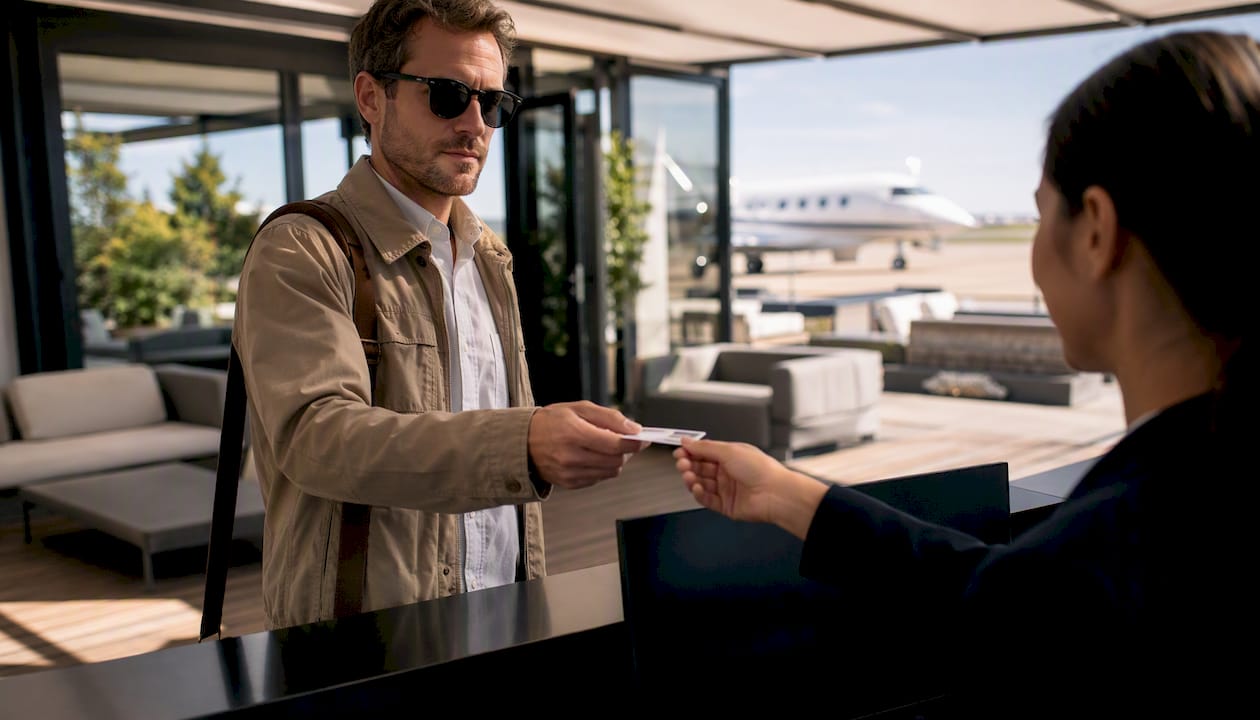
Private jet boarding skips the terminal chaos entirely. You drive to a Fixed-Base Operator (FBO), a private aviation terminal separate from the main airport, present your ID, settle into a quiet lounge, and get escorted directly to the aircraft. Many first-time passengers are airborne within 20 minutes of arriving at the FBO. No boarding pass. No gate. No line.
Here is what the sequence looks like at a glance:
- Arrive at the FBO (not the main terminal)
- Present government-issued ID at the front desk
- Check bags with ground crew, who load them directly
- Wait in the private lounge (sometimes just a few minutes)
- Get escorted to the aircraft by a crew member or FBO agent
- Board at the airstair, greeted by the pilot or flight attendant
- Wheels up
Timing windows to know:
- Domestic flights: arrive shortly before departure
- International flights: arrive 30–45 minutes before, or longer for complex customs situations
Commercial travel typically demands 90 minutes to 3 hours at the airport before departure. Private check-in and boarding combined run 10–20 minutes, door-to-wheels-up. That gap is where private aviation earns its reputation for saving time for busy professionals.
Key Takeaways
Private jet boarding is a 15–30 minute process at a dedicated FBO terminal, with no boarding pass, no TSA line, and the aircraft waiting for you.
| Point | Details |
|---|---|
| Arrive at the FBO, not the terminal | Confirm the FBO address and parking separately; it is never at the main terminal entrance. |
| Domestic timing: 15–30 minutes | Arrive 15–30 minutes before departure for domestic flights; 30–45 minutes for international. |
| ID check replaces TSA screening | Present government ID at the FBO desk; baggage is handled by the operator, not a public checkpoint. |
| International flights need advance prep | Submit passport details for APIS at least 48 hours before departure; your operator files the manifest. |
| Bluebirdjets membership | Unlimited empty-leg access on Learjet 60s with pre-filed passenger details that reduce FBO check-in to under a minute. |
Table of Contents
- What is an FBO and why does it matter for your flight?
- How does private jet boarding work, step by step?
- How does security work on a private flight?
- What happens with customs and immigration on international private flights?
- What are the baggage rules for private jet travel?
- How early should you arrive, and what if there is a delay?
- Insider tips that first-time private flyers rarely hear
- Why private boarding is misunderstood, even by people who fly it
- Bluebirdjets: private boarding without the charter overhead
- Sources
What is an FBO and why does it matter for your flight?
FBO stands for Fixed-Base Operator. Think of it as a private aviation terminal: a dedicated facility on airport property where private aircraft park, refuel, and load passengers. The FAA recognizes and regulates FBOs as airport service providers operating within established safety and operational rules, so the experience is consistent and accountable, even when the vibe feels more like a boutique hotel lobby than an airport.
What you will typically find inside an FBO:
- Private lounges with seating, Wi-Fi, and often complimentary food and beverages
- Meeting rooms available on request for business travelers
- Concierge services including ground transportation coordination and catering arrangements
- Baggage handling by ground crew who transfer your bags directly to the aircraft hold
- Customs coordination for international arrivals and departures at FBOs with CBP access
The size varies. Some FBOs at major hubs like Teterboro (TEB) or Van Nuys (VNY) are polished, large-scale facilities with multiple lounges and dedicated staff. Regional FBOs tend to be smaller and quieter, which many travelers prefer. Either way, you will not be sharing space with hundreds of strangers.
One detail that catches first-timers off guard: the FBO is almost never at the main terminal entrance. It has its own address, its own parking lot, and sometimes its own gate off the airport road. Showing up at the wrong building costs you time you did not budget for.
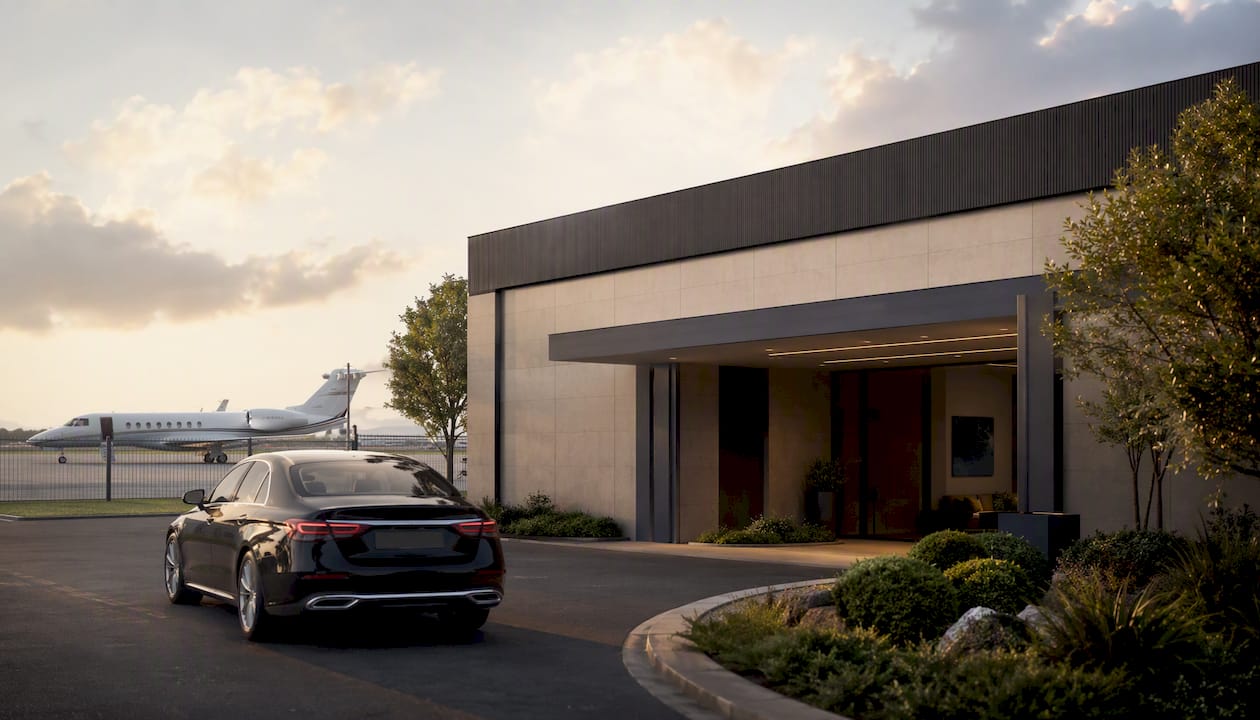
Pro Tip: Confirm the FBO’s exact address, parking instructions, and the operator’s designated meeting point at least 24 hours before departure. Save it in your phone separately from the airport name.
How does private jet boarding work, step by step?
The boarding process for private jets follows a consistent sequence, though the pace at each step is far more relaxed than commercial travel. Here is how it unfolds in practice.
- Arrive at the FBO. Pull into the FBO parking lot or have your car service drop you at the entrance. Ground staff often meet you at the door.
- Check in at the front desk. Present your government-issued photo ID. The FBO agent matches you to the passenger manifest. This takes roughly 2–3 minutes.
- Hand off your bags. Ground crew takes your luggage and transfers it directly to the aircraft hold. No baggage claim tags, no conveyor belts.
- Wait in the lounge. If the aircraft is still being prepped or catered, you wait here. On a tight domestic turn, this might be five minutes. On a longer setup, up to 20.
- Get escorted to the aircraft. A crew member or FBO agent walks you across the ramp to the plane. No departure board, no gate announcement.
- Board at the airstair. The pilot or flight attendant greets you by name. You step aboard, stow any personal items, and choose your seat.
- Safety briefing. Brief and direct, covering exits, seatbelts, and any aircraft-specific notes.
- Settle in, then pushback. Once everyone is aboard and the crew confirms readiness, you taxi and depart.
Domestic vs. international: how the timeline shifts
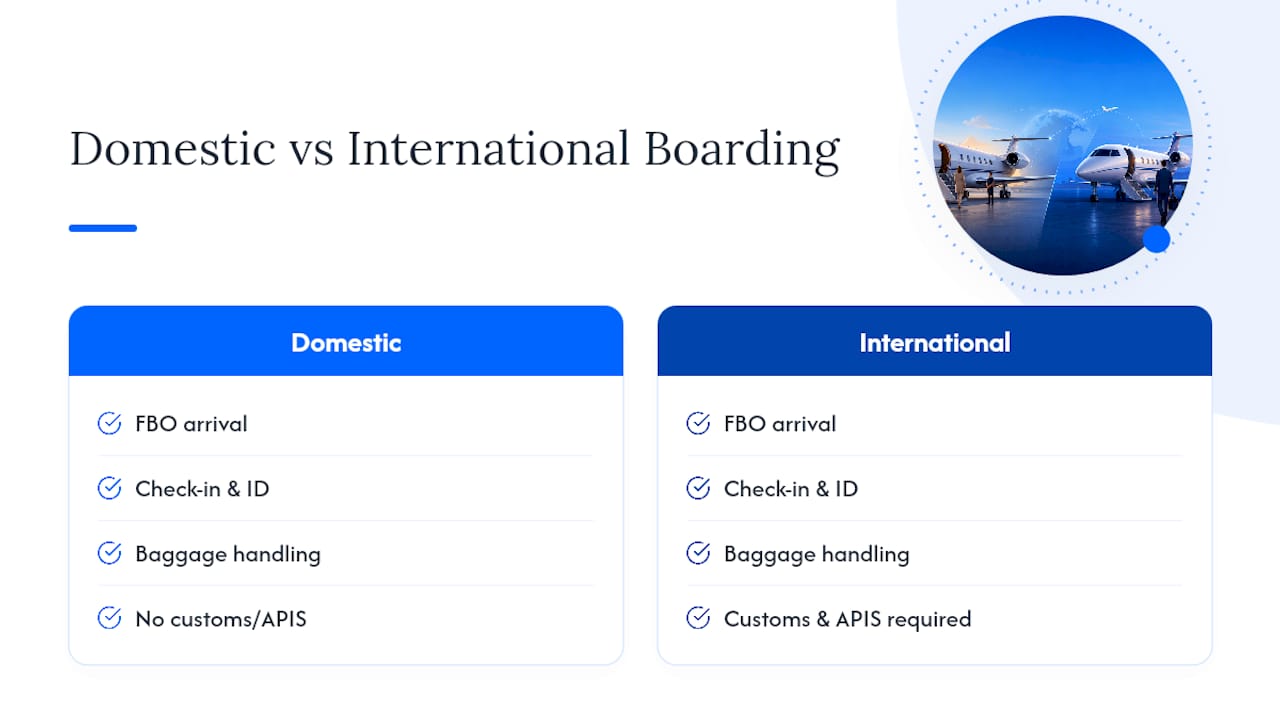
For a standard domestic private flight, the whole sequence from FBO arrival to wheels up runs 15–30 minutes. International departures add time for customs coordination, APIS submission confirmation, and occasionally a CBP officer visit to the FBO, pushing the realistic window to 30–45 minutes or more.
Sources: smart-privatejet.com and uncompromised.travel
Pro Tip: Have your ID, phone (with your booking confirmation), and any required travel documents in a jacket pocket or small bag you carry onto the aircraft. Digging through a carry-on at the FBO desk slows the one step that should be instant.
How does security work on a private flight?
Private flights still require identity verification and regulated screening. The difference is who performs it, where, and how it feels. TSA provides public guidance on security requirements that apply across aviation, and private operators must follow applicable procedures, but the experience looks nothing like a commercial checkpoint.
For most domestic private flights, you will not pass through a TSA screening lane. Instead:
- ID verification happens at the FBO front desk, matched against the passenger manifest
- Baggage screening is conducted by the operator or ground handling agent, often visually or with a handheld scanner
- The crew may ask you to confirm the contents of any unusual bags or items
- No shoe removal, no body scanner, no belt in a bin
The FAA and TSA set the regulatory framework, but the practical administration for Part 135 charter flights is handled at the operator level. NBAA publishes industry best-practice guidance that operators follow for passenger handling, baggage screening, and security compliance.
A few practical points on restricted items:
- Firearms must be declared, unloaded, and stored per FAA and operator rules
- Liquids rules are more relaxed than commercial, but confirm with your operator
- Prohibited items (explosives, hazardous materials) apply regardless of flight type
- International flights may trigger stricter customs-side screening on arrival
Pro Tip: Email your operator before travel to confirm any restricted or unusual items you plan to bring. Soft-sided luggage is easier for crew to inspect and stow in aircraft holds with limited space.
What happens with customs and immigration on international private flights?
For international departures and arrivals, private aviation handles customs and immigration at the FBO level, not in a public terminal hall. The process is faster and more private, but it requires more preparation from you before you ever leave for the airport.
Key points for international private boarding:
- APIS (Advance Passenger Information System) data must be submitted before departure. Your operator handles the submission, but you must provide full passport details, date of birth, and nationality in advance.
- Passenger manifest is filed by the operator with the relevant authorities. Confirm this has been done before you leave for the FBO.
- CBP officers may meet the aircraft at the FBO on arrival in the U.S. rather than directing you to a public customs hall. The inspection happens on the ramp or in a private room.
- Departure customs for international flights often involves a CBP check at the FBO before boarding.
NBAA’s guidance on international operations outlines best practices for operators coordinating these procedures, and most reputable charter operators follow this framework closely.
Arrival windows for international flights: plan for at least 30–45 minutes before departure, and add more time if your destination involves complex visa requirements, multiple stops, or unusual cargo. Some international itineraries warrant arriving an hour ahead.
Pro Tip: Confirm passport validity (most countries require 6 months beyond your travel dates), visa requirements for your destination, and APIS submission status with your operator at least 48 hours before departure. Last-minute passport issues cannot be resolved at the FBO.
What are the baggage rules for private jet travel?
Private aviation gives you more flexibility than commercial airlines, but it is not unlimited. Aircraft size is the binding constraint. A light jet like a Learjet 60 carries meaningfully less baggage volume than a large-cabin aircraft, and the hold dimensions are fixed.
Practical baggage guidance:
- Soft-sided bags load more easily into aircraft holds with irregular shapes. Hard-shell rollers can be difficult to fit in smaller jets.
- Weight and piece limits vary by aircraft. Your operator will specify these at booking. When in doubt, ask.
- Oversized items (golf bags, ski equipment, bicycles, surfboards) require advance notification. Some aircraft cannot accommodate them at all.
- Fragile items should be flagged to the crew, who can arrange secure stowage rather than standard hold placement.
For more on how private aviation handles baggage from loading to ramp delivery, this breakdown covers the full process.
Traveling with pets
Pets are commonly accommodated on private flights, but the rules depend on the operator and the destination:
- Health certificate from a licensed veterinarian, typically issued within 10 days of travel
- Vaccination records, especially for international travel
- Carrier requirements vary by operator; some allow pets in the cabin without a carrier
- International destinations may require additional documentation (import permits, rabies titers)
For special items like firearms, notify the operator at booking. Firearms must be unloaded, in a locked hard case, and declared. The operator will confirm storage and regulatory requirements for your specific route.
How early should you arrive, and what if there is a delay?
The standard guidance is 15–30 minutes before departure for domestic flights and 30–45 minutes for international. These windows account for ID check, baggage handling, and any last-minute catering or aircraft prep. They are not padded with buffer the way commercial airport advice is.
Private schedules are more flexible than airline schedules, but flexibility has real limits. Crew duty-time regulations, airport slot constraints, and ATC or weather holds can all force a schedule change regardless of how accommodating the operator wants to be. An aircraft will not hold indefinitely.
What to do if you are running late:
- Call the operator immediately. Do not wait until you are close. Early notice gives the crew options.
- Provide a realistic ETA. Operators can sometimes adjust pushback time within a window, but they need accurate information.
- Understand the limits. Crew duty rules are regulatory, not discretionary. If a delay pushes the crew past their legal duty window, the flight may need to reschedule.
Communicating delays immediately is the single most important thing a passenger can do when running behind. The aircraft waiting for you is not a given.
Insider tips that first-time private flyers rarely hear
Most first-timer guides cover the basics. These go a step further, drawn from operator-level experience with private boarding.
Dress and presentation. Business casual is the standard expectation at most FBOs. There is no dress code enforced, but showing up in athletic wear to a premium FBO can feel out of place, especially if you are traveling with a business associate or lead passenger. Read the room.
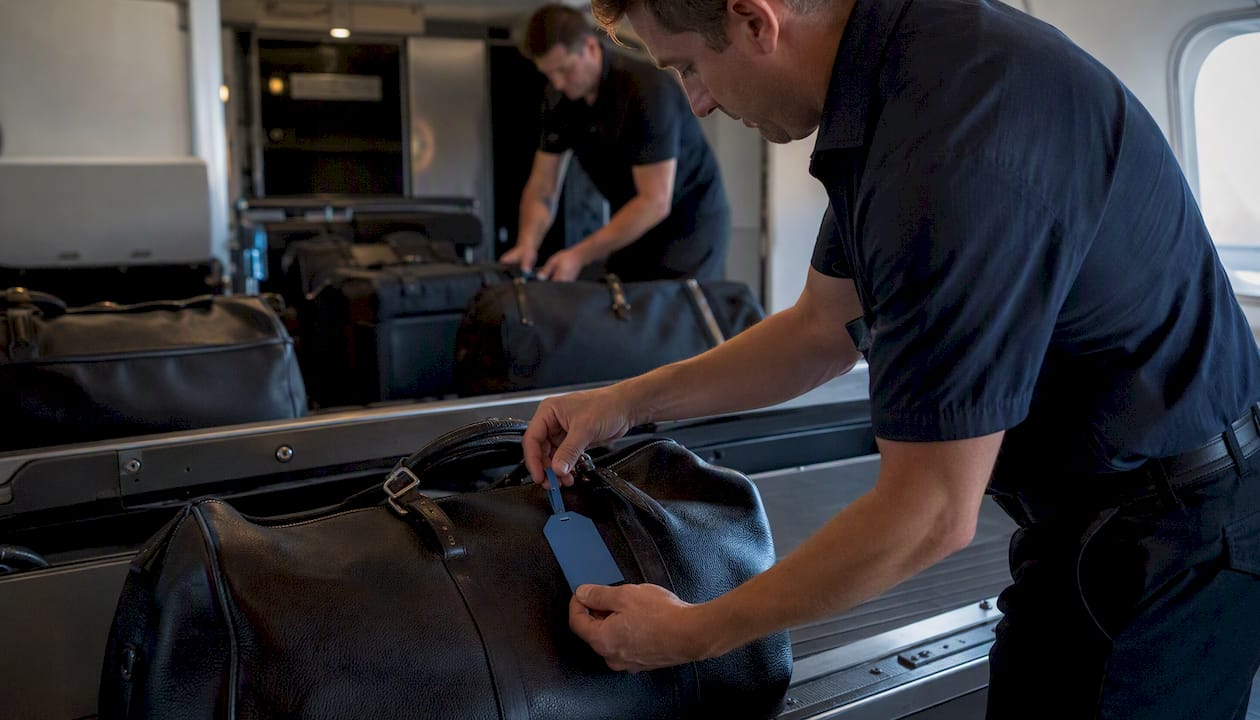
Label your bags before you arrive. Ground crew handles multiple aircraft simultaneously. A luggage tag with your name and flight details speeds the transfer and prevents mix-ups, especially at busy FBOs.
Request catering early, but late requests are possible. Most operators can accommodate last-minute catering changes if you call a few hours before departure. Waiting until you are at the FBO limits your options.
Seat etiquette when flying with others. If there is a lead passenger (the person who booked or is paying), they typically choose their seat first. Follow their lead rather than claiming the forward-facing window seat on arrival.
Send passenger details digitally before you travel. Operators and membership platforms increasingly use digital manifest uploads and concierge coordination to reduce ground time. Submitting your ID photo, passport details, and any special requests before arrival means the FBO desk check-in takes under a minute.
Empty-leg flights operate under the same Part 135 certification as standard charters. Safety and regulatory standards are identical regardless of whether you booked a full charter or an empty-leg seat. The aircraft and crew meet the same requirements either way.
For a deeper look at private jet etiquette for first-timers, including tipping guidance and on-board behavior, that resource covers the nuances most guides skip.
On tipping: there is no universal rule, but tipping the flight crew $50–$100 per person for a domestic flight is a widely accepted gesture for exceptional service. FBO ground staff appreciate tips for handling special requests or heavy bags. It is never required, but it is always noticed.
Pro Tip: Use your membership or booking platform’s live inventory and priority booking features before you leave home. Uploading your passenger details and confirming your manifest through the app means the FBO desk is a formality, not a process.
Why private boarding is misunderstood, even by people who fly it
Most people assume the time savings in private aviation come from the aircraft itself: faster cruising speed, direct routing. Those matter. But the bigger recovery happens on the ground, and it is the part that surprises first-timers most.
Commercial aviation has built its entire infrastructure around managing thousands of strangers simultaneously. The security theater, the gate queues, the 45-minute baggage wait on arrival: none of that exists because it is efficient. It exists because the scale demands it. Private boarding inverts the model. The aircraft waits for you. The crew knows your name before you arrive. The FBO is quiet by design.
What this means practically: a 90-minute flight from New York to Boston saves you roughly 30 minutes in the air compared to commercial. But it saves you 2–3 hours on the ground, each way. That is where the real math lives.
For members using a platform like Bluebirdjets, the friction drops further. When your passenger details are already on file, your manifest is pre-submitted, and you are booking from live inventory rather than negotiating a charter from scratch, the FBO experience becomes genuinely frictionless. The first time still feels novel. By the third flight, it feels like the only rational way to travel.
Bluebirdjets: private boarding without the charter overhead
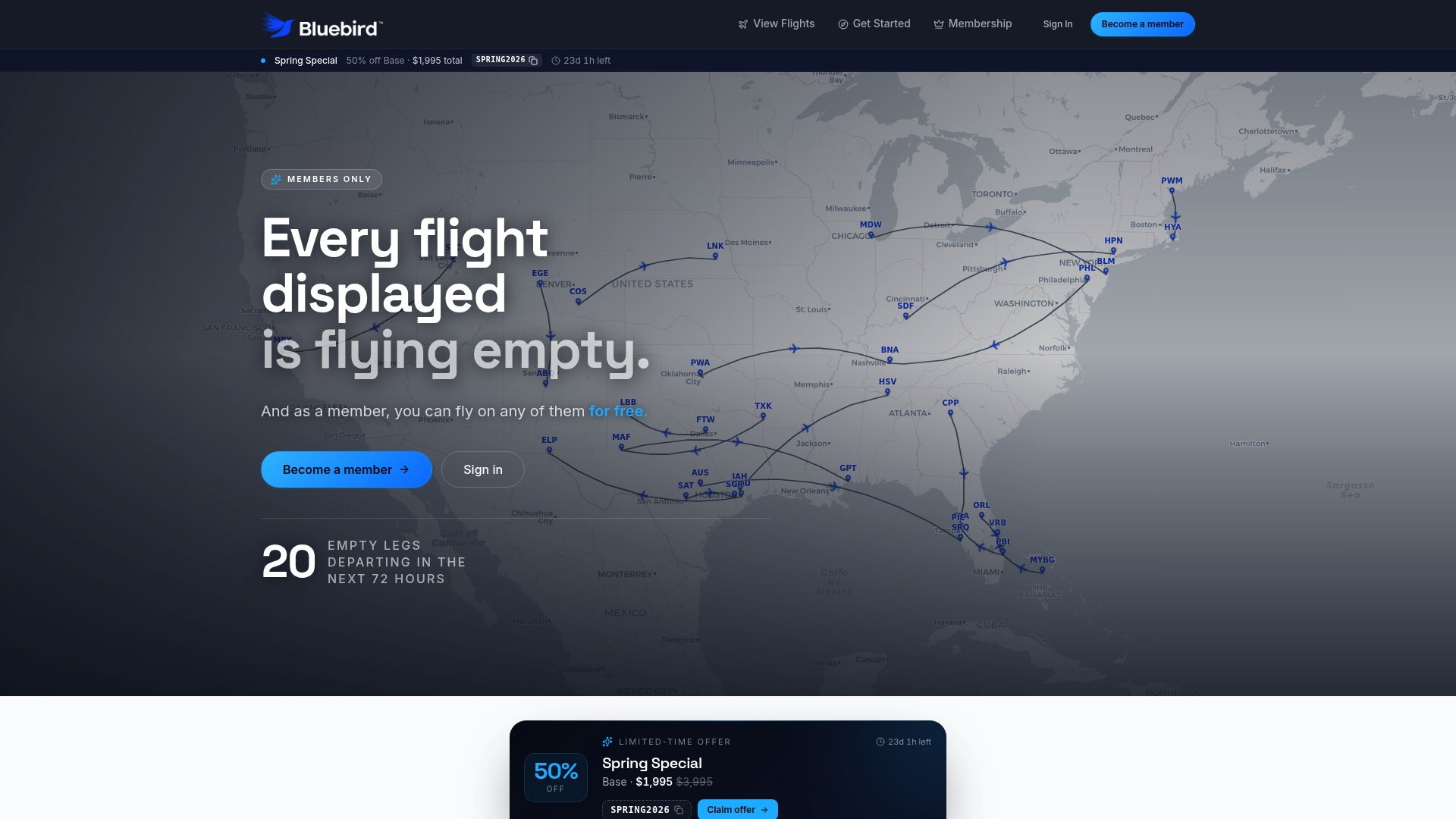
Bluebirdjets offers annual membership with unlimited access to empty-leg flights on operator-owned Learjet 60 jets, with no per-flight booking fees and no long-term charter commitments. Members bring up to six guests per flight, access live daily inventory with updated routes, and use priority booking to secure seats before the general queue. The boarding experience described in this guide applies directly: FBO arrival, ID check, lounge, ramp escort, wheels up. The difference is what you paid to get there.
For travelers who fly private more than a few times a year, the membership model cuts the cost per flight substantially compared to one-off charters while keeping every element of the private boarding experience intact. View current empty-leg availability or explore membership details to see if the routes and timing fit your schedule.
Sources
These are the primary official and industry resources referenced throughout this guide: