The Coastal Airport Advantage for Private Jet Travelers
The Coastal Airport Advantage for Private Jet Travelers
Coastal airport advantage refers to the combined edge private‑jet travelers get from flying into smaller fields near the water: less ground time, closer proximity to islands and resort towns, and a steady churn of repositioning flights that turn into bookable empty legs. Three benefits drive that edge. First, time saved: skipping a major hub can cut ground travel by 30 to 90 minutes each way. Second, destination access: many islands and beach towns are only reachable by small‑field aircraft, not by commercial airliners. Third, empty‑leg frequency: coastal leisure routes generate more repositioning flights than inland corridors because aircraft constantly shuttle passengers in and out of the same seasonal hot spots.
Bluebird members see this pattern directly in the app’s live inventory, where coastal routes refresh daily as operators reposition Learjet 60 aircraft between weekend hot spots.
- Time saved: faster FBO check‑in, no jetbridge, no baggage carousel.
- Destination access: direct routing into island and resort fields commercial carriers skip.
- Empty‑leg frequency: more repositioning flights near coastal leisure markets means more last‑minute seats.
Quick stat: Flying into a regional coastal field instead of a major hub often saves 30 to 90 minutes of ground transfer time on each leg of the trip.
Key Takeaways
Coastal airports create private‑jet value through shorter ground transfers, direct access to island and resort destinations, and a steady flow of repositioning flights that become bookable empty legs.
| Point | Details |
|---|---|
| Time savings are real | Smaller coastal fields can cut door-to-door travel by 30 to 90 minutes compared to major hubs. |
| Empty legs cluster around weekends | Coastal leisure markets generate concentrated Friday-out, Sunday-back repositioning flights worth tracking. |
| Runway length dictates aircraft fit | Coastal strips often run 3,000 to 6,000 feet, favoring light and midsize jets over heavier aircraft. |
| Curfews and weather add planning risk | Noise curfews, ramp scarcity, and sea breeze weather patterns require a backup plan at coastal fields. |
| Bluebird converts pattern into access | Bluebird’s membership gives unlimited access to daily-updated empty-leg inventory on coastal and other routes. |
Table of Contents
- What Makes Coastal Airports Operationally Better for Private Jets?
- How Do Coastal Routes Create More Empty-Leg Opportunities?
- What Limits Should Private Jet Travelers Plan Around?
- How Members Turn Coastal Advantages Into Booked Flights
- Why Coastal Access Changes the Math on Spontaneous Travel
- Turn Coastal Airport Access Into a Standing Habit
- Sources
What Makes Coastal Airports Operationally Better for Private Jets?
The advantage starts on the ground, not in the air. A major hub means a long taxi to a distant FBO, security lines, and a drive that can eat 45 minutes before you even reach your car. Coastal executive fields flip that script: you land, taxi a few hundred yards to a private terminal, and you’re in your car in the time it takes most travelers to find their gate at a commercial airport. That gap is why smaller airports near Manhattan or Aspen consistently outperform their larger neighbors on total door‑to‑door time [small-airport private jet].
Congestion plays a role too. Smaller coastal fields rarely deal with the hold patterns and sequencing delays that plague major airports during peak hours. Fewer aircraft movements mean simpler slot management, which matters most on Friday afternoons when everyone is trying to leave the city at once.
Then there’s the access question. Certain island and resort communities simply don’t have runways long enough for anything beyond light and midsize jets, which makes small‑field capability a requirement, not a preference. Executive coastal airports on the East Coast are built around this reality, pairing shorter runways with dedicated FBO service and, in some cases, on‑site customs.

Runway length dictates which aircraft can actually use these fields. Many coastal private airfields run between 3,000 and 6,000 feet, which is plenty for light jets and turboprops but tight for midsize aircraft in hot, humid conditions where takeoff performance degrades.
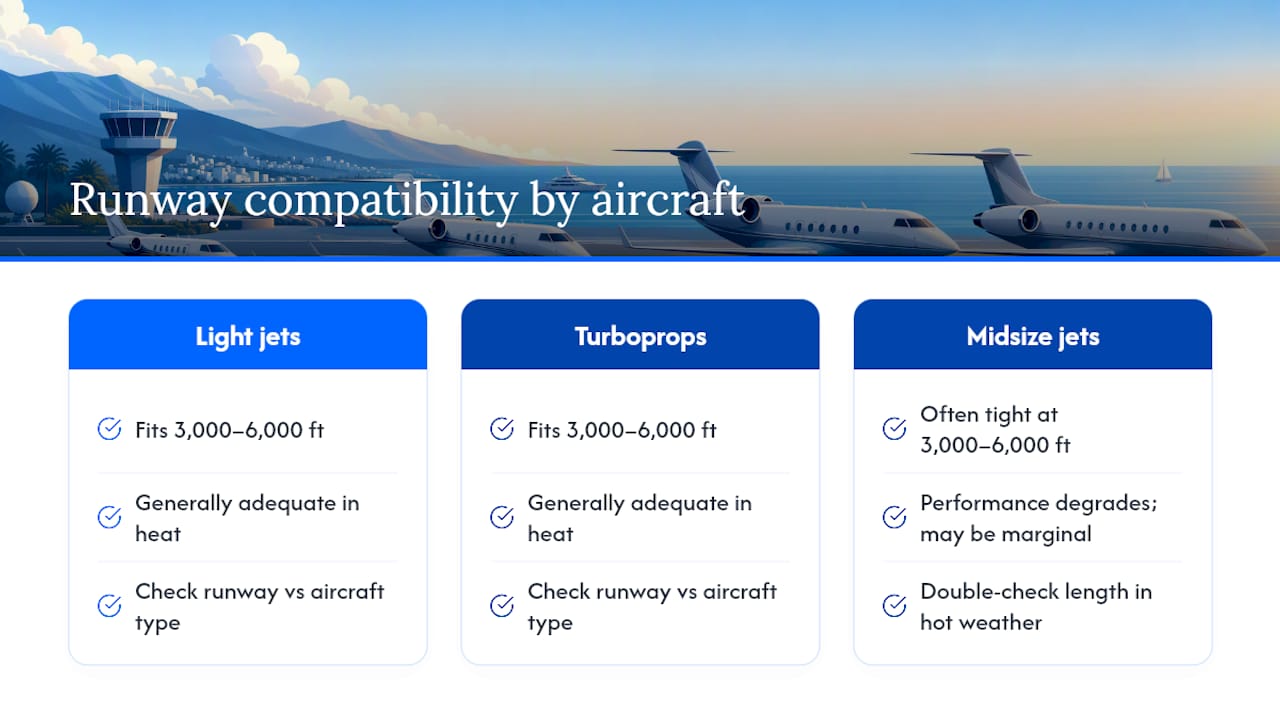
Pro Tip: Before booking an empty leg into an unfamiliar coastal field, check the runway length against the aircraft type listed. A 4,200-foot strip that’s fine for a light jet in cool weather can turn marginal for a midsize jet on a humid August afternoon.
How Do Coastal Routes Create More Empty-Leg Opportunities?
Empty legs exist because aircraft need to get from where they dropped someone off to where they’re picking someone up. Coastal leisure markets generate an unusual volume of that kind of movement, because so many trips are one‑directional: fly the family to the Vineyard on Friday, and the jet either sits idle or flies back empty unless another passenger books that return leg.
This repositioning pattern clusters around a few predictable triggers.
- Weekend surges — Friday outbound and Sunday/Monday inbound flights to markets like the Hamptons, Nantucket, and Martha’s Vineyard spike hard, then reverse.
- Event‑driven demand — regattas, film festivals, and summer social calendars pull concentrated traffic into small coastal fields for a few days at a time.
- Seasonal migration — as summer ends, repositioning shifts from island runs to southern coastal fields near Palm Beach and the Gulf.
The seasonal compression around the Northeast’s summer home season is a good example: demand between New York or Boston and the East End gets so lopsided that operators are almost guaranteed to have an aircraft going the “wrong way” at some point in the weekend cycle. That’s the empty leg a member captures.
For short regional hops like New York to East Hampton, flight time can run under an hour, which means operators cycle aircraft through these routes multiple times a day during peak season. More cycles mean more empty legs showing up in inventory, often with only a day or two of notice.
Quick stat: Empty‑leg pricing on these routes depends far more on distance and last‑minute availability than on the size of the airport itself, which is why a short coastal hop can sometimes cost a fraction of a full charter booked at the last minute.
What Limits Should Private Jet Travelers Plan Around?
The advantages are real, but coastal fields come with constraints that catch first‑time flyers off guard. None of these are dealbreakers. They’re planning variables.
- Noise curfews. Island communities like Martha’s Vineyard enforce strict overnight curfews, which can push a late departure to the next morning or force a reroute to a nearby field.
- Runway and ramp limits. Shorter strips exclude heavier aircraft outright, and ramp space at small fields can vanish fast during a holiday weekend.
- Seasonal congestion. The same demand surge that creates empty legs also creates parking scarcity. A field with three ramp spots fills up quickly when six operators want to park there Friday night.
- Coastal weather. Sea breeze patterns, shifting crosswinds, and marine fog affect performance and approach minimums more at coastal fields than at inland airports with longer, straighter runways.
Pro Tip: Always ask about the alternate airport before confirming a coastal empty leg. Fog rolling in off the water is common enough at seaside fields that having a backup plan isn’t optional. It’s basic trip insurance.
One overlooked variable: customs. Some executive coastal airports offer on‑site U.S. Customs and Border Protection clearance with advance notice, which can make an international arrival dramatically smoother than routing through a major international hub. Not every field offers it, so this is worth confirming before you build an itinerary around it.
How Members Turn Coastal Advantages Into Booked Flights
Knowing the pattern only pays off if you act on it. A working checklist:
- Monitor live inventory daily. Coastal routes refresh often, and the best empty legs move fast.
- Set alerts for your regular routes. If you fly the same corridor most summers, let the pattern work for you instead of searching cold every time.
- Use priority and queue features during peak weekend windows when demand for the same leg spikes.
- Consider Skip‑the‑Line or a custom charter request when timing matters more than price.
- Run pre‑flight checks on runway compatibility, FBO service hours, customs availability, and ground transfer options before confirming.
The decision between an empty leg and a full charter usually comes down to flexibility. An empty leg wins on price and often on convenience, but it locks you into a fixed departure window. A full charter costs more but bends to your schedule. For a family of four heading to the same coastal town every summer, that tradeoff is worth thinking through each time, not assuming.
Operators plan repositioning legs around forecasted demand, and coastal resort peaks on weekends and holidays produce predictable outbound and inbound movements that a membership platform can aggregate into bookable seats.
A recent example: a Learjet 60 empty leg from JWY to PQL on July 18 showed up in Bluebird’s inventory with about a week’s notice, the kind of coastal repositioning flight that fits exactly the pattern described above.
Why Coastal Access Changes the Math on Spontaneous Travel
Coastal airports don’t just save time. They change what’s possible on short notice, turning a weekend impulse into an actual trip because the aircraft, the runway, and the routing already line up in your favor. A membership that puts you in front of that inventory every day, rather than making you chase it, is what turns an occasional lucky booking into a habit. That’s the part most people underestimate about coastal access: it rewards the traveler who checks often, not the one who plans months ahead.
— Nick
Turn Coastal Airport Access Into a Standing Habit
Reading about coastal empty legs is one thing. Having them show up in your inventory every morning is another. Bluebird’s annual membership gives you unlimited access to empty‑leg flights on operator‑owned Learjet 60 aircraft, with live routes updated daily and priority booking features built specifically for the weekend surges and repositioning patterns described above. Bring up to six guests, skip the per‑flight negotiation, and use Skip‑the‑Line or a custom charter request when a specific date matters more than flexibility.

If coastal routes are where you already want to be flying, check today’s live empty‑leg inventory and see what’s departing this week.
Sources
- Summer Private Jet Destinations in the Northeast Guide | Amalfi Jets
- Top Private Jet Airports on the East Coast 2025 - Magellan Jets