Why Empty Leg Insurance Rarely Covers Private Jet Cancellations

Why Empty Leg Insurance Rarely Covers Private Jet Cancellations
Operator insurance protects the aircraft, the crew, and third parties, but it usually will not reimburse you for the hotel you lost or the meeting you missed when an empty leg falls through. Travel insurance sometimes fills that gap, but only if the policy explicitly names private charter flights, which many do not. Before you pay for an empty leg, read the cancellation clause, get the insurer’s coverage confirmation in writing, and skip any nonrefundable bookings downstream until the flight is locked in.
TL;DR:
- Insurance typically does not cover lost hotel nights or missed meetings caused by empty leg cancellations unless explicitly included in your policy.
- Booking an empty leg involves schedule and aircraft ownership risks that can lead to last-minute cancellations or changes with little notice.
- Private jet insurance covers the aircraft’s physical damage and third-party liabilities but does not compensate travelers for canceled flights or personal expenses.
- Many travel insurance policies exclude private aviation and known circumstances at the time of booking, requiring pre-confirmation for coverage of cancellations.
- To limit risk, travelers should hold refundable bookings, verify operator insurance and safety ratings in writing, and use platforms with live inventory and priority access.
Table of Contents
- How Empty Leg Flights Work and Why They Carry Real Risk
- What Private Jet Insurance Actually Covers
- What Happens Contractually When an Empty Leg Cancels or Changes
- Does Your Travel Insurance Cover Private Charter Cancellations?
- The Pre-Booking Checklist Every Empty-Leg Traveler Needs
- How to Limit Your Exposure If an Empty Leg Falls Through
- How Bluebird’s Live Inventory Reduces Your Exposure
- What Insurance Claims on Empty Legs Actually Look Like
- Legal and Regulatory Gaps That Shape Empty Leg Coverage
- Risks Unique to Empty Legs That Complicate Any Insurance Claim
- Verifying an Operator’s Insurance and Safety Status Before You Pay
- When Insurance Helps and When It Cannot Replace a Guaranteed Charter
- Join a Membership Built Around Live Empty-Leg Access
- Where to Verify Coverage and Operator Standing
- Sources
- FAQ
How Empty Leg Flights Work and Why They Carry Real Risk
An empty leg exists because a jet has to fly back to base or on to its next job with no paying passenger aboard. Instead of eating that cost, operators sell the seat at a steep discount, often 30% to 60% below retail. You are not booking a scheduled service. You are booking the leftover half of someone else’s charter.
That distinction drives everything about the risk. The flight’s real owner is the original charter client, not you. If their plans shift, your flight shifts, gets reassigned to a different tail, or disappears entirely.
Timing makes this worse. Most empty legs surface inside a narrow window before departure, and inventory patterns show many legs post within seven to fourteen days of the flight, sometimes within hours. The closer to departure, the deeper the discount, because the operator’s alternative is an empty seat and zero revenue.
A few consequences follow directly from that structure:
- The published schedule is provisional until the original charter confirms its own plans.
- Weather, mechanical issues, or a client extending their trip can bump or cancel your leg with little notice.
- Deep discounts exist precisely because you are absorbing schedule risk the operator does not want to carry alone.
- Last-minute postings favor travelers who can move fast, not travelers who need a guaranteed date.
None of this makes empty legs a bad idea. It makes them a different kind of product than a scheduled charter, and insurance has to be evaluated against that reality, not against how airline tickets work.
What Private Jet Insurance Actually Covers
Private jet insurance is built around the aircraft and the operator’s legal exposure, not your itinerary. Two components matter most.
Hull coverage insures the aircraft itself against physical damage, usually written on an agreed-value basis so the insurer and owner settle on a fixed payout before anything happens. It protects the aircraft owner or operator. It has nothing to do with your lost weekend.
Liability coverage protects against claims from third parties and covers passenger bodily injury, with limits that vary by aircraft, use, and insurer. This is the policy that would respond if something went wrong physically during the flight. It is not designed to compensate you because the flight got canceled and you had to rebook commercial at triple the price.
That gap between passenger injury coverage and passenger inconvenience coverage is the single most misunderstood part of private aviation insurance. Bodily harm and financial disruption are treated as entirely separate risks, and only one of them is standard on an operator’s policy.
Private jet insurance premiums vary enormously. Depending on hull value, liability limits, aircraft use, and pilot qualifications, annual premiums can range from the tens of thousands into the hundreds of thousands of dollars. That range alone tells you how differently two operators can be insured, even flying similar aircraft.
Some operators carry optional extensions:
- Loss of use coverage, which compensates the operator, not the passenger, if the aircraft is grounded.
- Trip interruption provisions, which some specialist policies bundle in for the operator’s own operational risk.
- Higher passenger liability limits than the regulatory minimum, often marketed by charter brokers as a selling point.
These extensions protect the business running the aircraft. They rarely function as a substitute for personal travel insurance, and no operator policy is designed to make you whole for a canceled empty leg. If you want that kind of protection, it has to come from a separate policy you buy yourself, or from the terms you negotiate before you pay.
What Happens Contractually When an Empty Leg Cancels or Changes
There is no regulatory floor here. Unlike a commercial airline, which operates under consumer protection rules for cancellations and delays, a charter operator’s private booking contract is the entire rulebook, and outcomes depend entirely on what that contract says.
When you book an empty leg, one of three outcomes typically applies if the flight falls through:
- Full refund. Some operators return your payment in full, particularly for deals sold well before departure with generous terms.
- Credit toward a future flight. Common with brokers and platforms that want to keep you as a repeat customer rather than issue cash back.
- No refund at all. Deep last-minute discounts are sometimes priced with an explicit no-refund clause, because the operator is already taking a loss on the seat.
None of these outcomes typically extends to your consequential losses. If the cancellation forces you to book a same-day commercial flight or eat a nonrefundable hotel night, that cost is yours to absorb unless you negotiated otherwise in writing before booking.
Before you pay, confirm three specific things with the operator or broker: the exact refund percentage if they cancel versus if you cancel, whether a credit has an expiration date, and how many hours of notice they typically give before pulling a leg. Get the answer in writing, even if it is just an email reply. Verbal assurances about “we’ll take care of you” carry no weight against a signed booking confirmation that says otherwise.
Does Your Travel Insurance Cover Private Charter Cancellations?
Probably not, and this is the exclusion that catches the most travelers off guard. Standard travel insurance policies are written with commercial airline patterns in mind, and many explicitly exclude private charter flights or exclude cancellations tied to known circumstances the traveler was aware of at time of purchase.
Reading the policy wording matters more here than in almost any other travel insurance context. Look for these specific terms:
- The definition of a “covered reason” for cancellation, and whether it lists charter or private aviation at all.
- Explicit exclusions for “private aircraft,” “charter flights,” or “non scheduled carriers.”
- Known-circumstance clauses that void coverage if the cancellation risk was foreseeable when you bought the policy, which matters if you booked an empty leg already flagged as tentative.
- Caps on consequential-loss reimbursement, since some policies pay a token amount toward rebooking costs that will not come close to covering a commercial last-minute fare.
Specialist aviation insurers and brokers do sell charter-specific coverage, sometimes bundled as trip interruption or cancellation riders designed around private aviation’s actual risk profile. These cost more than standard travel insurance and are usually purchased by operators or frequent charter clients rather than one-off empty-leg travelers.
Pro Tip: Call your insurer before you book, not after you’ve paid. Ask them directly: “Does this policy cover cancellation of a private charter or empty-leg flight?” Get the answer by email. A verbal “yes” from a call center rep means nothing if the claim gets denied later.
The Pre-Booking Checklist Every Empty-Leg Traveler Needs
Most empty-leg disappointments trace back to a question nobody asked before paying. Run through this list with the operator or broker first.
- Get the exact departure window in writing, along with the tolerance for delay before you can walk away and request a refund.
- Confirm whether the refund policy is full refund, credit, or no-refund, and get the refund timeline in days, not “soon.”
- Ask for the operator’s certificate details, confirm they hold the appropriate Part 135 operating authority, and request evidence of their passenger liability limits.
- Request a copy of the insurance summary and any substitution policy covering what happens if the original tail aircraft is swapped.
- Check third-party safety ratings through ARGUS or Wyvern trip-level reports, which audit operator safety records independently of the operator’s own marketing.
Pro Tip: If an operator hesitates to send you their insurance summary or safety audit status in writing, treat that hesitation as your answer. Reputable operators share this information without friction, because they have nothing to hide in it.
How to Limit Your Exposure If an Empty Leg Falls Through
You cannot eliminate empty-leg risk, but you can structure your trip so a cancellation costs you an afternoon instead of a vacation. A few habits matter most.
- Hold off on nonrefundable bookings. Book refundable hotel rates and flexible-fare rentals until your seat is fully confirmed, not just reserved.
- Keep a commercial backup in your pocket. Price out a refundable commercial ticket for the same route and hold it until the private flight is locked, then cancel it once boarding is certain.
- Work with brokers or platforms that carry replacement capacity. A broker with an active operator network can sometimes source a same-day substitute far faster than you could rebuild a plan from scratch.
- Set alerts and stay flexible on dates. Since most legs surface within a week or two of departure, travelers who can move on short notice consistently get better access and better pricing than those chasing a fixed date.
Contingency planning is not glamorous, but it is the one part of empty-leg travel entirely within your control.
How Bluebird’s Live Inventory Reduces Your Exposure
Speed matters more than paperwork when a leg needs replacing. Bluebirdjets publishes live empty-leg inventory with daily updated routes, so members see newly posted flights, like a listing from ECP to CJR or JWY to PQL, the moment they go live rather than after a broker’s email digest arrives.
Membership adds priority and queue booking, so when a desirable leg appears, members with priority status get first crack at it instead of competing in an open scramble. That combination, live visibility plus priority access, shrinks the window during which you need to be holding refundable backup plans, because you can often lock in a replacement flight faster than a standard broker relationship allows.
What Insurance Claims on Empty Legs Actually Look Like
Empty-leg insurance disputes rarely resemble a dramatic denied claim story. They tend to be quieter and more procedural than that.
The most common pattern involves a traveler filing a trip-interruption claim with their standard travel policy after an empty leg canceled, only to have the insurer deny it because the policy’s fine print excluded “non scheduled” or “private charter” flights. The traveler assumed private jet travel fell under the same umbrella as any flight disruption. It did not, because the policy was written around commercial carrier patterns.
A second pattern involves consequential-loss disputes with the operator directly, not an insurer. A traveler books a no-refund empty leg, it cancels, and they ask the operator to cover the hotel night lost as a result. Since the booking terms already priced in that risk through the discount, the operator has no contractual obligation to pay, and most decline. This is not fraud or bad faith. It is the private contract functioning exactly as written, which is why reading that contract before paying matters more than most travelers assume.
The rare success stories involve travelers who secured written insurer confirmation before booking that their policy specifically covered charter cancellation, then filed a documented claim with receipts for the consequential costs. Written pre-confirmation is consistently the difference between a paid claim and a denied one.
Legal and Regulatory Gaps That Shape Empty Leg Coverage
Empty-leg bookings sit in a regulatory gray zone that surprises a lot of first-time charter travelers. Commercial airlines operate under consumer protection frameworks that mandate certain refund and compensation rules for cancellations and delays. Private charter has no equivalent federal passenger-compensation standard.
That means your protection comes entirely from contract law, not aviation regulation. The operator’s booking terms are the governing document, and courts generally enforce those terms as written unless they violate broader consumer protection statutes around deceptive practices. Part 135 certification, the FAA authority under which most charter operators fly, governs safety and operational standards. It says nothing about passenger refunds if a flight cancels.
This matters practically because it shifts the entire burden of protection onto you, the traveler, at the negotiation stage. You cannot lean on a regulatory backstop the way commercial airline passengers sometimes can. Whatever the booking confirmation says about refunds, credits, or no-refund terms is very likely what a court would enforce if a dispute ever escalated that far, which is rare given the dollar amounts involved relative to litigation costs. The practical answer is not to plan around regulation that does not exist. It is to negotiate better terms up front and get them in writing.
Risks Unique to Empty Legs That Complicate Any Insurance Claim
Three risks specific to empty legs make insurance claims harder to win than they would be for a standard charter booking.
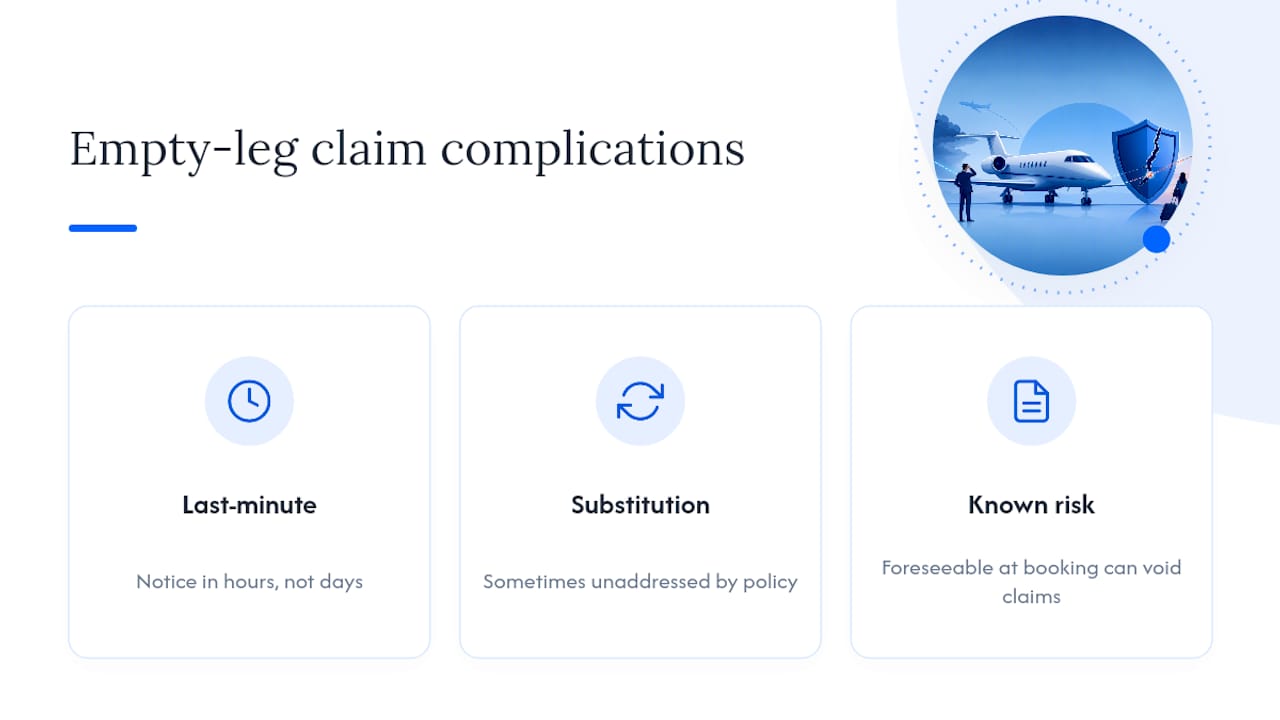
Last-minute cancellation is the most common. Because the flight belongs to someone else’s original charter, your notice period can be measured in hours, not days. Insurers reviewing a claim often ask for documentation of when you were notified, and thin notice windows sometimes work against you if the policy has a minimum-notice clause for what counts as a “covered” cancellation.
Operator or tail-aircraft substitution is the second. If the operator swaps the original jet for a different aircraft, insurers may treat that differently than an outright cancellation, and some policies simply do not address substitution at all. That silence usually resolves against the traveler, since an undefined scenario in a policy tends to fall outside covered events by default.
Ambiguous “known circumstance” timing is the third. If you booked knowing the leg was tentative, an insurer may argue the risk was foreseeable at purchase, voiding a claim that would otherwise be valid. This is precisely why written pre-confirmation of coverage matters more for empty legs than for a standard scheduled booking. You are removing ambiguity before it becomes a dispute.
Verifying an Operator’s Insurance and Safety Status Before You Pay
Confirming an operator carries adequate insurance is not intrusive. It is standard due diligence, and legitimate operators expect the question.
Start by requesting a certificate of insurance directly from the operator, which should name the insurer, the policy limits, and the coverage period. A hesitant or vague response is itself useful information. Cross-check the operator’s Part 135 certificate status, which confirms they hold current FAA operating authority for commercial passenger flights, not just a private pilot’s license and a plane.
Then look outside the operator’s own claims entirely. ARGUS and Wyvern issue independent trip-level safety audits that review an operator’s maintenance records, pilot training, and incident history. Brokers and membership platforms often reference these ratings directly, and asking for the specific audit level, ARGUS Gold or Platinum, Wyvern Wingman, gives you a documented, third-party benchmark instead of relying on an operator’s self-description.
Finally, ask who underwrites the aircraft’s liability coverage and whether limits meet or exceed industry norms for the aircraft category. A light jet with minimal liability coverage carries different exposure than a midsize cabin insured well above standard limits, and that distinction is worth ten minutes of questions before you commit to a seat.
When Insurance Helps and When It Cannot Replace a Guaranteed Charter
Empty legs work best for flexible leisure travel where a schedule slip is an inconvenience, not a crisis. Insurance can soften some financial edges, but it cannot recreate a guaranteed departure time. If your date is immovable, book a guaranteed charter instead. If you can bend, manage exposure through refundable downstream bookings and platforms that move fast, because contract terms and speed matter more than any policy you can buy.
— Nick
Join a Membership Built Around Live Empty-Leg Access
Reading fine print and holding refundable backups helps, but the fastest way to cut cancellation exposure is simply not competing for scraps after the fact. Members can get unlimited access to empty legs through a live inventory updated daily without broker markups.

Membership works on two tiers. The Base plan runs $3,995 per year, and the Plus plan runs $9,995 per year with higher-priority queue access when multiple members want the same leg. Both let you bring up to six guests per flight, and both give you the priority booking tools that matter most when a desirable route posts with only hours of notice. Prefer to skip the queue entirely on a specific flight? The Skip-The-Line fee runs $2,000 one time for that priority. None of this is insurance, and it is not sold as insurance. It is a faster, more transparent way to get seats before they disappear, which is the exposure that actually costs travelers money. Check current live routes and see what is flying this week before you plan around a slower alternative.
Where to Verify Coverage and Operator Standing
Confirm anything an operator or insurer tells you against a primary source before you rely on it. Start with an insurer’s own private jet insurance policy page to see standard hull and liability structures, then review empty-leg cancellation guidance for what refund outcomes typically look like. For booking-term specifics, Bluebirdjets’ guide to route flexibility walks through how schedule risk actually plays out for travelers.
This article is general information, not a substitute for advice from a qualified financial advisor. Consult a qualified financial professional about your own circumstances before acting on anything here.
Sources
- Private Jet Empty Legs: Price and Risk Guide
- Private jet insurance
- Empty-Leg Private Jets 2026: Price and Risk Guide
- Empty Leg Flights: Costs and How to Book One
FAQ
Can You Negotiate Empty Leg Pricing?
Yes, especially on listings close to departure where the operator’s alternative is flying with an empty seat. Operators and brokers have room to move on price when a leg has not sold within a few days of posting, though outcomes always depend on the specific booking terms offered.
Are Empty Leg Flights Worth It?
For flexible travelers, yes. You get discounts commonly in the 30% to 60% range off retail charter pricing, but only if you can tolerate schedule uncertainty and skip nonrefundable downstream bookings until the flight is confirmed.
What Is the Average Cost of an Empty Leg Flight?
Pricing varies greatly depending on aircraft type, route, and booking timing, so there is no single average cost applicable market-wide. Bluebirdjets members access published empty-leg inventory directly through their membership, which shows current route pricing rather than a generalized estimate.
Do You Tip a Private Jet Pilot?
Tipping pilots is not standard practice in private aviation the way it is with ground crew or service staff, since pilots are salaried professionals rather than gratuity-based workers. Cabin crew or ground handling staff sometimes receive tips for exceptional service, but this varies by operator and is never required.
Does Travel Insurance Cover a Canceled Empty Leg?
Usually not automatically. Many standard travel policies exclude private charter flights or known-circumstance cancellations, so you need written confirmation from your insurer before assuming a canceled empty leg qualifies for reimbursement.