What Is a One-Way Charter? A Private Jet Guide

What Is a One-Way Charter? A Private Jet Guide
A one-way charter is a private jet booked for a single leg, with you setting the departure airport, arrival airport, date, and time. No return commitment, no shared schedule, no compromise. U.S. operators run these flights under FAA Part 135 rules, meaning the aircraft and crew meet the same airworthiness and certification standards as any on-demand charter.
Two things worth knowing before you go further:
- Who it’s built for: Travelers with an open-ended return, a different return location, or a multi-city itinerary. If you need a guaranteed same-day return, a round trip is the cleaner choice.
- How fast you board: Private charter departures at most FBOs require check-in just 15–20 minutes before wheels-up, versus the 90-minute commercial airport grind.
Pro Tip: If your return date is uncertain, booking a one-way now and monitoring empty-leg inventory for the return leg often costs less than locking in a round trip today.
Table of Contents
- How is a one-way charter priced?
- What’s the difference between an empty leg and a repositioning flight?
- How can you reduce the cost of a one-way charter?
- How does an empty-leg membership change the economics?
- Key Takeaways
- The case for splitting your travel program in two
- Bluebirdjets membership: unlimited empty-leg access for frequent flyers
How is a one-way charter priced?
Price is where one-way charters get misunderstood. The quote you receive isn’t just flight time multiplied by an hourly rate. Several layers stack on top of each other.
The core components:
- Flight hours and hourly rate by aircraft category (the biggest variable)
- Repositioning or “deadhead” charges when the aircraft must fly empty to reach your departure airport
- Minimum flight-time requirements (most operators enforce a 1–2 hour minimum per leg)
- FBO and handling fees at departure and arrival
- Catering, ground transport, and concierge services
- Federal excise tax (currently 7.5% on domestic air transportation)
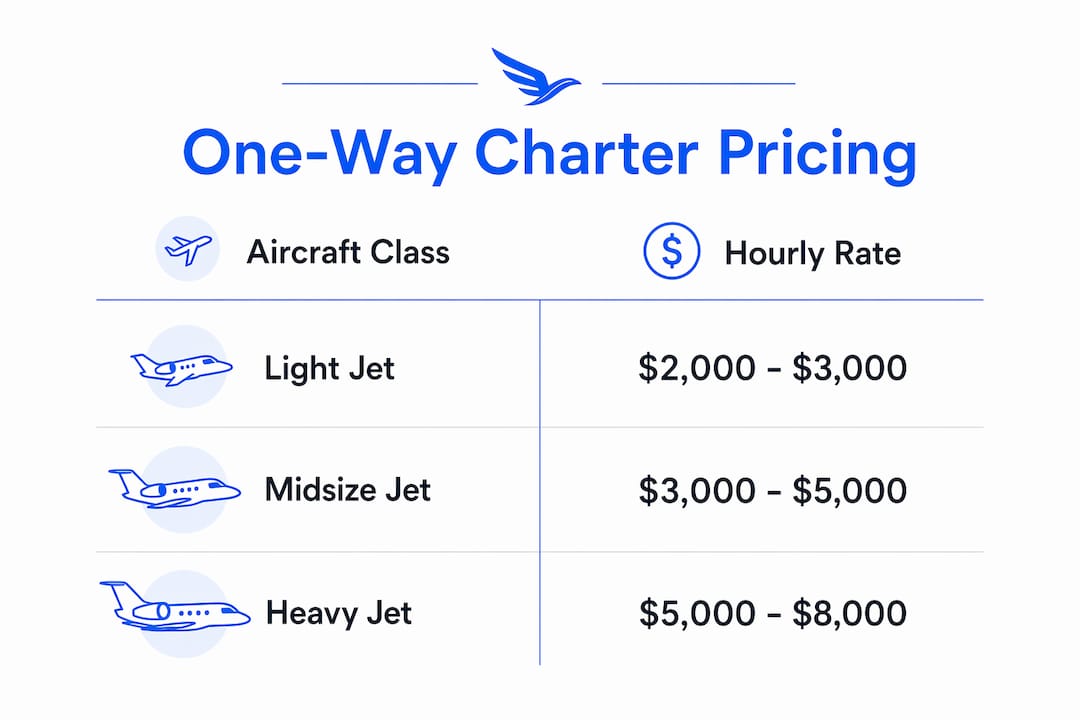
The table below shows realistic per-hour ranges by aircraft class for U.S. corridors. These are market estimates, not guaranteed quotes.
| Aircraft Class | Typical Hourly Rate | Example One-Way Leg | Estimated Leg Cost |
|---|---|---|---|
| Light jet | — | New York to Boston (1 hr) | — |
| Midsize jet | — | Chicago to Miami (3 hrs) | $18,000–$25,000 |
| Super-midsize jet | — | LA to New York (5 hrs) | — |
| Heavy jet | — | NY to LA | — |

Repositioning fees are the line item most travelers overlook. If the nearest available aircraft is two hours away from your departure airport, you may absorb some or all of that ferry time in your quote. Always ask where the aircraft is based before accepting a price.
Short-notice bookings compound this. An operator scrambling to reposition a jet within 24 hours will price that urgency into the quote. Booking 5–7 days out gives operators time to match available aircraft to your route, which typically produces a cleaner number.
Experienced private travelers increasingly book one-way legs separately rather than defaulting to round trips, because it lets them match aircraft type to each leg and defer the return booking until timing is confirmed.
Pro Tip: Ask for a breakdown of repositioning fees as a separate line item. Some operators bury them in a flat “one-way surcharge.” Seeing the number in isolation tells you whether a different departure airport or a floating-fleet operator would save you money.
What’s the difference between an empty leg and a repositioning flight?
These two terms get used interchangeably, but they describe different things.

A repositioning flight is an operational necessity. When an aircraft needs to move to a new city for a scheduled client, return to its home base, or reach a maintenance facility, it flies. That movement happens regardless of whether anyone pays for it.
An empty leg is what happens when an operator decides to market that repositioning flight to the public at a discount. Not every repositioning flight becomes an empty leg. Some operators keep them internal; others list them selectively.
That discount is real. The catch is what you give up to get it. The route is fixed by the primary client’s booking. The departure window is set. If the primary client cancels or changes plans, the empty leg disappears, often with little notice. You need a contingency plan.
For a leisure trip where a day’s flexibility doesn’t hurt, empty legs can be excellent value. For a board meeting, a medical appointment, or any departure where missing the window has real consequences, a guaranteed one-way charter is the only sensible choice. Empty-leg listings tend to surface close to departure, so travelers who rely on them need to stay alert and move fast when inventory appears.
How can you reduce the cost of a one-way charter?
Cost reduction on a one-way charter is mostly about timing, information, and flexibility on the return leg. Here’s how experienced travelers approach it:
- Pair your outbound one-way with a monitored empty-leg return. Book the outbound as a guaranteed charter, then watch empty-leg inventory for the return. This captures schedule certainty where it matters and price savings where it doesn’t.
- Use a broker for repositioning opportunities. Brokers with broad operator relationships often know about repositioning flights before they hit public listings. A quick call before you search on your own can surface options that never appear online.
- Request floating-fleet pricing. Some operators price routes based on where demand is, rather than where a specific aircraft sits. Floating-fleet quotes can be meaningfully lower when the corridor is active.
- Consider different aircraft categories for each leg. A super-midsize on the outbound and a light jet on the return (if passenger count allows) can cut total trip cost without sacrificing the experience where it counts.
- Compare operator direct quotes against broker quotes. Brokers add a margin, but they also have access to inventory operators don’t advertise publicly. Run both in parallel before committing.
Questions to ask every operator or broker before signing:
- How is the repositioning fee calculated, and is it itemized separately?
- What is the cancellation policy, and at what point does the fee become non-refundable?
- Is the aircraft and tail number guaranteed, or can it be substituted?
- What FBOs are available at my departure and arrival airports?
- How are fuel surcharges handled if prices move between booking and departure?
- What is the minimum flight-hour requirement for this leg?
For empty-leg pricing specifically, the best negotiating window is usually 48–72 hours before departure, when operators are most motivated to fill a seat rather than fly empty. Bundling two or more legs with the same operator also gives you leverage that a single booking rarely does.
How does an empty-leg membership change the economics?
Pay-as-you-go empty-leg hunting works, but it’s reactive. You find a listing, move fast, and hope the timing fits. A membership model flips that dynamic: instead of searching, you receive alerts when inventory matches your corridors.
For a traveler who flies the same routes repeatedly, say New York to Palm Beach four to six times a year, the math shifts. A guaranteed one-way charter on the New York to Palm Beach corridor typically costs $18,000–$25,000 per leg. An empty leg on the same route, captured through a membership alert, can be significantly less, though the specific discount depends on route and timing. Over a year of frequent travel, the cumulative difference is substantial.
| Factor | Pay-As-You-Go One-Way | Membership Empty-Leg Access |
|---|---|---|
| Cost per leg | Full charter rate | Discounted (varies by route) |
| Schedule control | Guaranteed | Flexible required |
| Availability | On-demand | Inventory-dependent |
| Booking lead time | Days to weeks | Often 24–72 hours |
| Cancellation risk | Low (guaranteed) | Higher (primary client dependent) |
| Best for | Fixed schedules | Flexible, frequent travelers |
Membership models work best when you fly at least six to eight times a year on predictable corridors. If you travel less often, the membership cost may outweigh the savings. The honest test: track your actual travel for six months, note which legs had schedule flexibility, and calculate what empty-leg pricing would have saved. That number tells you whether membership access makes sense for your pattern.
Pro Tip: Use the first six months of any membership as a data-gathering exercise. Log every alert you receive, every leg you could have taken, and the price difference. By month seven, you’ll know whether the model fits your travel rhythm or whether guaranteed charters are the smarter default.
For a deeper look at capturing empty-leg opportunities, the tactics around timing and corridor selection matter as much as the membership itself.
Key Takeaways
A one-way charter gives you full schedule control for a single leg; pairing it with empty-leg access on the return is the most cost-effective strategy for frequent private travelers.
| Point | Details |
|---|---|
| One-way charter definition | A private jet booked for a single leg, with the traveler controlling departure, arrival, date, and time. |
| Primary cost drivers | Flight hours, aircraft category, repositioning fees, FBO charges, and federal excise tax all stack into the final quote. |
| Empty-leg discount range | Empty legs typically price significantly below standard charter rates, with availability tied to the primary client’s schedule. |
| When to choose guaranteed charter | Fixed schedules, critical departures, or same-day returns require a guaranteed one-way, not an opportunistic empty leg. |
| Bluebirdjets membership | Bluebirdjets offers unlimited access to empty-leg inventory through membership, best suited to flexible, frequent-corridor travelers. |
The case for splitting your travel program in two
Most private travelers treat every flight the same way: find the aircraft, pay the rate, go. That’s leaving money on the table for anyone flying more than a handful of times a year.
The smarter approach is to split your travel program deliberately. Flights where timing is non-negotiable, a board presentation, a medical procedure, a family event with a hard start, get booked as guaranteed one-way charters. You pay for certainty, and it’s worth every dollar. Flights where a day’s flexibility exists, a seasonal home move, a leisure trip, a business trip where the meeting could shift, become candidates for empty-leg capture.
Seasonal home travelers are the clearest example. Flying New York to Palm Beach in November and back in April? The outbound is often worth booking as a guaranteed charter. The return, with weeks of flexibility, is a natural empty-leg target. That split alone, applied consistently, can meaningfully reduce annual aviation spend without ever sacrificing a critical departure.
The mistake I see most often is travelers applying the same booking logic to every flight. Certainty has a price. Pay it when it matters. When it doesn’t, there’s a better way.
Bluebirdjets membership: unlimited empty-leg access for frequent flyers
If the empty-leg strategy makes sense for your travel pattern, the friction is usually the hunting. Listings appear and disappear fast, and manually checking platforms across multiple operators is a real time cost.
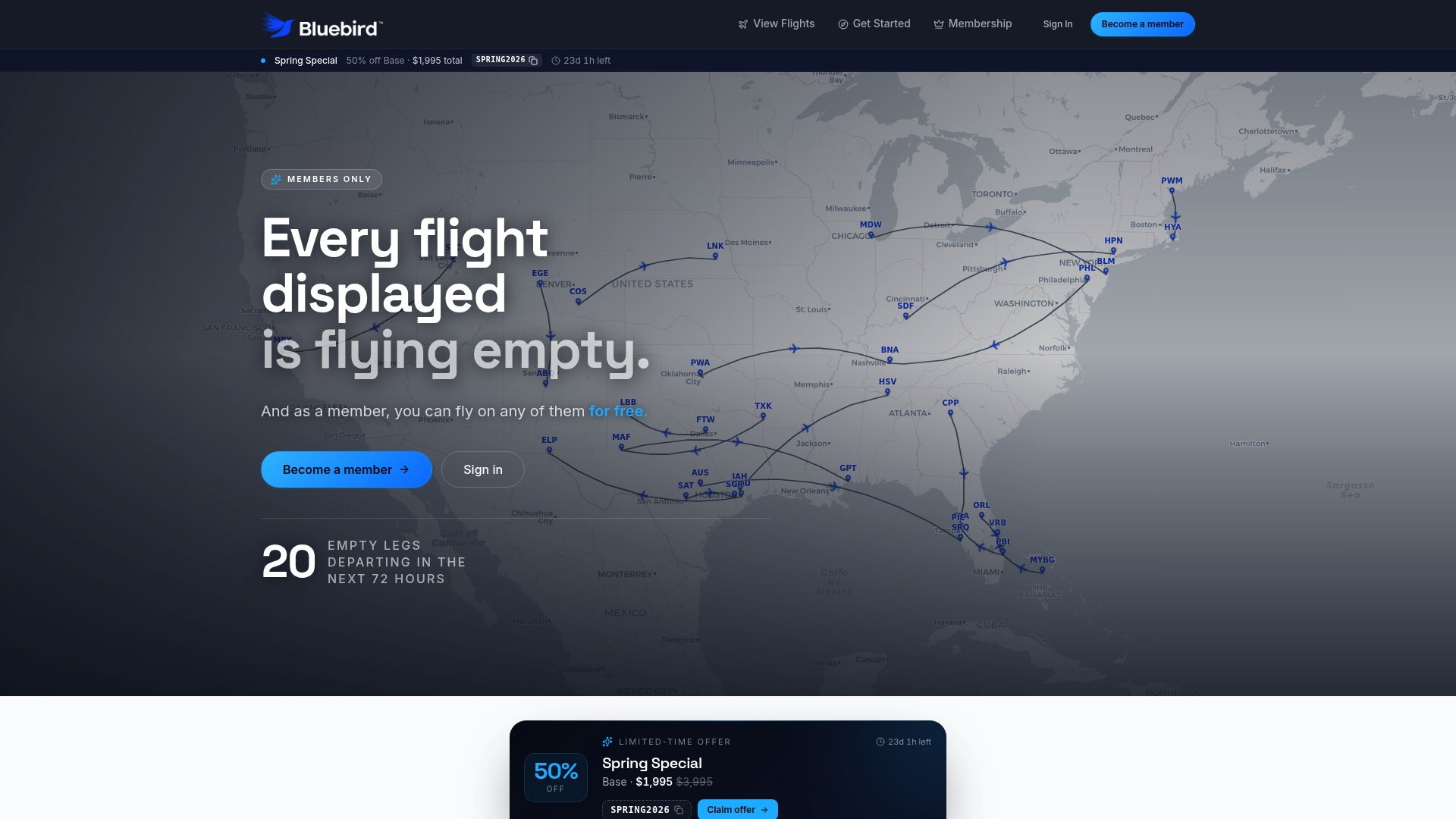
Bluebirdjets solves that with a membership model built around unlimited access to empty-leg inventory. Members receive alerts when legs match their corridors, with priority access to inventory before it hits broader distribution. It’s not a replacement for guaranteed charters when the schedule demands it, and Bluebirdjets is transparent about that. Empty-leg availability is never guaranteed. What membership does is make the opportunistic strategy systematic rather than accidental.
For travelers flying six or more times a year with any schedule flexibility, the model is worth a close look. Check available flights and inventory on the Bluebirdjets platform, or explore the membership to see whether the access model fits your travel program.