Private Jet Deicing Fees: How to Avoid Surprise $20,000 Charter Bills

Private Jet Deicing Fees: How to Avoid Surprise $20,000 Charter Bills
On most ad hoc private jet charters, the client who booked the flight receives the de-icing invoice directly from the FBO, typically ranging from a few hundred dollars for light frost on a small aircraft to several thousand for a medium jet in heavy snow. Before you fly, check your charter contract for a de-icing clause and ask the FBO for its published per-gallon rate.
TL;DR:
- Industry reports put bills from a few thousand dollars for smaller jets to more than $20,000 in severe conditions or after repeated applications.
- Ad hoc clients usually pay a separate postflight deicing charge, while some card and fractional programs include the fee or cap exposure.
- Crews use heated Type I fluid to remove ice, then thicker Type II, III, or IV fluid for protection; expired holdover time requires another application.
- Before booking, request the departure FBO’s published fluid rate and a weather estimate, then confirm in writing who orders treatment and receives the invoice.
Table of Contents
- Cost Ranges by Aircraft Size and Weather Severity
- Who Pays and What Your Contract Should Say
- How Deicing Actually Works and Why It Costs What It Does
- Reading a Deicing Invoice Line by Line
- How to Avoid a Surprise Deicing Bill
- What Frequent Winter Flyers Should Check Before Booking
- Balancing Safety, Cost, and Convenience
- A Different Way to Book Around Winter Fee Surprises
- FAQ
- Sources
Cost Ranges by Aircraft Size and Weather Severity
De-icing costs swing widely because three things change independently: the aircraft’s wing and fuselage surface area, the type and intensity of precipitation, and how many times the crew needs to reapply fluid before takeoff clearance. A small single-engine prop sitting under light frost might need a quick, cheap treatment. A large-cabin jet caught in freezing rain can require multiple heavy applications of thicker fluid, and the bill climbs accordingly.

Industry reporting backs up just how far apart these numbers land. According to Private Jet Card Comparisons, typical bills span a wide range, from a few thousand dollars for smaller jets up to over $20,000 in extreme cases depending on conditions and aircraft size when conditions are severe or multiple reapplications are needed.
Rough scenario patterns charter clients encounter:
- Light frost, small prop or very light jet: minimal fluid, one application, lower end of the cost spectrum.
- Moderate snow, light-to-midsize business jet: one or two applications, a few hundred to low thousands of dollars.
- Freezing rain or heavy wet snow, large-cabin jet: repeat applications, thicker Type IV fluid, and bills that can reach or exceed the thousands reported in industry accounts.
A single storm event does not produce a single predictable price. Gallons used, precipitation type, and aircraft size interact, which is why the same jet can see a $400 bill one week and a $4,000 bill the next.
Who Pays and What Your Contract Should Say
Billing responsibility depends heavily on how you booked. On a standard ad hoc charter, the operator typically orders de-icing from the FBO on your behalf and the charge flows through to you as a pass-through line item after the flight. Some jet card programs and fractional ownership plans instead build de-icing into the hourly or program rate, which smooths out the cost but may raise the baseline price for everyone enrolled, as industry sources note.
A de-icing waiver, when offered, caps your exposure or folds the charge into a flat program fee rather than billing actual usage. Before booking a winter trip, it helps to ask:
- Does this program include de-icing in the quoted rate, or will it appear as a separate post-flight charge?
- Who orders the de-icing service, the operator or the FBO directly?
- Who receives the invoice, and is there a cap or estimate provided in advance?
Reading the fine print on fees matters here just as much as it does in other charter arrangements. Guidance on spotting hidden fee clauses in a charter agreement applies directly to winter operations, where vague language around “applicable surcharges” often hides the de-icing pass-through.
How Deicing Actually Works and Why It Costs What It Does
De-icing and anti-icing are two different steps. De-icing removes existing frost, ice, or snow from the aircraft surface, usually with heated Type I fluid. Anti-icing follows immediately after, applying a thicker Type II, III, or IV fluid that resists new accumulation for a limited window before takeoff.
That window is called holdover time, and it is the core reason repeat applications happen. The FAA’s seasonal holdover-time tables set specific time limits based on fluid type, temperature, and the kind of precipitation falling. If weather conditions exceed that window before the aircraft departs, crews must reapply, and each reapplication adds to the invoice.

What appears on your bill reflects more than the fluid itself. The FBO’s charge covers the specialized truck, trained personnel, and environmental handling of runoff, all of which NBAA notes explain why invoices run well above the raw cost of glycol.
Reading a Deicing Invoice Line by Line
Most de-icing invoices follow a basic formula: gallons of fluid used multiplied by a local per-gallon rate, plus a labor and equipment minimum, plus any environmental or disposal fee. Because a de-icing truck itself represents a significant capital investment for an FBO, that cost is baked into the hourly and per-gallon rates you see, not billed as a separate line, according to NBAA’s cost breakdown.
Watch for charges that are easy to miss when you are focused on the headline fluid cost:
- Truck standby or positioning fees if the FBO has to pull equipment from another location.
- Environmental runoff or glycol recovery fees, which vary by airport.
- Hangar transfer charges if the aircraft needs to move for treatment.
National averages are close to useless for budgeting purposes, since rates vary by airport, FBO, and local environmental regulation. A published price list, like the example rates at Munich Airport, shows how pricing is structured by aircraft type and condition rather than as a flat number, and asking your departure FBO for its own published rate sheet gives you a far more useful figure than any industry-wide estimate.
How to Avoid a Surprise Deicing Bill
The most effective move is asking questions before you ever step on the aircraft. Confirm with the FBO or your operator whether de-icing capability exists at your departure airport and what the published per-gallon rate is. NBAA specifically recommends contacting the airport ahead of a winter trip rather than discovering the answer after landing.
A few additional tactics reduce both the odds and the size of a bill:
- Ask whether a de-icing waiver or fee cap is available, or choose a program that folds the cost into the hourly rate.
- Request hangar space if available; a heated hangar can reduce fluid use, though it will not eliminate the need to treat the aircraft during active precipitation.
- Time your departure to avoid the worst of active snow or freezing rain when your schedule allows it.
- Confirm in writing who approves the de-icing order and who the invoice will be addressed to.
Pro Tip: Ask for a weather-contingent cost estimate rather than a flat winter fee: the real driver of a surprise invoice is precipitation severity, not the season itself.
Included-in-rate programs make the most sense if you fly frequently in winter weather and want predictable costs. If you fly occasionally, fee transparency and a hard cap often serve you better than paying for coverage you rarely use.
What Frequent Winter Flyers Should Check Before Booking
How you book changes your exposure. Members who fly empty legs on a fixed fleet encounter more predictable operational patterns than one-off charter clients juggling different operators and airports each time, since the same aircraft and routine FBO relationships reduce the odds of an unfamiliar, inflated invoice. Before any winter booking, check the departure airport’s weather policy, confirm who the de-icing invoice will be addressed to, and flag any contract language around “applicable surcharges” as a red flag worth clarifying in advance. For more on how airport policy, not just weather, shapes these decisions, see our guide to private jet weather policy and our booking best practices checklist.
Balancing Safety, Cost, and Convenience
If you fly often in winter, prioritize contractual caps and invoice transparency over a headline hourly rate. A membership model that limits unpredictable per-flight line items is worth more than a marginally lower base price once you account for one bad storm.
— Nick
A Different Way to Book Around Winter Fee Surprises
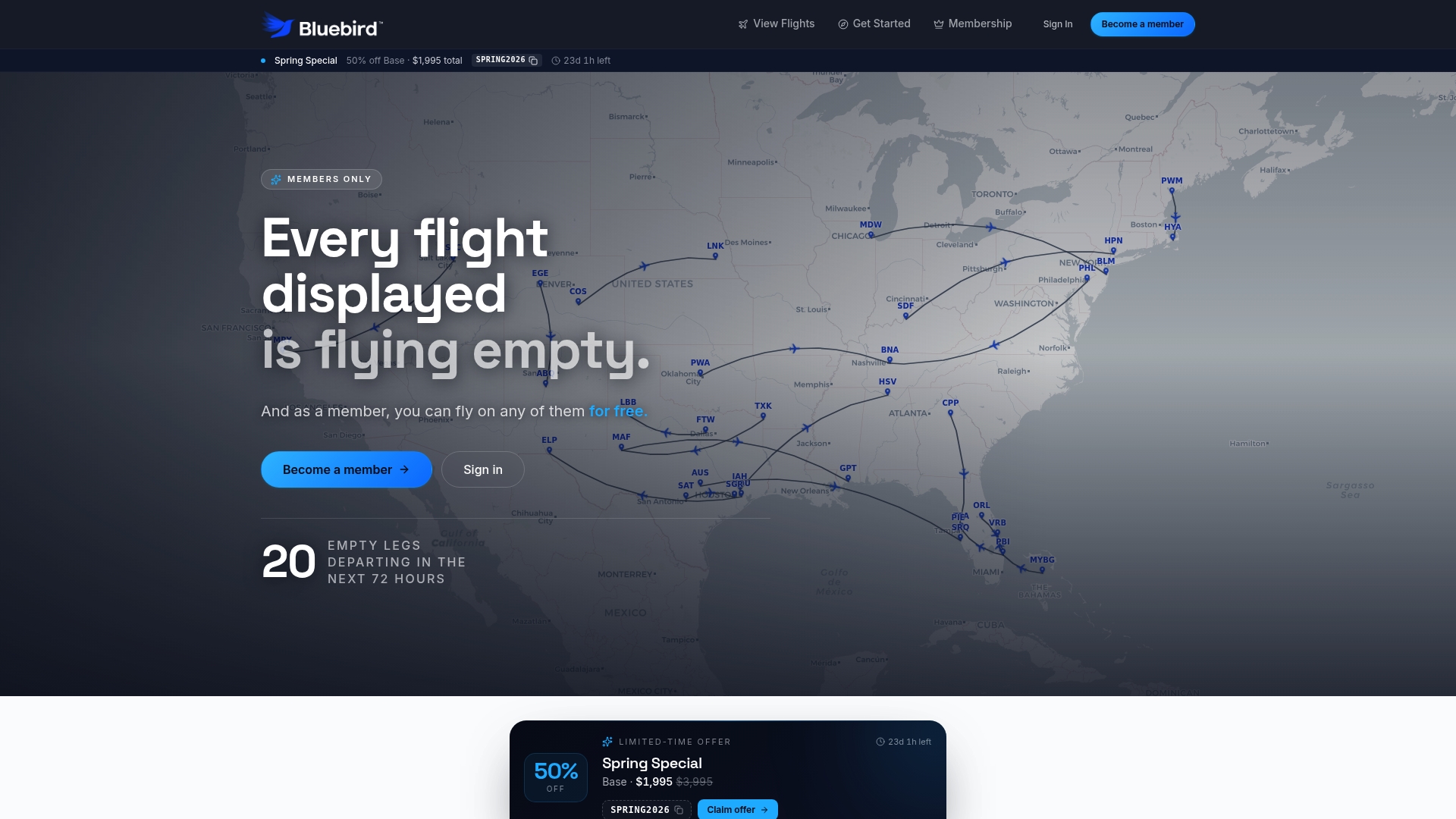
Ad hoc charter puts you in a new operator relationship and a new FBO invoice every time you fly, which is exactly where de-icing surprises tend to happen. Membership with Bluebird works differently: you get unlimited access to empty leg flights on our own fleet of Learjet 60 aircraft, with live inventory updated daily and no broker markups layered on top.
- Base membership ($3,995 per year) gives you unlimited empty-leg access with queue-based booking.
- Plus membership ($9,995 per year) adds higher booking priority for the same unlimited access.
- Skip-The-Line ($2,000 one-off) lets you jump the queue on a specific flight when timing matters.
Flying the same fleet with consistent operational relationships means fewer unfamiliar FBO invoices to decode. Check current routes and see how membership compares to one-off charter on our membership page or get started at Bluebirdjets.
FAQ
How long does de-icing a plane last?
How long de-icing fluid remains effective depends on the fluid type, temperature, and precipitation rate, a window the FAA calls holdover time. Once that window closes and the aircraft has not departed, crews must reapply fluid before takeoff.
Do you tip a private jet pilot?
Tipping a private jet pilot is not standard practice in most charter arrangements, since pilots are salaried professionals rather than service staff working for gratuities. If you want to recognize exceptional service, a direct note to the operator is more appropriate than cash.
Do airlines pay for deicing?
Commercial airlines typically absorb de-icing costs into their own operating budgets rather than billing individual passengers. Private charter clients, by contrast, commonly receive the de-icing charge as a direct pass-through invoice unless their program includes it in the rate, as industry reporting confirms.
What is the typical lifespan of a private jet?
Private jet lifespan varies widely by model, maintenance history, and usage pattern, and no single figure applies across the industry. Operators and maintenance programs are the most reliable source for an individual aircraft’s expected service life.
Sources
- Deicing: Dollars and sense (NBAA)
- FAA holdover-time tables (Winter 2025–26)
- What you need to know about deicing before you get the bill (Private Jet Card Comparisons)
- Example de-icing price list (Munich airport, 2025–26)