Airports, Not Storms, Decide Private Jet Weather Policy for Members

Airports, Not Storms, Decide Private Jet Weather Policy for Members
The pilot in command, operating within Federal Aviation Administration limits, makes the final call on whether a private flight departs, diverts, or waits out the weather. That decision draws on SIGMET, AIRMET, METAR and TAF products from the National Weather Service and the Aviation Weather Center. For passengers, the outcome usually lands in one of three buckets: a short delay, a rerouted trip, or a cancellation with rebooking.
TL;DR:
- Weather approval processes rely on NWS and FAA-approved reports, but individual operator minimums can be stricter than FAA regulations.
- Airports lacking deicing gear or automated weather stations often cause diversions or delays, regardless of aircraft capabilities.
- Strong storms, turbulence, and icing are primary hazards that trigger routing adjustments or delays, especially at smaller airports without ground support.
- Real-time weather data, formal risk assessments, and contingency planning determine whether a flight departs or is delayed, often differing from commercial options.
- Membership programs like Bluebird offer flexibility through unlimited empty leg access and priority queue options to navigate weather disruptions.
Table of Contents
- How weather changes departure, en route and arrival operations
- Regulatory and operator minimums that govern weather decisions
- Common weather hazards and how operators respond
- Forecasting, safety systems and the go or no go call
- What to ask before you fly and how to prepare
- How Bluebird membership adds flexibility when weather disrupts plans
- Perspective: why infrastructure, not just storms, drives cancellations
- If flexibility matters most, consider a membership built around it
- Sources
- FAQ
How weather changes departure, en route and arrival operations
A private jet trip has three phases where weather can intervene, and each carries its own risk profile. At departure, low ceilings, poor visibility, or contaminated runways can push back a takeoff time or ground the flight until conditions clear. En route, convective activity or turbulence can force a course change. On arrival, a ceiling that drops below approach minimums can send the aircraft to an alternate airport instead of the intended destination.
The decision points tend to follow a pattern:
- Around a day or so before departure, dispatch reviews forecasts and flags flights that may be at elevated risk.
- A few hours before departure, the crew rechecks current observations and updates the go or no go call.
- At the airport, the pilot makes the final decision based on real time conditions and aircraft performance limits.
Smaller regional airports often struggle more than the aircraft does, lacking essential ground handling and deicing services like those detailed by Aero Dynamic Jets - Detailing Services in Provo. A jet may be fully capable of handling snow or ice, but if the airport lacks deicing equipment or a certified weather reporting station, the flight simply cannot legally or safely use that field. This is one of the more overlooked reasons a private flight diverts. The problem is rarely the plane. It is the runway, the ground crew, or the absence of an automated weather observation system at the destination.
Regulatory and operator minimums that govern weather decisions
Federal Aviation Regulation Part 135, which governs on demand charter operations, sets the legal floor for weather related decisions. Section 135.225 spells out IFR takeoff, approach, and landing minimums, and it requires that pilots rely on weather reports from a source approved by the National Weather Service or the FAA. Section 135.213 covers what weather reports and forecasts qualify for use in flight planning, and section 135.219 requires that pilots check the weather before takeoff whenever conditions might affect the flight.
Operators must use weather reports and forecasts prepared by the National Weather Service or a source approved by that agency, and must apply the takeoff, approach, and landing minimums specified for the airport in use.
Part 135 sets IFR takeoff, approach, and landing minimums operators cannot go below, and it requires weather data from an FAA and NWS approved source. Those figures represent a legal floor, not a target. Individual operators frequently set higher internal minimums based on their own operations specifications, and pilot experience with a specific airport or aircraft type can raise the bar further. A jet certified for Category II approaches means little if the crew has not maintained currency for that procedure, so the real world margin is often tighter than the regulation alone suggests.
Common weather hazards and how operators respond
Different hazards trigger different operational responses, and the right move depends on the specific threat.
- Thunderstorms and convective activity. Crews route around cells identified through convective SIGMETs rather than attempt to fly through them, which often adds time to the trip.
- Icing. Aircraft need deicing before departure, and if the departure or arrival airport lacks that equipment, the flight may be delayed or moved to a different field entirely.
- Wind. Crosswind and gust limits are set for each aircraft type, and contaminated runways lower those limits further.
- Low ceilings and visibility. Instrument approach minimums determine whether a landing is legal at all, though Enhanced Flight Vision Systems can permit some approaches below standard visibility minima under strict, operator specific authorization.
- High temperature. Hot air reduces engine performance and lift, which can shorten the usable runway length available at a given airport on a given day.
- Turbulence. Crews typically request altitude changes and ask passengers to remain seated with belts fastened rather than attempt to fly through rough air.
Pro Tip: Ask your operator whether the departure and arrival airports have deicing capability and a certified weather reporting station before you book a winter trip.
Forecasting, safety systems and the go or no go call
Dispatch and pilots lean on a specific set of tools to make weather decisions, and the process is more structured than most passengers realize.
- SIGMETs and AIRMETs flag hazardous conditions like severe turbulence, icing, and low level wind shear across a region.
- METAR reports give current conditions at an airport, while TAF forecasts project conditions forward, and both are pulled from Aviationweather.
- Safety Management Systems formalize how an operator weighs risk, and many operators now use in house or contracted meteorologists to interpret data ahead of a flight, a practice NBAA has highlighted as increasingly common.
- Alternate airport selection and extra fuel uplift are decided in advance whenever forecasts suggest a marginal arrival.
This combination of real time data and formal risk review is why a private flight can sometimes depart when a commercial flight at the same airport is grounded, and why it sometimes cannot.
What to ask before you fly and how to prepare
A few questions before booking can save a lot of frustration later.
- Ask whether the departure and destination airports have deicing equipment and a certified weather station on site.
- Ask how the operator handles alternate airports if the destination becomes unusable.
- Confirm the crew’s currency for the approach type required at your destination, especially in winter or mountain terrain.
- Build slack into connecting travel plans, since a weather delay of a few hours can cascade into missed connections.
- If traveling with pets, ask how the operator handles a diversion or overnight delay for animals on board.
Operators generally communicate weather related changes as soon as a forecast shifts risk, often well before the scheduled departure, and most will offer rebooking options rather than a straight cancellation. Reviewing private aviation booking best practices ahead of a trip can help set realistic expectations for how that communication typically works.
How Bluebird membership adds flexibility when weather disrupts plans
Members get unlimited access to live empty leg inventory on operator-owned Learjet 60 aircraft, which means a canceled or delayed trip does not always mean waiting for the same flight to reopen. Members can bring guests and check pet related guest policies before travel. The Skip The Line option and queue based booking give members a way to move up for another available departure when a weather event forces a change of plans.

Perspective: why infrastructure, not just storms, drives cancellations
The aircraft is rarely the limiting factor. A small airport without deicing gear or a functioning weather station will ground a flight that a better equipped field would handle without issue. Operators choose safety over convenience every time, and that trade-off, more than the storm itself, shapes the passenger experience.
— Nick
If flexibility matters most, consider a membership built around it
Private jet weather delays hit hardest when you are locked into one aircraft, one operator, and one schedule. Bluebird’s membership gives you unlimited access to published empty leg flights on operator owned Learjet 60 aircraft, so a canceled departure does not have to mean waiting days for the next opening.
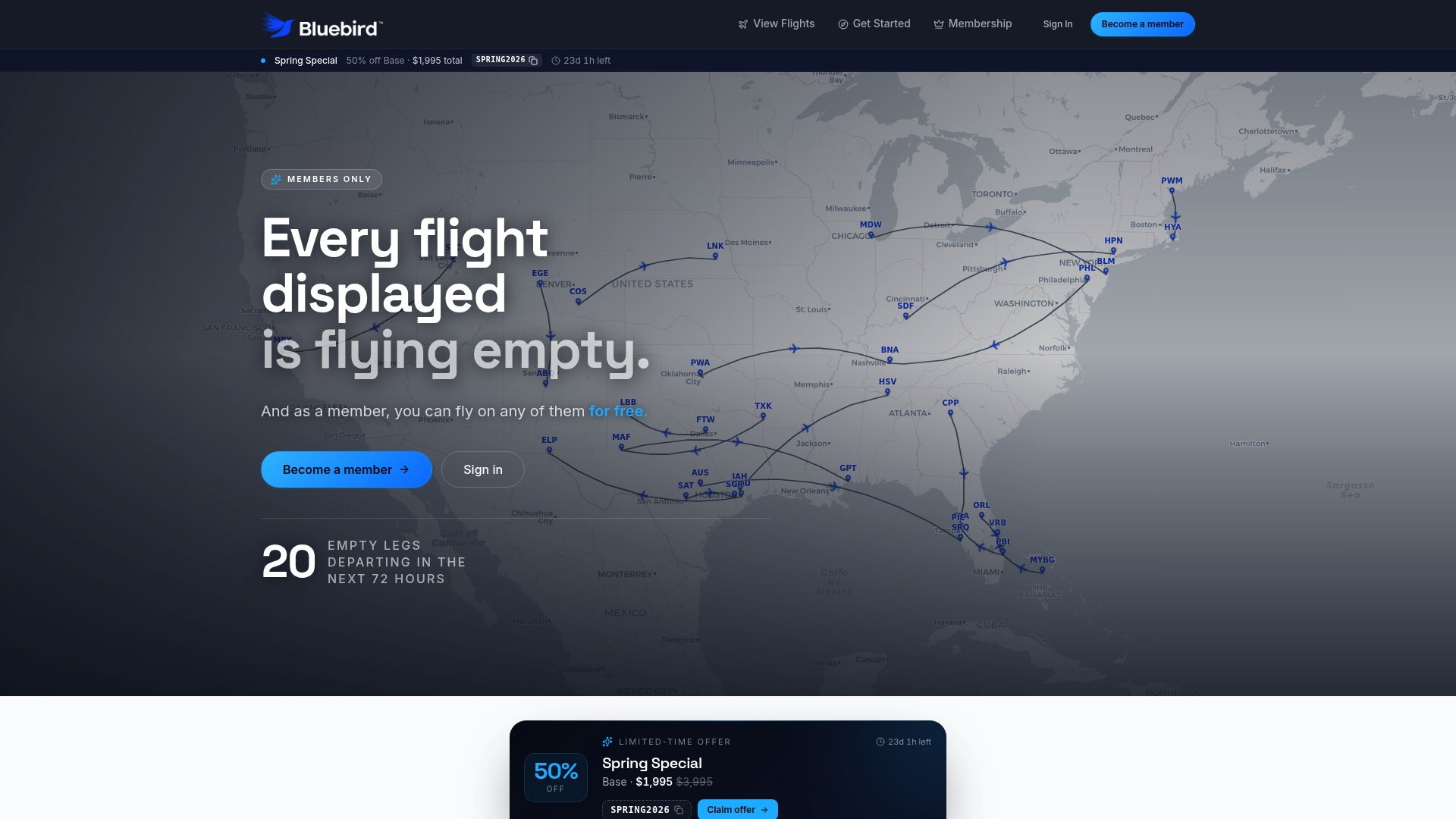
Bringing guests, checking daily updated routes, and using Skip The Line to move up the queue are ways members regain options after a weather disruption, not guarantees against one.
| Plan | Price | What it covers |
|---|---|---|
| Base | Annual membership fee | Unlimited access to published empty leg flights |
| Plus | Annual membership fee | Higher priority access to empty leg inventory |
| Skip The Line | One-time fee | Priority queue placement for a single flight |
Check current live inventory or start at Bluebird to see how membership fits your travel pattern.
Sources
- eCFR :: 14 CFR 135.225 – IFR: Takeoff, approach and landing minimums.
- Aviationweather
- Planning for the Unpredictable: Extreme Weather and Base Location — NBAA
FAQ
How early will they cancel a flight due to weather?
There is no fixed cutoff. Operators typically monitor forecasts starting a day or more ahead and make the final go or no go decision close to departure once current conditions and NWS approved reports are available.
How much is a 3 hour flight on a private jet?
Charter pricing varies by aircraft type, route, and operator, and Bluebird does not publish per flight charter rates since its model centers on annual membership access to empty leg flights. Membership pricing itself starts at $3995 per year for the Base plan.
Can planes fly in 90 degree weather?
Yes, but high temperatures reduce engine performance and lift, which can shorten the effective runway length available for a safe takeoff. Pilots factor air temperature into their performance calculations before every departure.
Can planes fly in 40 mph winds?
It depends on the aircraft type and the specific crosswind or gust component, since each jet has its own certified wind limits. Contaminated runways or gusty crosswinds can lower those limits further and lead to a delay or diversion.