Private Jet Membership Benefits: What You Get and Who Gains Most

Private Jet Membership Benefits: What You Get and Who Gains Most
The core benefits of a private jet membership are predictable pricing, easier booking, personal support and access to aircraft without owning one. How much of that you get depends on the model. Traditional memberships and jet cards lock in hourly rates on chartered aircraft. An empty-leg membership, the model we run at Bluebird, gives you a flat annual fee and access to flights that are already scheduled to fly. This guide covers each benefit, what the programs cost, and who gets the most out of them.
TL;DR
- Most private jet memberships sell three things: price certainty, simpler booking and concierge-style support.
- Costs across the market vary widely. One industry overview puts memberships at $25,000 to $500,000 depending on tier, while empty-leg programs charge far less.
- Our Bluebird plans are Base at $3,995 per year and Plus at $9,995 per year, with free last-minute flights for members and up to six guests per flight.
- Empty-leg access rewards flexibility. If you can leave on short notice, the value per year can be very high.
- Jet cards and memberships are different products, so compare how each bills you before you join anything.
Table of Contents
- What a private jet membership is
- The main benefits of a private jet membership
- What private jet memberships cost
- How access and booking differ between programs
- Our perspective
- When a membership makes sense
- How the Bluebird membership works
- FAQ
- Sources
What a private jet membership is
“Private jet membership” is used loosely. Programs that look alike on a landing page can work in very different ways, so it helps to separate them.
The National Aircraft Finance Association describes membership programs and jet cards as structurally distinct. With a membership, you agree to a fixed cost per hour at the start of the contract and are billed after each flight. Jet cards come in two types: a dedicated service with a set number of hours on a specific aircraft type, or a debit-style account you fund and draw from, choosing the aircraft category trip by trip at agreed hourly rates.

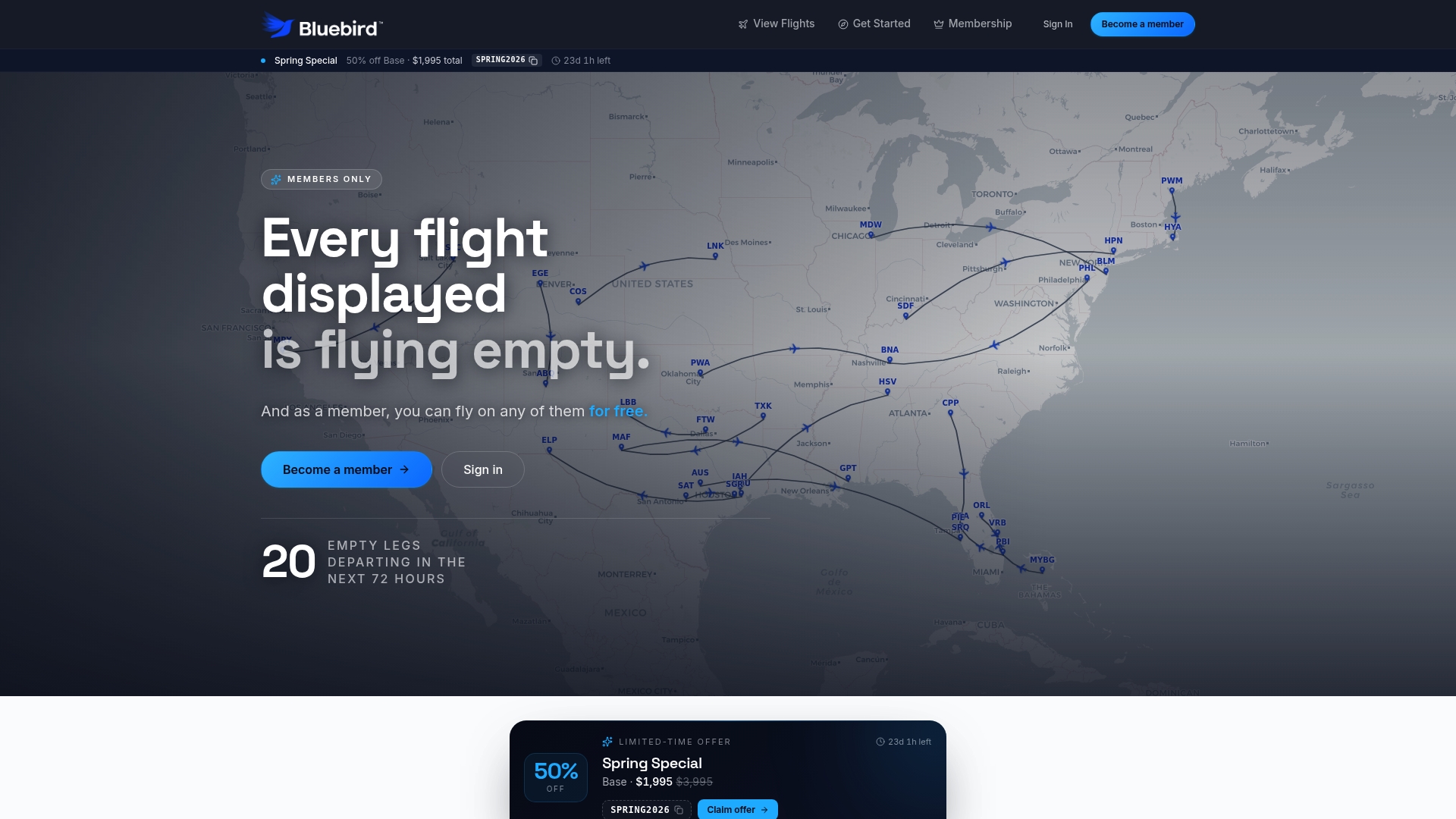
A third model sits beside those two: the empty-leg membership. An empty leg is a flight with no passengers on board, usually because the aircraft is repositioning to pick up its next trip or returning to base. The flight is going anyway, so the seats are available. An empty-leg membership gives you access to those published flights for a flat annual fee instead of an hourly rate.
That difference shapes every benefit below. Hourly-rate programs sell certainty on price per hour and on getting the aircraft you ask for. Empty-leg programs sell low cost per flight and spontaneity.
The main benefits of a private jet membership
Predictable pricing
Budgeting is the benefit that comes up most. When rates are agreed in advance, you are not exposed to the swings of the open charter market. Pricing is also the first place programs differ. Some charge by the hour. Ours is flat: you pay the annual fee, and published empty-leg flights are free for members.
If you want to see how annual spend compares across ways of flying, our private aviation cost breakdown examples walk through real scenarios.
Simpler booking
Traditional private charter means requesting quotes, waiting on availability and negotiating. Memberships replace that with a single relationship and a repeatable process. In our case you browse live inventory, see routes updated daily, and book through the platform. A queue and priority booking system shows you where you stand when a flight is popular.
Personal support
Nearly every program advertises a concierge. The practical value is having a person who knows your preferences and can handle changes, ground arrangements and special requests. We provide personal concierge support to members, which matters most when plans shift at the last minute.
Last-minute flexibility
Private travel is attractive because you are not tied to a commercial schedule. For members of an empty-leg program, the benefit goes a step further. Flights open up close to departure, and members can take them at no per-flight charge. If you are the kind of person who decides on Thursday that you want to be in another city by Saturday, that is the model that fits.
Time savings
Private travel typically means private terminals, shorter arrival-to-departure times and direct routes between smaller airports. That is where the time savings come from, and it is why frequent business travelers are the group that keeps coming back to this category. Our piece on private jet travel frequency benefits for business professionals goes deeper on how often flying changes the math.
Room for your group
Many memberships are priced per person or per seat, which makes bringing others expensive. Our members can bring up to six guests per flight, so a family, a small team or a group of friends can fly together on the same membership.
Added perks
Some programs add extras. As one example, a membership program covered by The Points Guy listed complimentary seats on empty legs, aircraft recovery at no additional cost and a $250 catering credit per flight leg in its top two tiers, as of its November 2021 article. Extras like these change from program to program and year to year, so read the current terms before you decide.
What private jet memberships cost
The range is enormous. A Simple Flying overview of private aviation membership programs puts membership costs between $25,000 and $500,000, depending on tier and benefits, with each tier carrying its own fee structure and initial investment. That is the figure for programs built around guaranteed access and hourly flying.
The entry end of the market is much lower. The Points Guy’s article noted a tier at $595 per year with no deposit, though non-members paid a $395 service fee per booking, and the top tier required a $100,000 minimum deposit. Those were 2021 numbers, so treat them as an illustration of structure rather than a current price list.
Here is how the models compare in broad terms:
| Model | How you pay | What you get | Best for |
|---|---|---|---|
| Hourly-rate membership | Initiation fee, then a fixed hourly rate billed after each flight | Agreed rates on chartered aircraft | Regular flyers who want to choose the exact trip |
| Jet card | Prepaid hours or a funded account | Locked-in rates, set aircraft category | Travelers who want to prepay and budget |
| Empty-leg membership | Flat annual fee | Access to published empty-leg flights | Flexible flyers who can go when a flight is available |
For a longer look at how annual fees compare with the value you take out, see is an empty-leg membership worth the annual fee.
How access and booking differ between programs
Two questions decide how a program feels in daily use: whose aircraft you fly, and who decides when you fly.
Who owns the aircraft. Flying Finance, a company blog on aviation finance, notes that most jet card operators do not own or operate aircraft, with the exception of fractional operators that own their fleets. They source your flight on the open charter market, and on many cards that can mean paying 5 to 15 percent above the prevailing market rate, in exchange for one phone call and a locked price. If you want to understand how sourcing affects the final price, charter provider alternatives are worth a look as you compare how different providers structure their pricing.
We do it differently. We own and operate our Learjet 60 fleet and publish live empty-leg inventory with no broker markups. That ties the flight you see on the platform directly to the aircraft that will fly it.
Who sets the schedule. In hourly programs you request a trip and the operator finds an aircraft. Some programs add call-out times, which is the notice you must give. In an empty-leg program, the schedule comes from the operator’s repositioning needs, and you choose from what is published. That is why flexibility on dates, and sometimes on airports, pays off.
The practical difference: with a request-based program you start from the trip you want. With an empty-leg program you start from the flights that exist. Members who browse inventory often find that a route they had not considered fits their calendar.

For how reliability works across the category, our guide to vetting empty-leg memberships lists what to check.
Our perspective
We built Bluebird on a simple idea: if an aircraft is already flying, the seats should not go to waste, and members should not pay a broker’s markup to use them.
Most of what is sold as private jet membership is a way to pre-pay for charter hours. That is a reasonable product, but it keeps the cost of flying tied to the hourly rate. We chose a different path. Because we own and operate our Learjet 60 jets, we can publish our empty legs directly and charge members a flat annual fee rather than a rate per hour.
The benefit we care about most is freedom. Our members can see live inventory, updated daily, and take a last-minute flight without a per-flight charge. The queue system is transparent, so you see how priority works instead of guessing. And a real person handles your concierge requests.
For the spontaneous traveler, who decides to go when a good flight appears, we believe this is the most direct way into private aviation. Our members can fly as often as the published flights suit them, with up to six guests along.
Nick
When a membership makes sense
A private jet membership tends to pay off when four things are true.
- You travel often enough to use it. Frequency is the single biggest driver of value. An annual fee spreads out over every flight you take.
- Your schedule has some give. Empty-leg flights follow aircraft movements. If you can pick from what is available, you capture the savings. If every trip is fixed to a date and a pair of cities, an on-request program or custom charter may fit better.
- You value time and privacy. Shorter airport processes and direct routes are the draw for many people who fly privately.
- You travel with others. Group size changes the economics. A membership that lets you bring up to six guests spreads the same annual fee across more people.
It may not be the right product when you need one specific trip on one specific date. For that, a custom charter quote is the better route, and we offer those as an optional paid request. Our guide on custom charter quotes explains how to read the numbers, and how to fly private without charter cost covers the alternatives.
Before you sign anything, read the contract. Our piece on private jet membership contracts lists the terms that matter: renewal, fees, priority rules and cancellation.
How the Bluebird membership works
Our annual membership gives you unlimited access to published empty-leg flights on our Learjet 60 aircraft. There are two plans:
- Base: $3,995 per year.
- Plus: $9,995 per year, with higher booking priority.
Both give you free last-minute private jet flights as a member, live inventory with daily updated routes, and the ability to bring up to six guests. If a flight is in demand and you want to move up, Skip-The-Line is available as a one-off $2,000 option. Custom charter requests are available separately as a paid service.
To see how it fits your travel pattern, read our overview of the flying membership for spontaneous flyers. You can also browse current empty-leg flights to see the kind of routes we publish.
Ready to join? Compare Base and Plus on our membership page.
FAQ
How do jet cards work?
A jet card is a prepaid way to buy private flying. According to the National Aircraft Finance Association, it comes either as a dedicated number of hours on a specific aircraft type or as a funded account from which you pick the aircraft category per trip at agreed hourly rates. A membership program, by contrast, bills you a fixed hourly rate after each flight.
What does a private jet membership cost?
It depends on the model. Industry overviews put hourly-rate memberships between $25,000 and $500,000 depending on tier. Our empty-leg membership is priced at $3,995 per year for Base and $9,995 per year for Plus, as published on our site.
Can I bring guests on a membership flight?
On Bluebird, yes. Members can bring up to six guests per flight. Other programs set their own rules, so check how each one handles passengers before you join.
Is an empty-leg membership the same as a jet card?
No. A jet card prepays hours or funds an account for charter flights at agreed rates. An empty-leg membership gives you access to flights that are already scheduled to fly, for a flat annual fee. The first is built around choosing a trip, the second around choosing from available flights.
Sources
- National Aircraft Finance Association: Understanding popular private jet share options
- The Points Guy: Private jet charters, shared flights and empty legs
- Simple Flying: Membership programs for private aviation
- Flying Finance: Jet card cost vs. membership vs. owning a jet